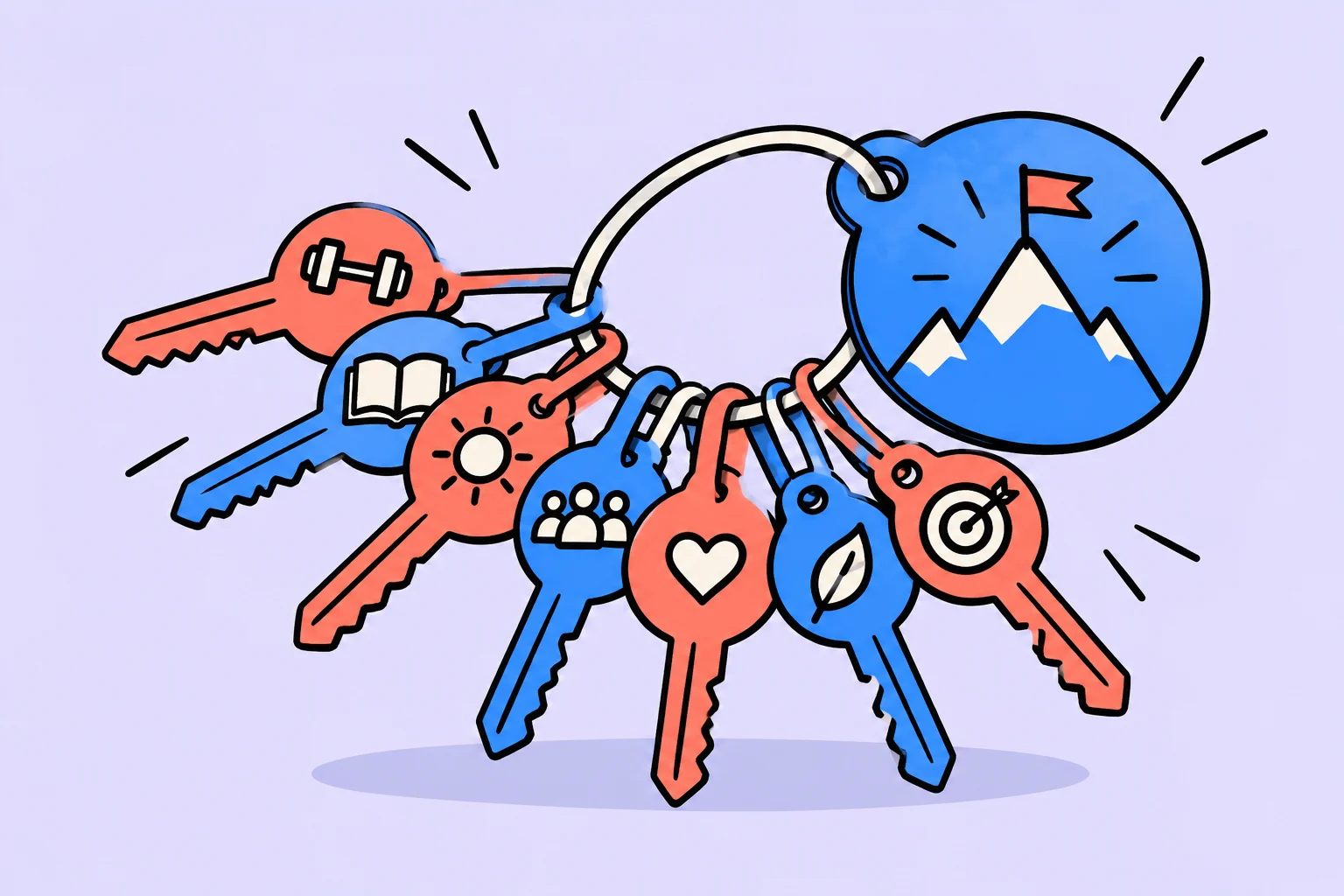
What distinguishes people who achieve outstanding results from those who dream but remain stuck? Decades of behavioral psychology research provide a clear answer: daily habits, rather than talent, luck, or connections. We studied the daily routines of hundreds of leaders—from technology CEOs to Olympic champions, Nobel Prize-winning scientists to serial entrepreneurs—and identified 15 shared habits you can start adopting today.
Successful people's habits are not a mysterious set of superpowers. They are specific, repeatable actions that create a cumulative advantage through daily practice. As Aristotle said: “We are what we repeatedly do. Excellence, then, is not an act, but a habit.” In this article, we will examine each of the 15 habits, understand the science behind them, and create an implementation plan.
of Fortune 500 CEOs wake up before 6 a.m.
read by Bill Gates each year
of behavior is determined by habits (HBR)
Why habits matter more than talent
Angela Duckworth, a professor at the University of Pennsylvania, conducted a large-scale study whose findings she published in Grit: The Power of Passion and Perseverance. Her conclusion: perseverance—the ability to work consistently at something day after day—is twice as important as talent for achieving long-term success. Talent determines your starting position, but habits determine your trajectory.
Why? Because talent without discipline is unrealized potential. A study by Harvard Business Review found that 95% of everyday behavior is determined by habits rather than conscious decisions. This means that the quality of your habits literally determines the quality of your life. Leaders understand this intuitively and invest time in building systems rather than seeking motivation: automatic behavior patterns that work even on bad days.
Stanford's Carol Dweck adds another layer: people with a growth mindset see habits as a tool for development rather than a restriction. They say “I'm learning to become a morning person” rather than “I'm not a morning person.” This approach to habit formation fundamentally changes the outcome.
Harvard Business Review research found that 95% of everyday behavior is determined by habits rather than conscious decisions. Leaders who invest in developing productive habits free up cognitive resources for strategic decisions. This explains why many CEOs deliberately simplify everyday choices (clothes, food, and routes): to preserve mental energy for what really matters.
Leaders' mornings: what they do first
Successful people's mornings involve more than waking up early. They follow a deliberate sequence of actions that builds energy, focuses thinking, and creates a sense of control over the day. Research by Christoph Randler of Heidelberg University found that people who are active in the morning are more proactive, goal-oriented, and satisfied with life.
A typical leader's morning looks something like this: wake up at 5:00-6:00, drink a glass of water, do 20-30 minutes of physical activity (running, yoga, or exercises), spend 10-15 minutes on meditation or breathing exercises, read or learn for 20-30 minutes, and plan the day's three main tasks. The entire ritual takes around 90 minutes, but its effect lasts all day.
One point is critical: leaders do not begin the morning with reactive activities. Checking email, social media, and news puts you in a position of responding to other people's priorities. A morning ritual is time for your priorities before the world starts making its demands.
1. Waking up early
Around 90% of Fortune 500 executives wake up before 6 a.m. Tim Cook starts his day at 3:45, Jeff Bezos at 5:00, and Howard Schultz (Starbucks) at 4:30. Early morning provides quiet, clear thinking, and time for yourself before the chaos of work begins. When you get up before others, you have an hour or two free of notifications, calls, and other people's requests.
However, the point is to use the morning deliberately, rather than to wake at a particular time. Chronotype research shows that not everyone is naturally a morning person. If your biological chronotype is a night owl, you do not need to torment yourself by getting up at 4 a.m. Finding your “golden time”—your period of peak productivity—and using it for your most important tasks matters more. But if you want to learn to wake up earlier, start shifting your wake-up time by 15 minutes each week so your body adapts smoothly.
2. A morning ritual
Successful people do not check their phone first thing. They have a clear morning ritual: meditation, exercise, reading, or planning. Hal Elrod, author of The Miracle Morning, proposes the SAVERS system: Silence (quiet or meditation), Affirmations, Visualization, Exercise, Reading, and Scribing (writing or journaling). You do not have to do all six, but the idea of a structured morning is essential.
A ritual creates a predictable start to the day and reduces the number of decisions, conserving willpower. Baumeister's research on willpower depletion found that every decision, even a small one, consumes mental energy. An automatic morning ritual removes dozens of decisions: What should I do first? When should I start? How much time should I spend? Everything is already decided in advance.
3. Physical exercise
Richard Branson says workouts add 4 hours of productivity to his day. It sounds like marketing exaggeration, but science supports it. A study published in British Journal of Sports Medicinefound that 30 minutes of aerobic exercise boosts cognitive function for 2-3 hours by increasing blood flow to the brain and production of BDNF (brain-derived neurotrophic factor).
You do not have to go to a gym and lift weights. Mark Zuckerberg runs, Barack Obama does strength training and cardio, and Oprah Winfrey practices yoga. Consistency matters more than intensity. Even a 20-minute walk outdoors significantly improves mood and focus. The key is making movement a daily habit rather than something you do when you feel like exercising.
4. Reading as a daily leadership habit
Bill Gates reads 50 books a year, Warren Buffett spends 80% of his working day reading, and Elon Musk read for 10 hours a day as a teenager. Leaders keep learning. Reading is the most effective way to absorb another person's concentrated experience in a few hours. One book represents years of someone's life compressed into 300 pages.
Start with 20 pages a day: around 20-30 minutes. Over a year, that means 30+ books, putting you in the top 1% of readers. The trick: read more than business books. Leaders often note that the best ideas emerge where disciplines meet. Read biographies, history, science, and philosophy. Diverse information fuels creativity.
5. Planning the day with focus blocks
Successful people do not leave their day to chance. They plan the day in advance, allocating blocks for deep work, meetings, and rest. Elon Musk, Cal Newport, and Bill Gates use time blocking. Musk divides his day into 5-minute blocks, although 30-60-minute intervals are enough for most people.
The key principle: distinguish “reactive” work (answering emails, meetings, and small tasks) from “proactive” work (strategic thinking, creating, and learning). Leaders protect morning hours for proactive work and move reactive tasks to the afternoon. If you start your day by checking email, other people's priorities will take over your agenda.
In the evening, write down 3 main tasks for tomorrow—no more
In the morning, devote the first 2 hours to the most important task—without your phone
Block out time for email and meetings rather than scattering them throughout the day
Take a 10-15-minute recovery break every 90 minutes
In the evening, reflect for 5 minutes: what is done and what needs to move
6. Meditation and mindfulness
From Ray Dalio to Oprah Winfrey, Jack Dorsey to Marc Benioff, meditation has become standard practice among leaders. Dalio calls meditation “the single most important reason” for his success. Harvard Medical School research found that 8 weeks of regular meditation increases gray matter density in brain regions responsible for learning, memory, and emotional regulation.
Even 10 minutes a day lowers cortisol and improves focus and emotional intelligence. You do not have to sit in a lotus position and “clear your mind.” Simply focus on your breathing: inhale for 4 counts, hold for 4, and exhale for 6. When your thoughts wander, gently return your attention to your breathing. This simple exercise trains the “attention muscle” that works throughout the day.
7. Keeping a reflection journal
Journaling for reflection helps you process experience, notice patterns, and make better decisions. A University of Cambridge study found that people who journal regularly solve problems 22% more effectively. Written reflection turns chaotic thoughts into structured conclusions.
Many leaders keep a gratitude journal, recording 3 things they are grateful for. It is a simple practice, but dozens of studies confirm its effects on positive thinking and stress resilience. Other forms of journaling include “3 wins today,” “1 lesson today,” and “what I would do differently.”
8. Deep work without distractions
Leaders protect time for focused, distraction-free work. This is what Cal Newport calls Deep Work —the ability to concentrate on a cognitively demanding task without switching. In a world of constant notifications, this ability has become a superpower and a competitive advantage.
A University of California, Irvine study found that after each interruption, returning to the previous level of concentration takes an average of 23 minutes. If you are interrupted 10 times a day, you lose almost 4 hours of pure productivity. Leaders solve this simply: a block of deep work with their phone switched off, messaging apps closed, and a “do not disturb” sign. Doing 2-4 hours of this work daily produces more results than 8 hours of work with constant interruptions.
9. Networking and choosing your circle deliberately
Successful people build their circle deliberately. They invest time in relationships with people who inspire them and encourage growth. The “five people” rule (attributed to Jim Rohn): you are the average of the five people you spend the most time with. This applies to income, habits, and worldview.
Networking for leaders involves more than exchanging business cards at conferences. It means deliberately building relationships with people from different fields whose expertise complements yours. Many leaders set aside specific time for mentoring, both receiving it and sharing their knowledge. Mentoring is one of the habits with the highest ROI: a 30-minute conversation with an experienced person can save years of trial and error.
10. Healthy sleep as a leadership habit
The myth that successful people sleep for 4 hours has long been debunked. Jeff Bezos insists on 8 hours: “I need 8 hours of sleep to make good decisions.” Arianna Huffington wrote an entire book, The Sleep Revolution, after collapsing from exhaustion at work.
Science confirms that 7-9 hours of sleep is critical for decision-making, creativity, and health. Research by Berkeley's Matthew Walker found that after a sleepless night, cognitive ability drops to a level comparable to alcohol intoxication. Evening rituals help ensure quality sleep: switching off screens an hour before bed, dimming the lights, keeping the room cool, and going to bed at a fixed time.
Set a “bedtime alarm”: a reminder an hour before going to bed. Begin an end-of-day ritual: write down 3 wins, prepare your clothes for the morning, and read a paper book. A consistent bedtime ritual is just as important as a morning ritual.
11. Financial discipline
Warren Buffett lives in a house he bought in 1958 for $31,500, despite a fortune of $100+ billion. This is financial discipline rather than stinginess. Leaders track spending, live below their means, and invest the difference. Knowing where your money goes creates a sense of control and reduces financial stress.
A practical habit: a weekly 15-minute financial review. Look at the week's spending, compare it with your plan, and adjust. Automate savings by setting up an automatic transfer of 10-20% of your income on payday. This is a “single decision” that works every month without your involvement. Financial habits provide a foundation that frees you from stress and lets you think bigger.
12. Knowing how to say no
Steve Jobs said: “Focus means saying "no" to a hundred good ideas to choose one great one.” Warren Buffett adds: “The difference between successful people and very successful people is that very successful people say "no" to almost everything.” This is a strategic defense of time rather than rudeness.
Everyone has 24 hours in a day. Every “yes” to one thing automatically means “no” to something else. Leaders understand the opportunity cost of their time and ruthlessly cut nonessential tasks, meetings, and projects. A practical tip: before saying “yes,” ask yourself, “Would I agree if I had to do this right now?” If the answer is “no,” decline.
13. Continuous learning
Leaders see themselves as lifelong students. Reading is only one form of learning. Satya Nadella (Microsoft) takes online courses, Bill Gates takes an annual “Think Week” to explore new topics in depth, and Jeff Bezos sets aside time for experiments. Learning something new every day is insurance against becoming outdated.
Forms of daily learning include podcasts during a walk, one new skill a month, conversations with people from other industries, attending conferences, and mentoring (teaching means learning twice).
14. Taking care of your health
Health is the foundation without which every other habit loses its meaning. Leaders approach health proactively: regular medical checkups, healthy eating, stress management, and enough rest. Jack Dorsey practices intermittent fasting, Tim Ferriss experiments with different diets, and Richard Branson exercises daily.
Three simple health habits with the greatest impact: 7+ hours of sleep, 30+ minutes of movement a day, and 8+ glasses of water. They sound obvious, but most people do not meet even this minimum. Start by tracking: record sleep, activity, and water intake for a week. Observation itself changes behavior: this is called the Hawthorne effect. When you see objective data about your habits, motivation to improve arises naturally.
Leaders also pay attention to mental health. Talking to a psychotherapist is no longer taboo: many CEOs speak openly about working with psychologists. Regular “mental checkups,” even when everything seems fine, help prevent burnout and maintain emotional resilience.
15. Life balance and deliberate rest
Leaders are not robots working 24/7. Jeff Bezos insists on “work-life balance” and rejects the idea that you have to choose one. Sheryl Sandberg used to leave work at 17:30 to have dinner with her children. Richard Branson spends substantial time with his family on his island.
Deliberate rest means more than “doing nothing” (although that is useful too). It is time for relationships, hobbies, nature, and recovery. Research shows that regular rest improves creativity and prevents burnout. A practical habit: a complete “digital detox” once a week—a day without screens. This resets your brain and strengthens relationships with loved ones.
Balance does not mean equal time for everything. It means deliberately distributing attention among areas of life according to your current priorities. Sometimes your career needs 80% of your energy, and that is fine if you understand it is temporary and remember your health and relationships. Leaders manage balance dynamically rather than statically.
Leadership habits for emotional intelligence
Daniel Goleman, author of the bestselling Emotional Intelligence, identifies emotional intelligence (EQ) as a key leadership factor. TalentSmart research found that 90% of top leaders have high EQ. This is a trainable skill developed through daily habits rather than an inborn quality.
Habits for developing EQ include a morning emotional check-in (5 minutes: “How do I feel, and why?”), active listening (giving the other person your full attention without planning your response), and evening reflection on interpersonal interactions (what went well and what could improve). Leaders with high EQ make better decisions, build stronger teams, and manage stress more effectively. Developing emotional intelligence is an investment that pays off in every area of life.
Habits and productivity: the scientific connection
How exactly do habits affect productivity? Neuroscience gives a specific answer. When an action becomes a habit, control over it shifts from the prefrontal cortex (conscious thinking) to the basal ganglia (automatic behavior). This frees up an enormous amount of cognitive resources.
Imagine making 50 decisions every morning: what to wear, what to eat, when to start work, and where to begin. Every decision puts a load on your prefrontal cortex. By lunchtime, your “decision battery” is drained and your decisions become progressively worse: the phenomenon of decision fatigue. Leaders automate routine decisions through habits, preserving mental energy for strategic ones.
A Duke University study found that around 40-45% of daily actions are habits rather than conscious decisions. If you build productive habits for that 40%, your productivity will increase automatically, without additional effort or motivation.
There is another mechanism: habits improve both current productivity and the ability to learn. When basic processes are automated (planning, organization, and physical activity), the brain has more resources available to absorb new information. This creates a positive feedback loop: habits → more resources → faster learning → better habits → even more resources. Leaders enter this cycle and benefit from its cumulative power for decades.
How an ordinary person can adopt leadership habits
The main mistake is trying to become an “ideal leader” in a week. You do not need to get up at 4 a.m., run marathons, and read 50 books a year all at once. That guarantees failure and disappointment. Instead, use a scientific approach to habit formation: the one Stanford's BJ Fogg described in his Tiny Habits model.
Remember: the leaders whose habits impress you built them over years. Tim Cook did not start getting up at 3:45 overnight. Bill Gates did not start with 50 books a year. Each progressed from one small first step to an automatic system of habits. Your journey will be the same, and it starts with one simple action.
Choose ONE habit from the list that resonates with you most
Create a tiny version: “read 2 pages” rather than “read for 30 minutes”
Link it to an existing trigger: “After my morning coffee, I read 2 pages”
Track completion for 30 consecutive days in a habit tracker
When the habit becomes automatic, gradually increase its difficulty
Add the next habit only after the previous one is established
Use a habit tracker to track your progress. A visible chain of completed actions provides powerful motivation to keep your streak going.
Test one working method on a specific task instead of rebuilding your entire routine. Create a task in Sinqly: registration is free.
Leadership habits across cultures
Interestingly, successful people's habits are remarkably similar across cultures, despite enormous differences in outlook, religion, and traditions. The Japanese concept of kaizen—continuous improvement through small steps—essentially describes the same principle as James Clear's Atomic Habits. Toyota built one of the world's largest corporations on this principle.
In Scandinavian countries, the concept of lagom (moderation in everything) is reflected in habits of balance: leaders avoid overworking and sacrificing family for their careers, yet remain consistently productive. Swedish CEOs leave work at 17:00, but their companies are among the world's most innovative. The secret lies in the quality of hours rather than their quantity.
The Chinese tradition of “morning practices” (qigong and tai chi) predates the Western meditation trend by thousands of years but works on the same principle: a mindful start to the day through working with the body and attention. Whatever cultural framework you choose, the basic principles are the same: consistency, mindfulness, balance, and continuous learning.
Habits of a new generation of leaders
Gen Z and millennial leaders add new elements to classic habits. Digital hygiene has become as important a habit as physical exercise. Digital detox —deliberately limiting screen time—is practiced by technology founders who understand their products' addictive nature better than anyone. Tristan Harris (a former Google designer) and Jaron Lanier (a VR pioneer) publicly advocate limiting social media.
Another habit of the new generation of leaders is using AI tools to personalize productivity. Instead of blindly copying other people's rituals, they use data: tracking sleep, energy, and focus, then using analysis to choose the best routine.
A third new habit is deliberate rest and “doing nothing.” Research shows that mind-wandering at rest activates the brain's default mode network, responsible for creativity, self-reflection, and planning. A new generation of leaders schedules “time to be bored”: a strategic investment in creativity rather than laziness.
Leadership habits and the compound effect
In The Compound Effect, Darren Hardy describes the principle of cumulative effects: small, consistent actions produce disproportionately large results over time. The math is simple: improving by 1% every day produces 37-fold growth in a year (1.01^365 = 37.78). Declining by 1% means falling almost to zero (0.99^365 = 0.03).
This is why leadership habits seem unremarkable individually: 20 minutes of reading, 10 minutes of meditation, and 30 minutes of exercise. Each action is unimpressive on its own. But the cumulative effect over 5-10 years creates a gulf between people who practice these habits and those who “plan to start on Monday.” Leaders understand the compound effect intuitively, so they maintain habits even on difficult days.
The other side of the compound effect: negative habits accumulate too. Scrolling social media for 30 minutes daily adds up to 182 hours (more than 22 working days) a year. Leaders systematically remove bad habits as well as adding good ones, freeing time for what truly creates value.
How to measure progress with leadership habits
“What gets measured gets improved”: Peter Drucker's principle applies to habits too. Leaders track the effects of habits rather than simply doing them. But how can you measure the result of meditation or reading? Here is a practical approach: choose 2-3 quality-of-life metrics (morning energy from 1 to 10, number of focused hours, and evening mood) and track them weekly.
After 30 days, compare the averages with your baseline. If the habit works, you will see a positive trend. If not, that is a signal to adjust your approach or replace the habit. This data-driven approach removes subjectivity and feelings from the assessment, providing an objective picture. A habit tracker helps automate data collection and identify correlations that are otherwise hard to see.
Examples of correlations users find: “When I meditate in the morning, my focused work hours increase from 3 to 5.” Or: “On running days, my evening energy level is 2 points higher.” These insights turn an abstract “I should meditate” into a concrete “Meditation gives me 2 extra hours of deep work.” Motivation becomes rational rather than emotional, making it sustainable.
Common mistakes when adopting habits
Mistake 1: Too much at once. You read this article and decide that starting Monday, you will get up at 5 a.m., meditate, run, journal, and read. By Wednesday, you will be drained; by Friday, you will have abandoned everything. The rule: one new habit every 4-6 weeks. No more.
Mistake 2: Perfectionism. One missed day and “everything is ruined; I'm starting from scratch.” In fact, UCL research found that a single missed day does not affect habit formation. Neural connections established over weeks of practice do not disappear after one omission. Overall consistency matters more than absolute perfection. The rule “never miss twice in a row” is a sufficient standard for the vast majority of habits.
Mistake 3: Copying without adapting. What works for Tim Cook will not necessarily work for you. You have a different chronotype, different commitments, and different physiology. Take the principle rather than its specific form. The principle of a morning ritual matters more than a particular wake-up time.
Mistake 4: Focusing on motivation. Motivation is unreliable: it comes and goes. Leaders rely on systems rather than motivation. A system for maintaining a habit works even when motivation is at zero.
Leadership habits: where you should start
If you have read this far, you are probably wondering, “Which habit should I start with?” Here is a simple selection process. Ask yourself which area of life is struggling most right now: health, productivity, relationships, finances, or development. Choose one habit from that area.
If you cannot decide, start with physical activity. Why? Because it is a keystone habit that triggers a cascade of positive changes. Research shows that people who start exercising regularly automatically begin eating better, sleeping better, procrastinating less, and reading more. One habit leads to others.
The second candidate for a first habit is a morning ritual. It sets the tone for the day and provides a sense of control. Even a 15-minute ritual (a glass of water + 5 minutes of movement + 5 minutes of planning + 5 minutes of reading) creates a foundation on which to build other habits. Use the right implementation strategy and take your time: consistency matters more than speed.
Frequently asked questions
Which habits do all successful people share?
Five universal leadership habits: waking up early, regular physical exercise, daily reading, planning the day, and keeping a reflection journal. These habits provide energy, knowledge, focus, and self-awareness: the four pillars of productivity.
What time do successful people wake up?
Around 90% of Fortune 500 executives wake up before 6 a.m. Tim Cook at 3:45, Jeff Bezos at 5:00, and Howard Schultz at 4:30. However, chronotype research shows that what matters is deliberately using the morning hours before the working day's rush, rather than a particular time.
How long does it take to establish a leadership habit?
According to University College London, forming a habit takes an average of 66 days (from 18 to 254, depending on its complexity). Start with a tiny version—2 minutes a day—and build up gradually. One missed day is not critical; overall consistency matters.
Why do habits matter more than talent for success?
Angela Duckworth's research found that grit—consistent habits of daily effort—is twice as important as talent for long-term success. Habits create a cumulative effect: small improvements of 1% daily produce 37-fold growth over a year (the compound effect concept).
Which morning rituals do leaders practice?
A typical leader's morning ritual: wake up at 5-6 a.m., drink a glass of water, do 20-30 minutes of physical activity, meditate for 10-15 minutes, read for 20-30 minutes, and plan the day's three main tasks. The order may vary, but the elements remain consistent.
How are leadership habits linked to productivity?
Habits automate useful behavior, transferring it from the prefrontal cortex to the basal ganglia. This saves cognitive resources: according to HBR, 95% of behavior is determined by habits. Leaders who invest in productive habits free up mental energy for strategic decisions.
Can you become successful without leadership habits?
Habits are not the only factor in success, but they are the most controllable. Luck, connections, and starting conditions play a role, yet habits are the one thing entirely within your control. Systematic daily actions create a cumulative advantage that eventually outweighs initial differences.
Was this helpful?
Rate the article and tell us what was missing. Your feedback goes to the Sinqly team and will not be published on the site.
Atomic Habits: A Summary of James Clear’s Book
A summary of Atomic Habits: the 4 laws of behavior change, the 1% principle, the habit loop, and practical ways to apply Clear’s ideas.

Deep Work: a complete guide to deep, focused work
A complete guide to Cal Newport's Deep Work. How to practice deep work, 4 strategies, focus rituals, and the science of concentration.
How to stick with a habit: 8 science-based strategies
Why 80% of people abandon habits within 2 weeks and how to avoid it. 8 strategies for maintaining habits supported by neuroscience and behavioral psychology.