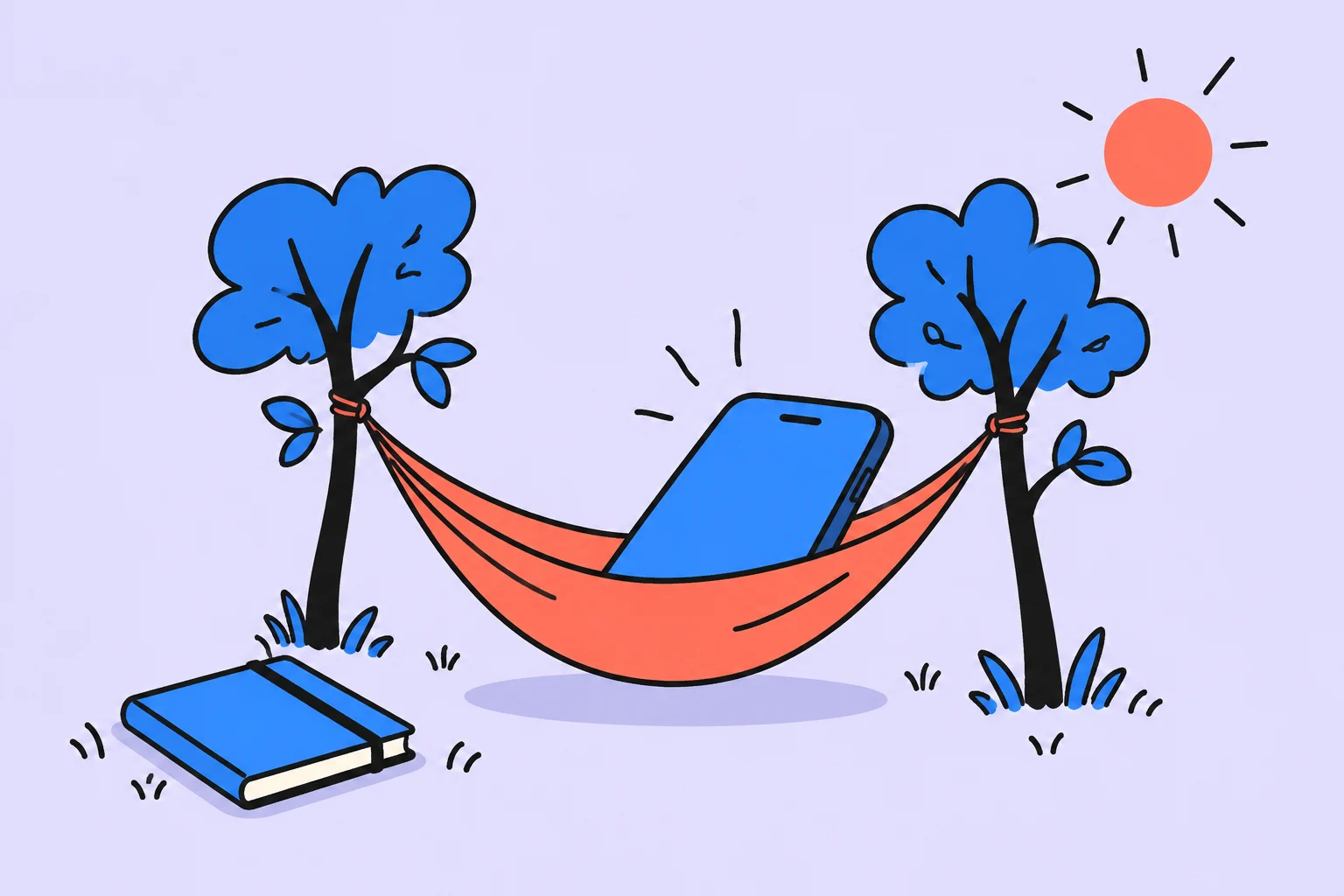
Have you ever caught yourself aimlessly scrolling for 40 minutes instead of the five you planned? Or waking up and reaching for your phone before you have even opened your eyes? Or feeling a strange anxiety when your phone dies and there is no charger? If so, it is time to consider a digital detox. The aim is to reset your relationship with the digital world and regain control of your attention, without hating technology or giving it up forever.
times a day the average person checks their phone
average daily screen time among adults
improvement in emotion recognition after 72h without screens
spent on social media daily by the average person in Russia
What is a digital detox, and why do you need one?
A digital detox is a deliberate period of limiting the use of digital devices and services. It can last from a few hours to several weeks. The aim is to give your brain a break from constant stimulation and restore the capacity for deep focus that we gradually lose under an endless stream of notifications, feeds, and messages.
Unlike digital minimalism, a long-term philosophy of mindful technology use, a detox is an intensive short-term practice. Think of it as a “rest day” for your brain. After a detox, it becomes much easier to make deliberate decisions about which technologies to bring back into your life and which to give up permanently.
The term “digital detox” entered the Oxford Dictionary in 2013. Since then, it has become a necessity rather than a passing trend: according to DataReportal research (2025), average adult screen time reached 6 hours and 58 minutes a day, including 2.5 hours on social media. That amounts to more than 100 days a year spent in front of a screen.
Dopamine dependence: how screens reprogram the brain
To understand why a digital detox works, you need to understand the neurobiology of phone addiction. Every notification, like, and new message triggers a small release of dopamine, the neurotransmitter responsible for anticipating rewards. The problem is that social media is designed to maximize these releases.
The endless feed uses “variable reinforcement,” the same principle as slot machines. You scroll without knowing what comes next: a boring post, a funny video, or important news. This unpredictability makes scrolling incredibly compelling: your brain keeps “hoping” for the next dose of dopamine and cannot stop.
Over time, baseline dopamine levels rise and receptors lose sensitivity. The result: ordinary pleasures (a walk, a book, or talking to a friend) stop being enjoyable because they cannot compete with the intensity of digital stimulation. This is the essence of information overload: the brain becomes accustomed to constant “noise” and forgets how to enjoy “quiet.” Stanford neuroscientist Anna Lembke describes this in Dopamine Nation as the “pain-pleasure balance”: the more we stimulate the reward system, the further the pendulum swings toward anxiety and dissatisfaction.
University of Pennsylvania research (2024) demonstrated that limiting social media use to 30 minutes a day for 3 weeks significantly reduces anxiety, depression, and loneliness. Participants also reported better sleep quality and higher self-esteem. Completely quitting social media was unnecessary: deliberate limits were enough.
Signs of information overload and phone addiction
How do you know you need a digital detox? Here is a detailed list of symptoms that signal a problem. If you recognize yourself in three or more, it is time to act.
Behavioral signs: you check your phone more than 50-80 times a day (the average is 96 times according to Asurion), cannot read a long text without wanting to switch away, pick up your phone “for a second” and find yourself on TikTok 30 minutes later, check notifications first thing in the morning, and scroll in bed last thing at night.
Emotional signs: anxiety when your phone is not nearby or its battery is dead (nomophobia, from “no mobile phone phobia”), irritation at slow internet, FOMO (Fear of Missing Out) when disconnected from social media, feelings of emptiness and boredom without a screen, and constantly comparing yourself with others on social media.
Physical signs: dry, tired eyes (computer vision syndrome), neck and shoulder pain (“text neck”), headaches after prolonged screen time, insomnia from evening scrolling, and poor posture. If you cannot concentrate on tasks you used to find easy, information overload may be a key cause.
A weekend digital detox plan (48 hours)
A 48-hour detox is ideal for your first attempt. It is long enough to feel an effect, without being as daunting as a week without screens. Here is a step-by-step plan that works.
Friday evening: preparation
Tell loved ones and colleagues you will be unavailable. Set up automatic replies. Download offline maps. Buy a paper book, a board game, and ingredients for cooking. Put your phone in a drawer—physically and literally.
Saturday morning: the first hours
Wake up without your phone's alarm (use a regular alarm clock). Have breakfast without screens. The first 2-3 hours are the hardest: you will reach for your phone out of habit. This is normal. Go for a walk.
Saturday afternoon: fill the gap
Exercise, walk, cook, read a paper book, spend time with loved ones, draw, or play music. By lunchtime, you will notice an unfamiliar quiet in your mind and a strange sense of freedom.
Saturday evening: reflection
Write in a paper journal: what you noticed, how you felt, what you missed, and what surprised you. Many people notice that without a phone, time passes more slowly—and it feels good.
Sunday: going deeper
Keep going. Add creative activity: drawing, music, crafts, or gardening. In the evening, make a list of which apps to bring back, delete, or limit.
A week-long digital detox plan
A full week without screens is for experienced participants. For your first attempt, try a gentle version: use only essential work tools, only during working hours; avoid social media and entertainment content completely; use your phone only for calls and navigation; and spend evenings without screens.
Keep a paper observation journal: what you notice, how you feel, and which thoughts arise. Many people describe a typical progression: days 1-2 bring “withdrawal,” restlessness, and boredom; days 3-4 bring clearer thinking and a slower internal monologue; days 5-7 bring better sleep, the return of forgotten ideas and desires previously drowned out by information noise, and a desire to do things with your hands.
According to University of California research, after 72 hours without screens, the ability to recognize nonverbal emotions recovers: we begin to “read” people better because the brain stops filtering reality through digital interactions. A week without social media lowers cortisol by 15% and improves sleep quality by 20%.
Screen-time statistics in 2026
These figures help reveal the scale of the problem. According to DataReportal and Deloitte research, the average adult spends 6 hours and 58 minutes a day in front of screens: 106 days a year, or around 29% of waking life.
The average person in Russia checks their smartphone 96 times a day (Asurion). 71% of people check their phone within the first 10 minutes after waking. 47% consider themselves addicted to their smartphone. The average TikTok session lasts 95 minutes. The average Instagram user spends 53 minutes a day in the app. 62% of people feel anxious at the thought of a day without their phone.
The situation is even more serious for teenagers: average screen time for 13-18-year-olds is 8.5 hours a day, excluding schoolwork. Research links this to a 40% increase in anxiety and depression among young people from 2012 to 2025, a period coinciding with widespread smartphone adoption.
days a year the average adult spends in front of a screen
check their phone within the first 10 minutes of the morning
consider themselves addicted to their smartphone
teenagers' daily screen time
The science of digital detox: what happens to the brain
Constant digital stimulation reprograms the brain on several levels. First, the prefrontal cortex suffers: the area responsible for self-control, planning, and decision-making. fMRI research shows reduced prefrontal cortex activity in people with high screen time, leading to impulsiveness, procrastination, and an inability to put the phone down.
Second, gray matter volume decreases in the insular cortex, an area responsible for empathy and emotional self-regulation. This explains why we feel emotionally empty and irritable after prolonged scrolling.
Third, the multitasking screens encourage (switching between tabs or reading while watching videos) reduces working memory capacity. A Stanford study (2009, Ophir et al.) found that chronic multitaskers are worse at filtering irrelevant information, switching between tasks, and remembering. Paradoxically, those who “practice” multitasking the most perform it the worst.
A detox allows these systems to “reset.” Dopamine receptor sensitivity recovers in 7-14 days. The capacity for deep work returns in 2-4 weeks. Full attention recovery may take up to 2 months, depending on the degree of dependence.
Digital detox for families with children
Detoxing alone is hard. Detoxing while surrounded by a family immersed in screens is almost impossible. A family digital detox is therefore a team project that starts with an honest conversation. Gather the family and discuss: How much screen time does each person have? What are we losing? What do we want to regain?
Family digital hygiene rules: no screens at the dinner table (this is time for conversation), a “phone basket” at the entrance (all phones in one place), one completely offline evening a week (board games, cooking together, or a walk), and a screen-free children's bedroom (especially before bed).
For children under 6, WHO recommends no more than 1 hour of screen time a day. For ages 6-12, no more than 2 hours of entertainment content. But alternatives matter more than bans. If a child is bored and the only available entertainment is a tablet, they will choose the tablet. Create an environment with books, building sets, paints, board games, and outdoor play space. Children copy their parents: if you are always on your phone, no rules will work.
Turn a family detox into an adventure rather than a punishment. Arrange an “analog weekend”: a hike, camping, a day outdoors, or a cooking class. When a detox is associated with fun rather than deprivation, children and adults participate more willingly. Use a habit tracker for the whole family: who can go the most consecutive days without social media?
Digital hygiene: daily practices against information overload
A full detox is a reset. But to avoid returning to your starting point, you need a daily digital hygiene system. This is a set of habits and rules that protect your attention and mental health every day, rather than only on detox days.
A screen-free morning (the first 60 minutes). Do not check your phone during the first hour after waking. This time is for you: a morning ritual, exercise, breakfast, and planning your day. When you start your morning with other people's notifications, you hand them control over your attention.
Notifications: keep only essential ones. Turn off push notifications from every app except calls and messages from loved ones. Check news, social media, and email on a schedule (2-3 times a day), rather than whenever your phone sounds. Every notification interrupts focus, and restoring deep concentration takes 23 minutes (research by Gloria Mark, UC Irvine).
The “2 minutes before a screen” rule. Before unlocking your phone, ask yourself, “Why am I picking it up?” If there is no specific answer, put it back. This small mindfulness ritual interrupts automatic behavior and reduces aimless screen time by 30-40%.
A screen-free evening (the final 60-90 minutes before bed). Blue light from screens suppresses melatonin production by 50%. Replace evening scrolling with an evening ritual: a book, a warm shower, talking to your partner, or gentle stretching. Sleep quality will improve within 3-5 days.
Minimalism and digital detox: a philosophy of mindful technology use
Digital detox is a tactic. Digital minimalism is a strategy. Cal Newport, a Georgetown University professor and author of Digital Minimalism, proposes a radical approach: start from zero. Delete all nonessential apps and services. Then slowly and deliberately bring back only those that provide real value aligned with your goals and values.
Three principles of digital minimalism: (1) clutter is costly—every additional service consumes attention; (2) optimization matters—using a tool is not enough; you need to use it optimally; (3) intentionality is satisfying—choosing technology deliberately rather than consuming passively improves quality of life.
A practical example: instead of ten apps for tasks, habits, journaling, lists, goals, and planning, use one tool that combines everything you need.
Digital detox and sleep: how screens damage sleep quality
The relationship between screen time and sleep quality is one of the most studied topics in sleep medicine. Blue light from screens (wavelength 450-490 nm) suppresses melatonin production, shifting the circadian rhythm 30-90 minutes later. But light is only part of the issue: content matters too. Distressing news, arguments in comments, and FOMO from other people's Instagram stories activate the sympathetic nervous system and raise cortisol. The brain enters “fight or flight” mode, hardly an ideal state for falling asleep.
A Brigham and Women's Hospital study (2014) found that reading on an iPad before bed (compared with a paper book) reduces melatonin production by 55%, delays REM sleep, and leaves people feeling exhausted in the morning even with the same sleep duration. A phone's night mode (warm colors) helps only partly: it reduces melatonin suppression by 20-30% but does not eliminate it.
Practical recommendations: avoid screens completely for 60-90 minutes before bed (replace them with a paper book, an audiobook, talking to your partner, or an evening ritual). If you cannot do without your phone in the evening, use minimum brightness, night mode, and only calm content (no news or social media). Charge your phone outside the bedroom: research shows that even a switched-off phone on the bedside table makes the brain “vigilant” and worsens deep sleep.
Digital detox at work: productivity without distractions
The average office worker checks email 74 times a day and switches tasks every 3 minutes (RescueTime research). Each switch “costs” 23 minutes to regain focus (Gloria Mark, UC Irvine). This means a significant part of the working day goes toward recovering from interruptions rather than working.
A work mini-detox: the “focus blocks” technique—90-minute sessions of deep work without checking email, messaging apps, or social media. Set your phone to Do Not Disturb, close every tab except the one needed for work, and use a website blocker (Cold Turkey or Freedom) for social media during working hours. After a 90-minute block, spend 15 minutes checking notifications, then begin the next block.
Companies that introduced “email-free hours” policies (Basecamp and Volkswagen) report productivity gains of 20-30% and lower employee stress. Some teams practice “quiet Wednesdays”: a day without meetings or internal messages, devoted to individual deep work. If you are a manager, start with yourself: show your team that instant replies are unnecessary and establish reasonable response-time norms (4 hours for email, 30 minutes for urgent messages).
Alternatives to screen time: what to replace scrolling with
The main reason a digital detox fails is a vacuum. If you remove screens without filling the freed-up time, boredom will quickly drive you back to your phone. Prepare alternatives in advance: specific things already within reach, rather than just a list.
For the mind: paper books (buy 2-3 before the detox), audiobooks and podcasts (download them offline), crosswords and puzzles, learning a new language with a paper textbook, and handwriting (journaling, letters to friends, or morning pages). Use a reading habit as a substitute for scrolling.
For the body: walks (without headphones—listen to the city), yoga, running, cycling, swimming, dancing, gardening, and housecleaning (yes, it is physical activity too, and a tidy home improves your mental state).
For the soul: cooking (a new recipe every weekend), board games with family or friends, drawing or adult coloring books, playing an instrument, volunteering, conversations with loved ones (face to face rather than through messaging apps), meditation, and breathing exercises.
For productivity: planning the week on paper, reviewing finances, sorting your wardrobe, organizing your space, and fixing small things you have postponed for months. These all produce tangible results and a sense of completion, unlike scrolling, which leaves only emptiness.
How to return to the digital world after a detox
The most important point is to avoid “switching everything back on” at once. This is the main mistake that undoes the entire effect of a detox. Reintroduce technologies one at a time, deliberately evaluating each: Did I really miss this? Does it add value? Can I limit my use?
Recommendations for returning: set screen-time limits BEFORE going back to social media (iOS Screen Time or Android Digital Wellbeing: a maximum of 30 minutes for social media); delete apps whose absence you did not notice (if you did not open one for a week, you do not need it); disable all nonessential notifications; and for the first few days, check social media only once a day and monitor how you feel.
A useful exercise: make two lists. The first is “What I did with the freed-up time during the detox” (walks, reading, conversations, and creativity). The second is “What I did with screens before the detox” (scrolling, news, and TV series). Compare them. Which list brings more happiness and satisfaction? The answer is usually obvious.
Regular mini-detoxes to maintain digital hygiene
You do not need a full detox every month. Small everyday practices maintain the effect and prevent a return to uncontrolled consumption. Incorporate them into your mindfulness practice.
Daily: keep the first hour of the morning and last hour of the evening phone-free. Take your lunch break without gadgets (eat mindfully). Check notifications 2-3 times a day on a schedule.
Weekly: spend one evening completely offline (Wednesday, for example). Have a “slow Sunday” with minimal screens and maximum analog activities. Review the week's screen time.
Monthly: spend a full day without screens (Saturday or Sunday). Review your apps and delete unused ones. Assess which technologies receive more of your time than they deserve.
Quarterly: take a full 48-72-hour detox. Reflect deeply on your relationship with technology. Update your digital hygiene rules.
Plan a short period without nonessential screens and decide what you will do instead. Create a task in Sinqly: registration is free.
The psychology of phone addiction: why we cannot stop
Phone addiction is not a lack of willpower. It is the result of work by thousands of engineers and designers whose job is to hold your attention as long as possible. Former Google design ethicist Tristan Harris calls this the “attention economy” and compares a smartphone to a “slot machine in your pocket.” Every pull-to-refresh, endless scroll, and push notification results from A/B testing on millions of users to maximize “engagement” (meaning time spent in the app).
Four mechanisms that make phones addictive: (1) variable reinforcement —like a slot machine, you do not know what you will see the next time you open the app; (2) social approval —likes, comments, and reactions connect to basic needs for recognition and belonging; (3) FOMO —the fear of missing something important makes you check the feed even without notifications; (4) endless content —unlike a book or newspaper, a social media feed has no end, so there is no natural stopping point.
Understanding these mechanisms is the first step toward freedom. When you realize that your “desire to check your phone” comes from the app's design rather than your own genuine wishes, resisting becomes easier. Use mindfulness practicesto notice the moment an impulse arises and pause before reaching for your phone.
Digital detox and mental health: what science says
The relationship between social media use and mental health is one of the most actively studied topics in modern psychology. A meta-analysis of 55 studies (Huang, 2022) confirmed a statistically significant relationship between time on social media and levels of anxiety, depression, and loneliness, especially among young people aged 16-25. The mechanism works through social comparison: we see the “best version” of other people's lives and feel that our own life is inadequate.
But there is good news: the effect is reversible. A University of Bath study (Lambert et al., 2022) found that just one week away from social media significantly improves well-being and reduces anxiety and depression. The effect was especially pronounced among people with initially high screen time (more than 3 hours a day on social media). After returning, participants spontaneously limited their time: a deliberate break helped reshape their relationship with the platforms.
A practical recommendation: if you experience anxiety, insomnia, or low mood, try a 7-day social media detox as a first step before consulting a professional. It is free, safe, and may produce noticeable results. If symptoms persist, consult a psychologist or psychotherapist. A digital detox is a useful tool, but it does not replace professional help for clinical depression or an anxiety disorder.
Measuring progress: how to track screen time
What gets measured gets improved. Start tracking screen time before your detox to establish a baseline. iOS Screen Time and Android Digital Wellbeing provide detailed statistics: total time, unlock count, time in each app, and notification count. Often, simply seeing the figures is enough to motivate change: people usually underestimate their screen time by a factor of 2.
Set specific, measurable goals: reduce total screen time by 30% in a month, limit social media to 30 minutes a day, and reduce unlocks to 50 a day (the average is 96). Record your progress weekly.
Conclusion: digital detox as the first step toward mindful living
A digital detox is about deliberate choice. When you know what living without constant information noise feels like, you begin to value quiet and control when and why you connect. You stop passively consuming content and start actively directing your attention.
Try at least one completely screen-free day: you will be surprised by how much space in life used to be filled with scrolling. How many thoughts, ideas, and feelings emerge when your brain gets a break from endless stimulation. How much joy there is in simple things—a walk, a conversation, a book, or cooking—when your attention is fully present.
Frequently asked questions about digital detox
How long does a digital detox last?
A digital detox can last from a few hours to several weeks. For your first attempt, a weekend—48 hours—is ideal. A noticeable resetting effect on the dopamine system begins after 72 hours. For everyday life, mini-detoxes work well: an hour without your phone in the morning and evening, and one offline evening a week.
How do I know I need a digital detox?
Key signs of information overload: checking your phone more than 50 times a day, being unable to read a long text, anxiety without your phone (nomophobia), insomnia from scrolling, and a feeling of information hangover. If you recognize yourself in 3+ of these signs, a detox is necessary.
Can I work during a digital detox?
With a gentle version, yes. Use work tools only during working hours, avoid social media and entertainment, and spend evenings without screens. A full detox without any screens is best planned for a vacation or long weekend.
Does digital detox help with anxiety and phone addiction?
Yes, numerous studies support this. Spending 72 hours without screens restores emotional sensitivity. A week without social media lowers cortisol by 15% and improves sleep by 20%. Limiting social media to 30 minutes a day reduces anxiety within 3 weeks (University of Pennsylvania, 2024).
How can I do a digital detox with children?
Start with family rules: no screens at the table, a “phone basket,” and one offline evening a week. Create alternatives: board games, creative activities, walks, and cooking together. Turn the detox into an adventure rather than a punishment. Remember: children copy their parents' behavior.
What if phone addiction returns after the detox?
Establish a digital hygiene system: screen-time limits, notifications only from essential contacts, and regular mini-detoxes. Use minimalist tools instead of ten apps. Review monthly: which apps take your time without providing value?
Is a dopamine detox the same as a digital detox?
Not quite. A dopamine detox is a broader concept: temporarily giving up any “quick pleasures” (social media, fast food, video games, and shopping). A digital detox is a subset focused on screens and digital services. Both aim to reset the brain's reward system, but a digital detox is more practical to start with.
Which apps help limit screen time?
Built-in tools: iOS Screen Time and Android Digital Wellbeing—set social media limits (30 minutes a day). Third-party tools: Forest (visualizing focus through growing trees), Cold Turkey (blocking websites during working hours), and Freedom (blocking across all devices simultaneously).
Is a digital detox bad for your career?
No, if you approach it deliberately. A gentle detox is compatible with work: use work tools during working hours and give up only entertainment and social media. Research shows that employees with limited screen time are 20-30% more productive, experience burnout less often, and make better decisions. Tell colleagues when to expect a reply, and your career will benefit from improved focus.
Was this helpful?
Rate the article and tell us what was missing. Your feedback goes to the Sinqly team and will not be published on the site.
Deep Work: a complete guide to deep, focused work
A complete guide to Cal Newport's Deep Work. How to practice deep work, 4 strategies, focus rituals, and the science of concentration.
How AI helps personal development: a complete guide for 2026
Artificial intelligence for life and personal development: AI coaching, habit tracking, and personalized plans. A practical guide with examples.
How to Track Habits Effectively: The Complete 2026 Guide
Science-based habit tracking: habit diaries, habit journals and digital trackers. 7 methods and step-by-step instructions.