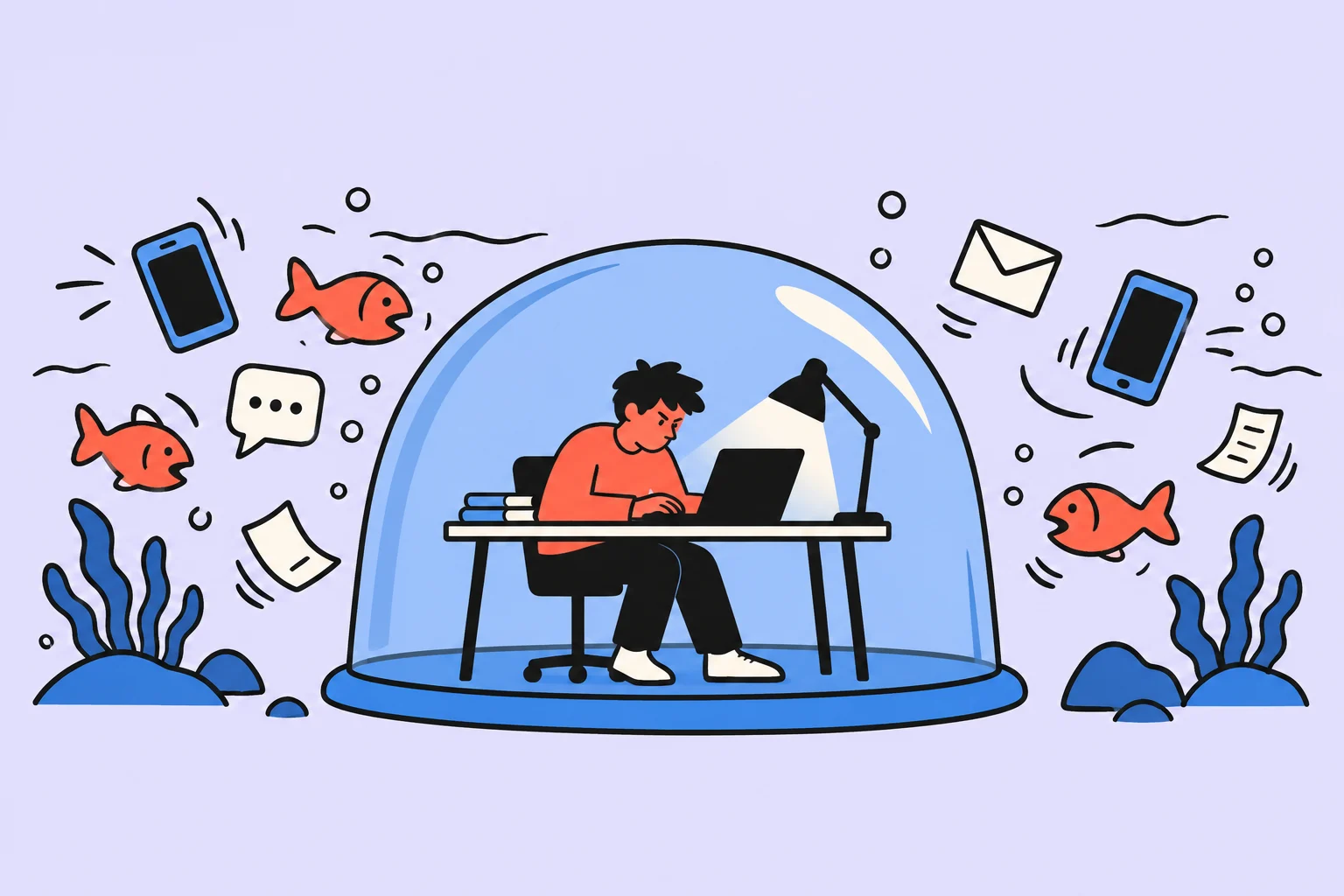
In an era of constant notifications, messaging apps, and endless scrolling, sustained concentration has become rare and also the most valuable professional skill of the twenty-first century. Professor Cal Newport introduced “Deep Work” for complete immersion in a cognitively demanding task without distractions. Two hours of deep work produce results equivalent to eight hours of ordinary work. Here is how to master this skill.
Of deep work replace 8 hours of shallow work in terms of result quality
Average uninterrupted focus on one task in 2023 (UC Irvine)
Maximum productive Deep Work per day, even for experts
What Deep Work is and why it matters
Cal Newport, a computer science professor at Georgetown University, defines Deep Work as “professional activity performed in a state of complete concentration that pushes cognitive abilities to their limit.” This includes coding, strategic planning, scientific research, content creation, and complex analysis: anything requiring deep thinking and creating unique value.
The opposite is Shallow Work: email, messaging apps, routine reports, and meetings without agendas. These tasks require no cognitive effort and are easily replicated. The problem: most people spend 60-80% of working time on shallow work, leaving only fragments for what truly advances careers and projects.
Newport argues that people capable of Deep Work win in the knowledge economy. Two key future skills are learning difficult things quickly and producing at an elite level. Both require deep concentration. The good news: Deep Work is a trainable skill. The bad news: the longer you live with constant distractions, the harder it is to regain focus.
During sustained focus, the brain enters a flow state (described by Mihaly Csikszentmihalyi). Myelin, the insulating sheath around neurons, thickens during concentrated practice, making neural connections faster and more reliable. This is the physical mechanism of mastery. Interruptions reset the process: after every distraction, returning to deep focus takes 23 minutes (Gloria Mark, UC Irvine).
Why deep work has become rare
Research by Gloria Mark at UC Irvine revealed a shocking trend: average uninterrupted focus on a single task fell from 2.5 minutes in 2004 to 47 seconds in 2023. The average office worker checks email 74 times daily and their smartphone more than 150 times. Each switch activates a stress response, raising cortisol.
The causes are systemic. Social media is designed against focus: infinite feeds, notifications, and recommendation algorithms all work to capture attention. Corporate culture rewards “visible busyness”: quick email replies, presence in chats, and attendance at meetings are all Shallow Work that looks productive but creates no value. Multitasking has become the norm: research clearly shows that multitasking lowers IQ by 10-15 points, but culture continues to celebrate it.
Under these conditions, Deep Work becomes a superpower as well as an advantage. The few who can work deeply achieve disproportionately greater results in the same number of working hours.
Newport's four Deep Work strategies
Newport describes four ways to organize deep work. The choice depends on your profession, commitments, and lifestyle:
1. The monastic strategy. Complete isolation for extended periods: weeks or months of minimal communication. Suitable for writers, researchers, and academics. Example: Donald Knuth (the creator of TeX) has not used email since the 1990s. Unrealistic for most, but produces the greatest results.
2. The bimodal strategy. Alternating periods: a week of deep work → a week of communication. Or 3 days in the office (Shallow) + 2 days at home (Deep). Suitable for managers, consultants, and entrepreneurs. Requires organizational support.
3. The rhythmic strategy. Fixed Deep Work blocks at the same time every day. For example, 6:00-9:00 is deep work, followed by a normal day. The most realistic option for most people. Consistency turns Deep Work into a habit.
4. The journalistic strategy. Switching into Deep Work whenever a free window appears: 30 minutes between meetings or an hour after lunch. Requires considerable skill in “entering” focus. Suitable for experienced practitioners. Too difficult for beginners: start with the rhythmic approach.
If you work in an office or remotely with colleagues, start with the rhythmic strategy. Block 1.5-2 hours every morning in your calendar as a “meeting with yourself.” This block is protected: no meetings, calls, or message replies. After 3-4 weeks, it will become a habit.
A ritual for entering deep work
Newport emphasizes that spontaneously “deciding to work deeply” is ineffective. You need a predictable ritual that signals the brain to switch into focus mode. The ritual answers three questions:
Where will you work?
Choose a specific place for Deep Work. Ideally, a separate room or at least a particular desk used only for deep work. The brain associates the place with the action.
How long will you work?
Set a specific duration. Start with 60 minutes. With experience, use 90-120 minutes. Use a timer so you do not have to think about time.
What are the rules?
Decide in advance: phone off/in another room, internet off (unless needed for the task), and no email checking. Clear rules remove the need for decisions during the session.
What support do you need?
Coffee, water, headphones with white noise, and a closed door. Prepare everything before starting to avoid interruptions for everyday needs.
An example ritual: sit at the desk → put on headphones → turn on a white-noise generator → start a 90-minute timer → open a single document → work. After 2-3 weeks, the brain will automatically enter focus mode when this sequence begins. The same principle applies to morning rituals.
A Deep Work environment: removing distractions
A University of Texas study (2017) found something striking: simply having a smartphone in sight reduces cognitive performance, even when it is off and face down. The brain spends resources suppressing the urge to check it. Removing the phone from the room literally raises your IQ while you work.
Physical space. Minimal visual distractions, good lighting, and a temperature of 20-22°C. Remove unnecessary items from the desk: each takes a tiny dose of attention. Use noise-canceling headphones or a white-noise generator. Research shows moderate background noise (~70 dB) improves creativity, while colleagues' speech reduces productivity by 66%.
Digital space. Close every tab except those needed for the current task. Use a website blocker (Cold Turkey or Freedom) during Deep Work. Turn notifications off completely rather than merely silencing them. Practice digital minimalism consistently, beyond Deep Work sessions alone.
Shutdown Ritual: how to finish work properly
Finishing Deep Work, and the workday overall, properly is equally important. Newport recommends a daily Shutdown Ritual:
Step 1: Review unfinished tasks. Step 2: For each, make sure there is a plan (a date and next action) or that it has been moved to a specific day. Step 3: Check the next day's calendar. Step 4: Say a trigger phrase: “Shutdown complete” (or any other phrase).
Why? Without a shutdown ritual, the brain continues processing work tasks in the background (the Zeigarnik effect: unfinished tasks occupy working memory). This reduces the quality of rest, sleep, and consequently the next day's Deep Work. The ritual “closes” all open loops and gives the brain permission to rest.
Deep Work for programmers and analysts
Programming is ideal for Deep Work: complex, cognitively demanding, and requiring sustained mental context. One interruption can cost 30-45 minutes to rebuild the “working set” in memory (variables, logic, and context).
Recommendations for developers: a morning block of 2-3 hours for complex architecture and coding. Slack/Teams only after 11:00. Code reviews and standups at fixed times. Use Pomodoro to structure blocks: 90 minutes of coding → 20 minutes of review/communication. This matches the brain's ultradian rhythm.
Deep Work for creative professions
Writers, designers, and musicians all depend on deep work, but have particular needs. Creativity requires focus and space for mind wandering. The best strategy therefore alternates Deep Work (focused creation) with “productive idleness” (a walk, shower, or routine chores): these are the moments when insights arrive.
A schedule of “morning for Deep Work, daytime for Shallow Work” works particularly well for creative professions. Ernest Hemingway wrote from 6 to 12 in the morning and never worked after lunch. Stephen King works for 4 hours in the morning. Maya Angelou rented a hotel room solely for writing. The pattern is the same: a fixed morning block protected from everything else.
Research by K. Anders Ericsson (who developed the “10 000 hours” concept) found that elite musicians and athletes engage in deliberate practice for no more than 4-5 hours a day. Beyond that, maintaining the concentration needed for quality work is impossible. This sets a natural Deep Work ceiling of 4 hours a day for most people.
Deep Work with ADHD: adapting to neurodivergence
The paradox of ADHD: concentration problems coexist with hyperfocus, a state in which a person with ADHD can work deeply for hours if the task is stimulating enough. The key is creating conditions that activate hyperfocus.
Short blocks. Instead of 90-minute sessions, use 30-45 minutes with frequent breaks. High stimulation. Music, movement (a standing desk or exercise ball), and an unusual setting (a café or library). Deadlines and excitement. Artificial deadlines and gamification work better than discipline. External structures. Timers, an accountability partner, and visual boards: anything that creates an external framework for focus.
The 4DX framework for personal productivity
Newport adapted the business framework “4 Disciplines of Execution” for personal Deep Work practice:
Focus on what matters most
Choose 1-2 “wildly important goals” for the quarter. These are projects that will benefit most from Deep Work. Avoid spreading yourself thin.
Identify the lead measure
Hours of Deep Work per week are the best predictor of results. Measure hours rather than output (articles, code, or sales).
Keep a visual score
Put up a board or use a tracker to record Deep Work hours daily. Visible progress motivates you to maintain a streak.
Weekly review
Every Sunday: how many hours of Deep Work did you do this week? What hindered it? What helped? What should change next week?
Digital detox as preparation for Deep Work
You train the ability to do Deep Work outside sessions as well as during them. If you constantly check your phone, scroll feeds, and switch apps in your free time, you train the brain to be distracted. It carries that distractibility into working hours.
Newport proposes “digital minimalism,” a deliberate approach to technology. Choose which apps and services truly provide value rather than rejecting technology. Practical steps: disable nonurgent notifications. Remove social media from your phone (use it only on a computer). Set the screen to grayscale. Introduce “no phone at meals or before bed.”
After 2-3 weeks of digital minimalism, you will notice that entering Deep Work is easier, blocks are longer, and work quality has improved. The brain literally reorganizes when it regularly experiences periods without information noise. A complete guide to digital minimalism.
A practical plan: introducing Deep Work in 4 weeks
Week 1: One block. Every day, do 1 hour of deep work in the morning. Turn off your phone and close messaging apps. Work on one task. Record hours on a board or in a tracker.
Week 2: Ritual and environment. Create an entry ritual. Organize your workspace for focus. Add a Shutdown Ritual at the end of the day. Increase the block to 75-90 minutes if comfortable.
Week 3: Protecting time. Block time in your calendar. Tell colleagues about your “office hours.” Begin digital minimalism outside work. Increase to 2 blocks of 60-90 minutes.
Week 4: Weekly review. Introduce 4DX: counting hours, a visual board, and Sunday reviews. Assess how many hours of Deep Work you completed this week and how it affected results. Adjust the system.
Choose one result for a focused work block and keep other activities outside it. Create a task in Sinqly: registration is free.
Frequently asked questions about Deep Work
What is Deep Work?
Deep Work is Cal Newport's term for complete immersion in a cognitively demanding task without distractions. This includes coding, scientific work, and creativity: anything creating unique value and requiring deep concentration.
How many hours of Deep Work can you realistically do each day?
For beginners, 1-2 hours. For experienced practitioners, 3-4 hours. Even world-class professionals rarely exceed 4-5 hours. Trying to work deeply for 8 hours leads to burnout and lower quality.
How do you start practicing?
One 60-minute morning block. Phone in another room. One task. A timer. Increase by 15 minutes each week. Within a month, 90-120 minutes will become normal.
Is Deep Work suitable for ADHD?
Yes, with adaptation: short blocks (30-45 minutes), a highly stimulating environment, and external structures (timers and a partner). Hyperfocus with ADHD is a Deep Work superpower when the right conditions are created.
How does Deep Work differ from flow?
Deep Work is a discipline and practice. Flow is a spontaneous psychological state. Deep Work creates conditions for flow, increasing its frequency and duration. Flow is a bonus; Deep Work is a daily practice.
How do you protect time for Deep Work?
Block it in your calendar as a “meeting.” Introduce “office hours” for colleagues. Show management the results: Deep Work productivity is usually so much higher that support comes quickly. Plan your day around protected blocks.
Was this helpful?
Rate the article and tell us what was missing. Your feedback goes to the Sinqly team and will not be published on the site.
Digital detox: a complete guide
A complete guide to digital detox. Signs of information overload, dopamine dependence, weekend and week-long plans, and a family detox.

Procrastination: 12 science-based ways to stop putting things off
Why we procrastinate and how to stop putting things off. 12 scientifically grounded methods for tackling procrastination, from the two-minute rule to cognitive therapy.
GTD: a planning system explained simply, with a diagram and example
How the GTD planning system works: a five-step diagram, processing your inbox, and a project example. Where to start, where to record the next action, and when you need a calendar.