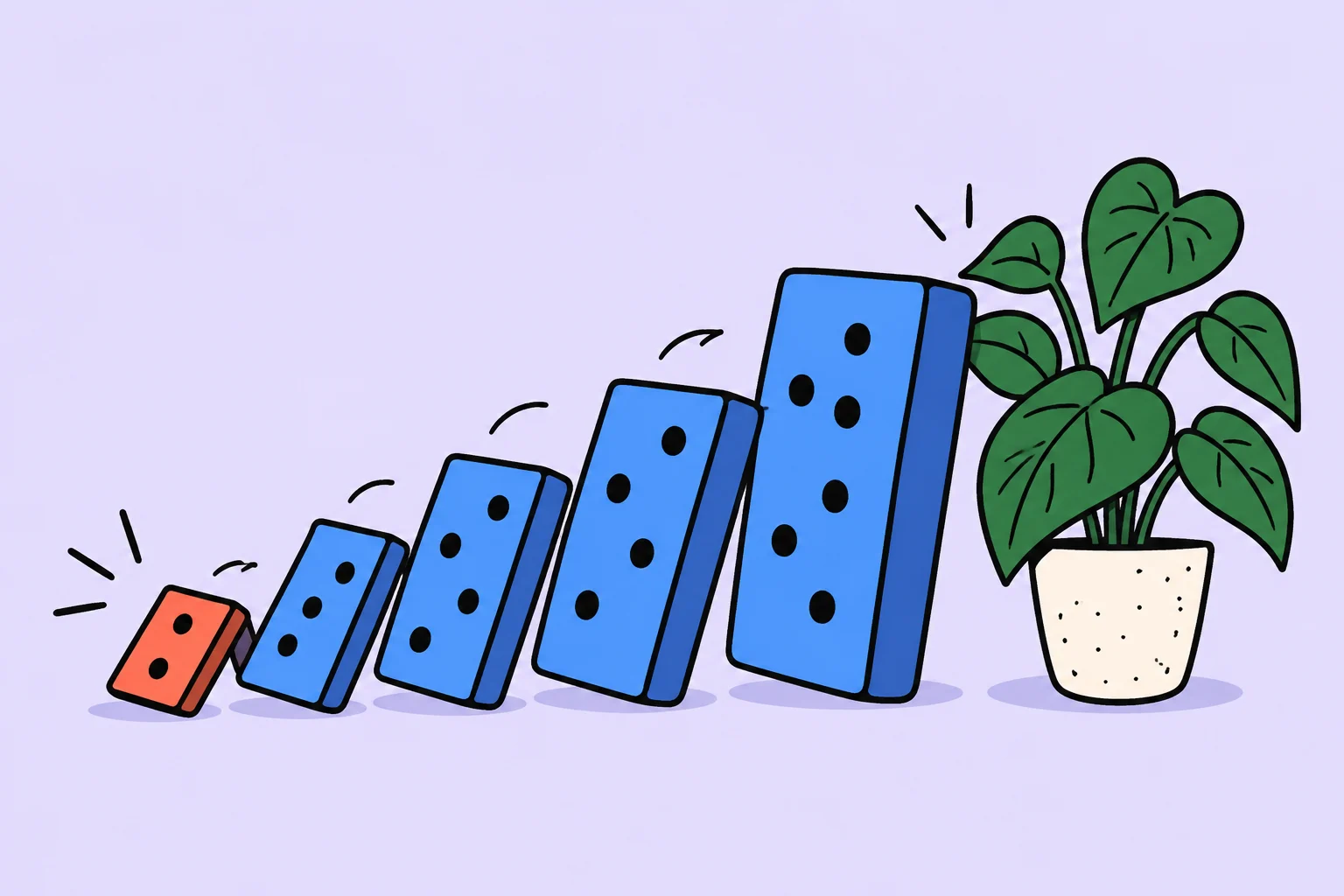
James Clear’s Atomic Habits is one of the most influential books on behavior change of the past decade. It has sold more than 15 million copies and been translated into 50 languages. The central idea is simple and powerful: radical changes are unnecessary; improving by 1% every day is enough. In this detailed review, we will examine every key concept in the book and show how to apply it in practice.
improvement every day produces a 37-fold increase over a year
average time to form a habit (UCL)
copies of Atomic Habits sold worldwide
About the author: who is James Clear?
James Clear is an American writer, speaker, and habit-formation expert. His blog, jamesclear.com , is read by more than a million people each month. Clear is a practitioner rather than an academic scientist: he organized scientific research on habits into an accessible, practical system.
The author’s personal story is compelling: while playing baseball in high school, Clear suffered a serious head injury. Recovery took years, and small daily steps helped him return to sport and enter college. This experience became the foundation of his “atomic habits” philosophy: small changes that accumulate into enormous results.
Atomic Habits was published in 2018 and quickly became a bestseller. Clear draws on research in neuroscience, psychology, and behavioral economics but presents it through personal stories and practical examples. This combination of science and accessibility made the book a phenomenon.
The central idea: systems matter more than goals
Clear’s first and perhaps most counterintuitive argument: goals are overrated. Winners and losers have the same goal: to win. Every Olympian wants a gold medal. Every entrepreneur wants a successful business. The difference lies in systems rather than goals.
A system is a set of daily habits that lead to a result. Instead of “I want to lose 10 kg,” create a system: healthy eating habits, regular exercise, and quality sleep. The result follows from the system rather than from setting a goal.
Clear identifies four problems with goals: (1) winners and losers have the same goals, (2) achieving a goal is only a momentary change, (3) goals restrict happiness because you are happy only when you achieve them, and (4) goals conflict with long-term progress because you achieve them and stop. A system solves all four problems by creating an ongoing process.
“You do not rise to the level of your goals. You fall to the level of your systems.” This sentence captures the essence of the book. Your life is determined by daily habits rather than ambitions. Focus on the system, and results will follow as a side effect.
Three layers of change: outcomes, processes, and identity
Clear identifies three layers at which change happens: outcomes , what you get, processes , what you do, and identity , what you believe. Most people begin with outcomes: “I want to lose weight,” “I want to write a book,” or “I want to learn a language.”
Clear suggests starting at the other end, with identity. Instead of “I want to quit smoking,” say “I am not a smoker.” Instead of “I want to run,” say “I am a runner.” When a habit becomes part of who you are, motivation becomes internal. A healthy person chooses a salad because that is what healthy people do, rather than because they are on a diet.
Every action is a vote for a particular identity. Every time you sit down to write, you vote for “I am a writer.” Every time you go to a workout, you vote for “I am an athlete.” You do not need a majority of votes immediately. You only need enough to make the trend clear.
This explains why people give up habits after achieving a goal. “Lose 10 kg” is a finite goal. Once it is achieved, motivation disappears. “Be a healthy person,” however, is an ongoing identity that sustains habits throughout life. Read more about retention strategies in our guide to sticking with habits.
The habit loop: 4 stages
Every habit passes through 4 stages: cue, craving, response, reward. This expands Charles Duhigg’s classic “trigger — action — reward” model. Clear added the “craving” stage: the internal motivation between the cue and the action.
Cue starts the process. It may be a time of day, a place, an emotion, a preceding action, or the presence of particular people. The brain constantly scans the environment for cues that predict a reward. Craving is the motivation to act. You do not want the habit itself; you want the change in state it provides. You do not want to brush your teeth; you want your mouth to feel clean.
Response is the action itself, the habit. A response happens only if motivation is sufficient and the action is easy enough. If a habit requires too much effort, it will not happen. Reward is the satisfaction that reinforces the cycle. The reward teaches the brain which cues to remember and which actions to repeat.
From this four-stage model, Clear builds a system of 4 laws of behavior change, one for each stage of the loop.
Law 1: Make it obvious
The first law addresses the cue stage. The more obvious the trigger, the more likely the habit. Clear offers three key techniques.
Implementation intention. The formula: “I will [action] at [time] in [place].” Instead of “I will meditate,” say “I will meditate at 7:00 on the mat in my bedroom.” Research by Peter Gollwitzer at New York University shows that a specific link to time and place increases the likelihood of follow-through by 2-3 times.
Habit stacking. Link a new habit to an existing one: “After [existing habit], I [new habit].” For example: “After I pour my morning coffee, I open my gratitude journal.” The existing habit becomes the trigger for the new one, using established neural pathways. Read more about linking habits in the article “How to Build a Habit”.
Environment design. Want to drink more water? Put a bottle on your desk. Want to read before bed? Put a book on your pillow. Every visual cue is an effortless trigger. For bad habits, invert this: hide the cues by putting away the cigarette pack or removing social media icons from your home screen.
Law 2: Make it attractive
The second law addresses the craving stage. The more attractive a habit, the stronger the desire to perform it. Dopamine is the neurotransmitter that governs motivation. The key insight: dopamine is released not when you receive a reward, but during its anticipation.
Temptation bundling. Pair a “need to” with a “want to.” Listen to your favorite podcast only while exercising. Drink a delicious latte only while working on a difficult project. Watch a show only on the treadmill. The “need to” becomes attractive through association with the “want to.”
Your social environment. We adopt the habits of three groups: the close, such as family and friends; the many, society; and the powerful, our role models. Join a community where your desired habit is normal. Want to run? Join a running club. Want to read? Find a book club. When a habit is associated with belonging to a group, it becomes much more attractive.
For bad habits, invert the law: make them unattractive. Reframe “I cannot smoke” as “I do not want to smoke because I care about my health.” Associate the bad habit with negative consequences rather than pleasure.
Law 3: Make it easy
The third law addresses the response stage. The easier the action, the more likely you are to perform it. Clear emphasizes that at the beginning, the number of repetitions matters more than quality.
He gives the example of photographers: by the end of a semester, a group taking 100 photos a day produced better pictures than a group trying to take one “perfect” photograph. The same applies to habits: showing up every day for 2 minutes matters more than showing up once a week for an hour.
The two-minute rule. Reduce the habit to a version that takes less than 2 minutes. “Read for 30 minutes” → “open a book.” “Run 5 km” → “put on running shoes.” “Learn English” → “open the app and review 1 word.” The 2-minute rule is an entry point, not a goal. After 2 minutes, you often continue, but even if you do not, the habit of showing up remains. Read about applying this principle in our article on micro habits.
Reducing friction. Lay out your workout clothes the night before. Cut vegetables in advance for a healthy snack. Keep your guitar in plain sight rather than in a case in the closet. Every removed barrier increases the likelihood of follow-through. For bad habits, invert the law: increase friction by hiding the TV remote or deleting social media apps.
Define the habit
Choose one specific habit you want to build. The more specific, the better: instead of “exercise,” choose “do 10 squats after waking up.”
Apply the 2-minute rule
Reduce the habit to its smallest version: “open a book,” “put on running shoes,” or “do 2 push-ups.” The starting action should be so small that you cannot say no.
Link it to an anchor: habit stacking
Use the formula: “After [existing habit], I [new habit].” For example: “After my morning coffee, I meditate for 2 minutes.”
Set up your environment
Place visual cues: a book on your pillow, a water bottle on your desk, or a yoga mat beside your bed. Every cue is an effortless trigger.
Add an immediate reward
Mark completion in a tracker, tell yourself “great job!”, and build a streak. An immediate reward reinforces the neural pathway.
Scale up gradually
After 2 weeks, increase the amount: 2 push-ups → 5, one page → 5 pages. Never increase by more than 10% at a time.
Law 4: Make it satisfying
The fourth law addresses the reward stage. The brain prioritizes immediate rewards over delayed ones, an evolutionary mechanism inherited from our ancestors. Good habits usually have delayed rewards, such as better health months later, while bad habits offer immediate rewards, such as the pleasure of sweets right now.
The solution: add immediate reinforcement to good habits. A habit tracker is the perfect tool because visually marking something “done” provides instant satisfaction. A streak , an uninterrupted series of completions, creates extra motivation: “I do not want to break the chain.”
Clear states the “cardinal rule”: the end of a habit should feel satisfying. If you allow yourself 10 minutes in the sauna or a delicious protein shake after a workout, your brain associates exercise with pleasure. If you drink a cup of your favorite tea after an hour of working on a book, writing becomes associated with a reward.
For bad habits, invert the law: make the consequences unpleasant. Clear suggests a “habit contract”: agree with someone that for every missed commitment, you pay a penalty or perform an unpleasant obligation. Social accountability is a powerful motivator.
The Valley of Disappointment and the Plateau of Latent Potential
One of the book’s most important and practically useful concepts is the nonlinearity of results. Clear uses a brilliant metaphor of melting ice: imagine heating a piece of ice. At minus 10, nothing happens. At minus 5, nothing. At minus 1, still nothing. Finally, at 0 degrees, the ice starts to melt. The previous degrees were not wasted: they accumulated. The result simply became visible at the transition point.
The same happens with habits. The first weeks of effort seem pointless: your weight does not change, your skill does not improve, and your business does not grow. This is the “Valley of Disappointment,” the period before habits produce visible results. Most people quit here, thinking their effort is not working.
But if you continue, you cross the “Plateau of Latent Potential,” and results begin growing exponentially. One day at the gym will not change your body. But 200 days will transform it completely. One article will not create a blog. But 200 articles will create a media empire. Patience is a strategic advantage as well as a virtue.
Research by Phillippa Lally at University College London (2009) found that a habit takes an average of 66 days to form, rather than the commonly assumed 21. The range is 18 to 254 days, depending on complexity. Missing one day does not erase progress, but extended gaps significantly slow the development of automatic behavior. Clear frequently cites this study in the book.
How to break bad habits: inverting the 4 laws
Clear offers an elegant solution for bad habits: invert all 4 laws. If we make the cue obvious for good habits, we make it invisible for bad ones. If good habits are attractive, bad habits should be unattractive.
Inversion of law 1: make it invisible. Remove triggers from your environment. Want to spend less time on your phone? Leave it in another room. Want to eat fewer sweets? Do not buy them for home. When the cue is invisible, the habit does not start.
Inversion of law 2: make it unattractive. Connect the bad habit with negative consequences. Instead of “I cannot eat fast food,” think “fast food harms my health and energy; I do not want to feel sluggish.” Reframing changes your attitude toward the habit.
Inversion of law 3: make it difficult. Increase friction. Delete social media apps from your phone. Ask the waiter not to bring a dessert menu. Every additional step before a bad habit reduces the likelihood of performing it.
Inversion of law 4: make it unsatisfying. Create immediate consequences. Make a “habit contract” with an accountability partner: every time you break your promise, pay a penalty. Social pressure works because we value other people’s opinions.
How Atomic Habits differs from other habit books
There are dozens of habit books on the market: Charles Duhigg’s The Power of Habit, BJ Fogg’s Tiny Habits, and Kelly McGonigal’s The Willpower Instinct. What makes Atomic Habits stand out? The main difference is its focus on identity. Duhigg describes the mechanism of a habit, the loop; Fogg provides a minimal entry point; and Clear proposes a shift in self-perception. He shows how habits shape your identity as well as explaining how they work.
The second difference is its systematic approach. Clear’s four laws cover the entire habit cycle, from creating a trigger to reinforcement through a reward. This is a coherent framework applicable to any habit, rather than a collection of disconnected tips. You can diagnose a problem, “Why can I not start meditating?”, by checking each law: is the trigger obvious enough? Is the action attractive enough? Easy enough? Is there an immediate reward?
The third difference is its scientific grounding without academic dryness. Clear cites research from Stanford, MIT, and UCL but presents it through personal stories and practical examples. The book reads like a conversation with a smart friend rather than a scholarly monograph. To apply the book’s ideas in everyday life, try our step-by-step habit-building plan.
A critical look at Atomic Habits
For all its strengths, the book has limitations that an honest review should mention. The main criticism: Clear simplifies complex psychological processes. Addictions involving alcohol, drugs, or gambling cannot be resolved with the 2-minute rule. Trauma-related behavior patterns require work with a psychotherapist rather than simply “changing your identity.”
Critics also note that the book focuses on individual change while ignoring systemic factors: poverty, discrimination, and mental disorders make habit formation significantly harder. Someone with clinical depression will struggle to “just start small”: they need medical help.
Nevertheless, Atomic Habits remains one of the best practical guides for most people seeking self-improvement. The book does not claim to replace therapy: it offers a system for people ready to make intentional changes. Within that category, it has virtually no competitors.
Advanced principles
In the final chapters, Clear examines several subtle but important aspects of habit formation that are often overlooked.
The Goldilocks rule. Motivation peaks when a task lies at the edge of your abilities: neither too easy, which is boring, nor too difficult, which is frustrating. Clear calls this the “Goldilocks rule”: optimal difficulty is your current level plus 4%. This aligns with Mihaly Csikszentmihalyi’s concept of flow. For habits, it means gradually increasing difficulty to remain engaged.
The downside of habits. Once an action becomes automatic, you stop noticing small mistakes. An experienced musician may play “on autopilot” and stop improving. Clear recommends periodic “habit reviews”: once a month or quarter, analyze whether your habits are working and adjust your course.
Genetics and habits. Clear emphasizes that genes determine direction rather than destiny. Choose habits that match your natural tendencies. An extrovert finds it easier to build a habit of morning meetups with friends; an introvert, a habit of evening reading. Use your nature rather than fighting it.
Turn your chosen principle from the book into a concrete action you can try today. Create a task in Sinqly: registration is free.
Key lessons from each part of the book
The book consists of 20 chapters grouped around the 4 laws. Here is a brief outline of the key ideas in each part:
Introduction (chapters 1-3): Clear explains the power of 1%, the difference between goals and systems, and the three layers of change: outcome → process → identity. The main argument: start with “Who do I want to become?” rather than “What do I want to achieve?” Each habit is a vote for a new identity.
Law 1 — Obviousness (chapters 4-7): The scorecard, or habit audit; implementation intention, linking to time and place; habit stacking; and environment design. Key insight: most habits happen unconsciously, so the first step is to become aware of current behavior.
Law 2 — Attractiveness (chapters 8-10): The role of dopamine, temptation bundling, and the influence of your social environment. Key insight: dopamine is released in anticipation rather than upon receiving a reward. Build anticipation around a good habit.
Law 3 — Ease (chapters 11-14): The law of least effort, the 2-minute rule, automation, and commitment devices. Key insight: mastery starts with repetition rather than perfectionism. Quantity matters more than quality at the beginning.
Law 4 — Satisfaction (chapters 15-17): Immediate versus delayed rewards, habit tracking, and habit contracts. Key insight: we repeat actions that provide immediate satisfaction. Add it to good habits.
Advanced topics (chapters 18-20): The Goldilocks rule, genetics and habits, and the downside of automation. Key insight: habits free up time and energy, but periodic review is necessary to avoid getting stuck in “comfortable” mediocrity.
How to apply Atomic Habits in practice
Theory without practice is just entertainment. Here is a concrete plan for bringing Clear’s ideas into your life, step by step.
Week 1: audit your habits. Write down all your daily actions, which Clear calls a “scorecard.” Mark each with +, -, or =: good, bad, or neutral. Do not try to change anything: simply become aware. Awareness is the first step toward change.
Week 2: choose one habit. Choose one good habit to build OR one bad habit to eliminate. Not two. Not three. One. Apply all 4 laws to it. Write a plan: “I will [action] at [time] in [place]. To make it attractive, I will combine it with [pleasure]. Minimum version: [2-minute action]. Reward: [what I do afterward].”
Weeks 3-10: practice and tracking. Perform the habit every day. Track your progress in a tracker. The main rule: never miss twice in a row. One missed day is fine. Two is the beginning of a new, unhealthy pattern. Effective tracking is your main ally at this stage.
Month 3: review and scale up. Analyze the results. Has the habit become automatic? If so, add the next one. If not, check whether all 4 laws are in place. You may need to simplify the action further or find a stronger trigger.
10 of the best quotes from Atomic Habits
Clear’s book is full of memorable phrases that act as mental triggers in their own right. Here are ten quotes worth remembering:
- “You do not rise to the level of your goals. You fall to the level of your systems.” — The essence of the book: systems matter more than goals.
- “Every action is a vote for the type of person you wish to become.” — Habits shape identity.
- “Habits are the compound interest of self-improvement.” — Small improvements accumulate exponentially.
- “The problem is not that you lack motivation. The problem is that you lack clarity.” — A specific trigger matters more than willpower.
- “True behavior change is identity change.” — Instead of “I want to quit smoking,” say “I am not a smoker.”
- “Environment is the invisible hand that shapes human behavior.” — Designing your surroundings matters more than willpower.
- “We do not rise to the level of our goals; we fall to the level of our systems.” — A systematic approach beats motivation.
- “The goal is not to read a book, but to become a reader.” — Identity sustains habits indefinitely.
- “The most effective way to change your habits is to change who you are, rather than what you do.” — An internal shift precedes an external one.
- “Never miss twice.” — One miss is an accident; two is a new pattern.
Applying Atomic Habits with Sinqly
Law 1 (Obviousness): Smart reminders arrive at the right time. The AI coach helps you create implementation intentions and habit chains. A visual dashboard shows all active habits, making them literally obvious every time you log in.
Law 2 (Attractiveness): Gamification turns routine into a game. Streaks create anticipation: “Can I keep the streak going?” The AI coach acts as an accountability partner.
Law 3 (Ease): Marking a habit takes one tap. The AI coach automatically applies the two-minute rule: if you regularly miss a habit, the system suggests a simplified version.
Law 4 (Satisfaction): Each check-in provides visual and audio reinforcement. Weekly reports show progress in numbers. The AI coach recognizes achievements: “30 days in a row: you are in the top 5% of users for consistency.”
Atomic Habits and ADHD: adapting the approach
People with ADHD, attention-deficit/hyperactivity disorder, often face particular challenges when building habits. Executive functions, including planning, self-control, and working memory, operate differently, so standard advice to “just start” does not work. However, Clear’s system in Atomic Habits adapts surprisingly well to neurodivergent people.
Law 1 for ADHD: visual cues are essential. An ADHD brain struggles to hold “mental notes,” so physical triggers, such as sticky notes or objects in plain sight, work much better than internal reminders. Use bright visual anchors and limit simultaneous habits to a maximum of 1-2.
Law 3 for ADHD: Clear’s 2-minute rule becomes a 30-second rule here. With ADHD, the threshold for initiating an action is significantly higher, so the habit must be as easy as possible to start. “Open the app” instead of “practice for 15 minutes.” Read more about managing ADHD through habits in our ADHD guide.
A study in the journal ADHD Attention Deficit and Hyperactivity Disorders (2015) confirms that structured approaches to habits significantly improve daily functioning with ADHD. Clear’s system is one of the most structured, making it particularly useful for this audience.
Common mistakes when implementing atomic habits
Even after reading a summary of Atomic Habits or the book itself, many people make the same mistakes. Let us examine the five most common so you can avoid them.
Mistake 1: too many habits at once. Enthusiasm after reading pushes people to start 5-10 habits immediately. This is a guaranteed route to failure. Willpower is a limited resource, according to Roy Baumeister’s model. Start with one habit and add the next only after the previous one becomes automatic, after 4-8 weeks.
Mistake 2: perfectionism instead of consistency. “If I cannot run 5 km, I will not run at all.” Clear teaches the opposite: putting on your shoes and walking for 5 minutes is better than skipping. A perfect plan you do not follow is worse than a mediocre plan you follow every day.
Mistake 3: ignoring your environment. People rely on motivation and willpower without changing their surroundings. But Stanford research shows that environment design explains up to 50% of behavioral variation. If your phone is in front of you in the evening, you will scroll rather than read a book. Change your environment before changing yourself.
Mistake 4: focusing on outcomes rather than the process. “I have been practicing for 2 weeks and see no change.” This is the classic “Valley of Disappointment.” Instead of tracking outcomes, track the process: the number of repetitions. The result is a side effect of the system, not its purpose.
Mistake 5: no tracking system. Without a tracker, a habit exists only in your head, and we forget, skip, and rationalize. A visual habit tracker makes progress tangible and adds an immediate reward, precisely what Clear recommends in Law 4.
The most dangerous illusion is thinking that understanding Clear’s ideas means applying them. 90% of Atomic Habits readers do not form a single new habit. Knowledge without action is entertainment rather than development. Choose one idea from this summary and implement it today. Right now.
Habit-stacking examples from Atomic Habits
Habit stacking is one of the most powerful tools in Atomic Habits. The formula is simple: “After [current habit], I [new habit].” Here are 10 real examples of chains that work:
- Morning chain: After I turn off my alarm → I drink a glass of water → take 5 deep breaths → write down 3 things I am grateful for.
- Work chain: After I sit down at my desk → I close all tabs → set a timer for 25 minutes → start the most important task.
- Lunch chain: After lunch → I take a 10-minute walk → summarize the first half of the day → plan the next 3 tasks.
- Evening chain: After dinner → I put my phone in another room → read 10 pages → write a daily reflection in my journal.
- Workout chain: After I park my car near the office → I go to the gym → after the gym → I record the workout in a tracker.
The power of chains is that each preceding habit becomes an automatic trigger for the next. After a few weeks, the entire chain starts through momentum: one action flows into another without willpower. Read more about micro habits and chains in our guide.
Who should read Atomic Habits?
Atomic Habits is useful for almost anyone, but especially for people who have repeatedly tried and failed to change their behavior. If you know you “should exercise” and “should eat well” but cannot force yourself to do it, this book shows why forcing yourself is the wrong approach and what works instead.
The book also suits entrepreneurs and managers who want to create productive team habits. Clear’s principles work beyond the individual level: they scale to teams and organizations. If you are a student, an early-career professional, or someone going through life changes, Atomic Habits provides a framework for managing your life intentionally.
Frequently asked questions
What is Atomic Habits about?
James Clear’s Atomic Habits is a practical guide to building good habits and breaking bad ones. The central idea: radical changes are unnecessary; improving by 1% every day is enough. Clear offers a system of 4 laws of behavior change: make it obvious, attractive, easy, and satisfying.
What is the 1% rule in Atomic Habits?
The 1% principle is the idea that improving by 1% each day produces a 37-fold increase over a year (1.01^365 = 37.78). Small changes are imperceptible in the moment but accumulate into enormous results through compound interest applied to behavior.
Which 4 laws of behavior change does Clear describe?
The four laws: 1) Make it obvious: create clear triggers. 2) Make it attractive: link it to pleasure through temptation bundling. 3) Make it easy: reduce friction and use the 2-minute rule. 4) Make it satisfying: add an immediate reward through a tracker and streaks.
What is the “Valley of Disappointment”?
The Valley of Disappointment is the period when your habit-building efforts have not yet produced visible results. The first weeks and months seem pointless because results are nonlinear. Most people quit here. Clear recommends continuing: exponential growth follows the “valley.”
How does Atomic Habits differ from other habit books?
Clear emphasizes identity, who you want to become, rather than goals, what you want to achieve. He offers a specific system of 4 laws grounded in scientific research. The book contains step-by-step instructions rather than abstract advice, making it practical to apply.
How can you put Clear’s ideas into practice?
Choose one habit. Create an implementation intention: “I will [action] at [time] in [place].” Simplify it to a 2-minute version. Link it to an existing habit. Add an immediate reward through a habit tracker. The main rule: never miss twice in a row.
How long does habit formation take?
Clear cites research by Phillippa Lally at University College London: an average of 66 days, ranging from 18-254 days. The number of repetitions and consistency of context matter more than the number of days. Simple habits form in 3-4 weeks; complex ones take several months.
How to turn an idea from a book into a small experiment
Choose one behavior and a specific situation in which it should happen. Change your environment so starting takes less effort. During the first week, test how manageable the action is, rather than your strength of character. This is a learning exercise for applying an idea, not a promise to form a habit in seven days.
After your morning tea, open the book placed beside your mug and read one page. If mornings consistently do not work, move the trial to evening tea while keeping the amount small.
- Name an observable action rather than an abstract aim to “be better.”
- Leave the item you need somewhere accessible in advance.
- Record the circumstances of missed attempts: they suggest what to change.
Was this helpful?
Rate the article and tell us what was missing. Your feedback goes to the Sinqly team and will not be published on the site.
How to stick with a habit: 8 science-based strategies
Why 80% of people abandon habits within 2 weeks and how to avoid it. 8 strategies for maintaining habits supported by neuroscience and behavioral psychology.

How to Track Habits Effectively: The Complete 2026 Guide
Science-based habit tracking: habit diaries, habit journals and digital trackers. 7 methods and step-by-step instructions.
How habits change the brain: habit neuroscience in simple terms
What happens in the brain when we form habits? The basal ganglia, myelination, dopamine, and the habit loop: neuroscience explained accessibly.