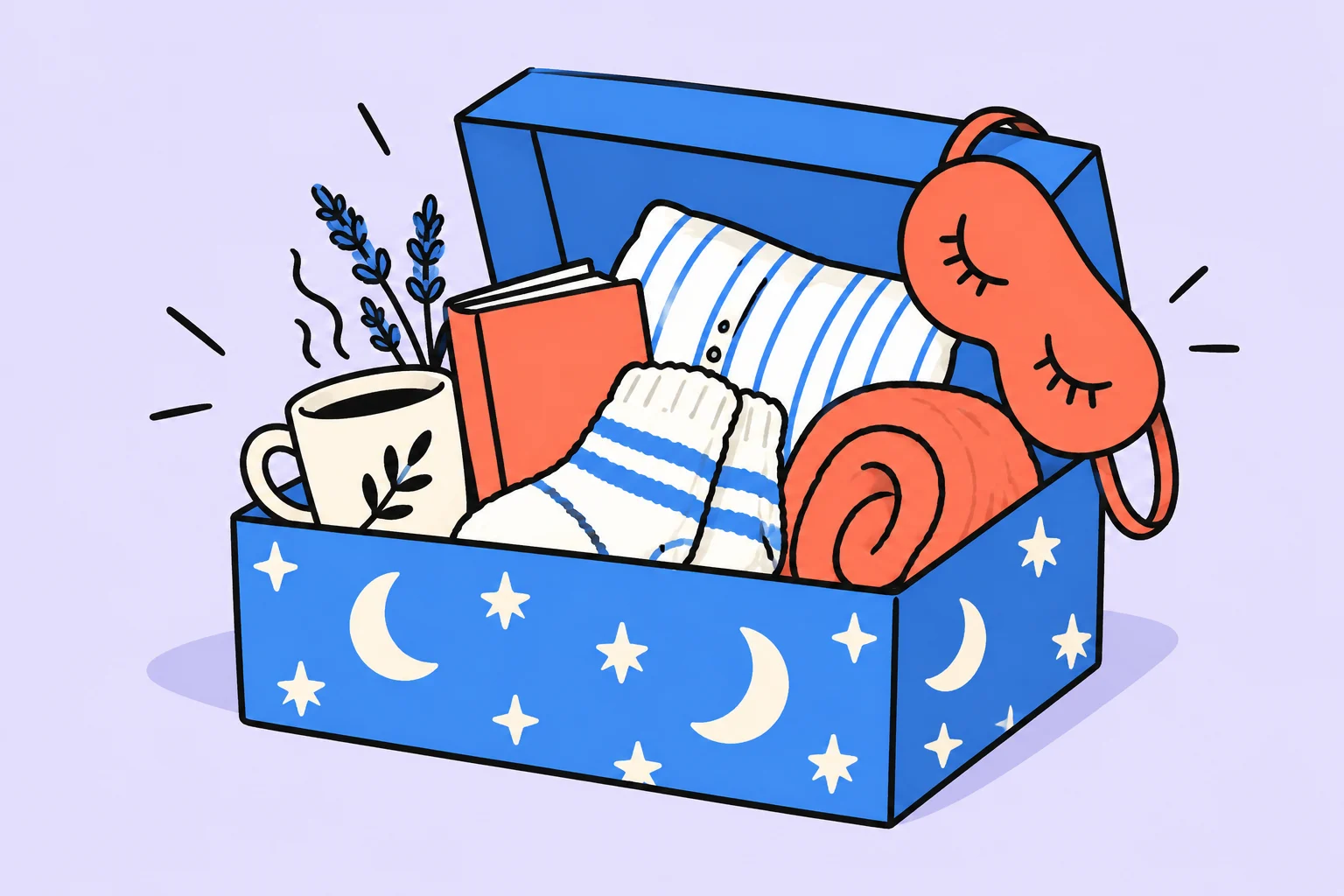
The quality of your morning is determined the evening before. Research from the Stanford sleep center shows that people with consistent evening rituals fall asleep 40% faster and get 25% more deep sleep. If morning rituals launch a productive day, evening bedtime habits provide full recovery.
Chronic sleep deprivation is a twenty-first-century epidemic. According to the CDC, one in three adults sleeps less than 7 hours. Matthew Walker's UC Berkeley research found that 6 hours of sleep impair cognition as much as two days of complete wakefulness. Evening rituals are the simplest, most accessible way to improve sleep quality without pills or supplements.
faster sleep onset among people with evening rituals
more deep sleep with a consistent evening routine
melatonin suppression from screen blue light
Sleep science: why evenings decide everything
Sleep is not a passive process, but a complex sequence of phases, each with its own function. N3, deep sleep, handles physical recovery and immune strengthening. REM sleep handles memory consolidation, learning, and emotional regulation. Healthy sleep includes 4-6 complete 90-minute cycles.
An evening ritual primarily affects sleep latency, the time between lying down and falling asleep. Normally this is 10-20 minutes. Falling asleep instantly probably indicates chronic sleep deprivation. Taking over 30 minutes means your evening is not preparing the brain for rest. Appropriate bedtime habits shorten latency and increase deep sleep's share.
The key mechanism is “adenosine sleep pressure.” Adenosine accumulates in the brain throughout the day: more adenosine means a stronger urge to sleep. Caffeine blocks adenosine receptors, masking fatigue. Your last coffee should therefore be no later than 14:00: caffeine's half-life is 5-7 hours, and complete clearance takes up to 12 hours.
Stanford research found that a consistent evening ritual of 3 or more actions in a fixed order forms a conditioned response: the body starts producing melatonin before sleep onset. The effect appears after 2-3 weeks of regular practice. Important: actions must be identical and in the same order every evening.
Chronobiology and circadian rhythms
Your body follows an internal clock: the hypothalamus's suprachiasmatic nucleus regulates the 24-hour sleep-wake cycle. Circadian rhythms synchronize with external cues: light, temperature, meals, and social interaction. An evening ritual is a powerful “zeitgeber,” a synchronizer telling the brain: “The day is over; prepare for sleep.”
Melatonin, the sleep hormone, starts being produced 2 hours before your usual sleep onset, provided lighting decreases. This is DLMO, Dim Light Melatonin Onset. Bright light after DLMO shifts circadian timing later, which is why scrolling in bed gradually pushes bedtime later and later.
Understanding chronotypes matters too. “Larks,” 15-20% of the population, naturally fall asleep at 21:00-22:00; “owls,” 15-20%, after midnight. The remaining 60% are intermediate. Your ritual should respect chronotype: forcing a 22:00 bedtime makes little sense if your biological rhythm targets midnight. But a ritual 60-90 minutes before natural bedtime works for every chronotype.
1. A fixed screen-off time
Blue screen light at 450-495 nm suppresses melatonin production by 50%. But light is only part of the problem. News, social media, and work emails activate the sympathetic nervous system and increase cortisol. The brain switches to “fight or flight” instead of “rest and digest.”
Set a firm rule: no screens for 60 minutes before bed. This is the first and most important bedtime habit. If impossible, start with 30 minutes and increase gradually. Replace scrolling with a paper book, talking with loved ones, or any offline activity.
If avoiding screens is impossible because of work, minimize harm: enable Night Shift or a warm filter, reduce brightness to minimum, and avoid emotionally charged content. Remember: even with a filter, screens delay sleep onset by 15 minutes; a paper book is better.
2. A reflection journal before bed
Write three outcomes from today and three tasks for tomorrow. This unloads working memory: thoughts move from your head to paper, calming the mind. Research published in the Journal of Experimental Psychology found that journaling before bed reduces sleep-onset time by an average of 9 minutes.
The mechanism is simple: unfinished tasks create the “Zeigarnik effect,” keeping the brain thinking about unresolved problems. Writing them down tells the brain: “The task is recorded; we will handle it tomorrow.” This relieves cognitive load and allows relaxation.
Format does not matter: exercise book, notebook, or notes app. Regularity matters. Write for 5-10 minutes: what worked, what did not, and what to do tomorrow. Some add gratitude practice: three things they appreciated today. This further reduces anxiety and shifts the brain into a positive mode.
3. The 4-7-8 breathing technique for falling asleep
Developed by Dr. Andrew Weil and based on ancient pranayama, 4-7-8 breathing means inhaling through the nose for 4 seconds, holding for 7, and slowly exhaling through the mouth for 8. Three or four cycles provide noticeable relaxation.
Why it works: a long exhalation activates the vagus nerve, the main parasympathetic nervous system regulator. Pulse slows by 10-15 beats, blood pressure falls, and muscles relax. Holding the breath raises blood CO₂ partial pressure, further calming the nervous system.
If a 7-second hold is difficult, start with 4-4-6 and increase gradually. Practice lying down with eyes closed. After a week of daily practice, you will notice relaxation beginning in the first cycle: a conditioned response is forming.
4. Prepare for morning the night before
A simple action with a double effect: saving time and decisions in the morning while creating a ritual transition from the day to rest. Prepare clothes, pack your bag, and check tomorrow's schedule. Many successful leaders prepare everything the night before so their morning runs on autopilot.
Psychologically, this closes the day. You physically transfer concerns to tomorrow: they are planned, clothes are ready, and everything is under control. The brain receives the signal: “No more decisions are needed today.” This especially helps anxious people lying awake wondering, “Did I forget...?”
5. Gentle stretching or evening yoga
10 minutes of gentle stretching release muscle tension accumulated during a sedentary workday. Journal of Sleep Research findings showed that moderate bedtime stretching improves subjective sleep quality by 30% and reduces nighttime awakenings.
Important: avoid intense workouts for 2 hours before bed. They raise cortisol and body temperature, hindering sleep onset. Slow stretching instead promotes relaxation. Focus on the neck, shoulders, lower back, and hips, where daily tension accumulates.
A simple evening sequence: standing forward fold for 30 seconds, child's pose for 1 minute, supine twist for 30 seconds per side, legs up the wall for 2 minutes, and corpse pose, shavasana, for 2-3 minutes. The whole ritual takes 7-10 minutes and needs no equipment.
6. The optimal room temperature for sleep
The optimal sleep temperature is 18-20°C. Air the room 30 minutes before bed. National Sleep Foundation (NSF) research shows that above 24°C, deep sleep decreases by 20-30%. Below 12°C, the body spends energy warming itself instead of recovering.
A body-temperature drop of 1-2 degrees is a main sleep-onset trigger. A warm shower 60-90 minutes before bed paradoxically helps: dilated vessels release heat faster, lowering body temperature more quickly. A 2019 Sleep Medicine Reviews meta-analysis confirmed that a warm bath 1-2 hours before bed speeds sleep onset by 10 minutes.
Practical recommendations: in a hot summer apartment, use a fan, light natural-fabric bedding such as cotton or linen, and minimal sleepwear. In winter, avoid overheating the bedroom: a warm blanket in a cool room is better than hot air.
7. Gratitude practice before bed
Three things you are grateful for today. This simple practice from a gratitude journal shifts the brain from anxiety toward positivity. Applied Psychology: Health and Well-Being research found a 25% improvement in sleep quality among people practicing bedtime gratitude for two weeks.
The mechanism: anxious thoughts activate the amygdala, the fear center, while gratitude activates the prefrontal cortex, the rational thinking center. Writing gratitude literally shifts brain activity from fear to calm. fMRI studies confirm that gratitude practice reduces amygdala activity by 13%.
Important: be specific. Instead of “I am grateful for my family,” write “I am grateful that my daughter made me laugh at dinner today.” Specificity activates emotional memory and strengthens the effect. After a month, the brain starts noticing reasons for gratitude throughout the day.
8. Herbal tea as an evening ritual
Chamomile tea is among the most studied natural sleep aids. Apigenin, a chamomile flavonoid, binds to the brain's benzodiazepine receptors and has a mild sedative effect. A randomized trial found that 270 mg of chamomile extract twice daily improve sleep quality in people with chronic insomnia.
Other useful herbs: valerian, reducing sleep-onset time by 15-20 minutes; passionflower, improving subjective sleep quality; and lavender, reducing anxiety. Peppermint tea is not recommended: menthol can cause heartburn when lying down.
Brewing tea is itself a mini-ritual. Boiling water, steeping, and drinking slowly reduce the evening's pace and signal a transition to rest. Avoid caffeinated drinks such as black or green tea, cola, and cocoa after 14:00.
9. Meditation before bed
Even 5-10 minutes of mindful meditation reduce anxiety and speed sleep onset. JAMA Internal Medicine research found that mindfulness meditation improves sleep quality in people with insomnia as well as specialized therapy, CBT-I.
The simplest technique: lie down, close your eyes, and focus on breathing. Count exhalations from 1 to 10, then restart. When thoughts wander, as they will, gently return attention to breathing. Observe thoughts like clouds in the sky instead of fighting them.
An alternative is a body scan: sequentially relax body parts from toes to crown, allowing 3-4 breaths per area. Usually you never reach the head: most people fall asleep around the abdomen. That is the goal, rather than failed meditation.
10. An audiobook or podcast for falling asleep
A monotonous voice helps disconnect from intrusive thoughts. The brain shifts from inner dialogue to an external stimulus, gradually loses focus, and falls asleep. The key: set an automatic shutoff timer for 15-20 minutes.
Choose calm content: fiction, popular science, or stories. Avoid thrillers, news, and business podcasts calling for action: they activate the brain instead of relaxing it. Keep volume minimal, audible without straining.
Important limitation: do not wear headphones all night, which can cause ear infections or discomfort. Use an external speaker with a timer or special flat sleep headphones. If you consistently fall asleep within 10-15 minutes, the audiobook worked.
An evening ritual minute by minute: a step-by-step plan
An ideal evening ritual lasts 60-90 minutes. Adapt the plan below to your schedule. Sequence is key: identical actions in the same order every evening create a conditioned sleep response within 2-3 weeks.
21:00 — Screens off
Put the phone in another room or enable “Do not disturb.” Turn off the television and computer. If you need an alarm, set it now and leave the phone alone afterward.
21:05 — Brew herbal tea
Chamomile, valerian, or peppermint tea without caffeine. Brewing itself is a mini-ritual of slowing down.
21:15 — Reflection journal
Three outcomes from today, three tasks for tomorrow, and three gratitudes. 5-10 minutes of writing unload the brain and close “open tabs” in your head.
21:30 — Warm shower
A warm, not hot, shower for 5-10 minutes. It dilates blood vessels, allowing faster heat release afterward and speeding sleep onset.
21:45 — Stretching or yoga
10 minutes of gentle stretching: forward folds, twists, and child's pose. Releases the day's physical tension.
22:00 — Reading or meditation
15-20 minutes of paper-book reading or body scan meditation. The final transition toward sleep.
22:15-22:30 — Sleep
A dark, cool room. 4-7-8 breathing, and you fall asleep.
Evening habits for stress and anxiety
Stress and anxiety are sleep's main enemies. Cortisol, the stress hormone, directly suppresses melatonin. After a stressful day, the standard ritual may be insufficient: add extra relaxation techniques.
Progressive muscle relaxation (PMR). Alternate tensing and relaxing muscle groups: feet, with 5 seconds of tension and 10 seconds of relaxation; calves; thighs; buttocks; abdomen; chest; arms; shoulders; and face. Developed by Edmund Jacobson, the method is proven to reduce sleep-onset time by 20 minutes in people with stress-related insomnia.
The “worry dump” technique. Write everything worrying you on paper, without censoring or solving it. Simply unload thoughts. Then close the notebook and say: “I will handle this tomorrow.” Research shows that externalizing anxiety, moving it from head to paper, reduces rumination by 35%.
Lavender. Lavender essential oil is one of the few natural remedies with a proven sedative effect. Put 2-3 drops on the pillow or use a diffuser. A 2019 meta-analysis found that inhaling lavender before bed improves sleep quality by 15% and lowers anxiety. If you dislike lavender, try cedar or sandalwood.
More on tackling stress appears in our guide to stress management.
What you must avoid before bed
Knowing what to do matters, but knowing what to avoid matters even more. These habits destroy sleep quality:
Caffeine after 14:00. Caffeine's half-life is 5-7 hours. Coffee at 16:00 means 50% remains in the blood at midnight. Black tea, green tea, cola, energy drinks, and cocoa also contain caffeine. Even chocolate: 20 mg in a milk chocolate bar and 80 mg in dark chocolate.
Alcohol. Contrary to the myth, alcohol worsens sleep. It helps you fall asleep faster but suppresses REM by 20-40% and fragments the night's second half. Two glasses of wine at dinner reduce sleep's restorative potential by 24%, according to a 2018 RISE study.
Heavy meals. Fatty, spicy, or large meals 2-3 hours before bed raise body temperature, cause heartburn, and make the digestive system work instead of resting. For a snack, choose tryptophan-containing foods: bananas, almonds, turkey, or kefir.
Intense workouts. Cardio or strength training within 2 hours of bed raise cortisol and body temperature for 1-2 hours, the opposite of what sleep onset needs. If evening is your only workout opportunity, finish at least 3 hours before bed and prefer yoga or gentle stretching.
Work tasks and news. Checking work email, news, or financial reports activates analytical thinking and increases anxiety. Set a “no work after dinner” rule. If work thoughts persist, write them in the journal and close it.
A simple evening formula: 10 hours before sleep, last caffeine. 3 hours, last food and alcohol. 2 hours, last work. 1 hour, last screen. 0, times you press snooze in the morning.
Creating the ideal sleep environment
The bedroom should be associated exclusively with sleep and intimacy. Avoid working, eating, or watching television in bed. Give the brain a clear signal: bed = sleep. This is the “stimulus control” principle recommended by the American Academy of Sleep Medicine.
Darkness. Invest in blackout curtains: any light, even dim light at 5-10 lux, suppresses melatonin. Cover device LEDs with opaque tape. If you need a nightlight for a child or nighttime bathroom trips, use dim red or orange light, not white or blue.
Quiet. Noise above 40 dB disrupts sleep structure even without waking you. On a noisy street, use polyurethane foam earplugs reducing noise by 25-33 dB, or a white/pink noise generator. Pink noise is particularly effective: Northwestern University research found a 23% increase in deep sleep.
Mattress and pillow. An old mattress, over 7-8 years, may cause poor sleep. Oklahoma State University research found that replacing a mattress reduces back pain by 57% and improves sleep quality by 60%. A pillow should keep the cervical spine neutral, neither too high nor too flat.
Remove one optional late task and prepare a short end-of-day routine. Create a task in Sinqly; registration is free.
Evening rituals for children and teenagers
Children and teenagers need evening rituals even more than adults. Schoolchildren require 9-11 hours of sleep, teenagers 8-10. Teenagers' circadian rhythms naturally shift 1-2 hours later: they are biological “owls,” so forcing a 15-year-old to bed at 21:00 is pointless.
For children aged 6-12: screens off 60 minutes beforehand, a warm bath, reading with a parent, and a brief conversation about the day. For teenagers, agree on a phone handover time, such as leaving it charging in another room at 22:00. Suggest alternatives: an audiobook, paper journal, or stretching.
American Academy of Pediatrics research found that teenagers surrendering phones an hour before sleep slept 21 minutes longer and had 30% better attention at school. Set a family “digital curfew” and follow it yourself: parental example is stronger than prohibitions.
Evening rituals and bedtime eating habits
What and when you eat directly affects sleep quality. Heavy food makes the digestive system work while the body should rest. Harvard Medical School research found that dinner 4 hours before bed instead of 1 hour lowers blood glucose by 18%.
Foods improving sleep: cherries, a natural melatonin source; kiwi, with 2 fruits an hour before bed speeding sleep onset by 35%, according to Asia Pacific Journal of Clinical Nutrition; bananas, containing magnesium + tryptophan; almonds, magnesium + melatonin; turkey, tryptophan, a serotonin and melatonin precursor; and warm milk, containing tryptophan and calcium, with the ritual itself calming.
Foods worsening sleep: spicy food, raising body temperature and causing heartburn; fatty food, slowing digestion by 40-50%; sugar and simple carbohydrates, causing a glucose spike → insulin spike → waking after 3-4 hours from hypoglycemia; and chocolate, containing the stimulants caffeine and theobromine.
Ideal strategy: a light dinner 3 hours before bed, combining protein + vegetables + complex carbohydrates. If you need a snack, have a small 150-200 kcal portion of tryptophan-containing food 1-1.5 hours before bed. Read more about healthy eating for busy people.
Evening rituals on weekends and vacation
The most common mistake is abandoning the ritual on weekends: “I am on vacation; I can relax.” But circadian rhythms take no days off. “Social jet lag,” a sleep-timing difference exceeding 2 hours between weekdays and weekends, increases metabolic disorder risk by 11% and raises body mass index.
On weekends, going to bed and waking 30-60 minutes later is acceptable. But keep the basic ritual: screens off, journal, breathing. While traveling, adapt it: no bath means a warm shower; no journal means one quick phone note; no quiet means earplugs.
For time-zone changes, start adapting 2-3 days before flying: shift bedtime by 30 minutes toward the new zone daily. On arrival, use morning sunlight to synchronize circadian rhythms and follow the ritual in local time from day one.
Creating your own evening ritual: practical tips
You need not introduce all 10 bedtime habits. Choose 3-5 that resonate and do them in the same order every evening. Sequence is critical: it creates automaticity. After two weeks, your brain starts relaxing automatically at the first step.
Start minimally: screens off + journal + 4-7-8 breathing. These three habits take 15-20 minutes and deliver maximum effect. Once automatic, after 2-3 weeks, add stretching and herbal tea. Another month later, add meditation and gratitude.
Use a habit tracker to monitor progress. Mark each ritual step completed every evening. After a month, you will see a correlation: full-ritual days bring significantly better sleep and morning well-being. This motivates continued practice.
Do not idealize the ritual. Sometimes you will arrive home late and tired and only do 4-7-8 breathing. That is normal. The rule is never to skip entirely. Even a shortened ritual beats nothing. Preserve the sequence: the brain responds to the pattern even when abbreviated. Read more about how to keep a habit goingin our separate guide.
Evening rituals for shift work
Around 20% of workers work nights or rotating shifts. The standard evening ritual does not fit, but the principles remain: create a conditioned sleep response regardless of time of day.
Darkening the room. Critical for daytime sleep: use blackout curtains, a sleep mask, and white noise. Daylight suppresses melatonin, so total darkness is a necessity.
A shortened ritual. After a night shift, energy is low. Shorten the ritual to 15 minutes: shower, 4-7-8 breathing, earplugs/mask, and sleep. Avoid checking your phone or turning on television “for a minute.” Fall asleep as quickly as possible while adenosine pressure remains high.
Melatonin. For shift work, taking melatonin, 0.5-3 mg, 30 minutes before planned sleep may help synchronize circadian rhythms. Always discuss dosage with a doctor: melatonin regulates timing rather than acting as a sleeping pill.
How evening rituals affect productivity and health
Evening rituals affect more than sleep. Quality sleep supported by a good evening has cascading benefits throughout life. Walker research (2017) found that after full sleep, creativity rises by 33%, problem-solving speed by 40%, and emotional regulation by 60%.
Physical recovery. Growth hormone is mainly produced during deep sleep, N3. It handles muscle recovery, skin cell renewal, and bone strengthening. If you exercise but sleep poorly, workout results decrease by 30-40%.
Immunity. One sleep-deprived night, 4 hours instead of 8, reduces activity of NK, natural killer, cells, the main fighters against viruses and cancer cells, by 70%. Chronic sleep deprivation increases cold risk 4 times. An evening ritual providing 7-9 hours of quality sleep is among the best immune boosters.
Weight control. Sleep deprivation raises ghrelin and lowers leptin: you are literally hungrier and feel less satisfied. Research found that people sleeping under 6 hours consume 385 kcal more daily, equivalent to 18 kg of potential weight gain annually. How sleep affects productivity explores this topic in detail.
Frequently asked questions about evening rituals
How long before bed should you start an evening ritual?
Ideally, start 60-90 minutes before planned bedtime, allowing cortisol to fall, melatonin production to begin, and relaxation to start. The minimum is 30 minutes, but a longer ritual significantly improves sleep quality. If time is short, do at least three steps: screens off, 4-7-8 breathing, and gratitude.
Which bedtime habits are most effective?
Research suggests the greatest effects come from screens off 60 minutes before bed, reducing melatonin suppression by 50%; 4-7-8 breathing, lowering pulse by 10-15 beats; and journaling, speeding sleep onset by 9 minutes. Combining 3-5 habits in a fixed order creates a conditioned sleep response within 2-3 weeks.
Why should you avoid your phone before bed?
Screens emit blue light at 450-495 nm, suppressing melatonin by 50%. Content also activates the sympathetic nervous system. Even in night mode, screens delay sleep onset by 15-30 minutes. The best alternatives are paper books, audiobooks, or meditation.
Does a warm shower before bed help?
Yes, a 2019 Sleep Medicine Reviews meta-analysis found that a warm shower or bath 60-90 minutes before bed speeds sleep onset by 10 minutes. Warm water dilates vessels, allowing faster heat release afterward. Body temperature falls, the main sleep-onset trigger.
What if I cannot fall asleep even with a ritual?
If you do not fall asleep within 20 minutes, get up and do something calm in dim light. Return when sleepy. This is “stimulus control”: bed should mean sleep. If the problem is chronic, exceeding 3 weeks, consult a sleep specialist.
After how many days will an evening ritual work?
A conditioned response develops after 2-3 weeks of regular practice. Initial improvements appear after 3-5 days, but a lasting effect emerges by day 14. The key: identical actions in the same order every evening, without exceptions.
Do I need an evening ritual if I fall asleep in 5 minutes?
Instant sleep onset may indicate chronic sleep deprivation rather than good sleep. Normal latency is 10-20 minutes. An evening ritual improves sleep depth, REM amount, and morning well-being alongside onset speed. It therefore benefits everyone.
Was this helpful?
Rate the article and tell us what was missing. Your feedback goes to the Sinqly team and will not be published on the site.
How to start waking up early: a 30-day plan
A step-by-step plan for switching to an earlier wake-up time in 30 days. The science of circadian rhythms, chronotypes, nutrition, melatonin, morning habits, and a challenge.
How habits change the brain: habit neuroscience in simple terms
What happens in the brain when we form habits? The basal ganglia, myelination, dopamine, and the habit loop: neuroscience explained accessibly.
How to improve sleep quality: a scientific approach
Science-based ways to improve sleep quality: chronobiology, sleep hygiene, evening rituals, sleep tracking, and habits for healthy rest. A practical guide from Sinqly.