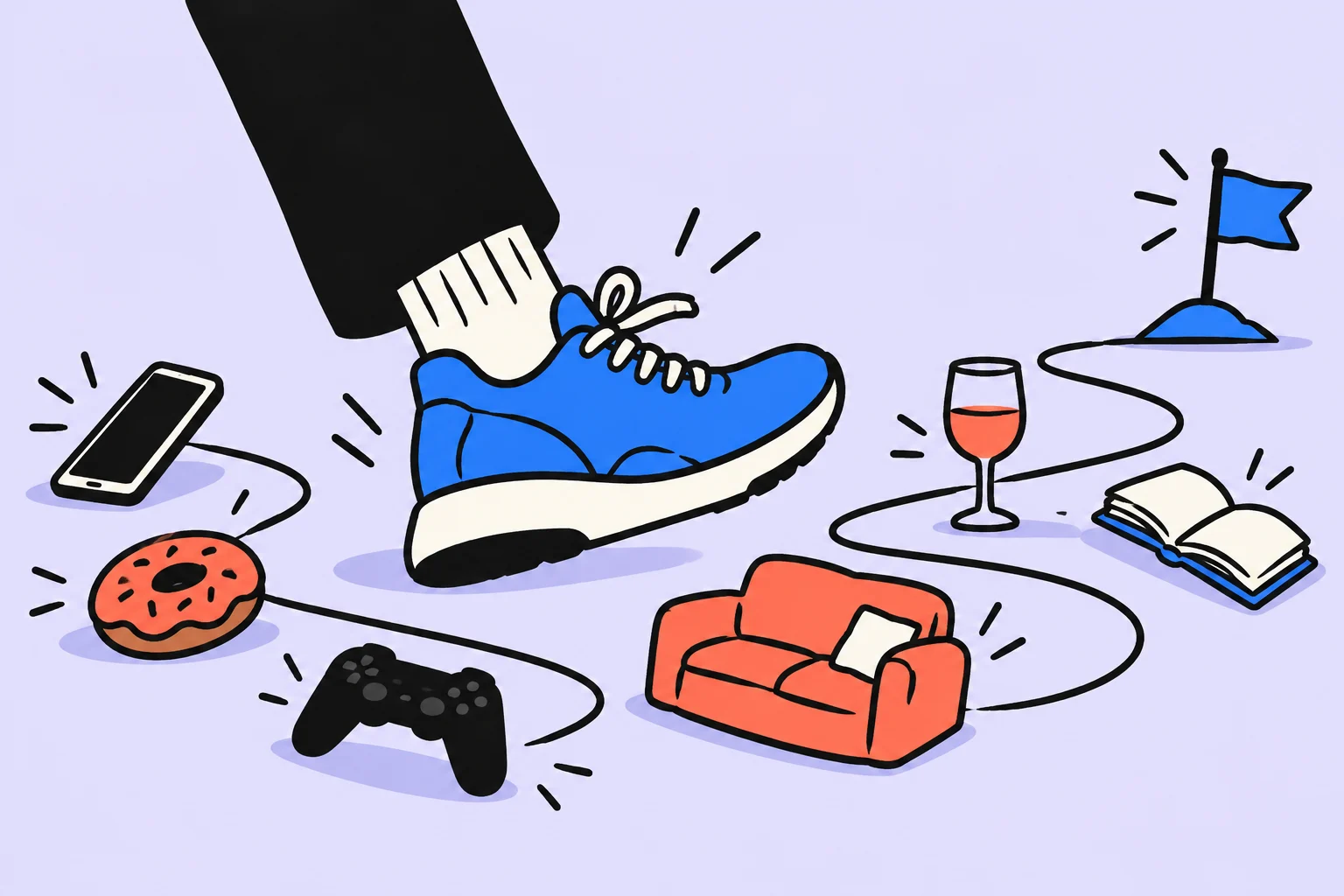
The statistics are discouraging: 80% of people abandon new habits within the first two weeks. By the third month, fewer than 10% remain. Sound familiar? You become excited about running, meditating, reading, or journaling, but after a couple of weeks your enthusiasm fades, missed days accumulate, and the habit quietly dies. The problem is not you, laziness, or weak willpower; it is the strategy.
Neuroscience and behavioral psychology from the past 20 years offer specific tools that increase the chances of success 3-5 times. In this article, we explore why habits lapse, which brain mechanisms work against you, and how to use 8 scientifically proven strategies to keep a habit going even when motivation is at zero.
of people abandon habits within the first 2 weeks
is the average time needed to form a habit (UCL)
higher chances of success with the right strategy
Why we abandon habits: the neuroscience of lapses
A habit's main enemy is not laziness but a mismatch between expectations and reality. We expect quick results, while changes remain invisible for weeks. James Clear, author of Atomic Habits, calls this the “Valley of Disappointment”: a period when you are putting in effort but have not yet seen results. This valley is where 80% of habits die.
Here is what happens in the brain: when you start a new habit, the prefrontal cortex, responsible for conscious decisions, works at full capacity. Every repetition takes willpower. Over time, control should shift to the basal ganglia, the automatic “pilot” that performs an action without conscious effort. But this transition takes time. According to a University College London study (Phillippa Lally, 2009), it takes between 18 and 254 days, with an average of 66.
The problem is that motivation is a short-term resource. It burns brightly in the first few days and inevitably fades. If your strategy for maintaining a habit relies on motivation, it is doomed. You need a system that works whether you “feel like it” or not. The following sections explain these systems.
Phillippa Lally and her UCL team found that habit formation takes between 18 and 254 days, with an average of 66 days. Their key finding: one missed day does not affect the eventual outcome. Overall consistency matters, rather than absolute perfection. This debunks the scientifically unsupported “21 days” myth.
Strategy 1: The two-minute rule — avoid slipping up at the start
Every habit should begin with a version that takes less than two minutes. “Read for 30 minutes” becomes “open a book and read one page.” “Run 5 km” becomes “put on running shoes and step outside.” “Meditate for 20 minutes” becomes “sit down and take 3 deep breaths.” Sound ridiculous? That is exactly where its power lies.
Psychology explains that the hardest part of any action is starting. The inertia of staying still is enormous. But once you start, continuing becomes much easier. Someone who puts on running shoes and steps outside has a 90% chance of running for at least 10 minutes. Someone who opens a book will read more than one page.
Important: for the first 2-3 weeks, genuinely limit yourself to two minutes. Resist the temptation to say, “Since I have started, I might as well do the full version.” At this stage, the goal is to build the “trigger → action” neural pathway rather than achieve results. Once that pathway is stronger, increase the amount gradually: 2 minutes → 5 minutes → 10 minutes → the full version.
Strategy 2: Connect it to a trigger (habit stacking)
Do not rely on memory or motivation. Attach the new habit to an existing action: “After I pour my coffee, I meditate for 2 minutes.” “After I brush my teeth in the morning, I do 10 squats.” “After I sit down at my desk, I write down my 3 main tasks for the day.”
This method is called “habit stacking” and works because it uses existing neural pathways. Your brain already automatically pours coffee every morning, so the trigger is strong and reliable. Attaching a new action lets you piggyback on an existing habit instead of building from scratch.
The stacking formula: “After [current habit], I [new habit].” Choose a trigger that happens every day at the same time and place. “After lunch” is a poor trigger, because lunch happens at different times. “After I put my plate in the sink after lunch” is a good trigger, because it is a specific action.
Strategy 3: Change your environment — choice architecture
Environment is the most underestimated factor in maintaining habits. Research by Wendy Wood at the University of Southern California found that people who move to a new city find it easier to change habits, because their old environment no longer triggers old patterns. You do not need to move: rearranging your space is enough.
Want to read? Put a book on your pillow. Want to drink water? Put a bottle on the desk in front of you. Want to scroll social media less? Remove the apps from your home screen. Want to exercise? Prepare your clothes the night before and put a mat in the middle of the room. Your environment should make good behavior easy and bad behavior difficult.
The “one-time decision” technique means taking one action that keeps working repeatedly. Unsubscribe from newsletters to remove hundreds of temptations, delete the food delivery app to remove a daily temptation, or buy a gym membership close to home to minimize the barrier. Each decision reshapes your environment in your favor for months ahead.
Strategy 4: Visual progress and habit streaks
The brain likes to see progress. Tracking habits with a tracker creates a visual chain you do not want to break. This is called the streak effect , a psychological mechanism in which a long sequence of repetitions becomes a motivation in its own right.
Why do streaks work? There are three psychological mechanisms. First, the sunk cost effect: “I have already done 23 days in a row; it would be a shame to lose them.” Second, visual pleasure: the brain gets a microdose of dopamine from seeing a growing chain of checkmarks. Third, identity: after 30 days of meditation, you start seeing yourself as “a person who meditates” instead of “a person trying to meditate.” This is a fundamental shift.
Even a simple paper calendar with crosses is more powerful than it seems. Jerry Seinfeld used exactly this method to write jokes every day. His “chain of crosses” became a famous productivity strategy.
Strategy 5: The “never miss twice” rule
One miss is an accident. Two in a row are the beginning of a new pattern. This is perhaps the most practical rule for maintaining a habit. You were ill, tired, forgot, or had a crisis at work: one miss is acceptable. But the next day, you must perform the habit, even in its smallest version.
If you missed Monday's workout, do something on Tuesday: 5 push-ups, a 10-minute walk, or one stretch. This maintains your identity as “a person who exercises” and prevents a pattern of skipping from forming. Neuroscience confirms that two consecutive misses begin to establish a competing habit: the habit of NOT doing it.
Practical tip: prepare a “minimum plan” for bad days in advance. Full version: 30 minutes of running. Minimum plan: 5 minutes of walking. Full version: 20 minutes of meditation. Minimum plan: 3 deep breaths. When a bad day arrives, you do not debate “do it or not”: you automatically switch to the minimum.
Strategy 6: Social commitment and accountability
Tell a friend about your habit or find a habit partner. An American Society for Training and Development (ASTD) study found that the probability of achieving a goal is 65% if you tell someone about it, and 95% if you have regular meetings with an accountability partner.
Why does accountability work? Social pressure is a powerful motivator. Humans are evolutionarily programmed to care about their reputation within a group. When you know someone will ask “How is the habit going?”, skipping becomes much harder. This is not manipulation: it uses natural social psychology to your advantage.
Forms of accountability include a habit partner, with daily check-ins by message; a group of like-minded people, with weekly meetings; a public journal, such as a blog or social network; or an AI coach, with automated daily check-ins. An AI coach is especially convenient: it will not forget to ask, get tired, or judge you for a missed day, and it will suggest a constructive solution instead of lecturing you.
An interesting fact: the effectiveness of accountability depends on the relationship. A Dominican University of California study found that people who reported their progress to a friend weekly achieved their goals 76% more often than those who simply wrote them down. The report need not be formal: a short message is enough, such as “Hi, week 5: 6 out of 7 days done.” The very fact that someone is expecting your report changes behavior.
Strategy 7: Immediate rewards
The brain forms habits through dopamine. Evolution has programmed us to repeat actions that deliver quick pleasure and avoid those with delayed rewards. The problem with many useful habits is that their reward is delayed: you run today but see results in the mirror in 3 months. The brain struggles to value such distant prospects.
The solution is to add immediate enjoyment to the habit. Listen to your favorite podcast only while running. Have delicious coffee only after meditation. Watch an episode of your favorite show only on the treadmill. Connect “have to” with “want to.” This is called “temptation bundling,” and research by Katy Milkman at the Wharton School supports its effectiveness.
Create a layered reward system: small rewards for daily completion, such as a tracker checkmark or delicious tea; medium rewards for weekly streaks, such as a film or a new book; and large rewards for monthly achievements, such as a massage, a gadget, or travel. Important: a reward must not contradict the habit. Cake for a week without sweets is counterproductive.
Another powerful technique is “reward preloading.” Instead of rewarding yourself after the habit, create anticipation of the reward beforehand. Plan a hot bath after your workout. Visualize the reward before starting. Studies show that anticipation activates the dopamine system even more strongly than receiving the reward itself. The brain starts associating the habit with pleasure before you perform it.
Strategy 8: Identity instead of results
This is the most powerful and profound strategy. Instead of “I want to run,” say “I am a runner.” Instead of “I want to read,” say “I am a reader.” Instead of “I am trying to meditate,” say “I practice mindfulness.” When a habit becomes part of your identity, the question of motivation disappears.
Runners run because it is part of who they are, rather than because they feel motivated. Musicians practice because “I am a musician, and musicians practice,” rather than because they “have to.” Shifting from “I want to do X” to “I am someone who does X” is a quantum leap in habit sustainability.
How do you make this shift? Every repetition of a habit is a vote for your new identity. 30 days of meditation = 30 votes for “I am someone who meditates.” Over time, the evidence reaches critical mass and your identity changes. Successful people's habits work in exactly this way: leaders do not “force themselves” to read or exercise. It is part of how they see themselves.
Scientific models of habit sustainability
Beyond practical strategies, understanding scientific models that explain habit sustainability is useful. Three key models provide a systematic understanding.
The habit loop model (Charles Duhigg). Every habit has three elements: a cue or trigger, a routine or action, and a reward. All three must work consistently to maintain a habit. An unstable trigger means you forget it. An overly complicated action demands too much effort. An imperceptible reward means it never sticks. Diagnose the weak element and strengthen it.
Self-determination theory (Deci and Ryan). Habits last when they meet three basic needs: autonomy, “I chose this habit myself”; competence, “I can feel progress”; and relatedness, “the habit connects me with people or something important to me.” Externally imposed habits, such as “the doctor said so,” are harder to maintain than internally motivated choices. That is why finding your own “why” matters.
The identity transformation model (James Clear). There are three levels of change: outcome, “I want to lose weight”; process, “I want to eat well”; and identity, “I am a healthy person.” Most people start with outcomes and move toward identity. Clear suggests starting with identity: first decide who you want to become, then choose habits that reinforce that identity. Every repetition is a vote for your new self.
Take a habit you abandoned in the past. Answer three questions: 1) What was the trigger? If there was none, that explains the lapse. 2) What reward did I get? If the answer is “none right now,” that explains the lapse. 3) Whose identity did this habit reinforce? If no answer comes to mind, you first need to choose an identity. Knowing the weak link lets you strengthen it specifically.
The psychology of habit lapses: three enemies of consistency
To keep a habit, you need to understand why lapses happen. Neuroscience identifies three key mechanisms working against you, each with an antidote.
Willpower exhaustion (Ego Depletion). Psychologist Roy Baumeister demonstrated that self-control is a limited resource. Every decision throughout the day uses it: choosing a healthy breakfast, resisting social media, or holding back irritation with a colleague. By evening, the “self-control tank” is empty. That is why evening habits fail more often than morning ones: by the end of the day, you literally lack the energy for extra effort.
The solution: schedule your most important habits in the first half of the day, when self-control is at its highest. Or simplify evening habits to the absolute minimum. A habit calculator can help calculate an appropriate workload.
Decision Fatigue. When your tracker contains 15 habits, every day begins with 15 decisions: do it or not. This is paralyzing. Steve Jobs wore the same clothes to minimize decisions and preserve resources for important matters, rather than out of eccentricity. For habits, automate everything you can. Link habits to a specific time and place to remove the element of choice.
Lapse triggers. Everyone has particular situations that trigger a lapse. For some, it is stress; for others, travel; for others, weekends. An AI coach analyzes patterns in your missed days and identifies triggers you might not notice yourself. For example: “You skip meditation 73% of the time when you went to bed after midnight the previous night.” Knowing the trigger lets you create a preventive strategy.
Habits and stress: avoiding lapses under pressure
Stress is the main killer of habits. Under pressure from deadlines, family problems, or financial difficulties, the brain switches to “survival mode.” The prefrontal cortex, responsible for long-term planning and habits, gives way to the amygdala, which responds to threats. In this state, the brain returns to familiar, tested patterns, even harmful ones.
That is why stress brings people back to smoking, comfort eating, and procrastination. Old habits are the brain's “comfort zone,” proven ways to reduce anxiety. A new habit is not yet deeply rooted enough to compete.
Prepare a “stress plan” in advance: a list of 3-5 micro-versions of your habits
During stressful periods, switch to micro-versions: 5 minutes instead of 30
Let go of “all or nothing”: even 2 minutes count
Add one “anti-stress” habit: 4-7-8 breathing, walking, or stretching
After the stressful period, gradually return to the full versions of your habits
Do not criticize yourself for reducing the intensity: adapting under pressure is a sign of maturity
Research found that people with a prepared “plan B” for stressful periods maintained habits 40% longer. The key is adapting the habit to current conditions rather than fighting stress. Procrastination under stress is a protective mechanism of the brain rather than laziness. Recognize this and work with it instead of against it.
When to change a habit instead of maintaining it
Sometimes the right decision is to change a habit or replace it with another. Not every lapse is a failure. Sometimes it signals that the habit does not suit you.
Signs that a habit needs changing include chronic stress rather than temporary discomfort; no enjoyment even after a month of practice; choosing it out of “should” with no internal “want”; or life circumstances changing so much that it is no longer relevant. In these cases, stop, analyze, and choose an alternative.
Example: you decide to run every morning but hate running. After 3 weeks of heroic persistence, you lapse. The problem is your choice of habit rather than the strategy. Replace running with something that suits you: swimming, yoga, dancing, or cycling. The goal is “30 minutes of physical activity,” whatever its specific form. Flexibility in form with consistency in substance is a wise approach to habits.
Myths about maintaining habits that hinder progress
Myth 1: “You need iron willpower.” In fact, people with better self-control use willpower less often. Research found that they structure their environment and automate behavior better, avoiding situations that demand willpower. Instead of training willpower, build systems that make it unnecessary.
Myth 2: “21 days and the habit is established.” This myth dates back to a 1960 book by plastic surgeon Maxwell Maltz. He noticed that patients needed 21 days to get used to a new face. Behavioral habits are a different matter. Actual UCL data: between 18 and 254 days, averaging 66. Underestimating the timeline leads to premature despair.
Myth 3: “If I lapse, I have to start from zero.” No. Your progress is not reset. Neural connections formed over weeks of practice do not disappear after one miss. They weaken during a long absence of practice, but resuming after a break is always easier than starting for the first time. The brain “remembers” the pattern.
Myth 4: “A habit has to be pleasant.” Not necessarily. Some useful habits are uncomfortable: cold showers, early mornings, or difficult conversations. A habit should be meaningful to your identity, making discomfort acceptable. “I am someone who takes cold showers” turns discomfort into a source of pride.
Combining strategies: building a habit maintenance system
Combining several approaches produces the greatest effect. Here is how to build a system from these strategies for the habit of “daily reading”:
Start with a micro-version: “read 1 page” (strategy 1). Attach it to a trigger: “after I get into bed at night” (strategy 2). Change the environment: “the book is on my pillow” (strategy 3). Track progress: “mark it in a tracker” (strategy 4). Apply the rule of two: “if I missed yesterday, I must read today” (strategy 5). Tell a friend: “I now read every evening” (strategy 6). Add a reward: “I only read interesting books” (strategy 7). Adopt the identity: “I am a reader” (strategy 8).
This approach turns willpower from a necessity into a bonus: the system works even on bad days. You do not need all 8 strategies for every habit. Choose 3-4 that address your weak spots. If you forget, strengthen the trigger. If boredom makes you quit, add a reward. If you lose motivation, work on identity.
Habit tracker
Visualize progress, build streaks, and get reminders. A visual chain motivates you to keep your streak going.
AI coach for habit maintenance
A personal coach available 24/7 identifies patterns in missed days, suggests adjustments, and keeps you from quietly abandoning a habit.
Progress analytics
Streak charts, completion trends, and insights reveal what works and what needs changing in your habit system.
The role of your social environment in maintaining habits
Social psychology research shows that habits are “contagious.” If your close friends exercise, your likelihood of exercising too increases by 36%, according to a Christakis and Fowler study published in the New England Journal of Medicine. If colleagues snack on sweets, you are very likely to do the same. Your social environment shapes habits more strongly than conscious decisions.
What can you do? Deliberately choose an environment that supports your habits. Join a running club if you want to run. Follow reading channels if you want to read more. Find a community of people with similar goals. Online communities work as well as offline ones: research shows that even virtual accountability significantly improves habit sustainability.
The other side: minimize contact with environments that trigger lapses. If friends invite you for beer every Friday while you are trying to quit alcohol, the issue is your environment rather than willpower. Sometimes changing the environment is the most productive decision. This is a strategy leaders use for building success habits.
Habits and emotional regulation
We often abandon habits because of emotions rather than laziness. Boredom, anxiety, sadness, and irritation all trigger a return to “comfortable” patterns: scrolling social media, overeating, and procrastination. The skill of emotional intelligence , the ability to recognize and manage your emotions, directly affects habit sustainability.
The practical “HALT” technique: before breaking a habit, ask whether you are experiencing Hunger, Anger, Loneliness, or Tiredness. These four states are the main triggers for lapses. If the answer is yes, address the root problem first: eat, rest, or call a friend. Then return to the habit.
Another approach: schedule “emotional buffers,” short practices for regulating mood. Try 5 minutes of 4-7-8 breathing: inhale for 4, hold for 7, exhale for 8; a 10-minute walk outdoors; or writing down three things you are grateful for. These buffers reduce emotional tension and the likelihood of an impulsive lapse.
Technology for maintaining habits: what really helps
The habit app market is enormous, but technologies are not equally useful. Research from Stanford's Behavior Design Lab (BJ Fogg) identifies three technological functions that really work: timely reminders in the right context rather than at random; progress visualization through streaks, charts, and percentages; and feedback through pattern analysis and recommendations.
What does NOT work: gamification for its own sake, because points and badges quickly lose value; overly frequent notifications, which irritate people and get disabled; and complicated interfaces, because if marking a habit takes more than 5 seconds, you will stop doing it. The best tracker requires minimal actions and provides maximum insight.
AI coaching is a relatively new technology showing promising results. Unlike static reminders, an AI coach analyzes your data and adapts the strategy. For example, if AI notices that you skip evening habits after long workdays, it can suggest moving them to the morning. If a streak breaks, AI helps identify the cause and adjust the approach rather than simply stating the fact.
A practical plan: keep a habit going for 90 days
Here is a concrete 90-day plan, approximately the time most habits need to move onto “autopilot.” It considers scientific evidence on habit formation and typical lapse points.
Days 1-14 (the “showing up” phase). Only the micro-version of the habit, 2 minutes. The goal is to build the neural pathway rather than achieve results. Attach it to a trigger. Mark it in your tracker every day. Do not increase the amount, even if it seems “too easy.” These two weeks are when 80% of people lapse; simplicity will protect you.
Days 15-30 (the “building up” phase). Gradually increase the amount: 2 minutes → 5 → 10. No more than double it in a week. Add an immediate reward. Tell an accountability partner. If you miss a day, apply the “never twice” rule.
Days 31-60 (the “Valley of Disappointment” phase). This is the critical period. The novelty has worn off, results are not yet visible, and motivation is at its lowest. Shift your focus from outcomes to identity: “I am someone who has [done X] for 40 days.” Use the streak as motivation. Stabilize the amount instead of increasing it.
Days 61-90 (the “consolidation” phase). The habit starts feeling more automatic. You notice that missing it feels more uncomfortable than doing it. This signals a transition toward automatic behavior. Increase the amount to your target. Prepare a “stress plan” for future difficult periods. Consider your next habit.
Why “all or nothing” fails for habits
Perfectionism is a hidden enemy of habits. “All or nothing” thinking sounds like: “If I cannot run 5 km, I might as well not run at all.” “If I ate a pastry, the diet is ruined, so I can eat anything.” “If I missed three days, the habit is lost, so why continue?” This cognitive distortion, black-and-white thinking, destroys more habits than laziness does.
The truth is that any completion is better than none. 5 minutes of meditation beat 0 minutes. 10 push-ups beat none. One page of a book beats no pages. Every repetition, however small, strengthens the habit's neural pathway and supports your identity. Every miss weakens it.
Switch from binary thinking to a scale: instead of “done / not done,” use “how much did I do?” A day with a 5-minute walk is 5 out of the planned 30 minutes. That is 17%, infinitely more than zero. Sinqly's habit tracker lets you record partial completion, so you see that even “bad” days contribute to overall progress.
90 days is a transition point. The habit becomes “semi-automatic”: severe stress or changed circumstances can still make you lose it. Full automaticity can take up to a year. Keep tracking it and preserve the trigger and environment. After 6-12 months, the habit becomes part of you, like brushing your teeth.
The main rule: adapt your habit to keep it going
If you remember just one idea from this article, let it be this: adapt a habit instead of abandoning it. Cannot run for 30 minutes? Run for 5. Cannot do 5? Walk. Cannot walk? Do 3 squats at home. Cannot squat? Simply put on your exercise clothes and take them off again. Any action toward the habit is better than zero.
A habit is a direction of movement rather than a fixed action. Its form can change and intensity can vary, while the direction remains. “I move” is a habit. “Run exactly 5 km every morning at 6:00” is a rigid rule that breaks at the first change in circumstances.
Flexibility in form with consistency in intention is the secret of people who maintain habits for years. They always find a way to do something, even though they sometimes miss. That “something” on bad days distinguishes them from the 80% who quit for good.
Frequently asked questions
Why do I keep abandoning habits?
The main reasons are overly ambitious goals, taking on too much at once; no connection to a trigger, relying on memory and motivation; an environment working against you; and unrealistic expectations about timing. Building a habit takes an average of 66 days. Most give up earlier because they expect results after 21 days.
What should I do if I miss one day of a habit?
One miss is not critical: UCL research confirmed that an isolated miss does not affect habit formation. Avoiding two consecutive misses is crucial. After a miss, do at least the micro-version of the habit, 2 minutes, to preserve the neural pathway and prevent a pattern of skipping.
How does a habit streak work, and why is it motivating?
A streak engages three psychological mechanisms: the sunk cost effect, reluctance to lose accumulated effort; visual progress, with dopamine from the growing chain; and identity, as a long streak strengthens self-perception. The effect is enhanced by visualization in a habit tracker.
How many days does a habit take to become automatic?
According to University College London, it takes between 18 and 254 days, averaging 66 days. Simple habits, such as drinking a glass of water, form faster; complex ones, such as daily running, take longer. The “21 days” myth lacks scientific support and creates false expectations.
How can I avoid abandoning a habit during a stressful period?
Switch to a micro-version: 5 push-ups instead of a 30-minute workout, or 2 pages instead of an hour of reading. Prepare a “plan B” in advance. Use an “if-then” formula: if stressed, do the minimum version instead of skipping entirely. Reducing intensity is a wise adaptation.
Which habit tracker should I use?
The best tracker is one you actually use every day. Key criteria: streak visualization, timely reminders, simple one-tap completion, and progress analytics over weeks and months.
Can I build several habits at once?
No more than two at a time is recommended. Studies show that attempting 3+ habits at once sharply reduces each one's chance of success because of willpower depletion and decision fatigue. An optimal strategy is one new habit every 4-6 weeks, adding the next only after the previous one becomes automatic.
Turn an idea into action
Was this helpful?
Rate the article and tell us what was missing. Your feedback goes to the Sinqly team and will not be published on the site.
21 Days to Build a Habit: Myth or Reality?
Are 21 days really enough to build a habit? Exploring the UCL study, the neuroscience of automatic behavior and realistic timelines.
How to Stick With a Goal: 8 Strategies and Reviewing Your Plan
How to keep moving toward a goal: manageable steps, support, working conditions and progress reviews. Learn when to change your plan and workload.
A Habit in 21 Days: What the Research Says and How to Start
Why 21 days does not guarantee a habit. The limits of Lally's research, a practical plan and a completed example for tracking actions and missed attempts.