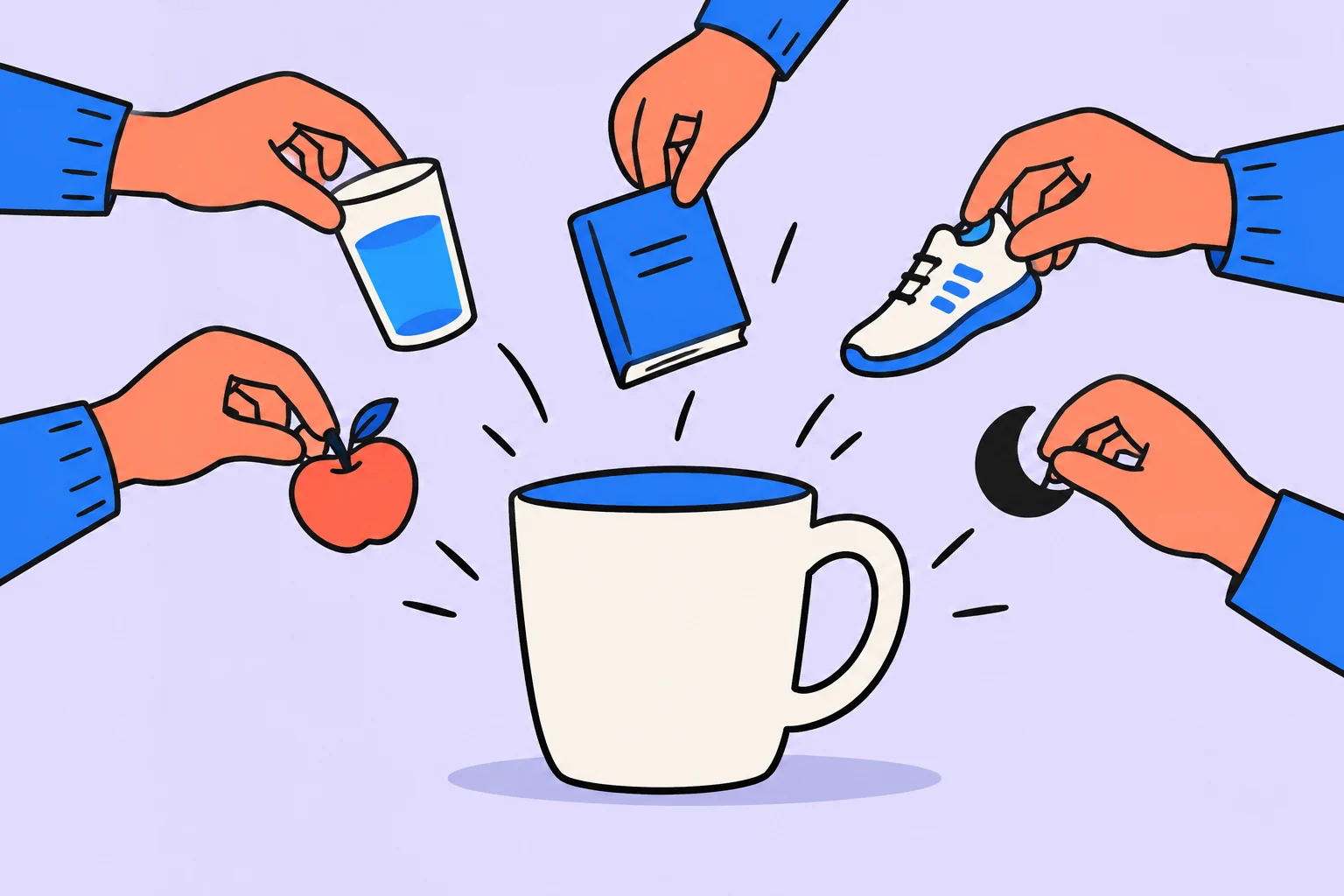
Big ambitions are wonderful but often lead to failure. Deciding to run 10 km, meditate for an hour and learn English from Monday sounds inspiring, but disappointment follows within three days. Micro habits take the opposite approach: start impossibly small and let the system grow naturally. Developed by Professor BJ Fogg at Stanford University, the method has already helped millions change their lives without exhaustion or disappointment.
Time for one micro habit
People maintaining a micro habit after 12 weeks
Pages per year when reading 1 page a day
Faster habit formation when linked to a trigger
What is a micro habit, and why does it work?
A micro habit takes less than 2 minutes and almost no willpower. One push-up. One book page. One minute of meditation. One glass of water. It sounds almost silly, and that is its strength. As James Clear explains in "Atomic Habits", the aim is building an identity rather than achieving a result. You become someone who exercises every day rather than trying to do 50 push-ups.
Small habits follow a fundamental behavioral principle: the simpler an action, the more likely it is to be repeated. Reducing the entry barrier minimizes resistance. Instead of an internal debate about whether you feel like it, you simply act. Each repetition strengthens a neural connection in the basal ganglia, turning conscious effort into automaticity.
A micro habit is a starting point rather than the final goal. You do not begin with one push-up intending to stay there forever. You establish a daily-exercise neural pattern. Once that pattern is established, increasing the activity happens naturally, often without conscious effort.
The science behind micro habits: BJ Fogg's method
BJ Fogg, a Stanford professor and founder of the Behavior Design Lab, spent more than 20 years studying how behavior forms. The Fogg Behavior Model says action occurs when motivation, ability and a prompt coincide. Its formula is B = MAP (Behavior = Motivation × Ability × Prompt).
Most habit approaches rely on motivation: motivate yourself to run daily. But motivation fluctuates with mood, sleep and stress. Fogg's method shifts attention to ability: make the action so easy it requires no motivation.
In a series of experiments, BJ Fogg's team found that micro habits anchored to existing behavior form 3 times faster than those requiring a separate trigger. Among Tiny Habits participants, 91% maintained a new habit after 12 weeks, compared with 20-30% retention in traditional approaches.
The Tiny Habits formula is "After [anchor habit], I will [micro habit], and I will celebrate." An anchor is something you already do automatically each day, such as brushing teeth, brewing coffee or getting into the car. Celebration is an immediate positive emotion, an inner yes, smile or fist pump, reinforcing the neural connection through dopamine.
How to create a micro habit with BJ Fogg's method
Choose your target behavior
Decide which habit to develop, such as starting meditation. Focus on the action itself rather than duration for now.
Make it absurdly small
Reduce it to less than 30 seconds. Meditating for 20 minutes becomes taking one mindful breath. If it feels too easy, you are on the right track.
Find an anchor habit
Identify an existing automatic action that will precede the micro habit: "After putting the kettle on, I will take one mindful breath."
Celebrate immediately
Create a positive emotion right after completion: say "Great!", make a victory gesture or smile. Dopamine reinforces the neural connection.
Avoid forcing growth
Let the habit grow naturally. Do more if you want; otherwise stop at the minimum. Daily consistency matters most.
20 everyday micro habits
Below are 20 established small habits grouped by life area. Each takes less than 2 minutes and can start major change. Choose 1-2 that fit your goals and begin there.
Health and body (1-5)
- One morning push-up. Once you are on the floor, doing 5-10 is easy. Anchor it to getting out of bed.
- A glass of water before every meal. That is 3 glasses daily without effort: 750 ml of hydration on autopilot.
- One minute of stretching before bed. Your body adjusts and wants more. It reduces muscle tension and improves sleep.
- Take the stairs for 1 floor instead of the elevator. Add floors gradually. Improve cardiovascular fitness without a gym visit.
- A 10-second plank. Anchor it before your morning shower. After a month, you will hold it for a minute.
Productivity and career (6-10)
- Write down one task for the day. Choose one main task rather than an entire list. Anchor it to switching on your computer.
- 2 minutes of desk tidying. A clear space supports a clear mind. Anchor it to the end of the workday.
- Turn off notifications for 15 minutes. The seed of deep work. Gradually extend it to an hour.
- Read one page of professional literature. 365 pages a year adds up to 2-3 books.
- Send one thank-you message to a colleague. Strengthens professional relationships and improves your reputation.
Mental health and relationships (11-15)
- Three things you are grateful for. Gratitude journaling in 60 seconds. Research shows a 25% increase in happiness.
- One minute of mindful breathing. Breathe in for 4 seconds, hold for 4, and breathe out for 6. Lowers cortisol immediately.
- Write one thought in a journal. The beginning of a reflection practice. Anchor: before bed.
- Step outside for 5 minutes of fresh air. Sunlight and movement are natural antidepressants.
- Message one person close to you. A short “thinking of you” message helps maintain relationships.
Finances and development (16-20)
- Record one expense from your day. Financial awareness starts with observation.
- Set aside 50 rubles. 18 250 rubles a year, without a noticeable sacrifice.
- Learn one new word in a foreign language. 365 words a year gives you a basic vocabulary.
- One minute of an educational video. Anchor: at lunch. Learn instead of scrolling.
- Write down one idea. By the end of the year, you will have 365 ideas, with at least 10 worth pursuing.
Why micro habits work: the neuroscience
Our brains resist change: an evolutionary protective mechanism involving the amygdala. The greater the impending change, the stronger the fight-or-flight response. Micro habits bypass this barrier: your brain does not see one push-up as a threat to the familiar order of things.
Neuroimaging studies (fMRI) show that as a habit forms, activity gradually shifts from the prefrontal cortex (conscious control) to the basal ganglia (automatic behaviors). This transition happens faster when the action is simple and performed in a consistent context. That is why micro habits tied to an anchor behavior form 3 times faster.
The neurotransmitter dopamine plays a key role. Each successful completion of a micro habit, especially with the “celebration” in Fogg’s method, produces a small release of dopamine. The brain remembers: “This action = pleasure.” Over time, dopamine begins to be released at the trigger itself, before the action, creating a feeling of “I want to do this.”
This dopamine mechanism explains why unhealthy habits, such as social media scrolling and eating sweets, form instantly: they provide strong and immediate dopamine reinforcement. Healthy habits usually offer weak or delayed reinforcement. BJ Fogg’s “celebration” method compensates for this imbalance: by deliberately adding a positive emotion after a useful action, you “trick” the brain’s reward system into working for you.
When you consciously decide to perform a new action, your prefrontal cortex is at work: it consumes a lot of energy and tires quickly, which is why “willpower” runs out by evening. When an action becomes a habit, control passes to the basal ganglia: they operate on “autopilot” and require no energy. Micro habits accelerate this transition.
Micro habits for health and energy
Health is an area where small habits produce the most noticeable cumulative effect. A study published in The Lancetfound that even 15 minutes of physical activity a day reduces the risk of premature death by 14%. What if you start with one push-up and let the habit grow?
Each of these healthy habits starts with the minimum. One push-up in the morning is an anchor. After a week, you do three. After a month, ten. After three months, a full workout. But even if you stick with one push-up, that is still better than zero. 365 push-ups a year is not zero. It is a habit. It is the identity of someone who exercises every day.
A glass of water before a meal is a micro habit with a double effect. You improve hydration while reducing portion size: studies show a reduction of 75-90 kcal per meal. Over a year, that could mean losing 2-3 kg, from just one glass of water.
Micro habits for productivity and career
Micro habits work on the same principle in productivity. Writing down one task for the day is a 30-second action that transforms your approach to work. When you know the day’s main task, you stop jumping between dozens of minor chores and focus on what actually moves you forward.
Tidying your desk for two minutes is a habit recommended by both deep work expertsand productivity specialists. Physical order reduces cognitive load and helps the brain switch from “chaos mode” to “focus mode.” According to a Princeton University study, visual clutter competes for attention and reduces productivity by 20-30%.
Turning off notifications for 15 minutes is a micro habit that could become the most productive one in your life. Every switch between tasks “costs” the brain 23 minutes to regain its previous concentration, according to research at the University of California, Irvine. Start with 15 minutes of quiet, and you will find yourself wanting more.
time to regain focus after switching
reduction in productivity caused by clutter
tasks a year if you write down one each day
Micro habits for mental health
Gratitude journaling in 60 seconds is one of the most studied micro habits in positive psychology. Robert Emmons of UC Davis showed that people who regularly write down things they are grateful for are 25% happier, sleep better, and get sick less often.
One minute of mindful breathing is a micro habit with an immediate effect. Breathe in for 4 seconds, hold for 4, and breathe out for 6. This pattern activates the vagus nerve, lowering heart rate and cortisol levels. You literally switch your nervous system from sympathetic (stress) to parasympathetic (rest) mode in 60 seconds.
Writing one thought in a journal is the beginning of a reflection practice, which research shows reduces anxiety by 43%. You do not need to write an essay: one sentence is enough. “Today was good because...” or “I noticed that...”. This small habit creates space between you and your thoughts, reducing their power over how you feel.
How to link micro habits into chains: habit stacking
Habit stacking is a technique described by James Clear in Atomic Habits and based on BJ Fogg’s work. The idea is simple: instead of creating separate habits, you build a chain in which each habit triggers the next.
The formula: “After [habit A], I do [habit B]. After [habit B], I do [habit C].” Neuroscience explains the effectiveness of stacking through “synaptic pruning”: the brain strengthens connections between neurons that activate together, following Hebb’s principle, “neurons that fire together, wire together.”
Trigger: alarm → Habit 1: a glass of water (30 sec) → Habit 2: one push-up (10 sec) → Habit 3: one minute of stretching (60 sec) → Habit 4: write down one task for the day (30 sec). The entire chain takes less than 3 minutes but sets a productive day in motion.
An important rule of stacking: do not add another link until the previous ones have become automatic. Start with two habits in the chain. After 2-3 weeks, add a third. After a month, a fourth. Trying to build a chain of 10 habits at once will prevent any of them from sticking.
Stacking works especially well for morning and evening routines. A morning chain sets the tone for the day: a glass of water → movement → planning → focus. An evening chain prepares you for sleep: tidy your desk → journal → stretch → turn off screens. Each link takes 1-2 minutes, but together they create a structure that makes the whole day more intentional and productive.
An advanced technique is “reverse stacking”: you attach a micro habit not after, but before an existing action. “Before I open Instagram, I will write one thought in my journal.” This creates a “buffer” between the trigger, the urge to scroll, and the unhealthy action, giving your brain a chance to make a conscious choice.
Micro habits for career and finances
Career growth and financial well-being are areas where small habits have a disproportionately large impact. The problem is that people associate career success with “big leaps”: changing jobs, getting an MBA, or launching a startup. But research shows that steady growth comes from daily micro actions.
One professional connection a week. Networking is one of the main drivers of career growth, according to a Harvard Business Review study, 2016. But “attending networking events” sounds intimidating. The micro version: message one professional contact a week to ask how they are, share an article, or congratulate them on an achievement. 52 contacts a year will transform your professional network.
5 minutes of learning a day. That adds up to 30+ hours of learning a year, equivalent to a full course. Anchor: during your lunch break. Instead of scrolling your feed, read one article, watch one video, or read one textbook chapter. Platforms such as Coursera and Stepik offer 5-10 minute micro lessons that fit this habit perfectly.
Automatically transfer 100 rubles to a savings account. A financial micro habit that works through automation. 100 rubles a day is 36 500 rubles a year. Hardly noticeable in your budget, but meaningful for your savings. This is an example of a habit where automation replaces willpower: an ideal scenario for tracking progress.
Micro habits vs. big goals: which works better?
A common misconception: “Micro habits are for weaklings. Real achievement requires big goals.” Research suggests the opposite. A meta-analysis of 138 studies (Gollwitzer & Sheeran, 2006) found that specific “if-then” plans, the foundation of micro habits, increase the likelihood of achieving a goal by 65% compared with abstract intentions.
Big goals set a direction but do not create action. “I want to run a marathon” is a direction. “After my morning coffee, I put on my running shoes” is an action. Without action, direction is useless. Micro habits bridge the gap between desire and reality.
What is more, big goals often demotivate. When there is a chasm between your current situation and your goal, the brain perceives a threat and activates procrastination. Micro habits remove that chasm: the next step is always clear and achievable. You do not think about the marathon; you think about putting on your running shoes.
increase in the likelihood of achieving a goal with specific plans
of people maintain a conventional habit after 3 months
maintain a micro habit after 3 months
Scientific studies on the effectiveness of micro habits
The effectiveness of micro habits is supported by dozens of studies, not just one. Alongside BJ Fogg’s work, several key scientific findings support the small-habits method.
A University of Bath study (UK, 2013) examined the formation of an exercise habit. 129 participants were divided into three groups: a “big goal” (30 minutes of exercise), a “medium goal” (15 minutes), and a “micro habit” (1 minute of movement after brushing their teeth). After 12 weeks, the micro-habit group had the highest retention rate, 89%, compared with 34% for the “big goal” and 51% for the “medium” one.
A meta-analysis by Gollwitzer & Sheeran (2006), covering 94 studies with a combined sample of more than 8000 participants, found that “implementation intentions,” the “if-then” formulas underlying micro habits, increase the likelihood of achieving a goal by 65%. This is one of the most reliably replicated findings in social psychology.
A study by Wendy Wood and David Neal at USC (2007) found that 43% of daily actions are automatic: in other words, habits. This means we spend almost half our day on “autopilot.” The only question is whether these automatic behaviors are programmed for productive or destructive behavior. Micro habits let you deliberately program this “autopilot.”
A study by Wood & Neal (USC, 2007) found that 43% of daily actions are automatic. Micro habits offer a way to reprogram this autopilot: replace unconscious unhealthy patterns with useful ones, starting with minimal actions.
Mistakes when working with micro habits
The most common mistake is increasing the workload too quickly. You do one push-up for three days, feel a surge of enthusiasm, and jump straight to thirty. On the fourth day, your body hurts, motivation is gone, and the habit dies. The rule: increase the workload by no more than 10-15% a week, and only if you want to.
The second mistake is dismissing a micro habit because it is “too easy.” “What is the point of one push-up?” The point is not the push-up itself but forming a neural pathway. You train your brain to act rather than think about acting. This is the foundation for every change that follows.
The third mistake is starting ten micro habits at once. Even simple actions compete for cognitive resources while habits are forming. Start with one or two. Give them 2-3 weeks to become automatic. Only then add more.
The fourth mistake is a lack of tracking. Visual tracking is a powerful motivator. When you see an unbroken chain of completed days, a streak, your brain does not want to break it. Without tracking, you lose this effect and miss days without noticing.
How Sinqly helps with micro habits
Write down the smallest action and the event after which you will try it. Create a task in Sinqly: registration is free.
Micro habits for family and relationships
Relationships are another area where small habits have a huge effect. Research by John Gottman (The Gottman Institute) showed that relationship stability is determined by daily “small moments of connection” rather than grand gestures. Gottman calls them “bids for connection”: small requests for attention that a partner can respond to. A couple who exchange warm words every day is more resilient than a couple who take a romantic trip once a year.
According to Gottman, couples who respond to 86% of their partner’s bids for connection stay together after 6 years. Couples whose rate is 33% separate. Relationship micro habits are a way to systematically improve this rate.
One sincere “thank you” to your partner. Deliberate rather than automatic: “Thank you for making dinner. I really enjoyed it.” A micro habit that transforms the atmosphere between you within a month. 5 minutes of conversation without phones. Anchor: after dinner. Put phones in another room and spend five minutes making eye contact and talking. One message to your child or parent. Maintains your connection even at a distance.
The snowball effect: from micro habit to transformation
The magic of micro habits lies in their cumulative effect. One push-up becomes ten, then a full workout. One page becomes a chapter, then a habit of reading every day. One glass of water becomes a mindful approach to hydration and nutrition overall.
James Clear’s “1% rule” describes this effect: improving by 1% every day produces a 37-fold increase over a year. The math is simple: 1.01^365 = 37.78. But the cascading effect matters even more. When you start exercising, you begin to sleep better. Better sleep gives you more energy. With more energy, you become more productive. One micro habit sets off a chain reaction.
A real example of this cascading effect: Anna (32, a marketer) started with one micro habit, a glass of water after waking up. After two weeks, she added one push-up. After a month, a minute of stretching. After three months, her morning routine included a 15-minute workout, a glass of water, a healthy breakfast, and 5 minutes of planning the day. It all began with one glass of water.
This cascade also works in reverse: one unhealthy habit pulls others along with it. An evening on your phone until 2 in the morning leads to waking up late, skipping breakfast, low energy, and procrastination. That is why replacing even one unhealthy micro habit with a helpful one can transform your whole day. Use the wheel of life in Sinqly to see which areas of your life need change most.
The key is not to force growth. Let the habit grow naturally. If you only feel like doing the minimum today, that is completely fine. What matters is not skipping it. One push-up on a bad day matters more than thirty on a good day, because on a bad day you reaffirm your identity: “I am someone who exercises every day, whatever happens.”
Myths about micro habits: what does not work
Despite the method’s scientific foundation, micro habits have their own myths. The first: “Micro habits are for lazy people.” In reality, starting with the minimum is a strategy, not laziness. BJ Fogg, the method’s creator, has a Stanford PhD and 20 years of research behind him. This is an engineering approach to behavior, not an excuse for inaction.
The second myth: “One push-up will not achieve anything.” In the short term, yes, one push-up will not build muscle. But the purpose of a micro habit is not a physical result in one day; it is to form an identity. You become “someone who exercises every day.” Identity determines behavior, and behavior determines results.
The third myth: “You can do without tracking.” The research is clear: visual tracking increases the likelihood of maintaining a habit by 42%. Without a tracker, you rely on memory, which is unreliable. You miss a day without noticing, miss another, and the habit quietly dies. Streaks and trackers are a necessity, not an optional extra.
The fourth myth: “Micro habits replace serious work.” They do not. They complement it. If you want to become a programmer, one line of code a day will not replace in-depth learning. But it will create a daily practice habit that eventually grows into 2-3 hours of focused work. A micro habit is the starter, not a replacement for the engine.
How to start today: a practical plan
Do not put it off. Right now, while you read this article, choose one micro habit from the list above. Identify an anchor action. Write the sentence: “After [anchor], I [micro habit].” And do your first repetition right now, if possible.
Your plan for the first week
Day 1: choose one micro habit
One. Not three or five, just one. Choose the easiest and most appealing. Identify an anchor action and write “after A, I do B.”
Days 2-3: do the minimum
Do exactly what you planned, no more. One push-up. One page. One minute. Even if you want to do more, stop at the minimum. Establish the pattern.
Days 4-5: add a celebration
After completing it, smile, say “yes!”, or make a victory gesture. This is neuroscience, not kindergarten. Dopamine reinforces the connection.
Days 6-7: assess and adjust
Is the anchor action working? You may need to link the habit to a different trigger. Do you feel resistance? If so, make it even smaller. Celebrate a 7-day streak: it is an achievement.
Frequently asked questions about micro habits
What is a micro habit?
A micro habit is an action that takes less than 2 minutes and requires almost no willpower. Examples include one push-up, one page of a book, or one glass of water. The method is based on research by BJ Fogg at Stanford University and helps bypass the brain’s natural resistance to change.
How many micro habits can you establish at once?
It is best to start with 1-2 micro habits. Once they become automatic, usually after 2-3 weeks, you can add more. Trying to introduce 5-10 habits at once usually leads to failure, even if each takes less than a minute.
Do micro habits work for major goals?
Yes. Research shows that micro habits trigger a snowball effect. One push-up grows into a full workout; one page into daily reading. The key is to start with the minimum and let the habit grow organically. A meta-analysis of 138 studies confirms that specific micro plans increase the likelihood of achieving a goal by 65%.
What is habit stacking?
Habit stacking is a method of linking a new habit to an existing one: “After [existing action], I do [new action].” For example, one push-up after brushing your teeth. The method is grounded in neuroscience, Hebb’s principle, and makes automatic behavior form 3 times faster than habits without a trigger.
How do micro habits differ from ordinary habits?
Micro habits take less than 2 minutes and require almost no motivation. Conventional habits, such as running for 30 minutes or meditating for 20 minutes, require substantial willpower at the start. Micro-habit retention is 91% after 3 months, compared with 20-30% for conventional habits.
Can micro habits replace big goals?
Micro habits do not replace big goals; they serve as a starting mechanism. The goal “run a marathon” sets a direction, while the micro habit “put on running shoes after breakfast” creates daily action. Over time, this action naturally scales up to a run.
Which tracker is best for micro habits?
Choose a tracker that records even the smallest actions and displays streaks.
Was this helpful?
Rate the article and tell us what was missing. Your feedback goes to the Sinqly team and will not be published on the site.
21 Days to Build a Habit: Myth or Reality?
Are 21 days really enough to build a habit? Exploring the UCL study, the neuroscience of automatic behavior and realistic timelines.
Atomic Habits: A Summary of James Clear’s Book
A summary of Atomic Habits: the 4 laws of behavior change, the 1% principle, the habit loop, and practical ways to apply Clear’s ideas.
12 Financial Habits That Will Change Your Life
12 financial habits of wealthy people. Expense tracking, the 50/30/20 budget, compound interest and an emergency fund: step-by-step instructions and research.