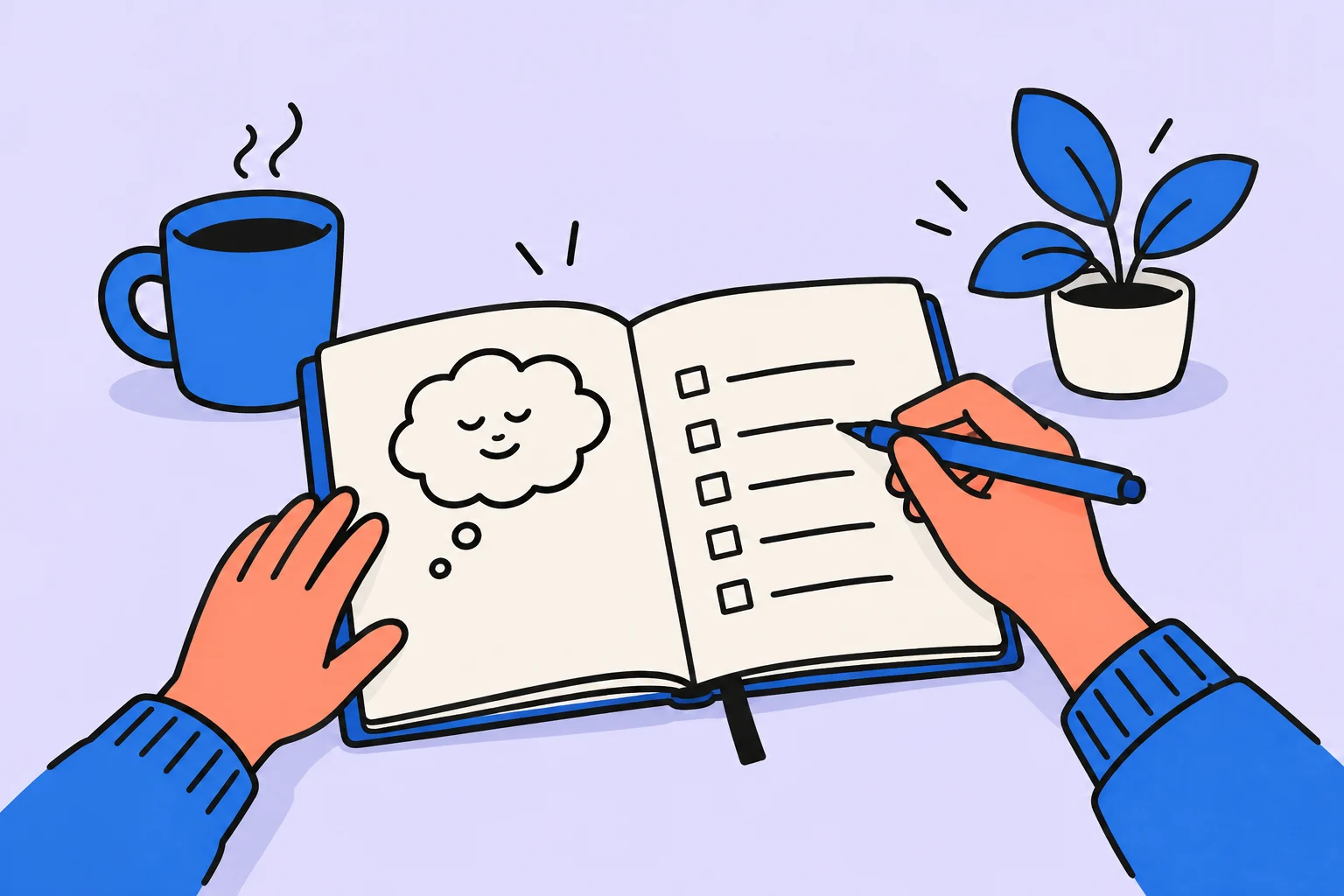
A reflection journal contains entries examining your experience: what happened, how you understand it, and what you will try next. You can keep it in a notebook or an ordinary file. Start with one event and a few sentences.
An entry does not have to end with a major conclusion. Sometimes a useful result is noticing that you do not yet have enough information and formulating a question for the next check.
How reflection differs from describing the day
“Today I had a difficult conversation with a client” describes an event. Reflection adds details: exactly what was difficult, what you did, and which hypothesis you could test next time.
Separate observation from interpretation. “The client asked twice for clarification of the deadline” is an observation. “The client does not trust me” is an assumption with other possible explanations. This distinction leaves room for clarification and avoids turning an entry into a verdict on yourself or another person.
What the research allows us to say
A Harvard Business School article describes research on reflection in puzzle experiments and workplace training. Under the conditions studied, examining experience was associated with better task performance than in the comparison conditions.
These findings concern specific tasks and participants. They do not establish that any journal will improve everyone's productivity, reduce stress by a particular percentage, or produce results within a fixed period.
The working paper's SSRN record is available as a bibliographic starting point. The full text could not be obtained when preparing the editorial inputs: the source returned 403. Therefore, this article provides no exact percentages or details requiring comparison with the full text.
The templates below are editorial exercises for personal notes. Their effectiveness has not been separately tested; they are neither diagnosis nor treatment.
How to start
Choose somewhere convenient for writing and rereading notes. For a trial, set aside five minutes after a familiar event, such as finishing the workday. This is a practical suggestion rather than a duration required for an effect.
Choose one situation. You do not need to analyze the whole day, find three wins at any cost, or write about experiences you do not want to share even with a journal.
Daily template
- Event: what happened? Which details did I observe?
- My reaction: what did I feel or do?
- Interpretation: how do I explain the situation? What other explanations are possible?
- Action: what specifically will I try in the next similar situation?
- Check: when will I return to the entry, and what will I look at?
If you have little energy, keep three lines: the event, one action, and a check date. You can also write “I do not know yet” rather than invent a lesson.
A completed example: from a report to the next action
Below is a fictional continuation of the report and client conversation example. The numbers describe only this example.
Event. “I finished the report on time, but started after lunch and rushed before sending it. In the client conversation, I used prepared arguments; I had to answer questions about deadlines as the meeting progressed.”
Reaction. “I was tired and pleased that I finished the work. Before sending the report, I worried that I had missed an error.”
Interpretation. “Perhaps I delayed the report because I had not defined the first step. But there were also urgent messages in the morning. I cannot yet say that procrastination was the only cause.”
One action. “On the next working day, before opening email, I will outline the report: headings and a list of missing data. If an urgent task appears, I will record it and separately decide whether to interrupt my work.”
Check. “On Friday, I will check whether I started with an outline, what got in the way, and whether I had time to review the report before sending it.”
You can do this without an app. You do not have to change meeting preparation, your daily routine, and all work habits simultaneously.
- 01 · FactStarted the report after lunch
Almost no time remained to check it before sending.
- 02 · HypothesisStart with an outline earlier
Perhaps a short morning outline will help identify gaps before the rush.
- 03 · CheckCompare next Friday
Did I manage to start earlier, and was there time to check the report?
Illustrative example: this is a hypothesis to test, rather than a promised result.
Weekly check: which decision changed
Choose a convenient day and reread entries related to your chosen action. You do not need to assess your entire life or seek a pattern in every coincidence.
Weekly template
- What did I intend to try?
- In which situations did I actually try it?
- What did I observe, and what am I only assuming?
- Which circumstances were different?
- What will I keep, change, or stop?
- When will I check the new decision?
Continuing the example
Plan. Start the report with a short outline before checking email.
Observations from the week. “There were three such working days. On two, I made the outline first and left time to review before sending. On the third, I immediately answered an urgent request and returned to the report after lunch.”
Limits of the conclusion. “The reports differed in difficulty. These entries cannot prove that the outline itself changed the result. But I can see that an urgent request prevented me from trying the chosen sequence.”
Revised decision. “Next week, I will prepare the report headings at the end of the previous workday. In the morning, I will begin filling in the first section. I will clarify the urgency of new requests before switching.”
Next check. “Next Friday, I will compare entries: whether I managed to start, what interrupted the work, and whether there was time to check the report.”
The check helps decide what to do next. If your chosen technique is inconvenient, simplify or replace it. A few entries cannot establish reliable causation.
Maintaining the practice without a fixed deadline
Do not set a date by which journaling must become a habit. In the study by Lally and colleagues , participants repeated chosen eating, drinking, or physical activity behaviors in a stable context. This was not a study of reflection journaling and does not prove that it accelerates habit formation.
For your own journal, try a consistent cue: finish work → record one event. If you regularly miss entries, check whether the timing and template length are convenient. After missing an entry, you can continue with the current day; reconstructing every entry from memory is optional.
For more on timelines and repeating actions, see the habit formation guide.
Paper or digital notes
A notebook is convenient if you want to write without a screen. A digital file is convenient for keyword searches and quick editing. Features depend on the tool: automatic analysis and access across devices are not available everywhere.
Try a format already available to you, then assess after a week whether opening and returning to entries was easy. Combining formats is optional.
Avoid unnecessarily recording other people's personal data, confidential work information, or details you are unwilling to share with a third-party service.
Questions to add
If the basic template is insufficient, choose one question:
- Which facts support my explanation of the situation?
- What do I not yet know, and whom can I ask?
- Which part of the situation depended on my action?
- Which next step is small enough to try?
You do not need to look for hidden fear behind every postponed task or force yourself to write about painful events. If writing intensifies distress or becomes a repetition of the same thoughts, you can stop. For significant or persistent difficulties, seek professional help. A journal does not replace it.
Where Sinqly may help
Sinqly includes tasks, projects, and habits. You can turn your chosen next step into a task. Learn about the product on the Sinqly homepage.
Frequently asked questions
How much should I write? As much as feels comfortable for examining one event. Start with a few sentences; there is no established amount that produces universal benefits.
Do I need to write every day? You can choose daily entries, entries after important events, or a weekly review. Test which format you can maintain and use when making decisions.
What if I have no conclusions? Write down an observation and a question. Having no conclusion is better than a confident explanation without evidence.
How does this differ from a gratitude journal? The main question here is what happened and what to try next. A gratitude journal focuses on what a person is grateful for. These are different intentions; see the separate article on gratitude journaling. This guide does not validate that article's scientific claims.
How can I tell whether the entries help me personally? See whether you can identify a specific decision you clarified after rereading. If the entries do not help with your chosen task, change the questions, shorten the format, or stop using it.
You can start today: record one observation, choose one action, and set a day to return to the result.
What to write when the day seems ordinary
Start with one episode rather than an assessment of your entire life. Separate observation from explanation: what happened, how you reacted, and what you want to test tomorrow. An entry is useful when it makes the situation clearer; text length is not a measure of results.
Fact: I postponed replying to an email three times. My explanation: I did not understand which decision was expected from me. Next step: ask one clarifying question in the morning before writing a long reply.
- Do not replace a fact with the label ‘I am lazy.’
- Choose one testable step; do not turn the entry into another list of obligations.
- Check your explanation the next day: sometimes the cause turns out to be different.
Turn an idea into action
Was this helpful?
Rate the article and tell us what was missing. Your feedback goes to the Sinqly team and will not be published on the site.
An AI-assisted advertising banner: concept, editable layout and checks
Build a banner around one message: brief, visual-concept prompt, separate text layers and a readability check before placement.
A business plan with AI: inputs, calculations, and assumption checks
Prepare a business plan with AI: a complete educational service model, break-even calculation, scenarios, and cash balances. Assumptions are separated from verified data.

Gratitude Journaling: Science, Practice and a Template
How to keep a gratitude journal based on research: studies, step-by-step instructions, entry templates, mistakes and variations on the practice. A guide to gratitude journaling.