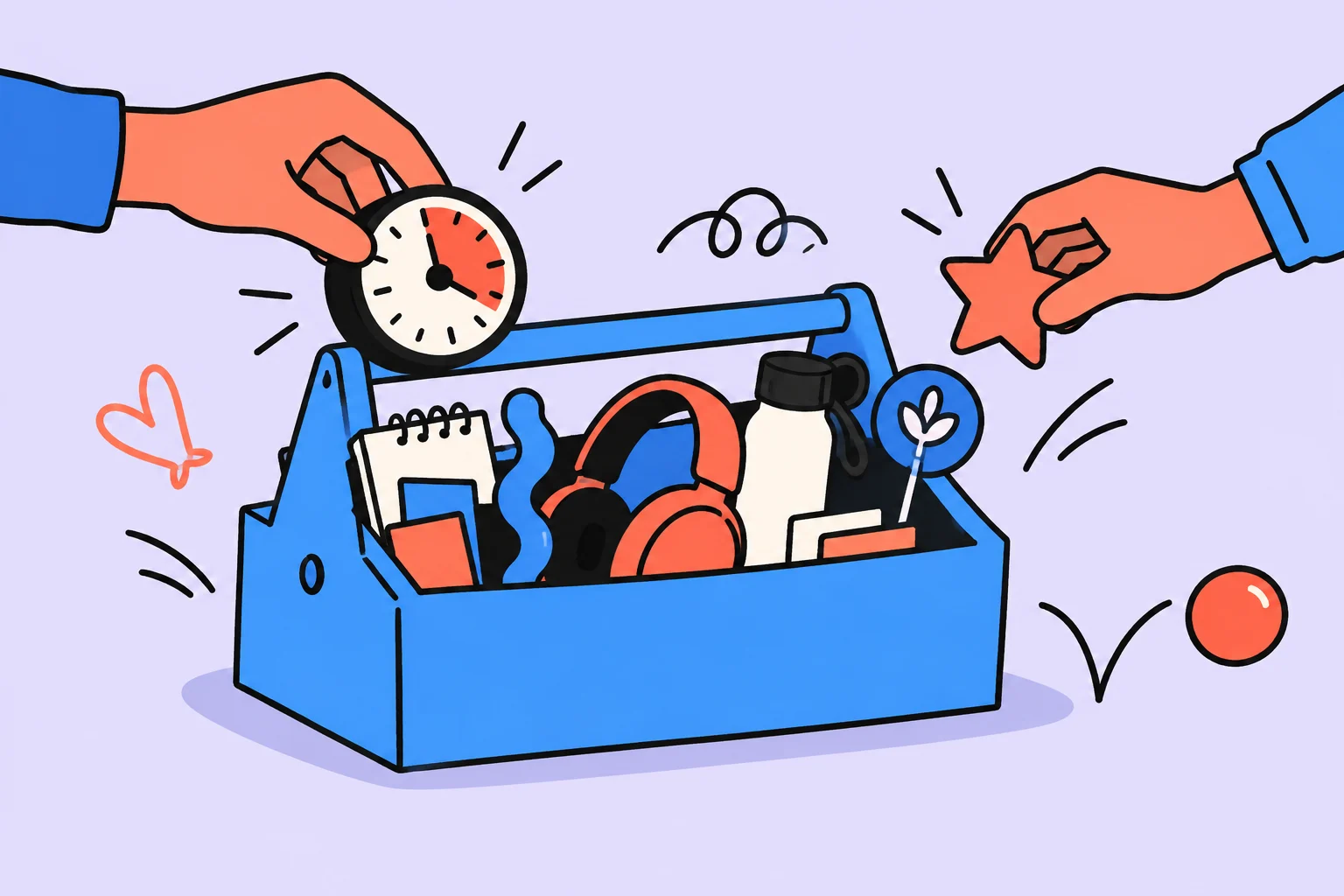
If you have ADHD, you already know that standard productivity advice does not work. "Make a to-do list," "work for 8 hours" and "just concentrate" are written for neurotypical brains. The ADHD brain works cyclically and unpredictably but can achieve extraordinary productivity in the right conditions. This guide offers 15 established strategies based on neuroscience and real experience.
Adults worldwide living with ADHD
Higher productivity during hyperfocus
Improvement in effectiveness with body doubling
ADHD productivity: myths and reality
The first myth is that people with ADHD are lazy and disorganized. ADHD is a neurobiological condition in which the brain processes dopamine and norepinephrine differently. This affects executive functions such as planning, organization and impulse control, but not intelligence or motivation.
The second myth is that ADHD productivity means working like everyone else. In reality, intense work alternates with recovery periods. Just 3 hours of hyperfocus can be more productive than 8 hours of ordinary work.
A study Journal of Attention Disorders (2019) found that adults with ADHD show greater creative potential and innovative thinking than neurotypical people. The key is finding ways to work with your brain's differences rather than fight them.
According to the American Psychiatric Association, 30% of entrepreneurs have ADHD, compared with a general prevalence of 4-5%. Examples include Richard Branson, David Neeleman of JetBlue and Paul Orfalea of Kinko's. In the right environment, ADHD can become a competitive advantage rather than a barrier.
The neurobiology of ADHD productivity: how the brain works
To become productive with ADHD, understand how your brain works. ADHD involves impaired functioning of the prefrontal cortex, responsible for executive functions. This explains difficulties with planning, organization, attention and impulse control.
The dopamine system also works differently. Dopamine is a neurotransmitter of motivation and anticipated reward, rather than a happiness hormone. Its baseline level is lower in ADHD, so the brain continually seeks stimulation. This produces a desire for novelty, difficulty with routine and impulsivity.
There are advantages too: hyperfocus, or hours of immersion in an interesting task; high creativity; rapid shifts between ideas; and effective crisis responses. Effective ADHD productivity uses these characteristics.
Accept your neurodivergence
Stop comparing yourself with neurotypical people. Your brain works differently; this is a difference rather than a deficiency.
Learn your patterns
Keep an energy diary for a week: concentration peaks, dips and factors affecting focus, such as sleep, food and stress.
Find your hyperfocus triggers
What triggers deep concentration: interest, novelty, deadlines or competition? Use this knowledge.
Create a supportive environment
Minimize distractions, use visual reminders and establish external structures such as timers and calendars.
Strategy #1: Working with circadian rhythms and energy
Energy and concentration fluctuate more dramatically throughout the day with ADHD. Most people with ADHD have 2-3 productivity windows, periods of naturally high concentration. Identifying and protecting these windows is the foundation of productivity.
Typical energy patterns include early birds peaking at 7-10 in the morning, afternoon types peaking at 14-17 and night owls peaking at 20-23. Some have morning and evening peaks with an afternoon dip. Your pattern may differ; find your own.
Tufts University research (2020) found that people with ADHD who schedule difficult tasks during peak hours complete 60% more work and experience 40% less stress. Build productivity around biology rather than fighting it.
To find productivity windows, record your concentration every 2 hours for a week on a scale from 1 to 10. Simply record without analyzing as you go. After a week, you will see a clear pattern.
Strategy #2: Small tasks for the ADHD brain
Large tasks create choice paralysis with ADHD. The brain sees an enormous task and refuses to start as protection against overload. Divide everything into 2-15-minute tasks. Replace "write a report" with "open the document," "write a heading," "find 3 sources" and "write the first paragraph."
Each completed small task provides a little dopamine reward that motivates you to continue. Instead of one large reward at the end, which may never arrive, you receive many small rewards along the way.
Strategy #3: Body doubling, a revolution in ADHD productivity
Body doubling is a powerful yet underestimated ADHD productivity technique. You work in another person's presence even if they are doing something else. Social accountability activates brain regions responsible for focus and self-control.
This could be a coworking colleague, a friend in a cafe, a family member at home or a virtual partner on Zoom. Another person's presence creates external structure that compensates for weaker internal regulation.
A study PLOS ONE (2021) found that body doubling increases ADHD productivity by 53% and reduces procrastination by 41%. Even virtual presence through video provides 70% of the effect of physical presence.
Strategy #4: Managing hyperfocus as a superpower
Hyperfocus lets someone with ADHD become so immersed in a task that time seems to disappear. You may spend 6-8 hours on a project, forgetting food, sleep and the world around you. This is a feature you need to learn to manage.
Hyperfocus cannot be activated on command. The ADHD brain enters it only for tasks it considers interesting, novel or urgent. Make a boring task interesting with play, competition or novelty. Change the tool, workplace or approach.
Create an entry ritual: a sequence that triggers hyperfocus through particular music, a location, a drink or a time of day. Your brain gradually associates the ritual with deep concentration. Read more in Dopamine and Motivation with ADHD.
Important: set a safety timer for 2-3 hours during hyperfocus. Otherwise, you risk spending the entire day on one task while forgetting food, water and other priorities. Hyperfocus is powerful but requires control.
Strategy #5: Dopamine techniques to get started
Starting is the hardest part with ADHD. Knowing what to do does not help when the problem lies in neurochemistry rather than understanding. Low baseline dopamine makes tasks feel boring even when you logically recognize their importance.
Dopamine techniques temporarily increase dopamine and make starting easier: physical activity such as 10 squats or a walk, a cold shower, bright light, favorite music, coffee or a small reward after beginning work.
Gamification is a powerful dopamine tool. Turn routine tasks into a game: set a timer and beat your speed record, award points for completed small tasks or compete with friends on productivity.
Strategy #6: External structures for executive dysfunction
Executive dysfunction means the ADHD brain struggles to create and maintain internal structures such as schedules, habits and plans. Use external structures instead: calendars with reminders, timers, physical anchors and accountability partners.
Examples include automatic phone reminders, timers for each task, different physical areas for different work types, such as a desk for focus, a chair for reading and the kitchen for calls, and daily check-ins with a colleague or friend.
Strategy #7: Managing time blindness
Time blindness is an underestimated but crucial ADHD symptom. A person may not sense time passing: 10 minutes and 2 hours feel alike. This leads to chronic lateness, missed deadlines and inaccurate estimates.
Use visual timers such as Time Timer, which displays time as a colored sector, audible reminders every 30-60 minutes and an analog desk clock whose moving hands create a visual sense of time.
When planning, use the multiplier rule: if a task seems likely to take an hour, allow 2-3 hours. This is realism rather than pessimism. ADHD time estimates are systematically low by 50-200%. A task manager with time tracking helps calibrate your estimates.
Tip: put a large analog clock on your desk. Digital clocks display time as a number; analog clocks show it as a process. Many people with ADHD find that analog clocks help them feel time passing.
Strategy #8: Optimize your work environment for focus
With ADHD, any external stimulus can capture attention. A notification, conversation or movement outside can cost 15-25 minutes of recovery before deep focus returns. Keep the environment as distraction-free as possible during important work.
A deep-focus protocol: phone in another room or airplane mode, notifications off on every device, noise-canceling headphones with white noise, a minimalist desk, unnecessary browser tabs closed and website blockers such as Cold Turkey or Freedom active.
When working from home, create physical signals such as a closed door, headphones or a special lamp. Tell loved ones you are focusing. Use different areas for different activities: a desk for deep work, a chair for reading and the kitchen for calls. Read more about working from home.
Focus zones
Create different physical areas for different work types. The ADHD brain concentrates better when a place is associated with a specific activity.
Audio isolation
Noise-canceling headphones with white noise or lo-fi music. Silence can be too stimulating for the ADHD brain.
Digital detox
Keep your phone in another room, block distracting sites and turn off notifications. Each distraction steals 20+ minutes of concentration.
Lighting and color
Bright natural light or daylight-white lighting. Dark rooms lower dopamine and worsen ADHD symptoms.
Strategy #9: Emotional regulation and productivity
ADHD involves emotions as well as attention. Emotional dysregulation, difficulty controlling emotional intensity, directly affects productivity. Minor criticism can derail an entire day. A setback can cause a wave of disappointment that paralyzes work for hours.
Rejection sensitive dysphoria, or RSD, often accompanies ADHD. Fear of criticism and rejection can become so strong that someone avoids starting projects, showing work or requesting feedback. It looks like procrastination but serves as emotional protection.
Emotional-regulation strategies include an emotional warm-up before work, with 2-3 minutes of breathing exercises or meditation, separating yourself from your work because criticism of work is not criticism of your identity, and a reflection journal to track emotional triggers.
Strategy #10: The physiology of ADHD productivity
The ADHD brain is particularly sensitive to physical factors. Sleep quality, nutrition, hydration and activity directly affect symptoms and productivity. These are specific needs of a neurodivergent brain, beyond general healthy-living advice.
Sleep: 75% of adults with ADHD have sleep disturbances, according to Sleep Medicine Reviews, 2019. One night of insufficient sleep reduces executive function by 32%, equivalent to skipping medication. A regular sleep schedule is essential for productivity.
Physical activity naturally stimulates dopamine. Just 20-30 minutes of aerobic exercise before work improves concentration for 2-4 hours. A Journal of Attention Disorders study (2018) found that one workout has an effect comparable to a low stimulant dose.
A 2020 meta-analysis found that regular aerobic exercise, 3-4 times weekly for 30-45 minutes, reduces ADHD symptoms by 25-30%. This is comparable to psychotherapy and greater than the effect of any dietary supplement.
Strategy #11: Nutrition for optimal brain function
The ADHD brain is particularly sensitive to blood-sugar fluctuations. Fast carbohydrates such as sweets and white bread provide a short energy rise followed by a sharp drop and increased inattention. Stable glucose supports stable concentration.
A protein-rich breakfast with eggs, Greek yogurt or nuts is a simple ADHD productivity technique. Protein provides a slow release of energy and stabilizes the dopamine system for 4-6 hours.
Research shows a positive effect of omega-3 fatty acids on ADHD symptoms: inattention falls by 16% with regular consumption of oily fish, flaxseed oil and walnuts. Magnesium and zinc also support neurotransmitter function. Adequate hydration is crucial: dehydration of 2% reduces cognitive function.
Strategy #12: Energy blocks instead of a fixed schedule
Rigid hourly schedules create anxiety and a sense of failure whenever plans change. Energy blocks are more effective: divide the day by energy type and tasks rather than time.
Use three energy-block types: high energy for creative and complex tasks, medium for communication, meetings and planning, and low for routine work, cleaning and simple tasks. Assess your energy each morning and choose matching tasks.
Include a required 10-15-minute buffer between blocks: stand up, walk and drink water. Switching task types takes longer with ADHD because the brain needs to reset. Avoid jumping directly from a meeting into deep work.
Identify your energy patterns
Track energy every 2 hours for a week. Find your peaks and dips.
Create energy-based task lists
High: creativity and analysis. Medium: communication and planning. Low: routine work and organization.
Plan in blocks rather than hours
Replace "10:00-11:00 report" with "high-energy block: report."
Add buffers between blocks
Allow 10-15 minutes for transitions. The ADHD brain needs more reset time.
Strategy #13: Teamwork and communication
Teamwork brings unique challenges: forgotten meetings, interruptions and losing track of long email threads. Strengths include unconventional ideas, quick crisis responses and seeing connections others miss.
Ask for agendas in advance so your brain can enter the topic, take meeting notes to maintain attention and record action items immediately afterward: details may be forgotten in 10 minutes.
Consider an open conversation with your team about ADHD. It provides context rather than showing weakness. When colleagues understand why you sometimes interrupt or arrive late, they respond with understanding. Neuroinclusive practices make many teams stronger.
Strategy #14: ADHD-friendly tools and apps
Not every productivity tool suits the ADHD brain. Complex planning systems are quickly abandoned because maintaining them takes too much cognitive energy. The best tools are simple, offer quick task capture and visual reminders, and minimize friction.
Selection criteria: adding a task in 3 seconds or less, ideally through a voice message or a tap; automatic reminders requiring no setup; subtasks; cross-device synchronization; and a clean, simple interface without distractions.
Strategy #15: Preventing burnout
People with ADHD burn out more often and faster than neurotypical people. Compensatory behavior is one cause: meeting conventional standards requires 2-3 times more energy for the same tasks. Constantly fighting your brain also drains mental resources.
ADHD productivity is a marathon rather than a sprint. Avoid trying to work 8 hours straight like neurotypical people. Just 3-4 hours of deep work in peak windows is more effective than 8 hours of fighting your brain. Make breaks a required part of the workflow.
Warning signs include worsening ADHD symptoms, disappearing hyperfocus, boredom even with interesting tasks, stronger emotional reactions and disrupted sleep. Reduce your workload at the first signs. Read more in ADHD and Burnout.
The 80% rule: avoid perfection in every task. Perfectionism is an ADHD trap: either you perform perfectly and burn out, or avoid acting because imperfection feels frightening. Good enough is an excellent result.
Building your personal ADHD productivity system
There is no universal ADHD productivity system; every brain is unique. There is, however, an established process for building your own, based on neuroscience and the real experience of thousands of people with ADHD.
Start with one or two elements rather than adopting everything at once. Changing habits takes longer with ADHD: 66 days instead of the standard 21. Be patient with yourself and remember that progress matters more than perfection.
Audit your current situation
For a week, track energy peaks, distractions, easy tasks and tasks that trigger procrastination.
Choose 3 key strategies
From the 15 strategies, choose those that resonate most. Start with the foundation rather than adopting everything.
Create external structures
Set reminders and timers, choose one simple planning tool and automate whatever you can.
Find an accountability partner
A colleague, friend or coach who regularly checks your progress without judgment.
Iterate every 2 weeks
Strengthen what works. Change or remove what does not. Your system should evolve.
Medication support for ADHD productivity
ADHD medication is a powerful tool that improves executive function in 70-80% of patients. Stimulants such as methylphenidate and amphetamines, and nonstimulants such as atomoxetine, normalize dopamine and norepinephrine systems, directly improving concentration, planning and impulse control.
Medication is not a magic solution. It creates a window of opportunity for productivity, but strategies, tools and habits remain necessary. Medication without a system is less effective, as is a system without medication when medication is indicated.
Only a psychiatrist can prescribe medication after a full assessment. Do not self-medicate. Meta-analyses show that combining medication, cognitive behavioral therapy and productivity strategies provides the best long-term results.
ADHD is a medical condition rather than a lack of willpower. If you suspect ADHD, consult a specialist. Diagnosis and treatment substantially improve quality of life and productivity. Read about signs in Adult ADHD.
Frequently asked questions about ADHD productivity
What is the maximum productivity possible with ADHD?
Very high productivity is possible, but it works cyclically. Rather than a steady 8-hour workday, intense hyperfocus lasting 3-6 hours alternates with recovery. ADHD affects 30% of entrepreneurs, including Richard Branson and JetBlue founder David Neeleman.
Which productivity methods do NOT work with ADHD?
Methods that do not work include traditional Pomodoro (25/5), rigid hourly schedules, complex systems such as GTD, long to-do lists and multitasking. ADHD calls for flexible systems adapted to fluctuating energy and attention differences.
What are productivity windows, and how do you find them?
Productivity windows are 2-3-hour periods of naturally high concentration. Find them through an energy diary: every 2 hours for a week, rate concentration from 1 to 10. Typical patterns are morning (8-11), afternoon (14-17) and evening (20-23).
How can you use hyperfocus for maximum productivity?
Hyperfocus is an ADHD superpower but activates only for interesting tasks. Add novelty to boring work, change tools or location, create an entry ritual and set a safety timer for 2-3 hours so you do not forget the rest of the world.
Which apps are best for people with ADHD?
Look for task capture in 3 seconds, automatic reminders, a simple interface and subtasks. Top options include Sinqly, designed for ADHD; Todoist for simplicity and capability; and Apple Reminders for Siri integration. Avoid Notion because it is too complex.
Does medication affect ADHD productivity?
ADHD medication improves concentration in 70-80% of patients but does not replace productivity strategies. The best results combine medication, cognitive behavioral therapy and personal productivity systems. Only a psychiatrist prescribes medication.
How does body doubling work for people with ADHD?
Body doubling means working in another person's physical or virtual presence. Social accountability activates self-control regions in the brain. Studies show a productivity increase of 53%. It works even through Zoom.
Why are small tasks crucial for ADHD?
Large tasks cause choice paralysis: the brain refuses to start. Tasks lasting 2-15 minutes are easy to begin and finish. Every completion provides a dopamine reward that motivates you to continue. Break a large challenge into manageable pieces.
How can you avoid burnout while being highly productive with ADHD?
Compensatory behavior causes faster burnout with ADHD. Use the 80% rule rather than seeking perfection, take required breaks between work blocks and monitor early warning signs. Just 3-4 hours of deep work is better than 8 hours of fighting your brain. Read more in ADHD and Burnout.
Turn an idea into action
Was this helpful?
Rate the article and tell us what was missing. Your feedback goes to the Sinqly team and will not be published on the site.
Digital detox: a complete guide
A complete guide to digital detox. Signs of information overload, dopamine dependence, weekend and week-long plans, and a family detox.
Deep Work: a complete guide to deep, focused work
A complete guide to Cal Newport's Deep Work. How to practice deep work, 4 strategies, focus rituals, and the science of concentration.
Focus techniques for ADHD: what really works in 2026
Scientifically grounded methods for improving focus with ADHD. 12 proven concentration techniques, exercises, and tools for people with attention deficits.