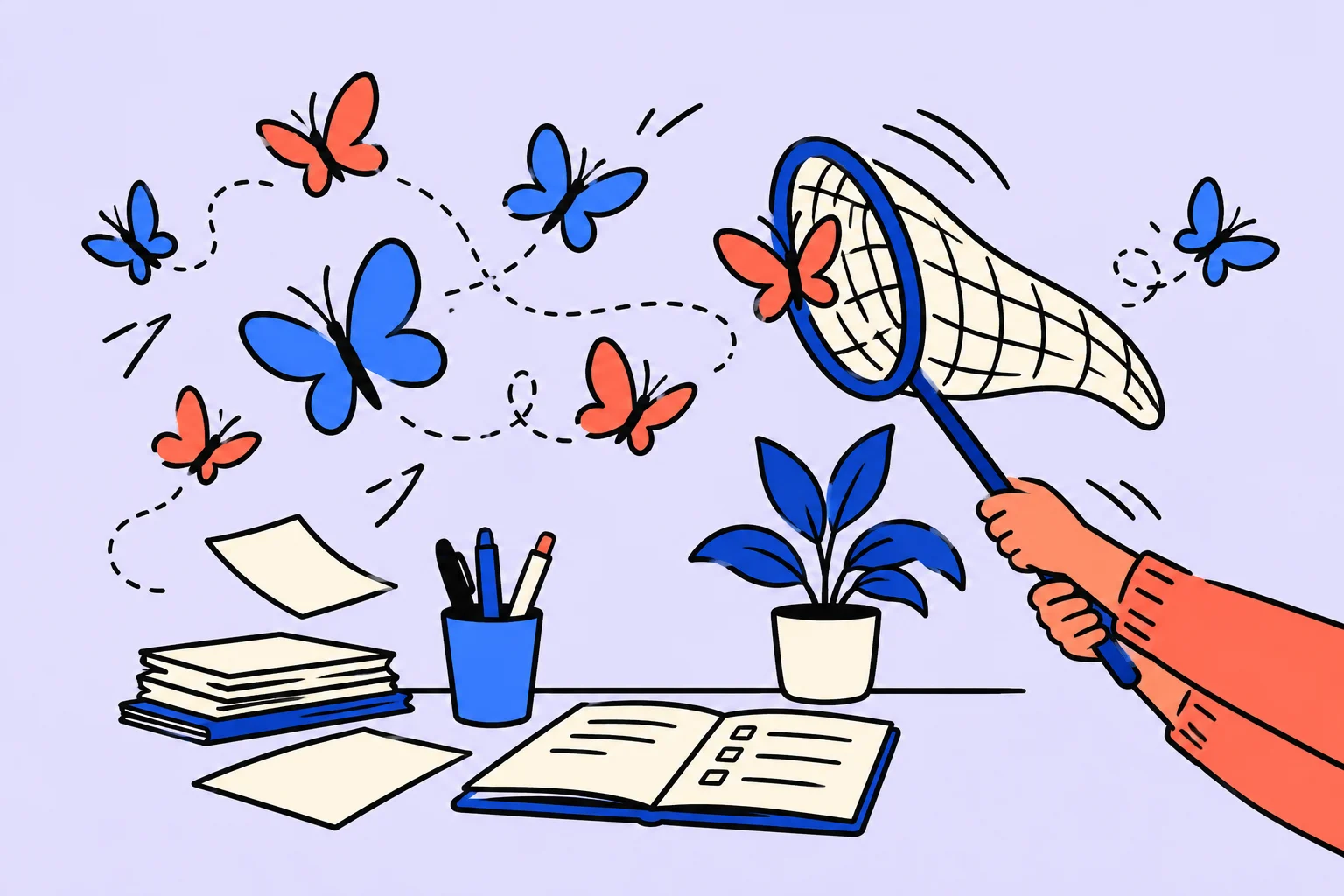
If you have ADHD, traditional productivity advice does not work. “Just make a to-do list,” “use a Pomodoro timer,” and “get up at 5 a.m.” are all written for neurotypical people. An ADHD brain works differently: it struggles to control attention rather than lacking it. This guide offers 10 ADHD productivity strategies that actually work, supported by scientific research and practical experience.
of adults worldwide live with ADHD
higher productivity when working during “focus windows”
improvement in effectiveness with external structures
Why standard productivity methods do not work for ADHD
ADHD involves a deficit in attention regulation rather than attention itself. As Dr. Russell Barkley, a leading ADHD expert, notes, people with ADHD can hyperfocus on interesting tasks for hours but struggle to concentrate on routine work for even 5 minutes. Standard productivity methods assume an even distribution of attention, which is impossible with ADHD.
ADHD also affects working memory, time perception, and emotional regulation. A person with ADHD literally does not experience time passing the same way a neurotypical person does, so deadlines “sneak up” and planning feels impossible. This is a neurobiological difference related to the brain's dopamine system, rather than laziness or irresponsibility.
You can find detailed information about diagnosis and support at CHADD (Children and Adults with ADHD). We covered the signs of adult ADHD in detail in ADHD in adults: signs and diagnosis. If you suspect you have ADHD, also read our article on diagnosing ADHD in adults.
Important: ADHD is a medical diagnosis, not a personality trait. If you suspect you have ADHD, consult a psychiatrist or neurologist for diagnosis. The strategies in this article complement professional help but do not replace it.
Productivity with ADHD: work with your energy rather than against it
With ADHD, energy levels and concentration fluctuate in waves throughout the day. Identify your “productivity windows”—periods when concentration is naturally high—and schedule your hardest tasks then. This is a fundamental principle of productivity with ADHD.
Keep an energy journal for a week: rate your concentration from 1 to 10 every two hours. After a week, you will see a pattern. Most people with ADHD have a productivity peak in the late morning (10-12) or late evening (21-23). Everyone has their own rhythm.
A University of Bristol study (2021) found that people with ADHD who schedule important tasks during their peak hours complete 47% more work than those following a fixed schedule. Use your biology rather than fighting it.
Keep an energy journal
Every 2 hours for a week, record your concentration level (1-10). Use notes on your phone or the Sinqly Telegram bot.
Identify the pattern
After 7 days, find 2-3 peak windows. These are usually 2-3 consecutive hours when concentration consistently exceeds 7.
Protect your peak windows
Block these hours in your calendar. No meetings, calls, or routine work: only your most important tasks.
Put routine work in the “valleys”
Answer emails, make calls, and handle routine work during low-energy hours. These do not require deep focus.
External structures instead of internal discipline for ADHD
ADHD makes creating internal structures—schedules, habits, and routines—difficult. Executive dysfunction means the brain literally cannot make itself do what it “should” without urgency or interest. The solution is to use external structures: timers, reminders, physical anchors, and accountability partners.
Set a timer for every task. Physically move between areas for different kinds of work (a desk for work, an armchair for reading, and another room for calls). Ask a colleague or friend to check your progress daily.
Body doubling: productivity through presence
Body doubling is one of the most effective productivity techniques for ADHD. The idea is simple: work in another person's presence, even if they are doing something else. Another person's presence activates social accountability and helps an ADHD brain maintain focus.
This could be a colleague in the office, a friend in a café, or even a virtual partner on a video call. Dedicated virtual body-doubling services let strangers work alongside one another over video. The effect is surprisingly powerful: many people with ADHD report their productivity doubling.
A Journal of Clinical Psychology study (2022) found that body doubling increases productivity among people with ADHD by 53%. Even another person's virtual presence activates mirror neurons and creates enough social accountability to maintain focus.
Small tasks and the two-minute rule for ADHD
Large tasks can paralyze an ADHD brain. This is called “task paralysis”: a task feels so enormous that you cannot even begin. The solution is to break everything into small tasks lasting 2-15 minutes. Instead of “write the report,” use “write the report's title,” “write the introduction,” and “collect data for the first section.”
The two-minute rule: if a task takes less than 2 minutes, do it immediately without adding it to a list. This reduces cognitive load and prevents small tasks from accumulating into a mountain. With ADHD, a mountain of small tasks causes the same paralysis as one large task.
How to work with ADHD: use hyperfocus as a superpower
Hyperfocus is the ability of someone with ADHD to immerse themselves in an interesting task so deeply that the rest of the world ceases to exist. Many great entrepreneurs, scientists, and creative people with ADHD have built careers on hyperfocus. It is a superpower rather than a bug: you need to learn to control it.
The problem with hyperfocus is that it does not switch on at your command: it activates only for tasks the brain finds interesting, new, or urgent. A practical trick: make a boring task interesting. Add an element of play, competition, or novelty. Set a timer and try to beat your record. Use a new tool for a routine task.
Set a “safety timer” for 2 hours so hyperfocus does not consume the entire day on one task while others become urgent. Read more about the mechanism in Dopamine and motivation in ADHD.
A tip: create an “entry ritual” for hyperfocus. This could be particular music, a place, a drink, or an action (putting on headphones or opening a particular app). Over time, the brain will associate the ritual with deep focus, making it easier to enter that state.
Managing your environment and distractions with ADHD
With ADHD, any external stimulus can capture attention. A phone notification, colleagues talking, or movement outside the window can each “steal” your focus for 15-25 minutes, the time the brain needs to restore deep concentration. Your work environment should therefore be as free of distractions as possible. Read more about concentration in our article Deep work: how to work deeply.
Create a “focus protocol”: phone in another room (not just face down—actually in another room), notifications disabled on every device, noise-canceling headphones with white noise or lo-fi music, a minimalist desk, and unnecessary browser tabs closed. Use a Pomodoro timer and website blockers (Cold Turkey or Freedom) during work sessions.
If you work from home, tell loved ones you are in “focus mode.” A physical sign (a closed door, headphones, or a special lamp) serves as a signal. Read more about working from home in How to work from home effectively.
Dopamine and motivation: why getting started is hard with ADHD
With ADHD, the brain produces less dopamine or uses it less effectively. Dopamine is a neurotransmitter responsible for motivation, anticipating rewards, and the ability to make yourself start. This is why a person with ADHD knows exactly what to do but physically cannot begin. The cause is neurochemistry rather than laziness.
The solution is to deliberately raise dopamine before work. Brief physical activity (10 squats or a walk), a cold shower, bright light, or favorite music temporarily increases dopamine and makes starting easier. Some people with ADHD report that a cup of coffee before work helps specifically through this dopamine mechanism.
Gamification is another powerful dopamine lever. Turn a routine task into a game: set a timer and try to beat your speed record, give yourself points for completed tasks, or compete with friends.
Time blindness in ADHD: how to manage time
Time blindness is one of the most underestimated ADHD symptoms. A person with ADHD literally does not feel time passing. Spending 5 minutes and 50 minutes feels the same. As a result, lateness, missed deadlines, and chronic time shortages become the norm.
Solutions include visual timers (Time Timer shows time as a shrinking colored segment), frequent alarms (every 30 minutes as a “reality check”), and a wristwatch (an actual physical watch: checking your phone is risky because you may drift into social media).
When planning, multiply your estimates by 2-3. If you think a task will take an hour, allow 2-3 hours. This is realism rather than pessimism: time estimates are systematically too low with ADHD. Use a task manager with actual time tracking to calibrate your estimates.
A practical trick for time blindness: put an analog clock with a large face on your desk. The moving hands provide a visual reminder of time passing that works subconsciously. Many people with ADHD note that digital clocks do not feel the same.
Emotional regulation and productivity with ADHD
ADHD involves more than attention. Emotional dysregulation—the inability to control emotional intensity—directly affects productivity. The smallest setback can trigger a wave of disappointment that paralyzes work for hours. Criticism, even constructive criticism, can derail your entire day.
Rejection Sensitive Dysphoria (RSD) often accompanies ADHD. The fear of criticism and rejection can be so strong that a person avoids starting projects, showing their work, or asking for help. This looks like procrastination but is actually emotional self-protection.
Strategies: practice an “emotional warm-up” before work (2 minutes of meditation or breathing exercises), separate “me” from “my work” (criticism of your work is not criticism of you), and keep a reflection journalto notice emotional patterns. Remember: with ADHD, emotions feel like they are at 200%. This is normal, and it passes.
Productivity tools for people with ADHD
Not all tools are equally useful for ADHD. The best tools require minimal effort to use and provide maximum external structure. Complex planning systems (Notion with 50 databases) are quickly abandoned: an ADHD brain needs simplicity and an immediate start.
Choose one outcome for your next work block and make the first step obvious. Create a task in Sinqly: registration is free.
Read more about ADHD tools in the review The best apps for ADHD. If you are comparing options, see our task manager comparisons for 2026.
How to work with ADHD: create your own productivity system
There is no universal productivity system for ADHD: every brain is unique. But some principles work for most people. Here is a step-by-step plan for creating your personal system:
Identify your focus windows
Keep an energy journal for a week. Find 2-3 periods of peak concentration.
Choose one simple tool
Do not try to configure a complex system. Use one task manager (Sinqly, Todoist, or Apple Reminders) and one timer.
Set up external structures
Reminders, timers, and physical work areas. The more automation, the better.
Start with 3 small habits
Not 10 or 5: exactly 3. For example, write down 3 tasks in the morning, do 2 minutes of breathing before work, and spend 5 minutes reviewing the day in the evening.
Adjust every week
Keep what worked. Replace what did not. With ADHD, your system needs to be flexible.
Sleep and productivity with ADHD: why your routine matters so much
Sleep disturbances affect 75% of adult ADHD patients, according to a meta-analysis published in Sleep Medicine Reviews (2019). The problem runs both ways: ADHD makes falling asleep difficult (the brain will not “switch off”), while insufficient sleep intensifies every ADHD symptom. This vicious cycle directly undermines productivity with ADHD.
A typical problem is delayed sleep phase syndrome: someone with ADHD cannot fall asleep until 2-3 a.m. because their brain finally “switches on” and starts generating ideas. Getting up becomes torture, and the first half of the day passes in a fog. If you are naturally a night owl, do not fight it. Schedule important tasks for the evening. If you must work in the morning, shift your bedtime gradually by 15 minutes a day.
Practical recommendations: avoid screens for 2 hours before bed (or use night mode with the warmest color setting), keep the bedroom at 18-20°C, consider magnesium before bed (200-400 mg; consult a doctor), and establish an evening ritual of 3-5 actions (a shower, reading, and a breathing exercise). With ADHD, the “switching off” ritual matters more than the “switching on” ritual.
A Harvard Medical School study (2020) found that in adults with ADHD, even one night with less than 6 hours of sleep reduces executive control function by 32%, equivalent to completely stopping ADHD medication. Sleep is the foundation of any productivity system.
Nutrition and physical activity: fuel for productivity with ADHD
An ADHD brain is especially sensitive to fuel quality. Sharp blood sugar swings increase inattention and impulsiveness. Protein and complex carbohydrates stabilize glucose levels and support steady dopamine production. A high-protein breakfast (eggs, Greek yogurt, or nuts) is one of the simplest, most effective ADHD productivity “hacks.”
Omega-3 fatty acids (oily fish, flaxseed oil, and walnuts) have shown positive effects on ADHD symptoms in several meta-analyses: a 16% reduction in inattention with regular intake. Drink enough water: even 2% dehydration reduces cognitive function. The habit of drinking water is one of the most underestimated productivity strategies.
Physical activity is an extremely powerful natural dopamine stimulant. Doing 20-30 minutes of aerobic exercise (running, brisk walking, or swimming) before a work session improves concentration for 2-4 hours. A Journal of Attention Disorders study (2018) confirmed that one workout produces an effect comparable to a low dose of stimulants. A running habit is an investment in daily productivity.
Working in a team with ADHD: communication and boundaries
Teamwork with ADHD creates unique challenges: forgetting meetings, interrupting discussions, struggling to sit quietly through long Zoom calls, and losing the context of lengthy email threads. But people with ADHD also bring team superpowers: generating ideas, seeing unusual connections, and responding quickly in a crisis.
Practical teamwork tips: ask for meeting agendas in advance (you need time to get into the topic), take notes during meetings (this helps maintain attention), and record action items immediately afterward—you may forget them in 10 minutes. Use chat messages rather than long emails: shorter formats work better with ADHD.
If you feel comfortable, tell the team about your ADHD. It provides context rather than revealing weakness. When colleagues understand why you interrupt or arrive late, they respond with understanding rather than irritation. Many companies now support neuroinclusion, which makes the team stronger.
ADHD and remote work: particular challenges
Remote work is a double-edged sword with ADHD. On one hand, there are no distracting colleagues, and you can work during your focus windows. On the other, there is no external office structure, nobody sees that you have spent 3 hours watching videos instead of working, and the refrigerator is two steps away.
The key is to create an “office at home.” Designate a physical area solely for work, even if it is a corner of a desk. Dress for work. Set clear start and finish times. Use virtual body doubling: open Zoom with a colleague or find an online partner. Use a habit tracker to maintain your work routine.
Productivity with ADHD: the “energy blocks” technique
Rather than a classic hourly schedule, an “energy blocks” system works better with ADHD. Divide the day into blocks by energy type rather than fixed time slots. High energy: creative and difficult tasks. Medium energy: communication, meetings, and organization. Low energy: routine work, cleaning, and simple tasks.
Every morning (or the evening before), assess your energy and distribute tasks among the blocks. Avoid tying specific tasks to specific times: with ADHD, rigid schedules create anxiety and a sense of failure whenever you deviate. Instead, keep a task list for each energy level and choose according to the situation.
Include a mandatory 10-15-minute buffer between blocks: stand up, walk, drink water, or look out the window. With ADHD, switching task types takes longer because the brain needs a reset. Do not try to jump straight from a call into deep work: it will achieve nothing. Use the Sinqly habit tracker to track energy patterns.
Avoiding burnout: productivity with ADHD without overexertion
People with ADHD experience burnout more often than neurotypical people. The reason is compensatory behavior: to meet “normal” standards, a person with ADHD spends 2-3 times more energy on the same tasks. This is exhausting and leads to ADHD burnout.
Productivity with ADHD is a marathon, not a sprint. Do not try to work for 8 hours straight. Doing 4 hours of deep work during focus windows is better than 8 hours of struggle. Schedule breaks as part of the routine rather than a “reward for work.” Use the mood tracker in Sinqly to notice early signs of burnout.
The 80% rule: do not aim for perfection. With ADHD, perfectionism is a trap: either you do everything perfectly and burn out, or you do nothing because you fear imperfection. “Good enough” is an excellent result, especially with ADHD.
Medication and productivity with ADHD: what you need to know
ADHD medication (stimulants and nonstimulants) is a powerful tool that significantly improves executive function in 70-80% of patients. However, medication is no magic pill: it creates a “window of opportunity” for productivity, but you still need strategies, tools, and habits. Medication without a system works poorly, as does a system without medication when it is indicated for you.
Important: only a psychiatrist can prescribe medication after diagnosis. Do not self-medicate. Remember that the strategies in this article also work without medication; they simply work even better with it. According to the American Psychiatric Association, combining cognitive behavioral therapy (CBT), medication, and external structures produces the best results.
ADHD is a medical condition, not a lack of willpower. If you suspect you have ADHD, consult a psychiatrist. All productivity strategies work better alongside professional support. Read more about diagnosis in our article ADHD in adults: signs.
Frequently asked questions about productivity with ADHD
Can you be productive with ADHD?
Yes, productivity with ADHD is entirely achievable. The key is using strategies adapted to a neurodivergent brain: external structures, small tasks, and working with your energy rather than against it. Many successful entrepreneurs, creative people, and scientists have ADHD, including Richard Branson, Simone Biles, and Justin Timberlake.
Which productivity techniques work best for ADHD?
The most effective techniques include body doubling (working in another person's presence), small tasks lasting 2-15 minutes, external timers and reminders, working during “focus windows,” gamifying routine tasks, and managing your environment (blocking distractions). Avoid complex systems: simplicity is critical with ADHD.
Why does Pomodoro not work with ADHD?
Classic Pomodoro (25 minutes of work + a 5-minute break) does not account for irregular attention in ADHD. An ADHD brain may not “switch on” within 25 minutes, or may enter hyperfocus that is risky to interrupt. Flexible intervals of 10-45 minutes and listening to your brain work better.
How can you manage procrastination with ADHD?
Procrastination with ADHD is linked to dopamine deficiency rather than laziness. Helpful approaches include the two-minute rule, breaking tasks into tiny steps, adding novelty and interest to boring tasks, body doubling, external deadlines, and countdown timers.
Which app is best for productivity with ADHD?
The best app is the one that requires the least effort to use.
How can you use hyperfocus for productivity?
Direct hyperfocus toward important tasks: make them interesting through gamification, novelty, or a change of surroundings. Create an “entry ritual” (particular music, a place, or an action) to trigger hyperfocus, and set a safety timer for 2 hours so you do not forget other commitments.
Does ADHD affect time perception?
Yes, ADHD affects time perception, a phenomenon called “time blindness.” A person with ADHD has difficulty estimating how much time has passed and how long a task will take. Visual timers (Time Timer), frequent alarms, an analog desk clock, and multiplying time estimates by 2-3 help.
How does physical activity affect productivity with ADHD?
Physical activity is one of the strongest natural dopamine stimulators for ADHD. Just 20-30 minutes of aerobic exercise (running, brisk walking, or cycling) before a work session improves concentration for 2-4 hours. Research shows that regular exercise 3-4 times a week reduces ADHD symptoms by 20-30%.
Should you disclose ADHD at work?
This is a personal decision that depends on your company's culture and team relationships. Disclosing ADHD can help: colleagues may understand why you interrupt or arrive late and offer adjustments. Many companies support neuroinclusion. Start with your manager or HR: they may offer flexible hours, a quiet workspace, or other accommodations that significantly improve your productivity.
Was this helpful?
Rate the article and tell us what was missing. Your feedback goes to the Sinqly team and will not be published on the site.
Dopamine and motivation with ADHD: using neurochemistry for productivity
How the dopamine system works with ADHD. 7 strategies for managing motivation through neurochemistry: gamification, stacking, micro rewards, and physical activity.
How to organize life with ADHD: a complete guide to systems and practical tips
A complete guide to organizing life with ADHD. Proven planning systems, practical tips, tools, and habits for people with attention deficit hyperactivity disorder.
How to Work from Home Effectively: A Complete Guide
A complete remote-work guide: workspace setup, routines, boundaries, focus, tools, health and a weekly plan for productive remote work.