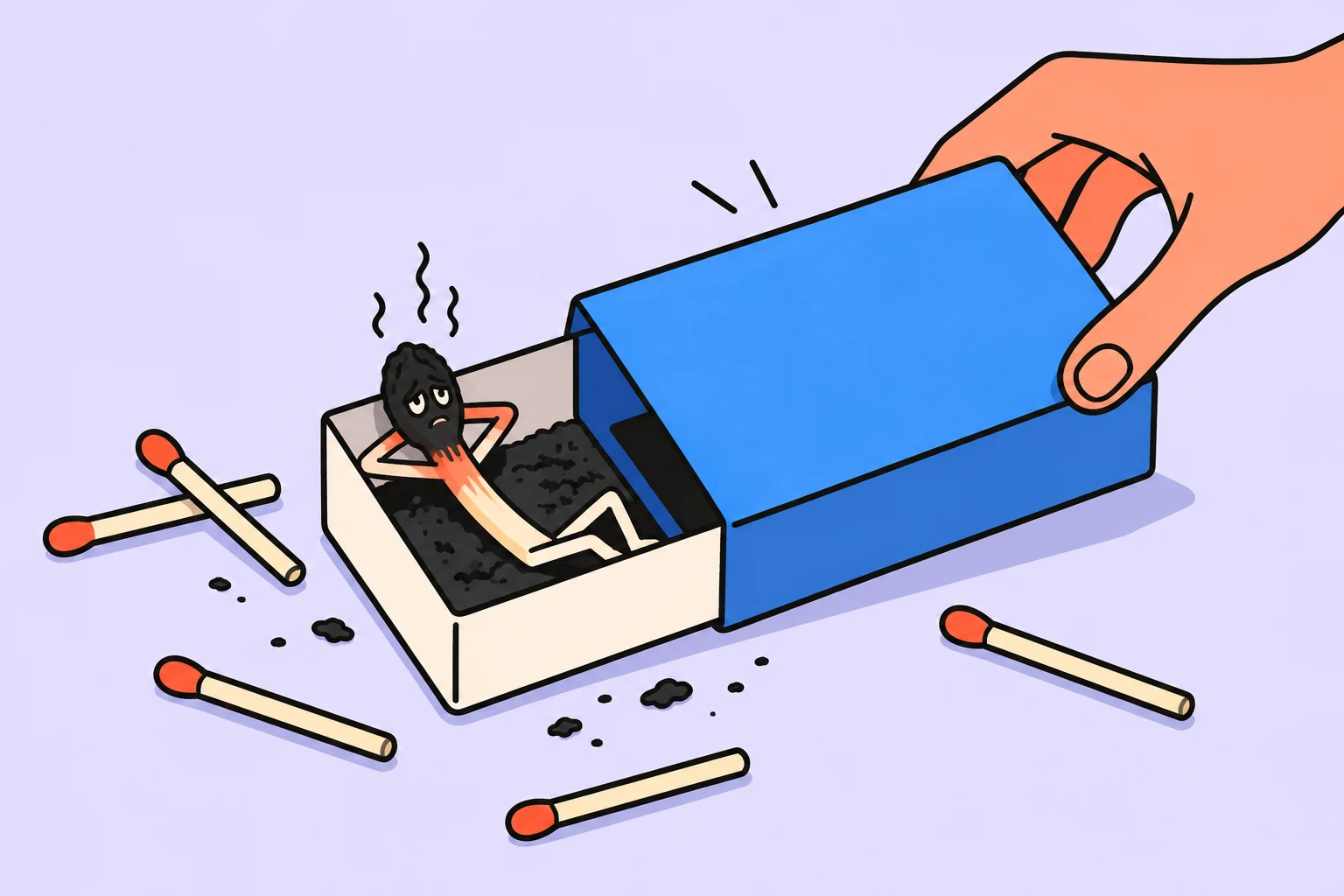
“I cannot do this anymore. I cannot work, I cannot think, I cannot even make myself get out of bed.” If this describes how you feel, and you have ADHD, you are not alone. ADHD burnout goes beyond ordinary tiredness. It is a systemic depletion of neurotransmitter resources that develops after months or years of overcompensation. People with ADHD burn out 3-4 times more often than neurotypical colleagues, and their burnout is deeper, lasts longer, and is harder to recover from. This article explains why it happens and how to protect yourself.
higher risk of burnout in adults with ADHD
of people with ADHD experience chronic exhaustion by age 30
more cognitive energy spent on everyday tasks with ADHD
Why ADHD and burnout form a perfect storm
To understand why ADHD burnout arrives sooner and hits harder, you need to appreciate the scale of daily energy expenditure. A neurotypical person handles most organizational functions on autopilot: remembering a task, switching activities, estimating time, and controlling impulses. With ADHD, each of these actions takes conscious effort.
Imagine spending the whole day driving a manual car in traffic while everyone around you drives an automatic. By the end of the day, you will be exhausted because every meter demanded attention and effort, regardless of the distance you traveled. That is what ADHD feels like: the same tasks, but 2-3 times the cognitive cost.
A University of Umeå study (Sweden, 2023) used fMRI to confirm that adults with ADHD activate additional brain regions during standard work tasks, regions that remain “dormant” in neurotypical people. The brain literally works harder to achieve the same result. Add chronic stress, masking, and guilt, and burnout becomes a question of “when” rather than “if.”
A meta-analysis of 23 studies published in European Psychiatry (2024) found that adults with ADHD have a 3.7 times higher risk of occupational burnout than a control group. The main factors were executive function deficits, emotional dysregulation, and compensatory behavior (masking).
ADHD masking: the silent energy drain
Masking means consciously or partly consciously hiding ADHD symptoms from others. You pretend to be organized while feeling chaotic inside. You pretend to pay attention in a meeting while your thoughts race. You pretend to be calm while anxiety rages within. Every moment of masking consumes cognitive energy.
Masking begins in childhood: a child with ADHD quickly learns that their “real” behavior leads to punishment and rejection. By adulthood, masking becomes second nature, so familiar that a person may not even realize how much energy it takes. But the body knows: chronic fatigue, headaches, muscle tension, and gastrointestinal problems are all physical manifestations of the energy spent on masking.
Masking is particularly destructive for women with ADHD: social expectations of organization, attentiveness, and emotional stability create a double burden. Many women with ADHD burn out before receiving a diagnosis. Read more about gender differences in the article Adult ADHD: signs and diagnosis.
How to distinguish ADHD burnout from ordinary tiredness
Ordinary tiredness goes away after rest. Ordinary burnout relates to specific external factors (a toxic job or overload) and improves when they are removed. ADHD burnout is different. It is systemic exhaustion resulting from years of chronic internal struggle with your own brain.
Specific signs of ADHD burnout include a complete collapse of compensatory strategies (you stop even trying to be organized), a sharp worsening of all ADHD symptoms (inattention, impulsivity, and forgetfulness all at their worst), emotional numbness or, conversely, uncontrollable emotional outbursts, physical exhaustion without objective causes, social isolation, and an aversion to any interaction.
The key difference: with ordinary burnout, a person knows they “need to rest.” With ADHD burnout, they may not even recognize the problem: masking runs so deep that exhaustion is disguised as laziness, depression, or a “bad character.” Check your condition regularly using the burnout test.
Four phases of the ADHD burnout cycle
ADHD burnout follows a predictable cycle. Understanding its phases helps you recognize where you are and take action before the situation becomes critical.
Phase 1: Overcompensation
You work harder than neurotypical colleagues to compensate for difficulties with organization and focus. Energy is high (often fueled by adrenaline), and results are impressive. Others admire you: “How do you get everything done?” Inside, tension is growing.
Phase 2: Increasing exhaustion
Neurotransmitter reserves are depleted. Productivity falls and procrastination increases. You try to push through with willpower: working even more, sleeping less, and giving up rest. This speeds up the approach to collapse. The first physical symptoms appear: insomnia, headaches, and colds.
Phase 3: Collapse (burnout)
A complete loss of productivity. Being unable to perform even basic tasks: replying to a message, washing dishes, or getting dressed. Often accompanied by depression, anxiety, and panic attacks. All ADHD symptoms are at their worst. A person may spend days in bed.
Phase 4: Slow recovery
Strength returns gradually over weeks or months. Without changes in strategies and lifestyle, the cycle repeats. Each subsequent cycle is usually deeper and longer than the previous one: the neurotransmitter system becomes increasingly vulnerable.
If you recognize yourself in Phase 3, see a doctor immediately. ADHD burnout at the collapse stage can be accompanied by clinical depression requiring medical intervention. You are more than “just tired”: your brain needs help. This is an understandable response to chronic overload, rather than weakness.
ADHD burnout: the role of dopamine depletion
At the neurochemical level, ADHD burnout involves depletion of the dopamine and noradrenaline systems. Baseline dopamine is already reduced in ADHD. Add months of chronic stress, insufficient sleep, and overcompensation, and the dopamine system literally “burns out”: receptors lose sensitivity and neurotransmitter synthesis decreases.
As a result, even things that used to motivate you (interesting projects, new tasks, and hyperfocus) stop producing a response. The world becomes “gray and meaningless”: a literal description of dopamine deficiency as well as a metaphor for depression. Read more about the dopamine system in ADHD in the article Dopamine and motivation in ADHD.
Restoring the dopamine system after burnout takes time. You cannot simply “recover over the weekend.” A systematic approach is required: quality sleep (receptor recovery), physical activity (stimulating synthesis), protein-rich nutrition (dopamine precursors), minimizing dopamine traps (social media and overeating), and possibly medication support under medical supervision.
Strategy 1: Stop masking and free up energy
Masking is one of the main sources of energy loss in ADHD. Where possible, begin taking off the mask, at least in safe settings. Tell loved ones, your partner, or trusted colleagues about your ADHD. Explain how it affects your work and life.
Ask for reasonable workplace accommodations: a quiet workspace or headphones, flexible hours (working during your productive windows), written rather than verbal instructions (to compensate for working memory), and the option to work from home when you need deep focus.
You do not have to disclose your diagnosis to everyone. But each person you trust with it becomes a “pressure-release point,” reducing the energy spent on masking. Even one understanding colleague or friend can radically change your energy balance.
Strategy 2: An energy budget for managing your resources
Imagine receiving a fixed number of “batteries” each day. With ADHD, you have fewer and use them faster. You cannot increase the number of batteries (except through treatment and recovery), but you can manage how you spend them.
Choose 1-3 priority tasks each day to receive most of your energy. Keep the rest at a “minimum setting” or delegate them. Never plan more than 3 difficult tasks in a day: that is a guaranteed path to exhaustion. Completing 2 tasks is better than starting 5 and finishing none.
Schedule recovery as an essential part of your day rather than a “reward for good work.” After 90 minutes of focused work, take a mandatory 15-20 minute break. Follow an intense workday with an easy evening without commitments. Follow a difficult week with a day off with minimal stimulation. The Sinqly task manager helps limit your daily workload.
Strategy 3: Automate everything you can
Every decision consumes cognitive energy. With ADHD, decisions are particularly difficult because of executive dysfunction and choice paralysis. Automation removes the need to make decisions and frees resources for genuinely important tasks.
What to automate: bill payments (automatic payments), groceries (a fixed list + delivery), clothing (a capsule wardrobe with the same combinations for each day of the week), breakfast (having the same thing every day is fine and even helpful for an ADHD brain), and work processes (email templates, checklists, and automatic replies).
Steve Jobs wore the same turtleneck to save decision-making resources for important things, rather than out of minimalism. With ADHD, this strategy is 10 times more relevant. Read more in the article How to organize life with ADHD.
Strategy 4: Establish early warning “stop signals”
Burnout does not happen suddenly: it develops gradually, often unnoticed. Learn to recognize your early “stop signals,” the individual signs that you are moving toward exhaustion.
Typical stop signals include deteriorating sleep (being unable to fall asleep or waking exhausted), increasing procrastination (putting off even favorite tasks), greater irritability (exploding over small things), physical symptoms (headaches, neck tension, and gastrointestinal problems), social withdrawal (canceling meetings and not replying to messages), and increased “self-medication” (more coffee, alcohol, sweets, and screen time).
Make a personal list of stop signals and share it with loved ones: they often notice changes before you do. Agree that when a partner or friend sees a stop signal, they will tell you directly: “Hey, I think you are at risk.” When a stop signal appears, immediately switch to recovery mode: reduce demands, increase sleep, and cancel nonessential commitments.
Strategy 5: Sleep is the foundation of recovery with ADHD
Sleep is the main tool for restoring neurotransmitter systems. Sleep problems affect 75% of adult patients with ADHD, creating a vicious cycle: poor sleep → worse ADHD symptoms → more stress → even worse sleep. Breaking this cycle is the number one priority in burnout prevention.
Practical recommendations: fixed bedtime and waking time (even on weekends, with no more than 1 hour of variation), a “shutdown ritual” 1-2 hours before bed (no screens, warm lighting, and quiet activities), a bedroom temperature of 18-20°C, magnesium before bed (200-400 mg, with your doctor's approval), and white noise or audiobooks to fall asleep (an ADHD brain cannot “switch off” in silence).
If you chronically get too little sleep, this is a problem you can and should address, rather than a “personality trait.” The effect of sleep on productivity is explored in detail in our separate article.
Strategy 6: Physical activity as an antidepressant
Physical activity during ADHD burnout is a form of medicine rather than “another obligation.” 20-30 minutes of aerobic exercise simultaneously raises dopamine, serotonin, and endorphins, creating a combined antidepressant and anti-burnout effect.
During burnout, start with the minimum: a 10-minute walk is better than nothing. Avoid ambitious goals: “running 5 km” is impossible in a state of burnout and will only increase guilt. Start with what you can manage: a walk around the block, 5 minutes of stretching, or gentle yoga. Gradually increase intensity as you recover.
For people with ADHD, novelty and enjoyment in physical activity matter. Running on a treadmill can be unbearably boring: try dancing, climbing, martial arts, or open-water swimming. A running habit can become a powerful source of support if you make it interesting: new routes, podcasts while running, or running with a friend.
Strategy 7: Accept your limitations without viewing them as weakness
This is the most difficult but most transformative strategy. People with ADHD often live with the belief that “I should be like everyone else.” Years of comparison with neurotypical peers, criticism from parents and teachers, and employers' expectations create an inner critic that demands the impossible.
The truth is that your brain works differently. It is neither better nor worse: it is different. Perhaps your productive windows total 4 hours a day rather than 8 (but in those 4 hours you can do more than most people do in 8). Perhaps you need to change tasks every 30 minutes. Perhaps you need more breaks. And that is okay.
Accepting limitations does not mean giving up. It means no longer spending energy fighting reality, and directing it toward building a system that works with your characteristics rather than against them. Read more about productivity strategies adapted for ADHD in the article ADHD and productivity.
Practice: make two lists. The first is “What I do exceptionally well because of ADHD” (creativity, hyperfocus, energy, and empathy). The second is “What is difficult for me because of ADHD” (organization, routine, and time estimation). Your task is to maximize the first list and automate or delegate the second. This is optimization rather than compromise.
Recovery after ADHD burnout: a step-by-step plan
If burnout has already happened, recovery will take time and patience. On average, 2-3 months with an active approach, and up to 6-12 months for severe burnout. Do not try to skip stages: each one matters.
Weeks 1-2: Reduce demands completely
Reduce all commitments as much as possible. Take vacation or sick leave if possible. Sleep as much as you need. No productivity: only basic needs such as food, sleep, and walks.
Weeks 3-4: Medical support
See a psychiatrist for an assessment and medication treatment (if you are not already receiving it). Begin or resume psychotherapy (CBT for ADHD). Get tests for vitamin D, iron, ferritin, and thyroid function: deficiencies worsen burnout.
Month 2: Gradual recovery
Add activities one at a time, one per week. Start with physical activities: a daily 20-30 minute walk and gentle exercise. Then add social activities: spending time with loved ones without commitments. Do not return to a full workload.
Month 3: Rebuild your system
Before returning to your previous rhythm, review your system. What led to burnout? Which compensatory strategies were unsustainable? Build a new system using these lessons: less masking, an energy budget, automation, and stop signals.
ADHD burnout and depression: how to tell them apart
ADHD burnout and depression have similar symptoms: loss of interest, fatigue, difficulty concentrating, and social isolation. However, they are different conditions that require different approaches. Depression can result from unrecognized ADHD: years of self-blame and setbacks create fertile ground for it.
Key differences: with ADHD burnout, a person can usually identify the exact cause of exhaustion (compensation, masking, or overload), while depression often seems “without cause.” With burnout, the ability to enjoy rest remains (even if briefly), whereas in clinical depression anhedonia is total. Rest helps with burnout (albeit slowly), but often does not help with depression.
Important: ADHD burnout can develop into full depression if no action is taken. Conversely, treating depression with antidepressants may be ineffective if the underlying cause is unrecognized ADHD. If you are unsure, see a psychiatrist specializing in ADHD for a comprehensive assessment.
When to seek professional help
Do not try to handle burnout alone: this is an ineffective strategy rather than a sign of strength. Seek help if burnout lasts longer than 2 weeks, you have suicidal thoughts (seek help immediately: helpline 8-800-2000-122), you cannot fulfill basic responsibilities, or compensatory strategies have stopped working.
Available help includes a psychiatrist for assessment, ADHD diagnosis (if not yet diagnosed), and medication; a psychotherapist (CBT for ADHD) for working through patterns and building sustainable strategies; an ADHD coach for practical organizational and planning support; and support groups for understanding from people with similar experiences.
The burnout section on Sinqly contains additional resources. And ADHD tools can help build a sustainable system that prevents the next burnout cycle.
Energy budget
Choose a few priorities for the day and leave the remaining tasks for later. There is no limit on the number of saved tasks
Smart break reminders
Automatic reminders to rest, adjusted to your work rhythm
Well-being monitoring
Daily check-ins track your emotional state and warn of approaching burnout
An AI coach without judgment
Support from AI that understands ADHD characteristics and helps without pressure or criticism
Frequently asked questions about ADHD and burnout
Why do people with ADHD burn out more often?
People with ADHD spend 40% more cognitive energy on everyday tasks because they must constantly compensate for executive function deficits. Masking, emotional dysregulation, and chronic guilt create additional demands that lead to systemic exhaustion.
How does ADHD burnout differ from ordinary burnout?
ADHD burnout results from a chronic internal struggle with your own brain, as well as external factors. Specific signs include a complete collapse of compensatory strategies, a sharp worsening of all ADHD symptoms, abandoning attempts to stay organized, emotional numbness, and physical exhaustion without obvious causes.
How long does recovery from ADHD burnout last?
An average of 2-3 months with active recovery, and up to 6-12 months for severe burnout. Recovery includes completely reducing demands (1-2 weeks), medical support, gradually returning to activity, and rebuilding your life system using the lessons learned.
How can you prevent burnout with ADHD?
Key strategies include reducing masking, managing your energy budget (1-3 tasks a day), automating routine work, establishing early warning stop signals, ensuring 7-9 hours of quality sleep and regular physical activity, and accepting your limitations without guilt.
Can ADHD treatment help with burnout?
Yes, ADHD medication (stimulants and nonstimulants), combined with cognitive behavioral therapy, significantly reduces the energy spent compensating for symptoms. When the brain receives neurochemical support, resources last throughout the day without overload.
What is masking, and why is it dangerous?
Masking means deliberately hiding ADHD symptoms from others. You pretend to be organized, attentive, and calm, spending enormous resources in the process. Years of masking are the main cause of accelerated ADHD burnout, particularly in women.
How are ADHD burnout and depression connected?
ADHD burnout often accompanies or develops into clinical depression. Chronic exhaustion and helplessness create the conditions for a depressive episode. Important: antidepressants may be ineffective if the underlying cause is untreated ADHD. See a specialist for a comprehensive assessment.
Turn an idea into action
Was this helpful?
Rate the article and tell us what was missing. Your feedback goes to the Sinqly team and will not be published on the site.
Dopamine and motivation with ADHD: using neurochemistry for productivity
How the dopamine system works with ADHD. 7 strategies for managing motivation through neurochemistry: gamification, stacking, micro rewards, and physical activity.
How to organize life with ADHD: a complete guide to systems and practical tips
A complete guide to organizing life with ADHD. Proven planning systems, practical tips, tools, and habits for people with attention deficit hyperactivity disorder.
The best apps for people with ADHD in 2026
The best ADHD apps: task managers, habit trackers, and focus timers. A detailed review of 12 tools for people with ADHD.