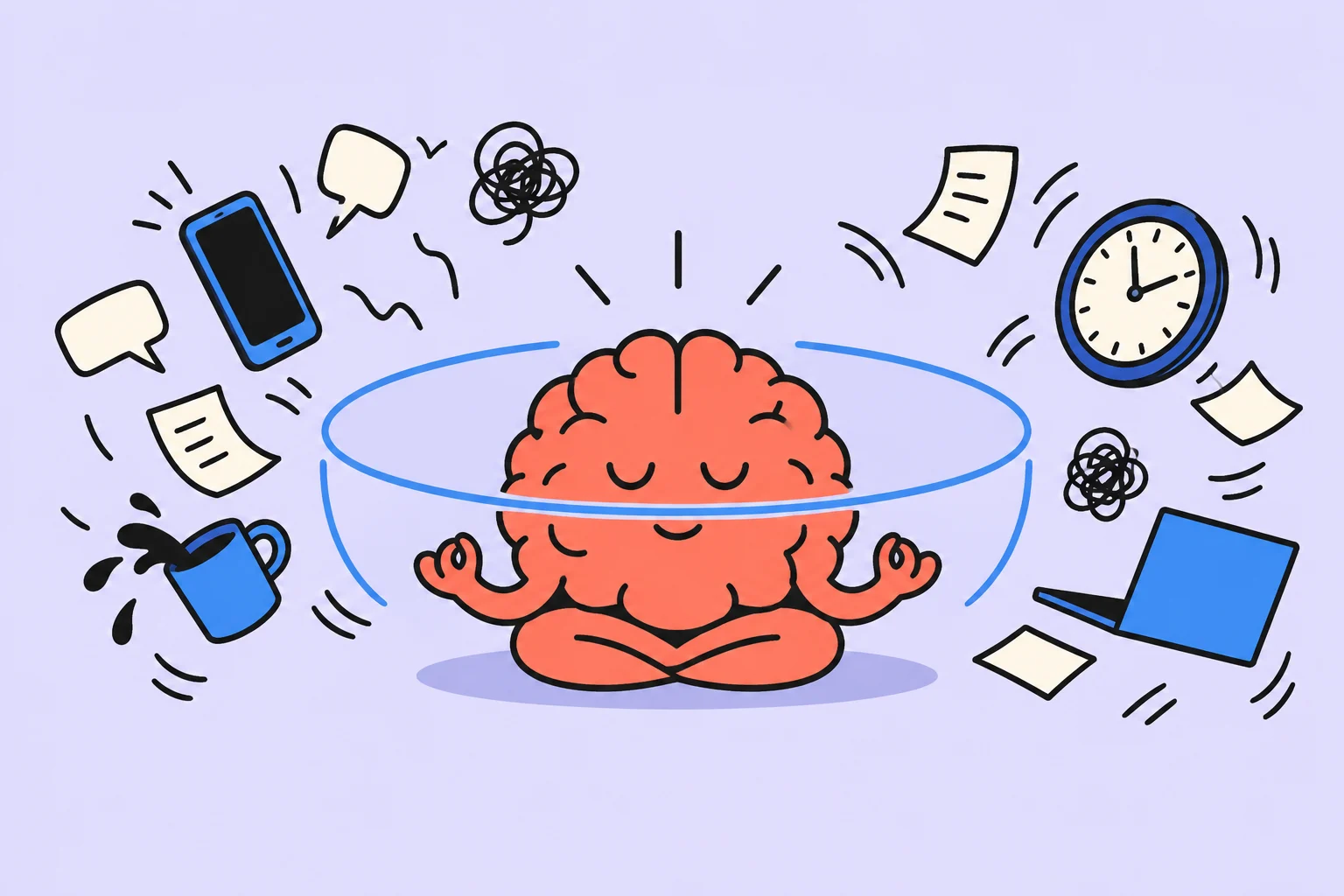
Concentration with ADHD involves more than simply learning to focus. It takes comprehensive work with the neurobiological characteristics of a brain that processes attention differently from a neurotypical brain. This article presents 12 scientifically grounded concentration techniques that really work for ADHD, from simple breathing exercises to advanced methods of managing attention.
minutes needed to restore concentration after a distraction
improvement in attention after 8 weeks of meditation with ADHD
increase in concentration after 20 minutes of physical exercise
The neurobiology of concentration with ADHD: why it is hard to focus
With ADHD, the brain's attention network functions differently: this is a group of regions including the prefrontal cortex, anterior cingulate cortex, and parietal lobe. These regions are responsible for executive attention, the ability to direct focus and hold it on the required object while ignoring distractions.
The dopamine and norepinephrine systems also work differently. A Nature Neuroscience study (2016) found reduced activity in the dorsolateral prefrontal cortex in ADHD, a key region for sustaining attention.
There is an important nuance, however: in ADHD, the problem is the inability to regulate attention rather than a lack of it. A person with ADHD can hyperfocus on an interesting task for hours, yet be unable to concentrate on a boring one for even 5 minutes. Effective concentration techniques take this characteristic into account.
A meta-analysis of 23 studies (2018) found that nonpharmacological interventions, including meditation, cognitive training, and physical exercise, improve attention with ADHD by 15–30%. This is a significant effect, comparable to low doses of medication.
Technique #1: adapted mindfulness meditation for ADHD
Traditional meditation, sitting quietly for 20 minutes and watching your breathing, works poorly with ADHD because there is too much internal activity. Adapted meditation techniques, however, show excellent results for improving concentration.
Walking meditation works better than remaining still: walk slowly (1 step per second), focusing on the sensations in your feet. Physical movement gives the ADHD brain enough stimulation to concentrate on the practice.
Short sessions of 3–10 minutes are more effective than long ones. A study in the journal Mindfulness (2017) found that adults with ADHD who practiced meditation for 8 minutes a day for 8 weeks improved their attention scores by 23%.
Start with 3-minute sessions
Find a quiet place and set a timer for 3 minutes. Do not try to meditate longer: with ADHD, short regular sessions are more effective than long ones.
Use an attention anchor
Instead of breathing, focus on a sound (white noise or a metronome) or tactile sensations (a stone in your hand or a textured ball).
Practice movement meditation
Slow walking, mindful eating, and focusing on body movements. Movement helps the ADHD brain sustain attention.
Do not fight distractions
With ADHD your thoughts will jump around: this is normal. Gently bring your attention back to the anchor without self-criticism.
Technique #2: physical exercise as a concentration stimulant
Physical activity is one of the most powerful natural attention stimulants for ADHD. Aerobic exercise increases BDNF (brain-derived neurotrophic factor), which promotes the growth of new neural connections in regions responsible for attention.
A study Journal of Attention Disorders (2018) found that 20 minutes of moderate aerobic exercise before cognitive tasks improves concentration by 40% and reduces impulsivity by 30% in people with ADHD. The effect lasts 2–4 hours.
The best exercises for concentration are brisk walking, jogging, cycling, swimming, and dancing: any activity that raises your heart rate to 120–140 beats per minute for 15–30 minutes. Strength training is less effective for immediately improving attention.
A workday tip: do 10 squats or push-ups before an important meeting or difficult task. Even brief activity increases dopamine and norepinephrine, neurotransmitters critical for concentration with ADHD.
Technique #3: managing your environment for maximum focus
With ADHD, your external environment plays a critical role in your ability to concentrate. Every stimulus within sight or earshot can potentially steal your attention. Creating an optimal environment for concentration is a necessity rather than a luxury.
The principle of minimalism: the fewer objects in sight, the easier it is to concentrate. Remove everything unnecessary from your desk, leaving only what you need for the current task. Close unused browser tabs: every open tab creates a cognitive load.
The sound environment: complete silence can be distracting for the ADHD brain, which starts searching for sounds. White or pink noise, instrumental music without lyrics, and nature sounds work better. Avoid music with lyrics: it competes with your main task for attention.
A minimalist space
A clear desk, unnecessary tabs closed, and minimal visual distractions. The ADHD brain finds it easier to focus in a sterile environment.
Optimal sound
White noise, binaural beats, and lo-fi music. The right audio accompaniment masks distracting sounds and stimulates concentration.
Lighting for focus
Bright daylight lighting (6500K) increases alertness. Dim light reduces dopamine and worsens ADHD symptoms.
Temperature comfort
A cool temperature of 18–22°C is optimal for concentration. Heat or cold diverts attention toward physical discomfort.
Technique #4: breathing exercises for regulating attention
Breathing is the only autonomic function we can consciously control. With ADHD, certain breathing techniques help activate the parasympathetic nervous system and improve the ability to concentrate.
The 4-7-8 technique: breathe in for 4 counts, hold for 7, and breathe out for 8. Repeat for 4–8 cycles. This technique reduces activity in the sympathetic nervous system (responsible for stress and anxiety) and activates the prefrontal cortex, a key region for attention.
Box breathing: breathe in for 4 counts, hold for 4, breathe out for 4, and hold for 4. Special forces use this technique to improve concentration under stress. With ADHD, it helps calm an overactive nervous system.
Technique #5: a modified Pomodoro technique for ADHD
The classic Pomodoro technique (25 minutes of work and a 5-minute break) is a poor fit for the ADHD brain. 25 minutes may be too long for tasks requiring intense concentration, or too short if you have entered a hyperfocus state.
An adaptation for ADHD: flexible intervals from 15 to 45 minutes, depending on the task and your current state. Use short intervals (15–20 minutes) for difficult tasks and long ones (30–45 minutes) for familiar tasks. Listen to your brain rather than the clock.
Active breaks instead of passive ones: get up, walk around, do a few exercises, and drink water instead of simply sitting on your phone. Physical activity during breaks resets attention better than passive rest.
A University of Illinois study (2019) found that people with ADHD using flexible work intervals (15–45 minutes) instead of a fixed 25 minutes demonstrate 35% better performance and lower stress levels.
Technique #6: visual anchors and external focusing aids
Internal attention regulation is weakened with ADHD, so external tools that remind the brain what to concentrate on are effective. Visual anchors create an external structure for attention.
A metronome or rhythmic sounds help synchronize attention. Many people with ADHD report that working to rhythmic music (80–120 BPM) improves concentration. Rhythm creates an external pacemaker for the brain.
Visual timers (Time Timer) show remaining time as a shrinking colored sector. This creates a visual sense of time, which ADHD often lacks because of time blindness.
Technique #7: cognitive training for working memory
Working memory, the ability to hold information in mind while processing it, is often impaired with ADHD. Weak working memory directly affects concentration: it is hard to focus on a task if you forget what you were doing a minute ago.
The N-back exercise: you are shown a sequence of stimuli (letters, numbers, or positions) and must determine whether the current stimulus matches the one N steps earlier. Start with 1-back, gradually increasing to 2–3-back.
A meta-analysis Clinical Psychology Review (2014) found that working-memory training improves inattentive symptoms with ADHD by 10–15%. The effect persists for up to 6 months after training ends.
Start with simple exercises
Do 5–10 minutes of working-memory training daily. Use apps such as Lumosity, Peak, CogniFit, or free N-back trainers.
Train regularly
The effect is cumulative: at least 4–6 weeks of regular training are needed for noticeable attention improvements.
Progress gradually
Increase difficulty only when you reach 80% accuracy at your current level. Tasks that are too difficult undermine motivation.
Transfer skills to real life
Consciously use your improved working memory in everyday tasks: planning, reading, and solving problems.
Technique #8: using interest and novelty to activate attention
With ADHD, attention is activated by three main factors: interest, novelty, and urgency. If a task is boring, familiar, and not urgent, the ADHD brain simply switches off. A useful hack is to artificially add these elements to any task.
Gamify boring tasks: turn routine work into a game with points, levels, and achievements. Set a timer and try to beat your speed record. Compete with colleagues to see who can process email faster. The ADHD brain loves competition and novelty.
Change context every 20–30 minutes: a different place, tool, or approach to the same task. For example, if you are writing a report on a computer, try outlining it by hand, switch cafés, or dictate instead of typing.
Technique #9: binaural beats for neural stimulation
Binaural beats involve playing sounds of slightly different frequencies in the left and right ear (for example, 400 Hz and 440 Hz). The brain hears the difference, 40 Hz, and synchronizes its activity with that frequency.
40 Hz (gamma rhythms) are associated with high concentration and cognitive performance. A study Frontiers in Human Neuroscience (2018) found that listening to 40 Hz binaural beats for 30 minutes improves attention and working memory.
Practical use: use 40 Hz binaural beats as background audio during work requiring intense concentration. Headphones are important: the effect works only when different frequencies reach different ears.
Binaural beats are unsuitable for people with epilepsy or seizure disorders. With ADHD and comorbid anxiety, start with low frequencies (8–10 Hz alpha rhythms) before moving to gamma frequencies.
Technique #10: cold therapy to activate attention
Brief exposure to cold activates the sympathetic nervous system and sharply raises dopamine and norepinephrine, neurotransmitters critically important for concentration with ADHD.
A cold shower for 1–3 minutes (15–20°C), or immersing your face in cold water for 30 seconds, activates the diving reflex, an evolutionary response that instantly increases alertness and concentration.
A study European Journal of Applied Physiology (2007) found that cold therapy raises norepinephrine by 530% and dopamine by 250%. The effect lasts 2–4 hours, making it ideal for activating concentration in the morning.
Technique #11: microbreaks to sustain attention
With ADHD, attention becomes exhausted faster than in neurotypical people. Trying to push through attention fatigue leads to a sharp drop in productivity. Regular microbreaks maintain a stable level of concentration.
The 20-20-20 rule: every 20 minutes, look at an object 20 feet (6 meters) away for 20 seconds. This both relieves eye strain and gives the attention system a microbreak.
Active microbreaks: 1–2 minutes of light exercise every 25–30 minutes. Jumps, stretching, and squats activate circulation in the brain and reset attention. Passive breaks (social media or videos) are less effective.
Technique #12: nutraceutical support for concentration
Some supplements show scientifically grounded effects for improving concentration with ADHD. Importantly, they complement the main techniques and medication (if indicated), rather than replacing them.
Omega-3 fatty acids (EPA/DHA): a meta-analysis of 10 studies found a 16% improvement in inattentive symptoms when taking 1000–2000mg daily for 12 weeks. The best sources are oily fish and quality fish-oil supplements.
Magnesium: it participates in more than 300 enzymatic reactions in the brain, including dopamine synthesis. Magnesium deficiency, common with ADHD, worsens concentration. Dosage: 200–400mg of magnesium glycinate before bed.
L-theanine and caffeine: the amino acid L-theanine (from green tea), combined with moderate doses of caffeine (a 2:1 ratio), improves attention without anxiety. Studies show a 15–25% improvement in concentration 30–60 minutes after taking it.
Consult a doctor before starting any supplement, particularly if you take ADHD medication. Some supplements can interact with medicines or intensify their side effects.
Creating a personal concentration system for ADHD
An effective concentration system for ADHD does not use all 12 techniques simultaneously: that would overload the brain. Start with the 2–3 techniques that resonate most, gradually integrating the others.
A basic combination for beginners: managing your environment (technique #3), modified Pomodoro (technique #5), and brief physical exercise before work (technique #2). These three techniques cover the main aspects: external distractions, time structure, and neurochemical activation.
An advanced system: add mindfulness meditation (technique #1), breathing exercises (technique #4), and binaural beats (technique #9). This level is for people who have already mastered the basics and are ready for more complex practices.
Choose 2–3 basic techniques
Do not try to introduce everything at once. Start with environmental management, physical exercise, and modified Pomodoro.
Practice regularly for 2–3 weeks
Concentration is a skill that develops only with practice. 10 minutes every day is better than an hour once a week.
Track results
Keep a concentration diary: which techniques work at which times of day, under what conditions, and for which tasks.
Gradually add new elements
Once the basic techniques become automatic, add more advanced ones: meditation, nutraceuticals, and cold therapy.
Frequently asked questions about concentration with ADHD
Can concentration be fully restored with ADHD?
ADHD is a lifelong neurobiological condition, but concentration can be significantly improved. A combination of techniques from this article can improve attention by 30–50%. With severe forms of ADHD, combining nonpharmacological techniques and medication achieves the greatest effect.
How long does it take to see results from concentration techniques?
Physical exercise and breathing techniques have an immediate effect (after 10–30 minutes). Meditation and cognitive training require 4–8 weeks of regular practice. Environmental changes work immediately, but getting used to new habits takes 2–3 weeks.
Which concentration techniques work best with ADHD medication?
Medication and nonpharmacological techniques reinforce each other. Stimulants increase the basic ability to concentrate, while the techniques help direct and sustain it. Environmental management, structured breaks, and cognitive training are particularly effective.
Do concentration techniques work for children with ADHD?
Many techniques can be adapted for children: short meditations (2–5 minutes), active breaks, gamification, and creating a calm study environment. Physical exercise is particularly effective for children: 20 minutes of activity before school improves attention for the whole day.
Can concentration techniques replace medication?
Only your treating physician can make this decision. Mild forms of ADHD can sometimes be managed well with nonpharmacological methods. With moderate and severe forms, medication remains the gold standard, but concentration techniques significantly increase its effectiveness and reduce the required dosage.
Which apps help train concentration with ADHD?
Effective apps include Forest (distraction blocking and timers), Headspace (short meditations for ADHD), Brain.fm (neuroacoustics), and Cold Turkey (website blocking).
Does nutrition affect the ability to concentrate with ADHD?
Very strongly. Avoid fast carbohydrates: they cause blood sugar spikes and worsen symptoms. A protein-rich breakfast, sufficient hydration, and omega-3 fatty acids improve concentration. Caffeine in moderate doses (50–100mg) can help, but avoid overdosing.
What music best helps concentration with ADHD?
The best options are white/pink noise, 40 Hz binaural beats, instrumental music without lyrics (lo-fi hip-hop or classical), and nature sounds. Avoid songs with lyrics: they compete with your main task for attention. A rhythm of 80–120 BPM is optimal for concentration.
Turn an idea into action
Was this helpful?
Rate the article and tell us what was missing. Your feedback goes to the Sinqly team and will not be published on the site.
Dopamine and motivation with ADHD: using neurochemistry for productivity
How the dopamine system works with ADHD. 7 strategies for managing motivation through neurochemistry: gamification, stacking, micro rewards, and physical activity.

Procrastination: 12 science-based ways to stop putting things off
Why we procrastinate and how to stop putting things off. 12 scientifically grounded methods for tackling procrastination, from the two-minute rule to cognitive therapy.
How to increase productivity: 10 scientific methods that really work
10 science-backed ways to increase productivity. Planning, focus, and energy-management techniques for maximum results.