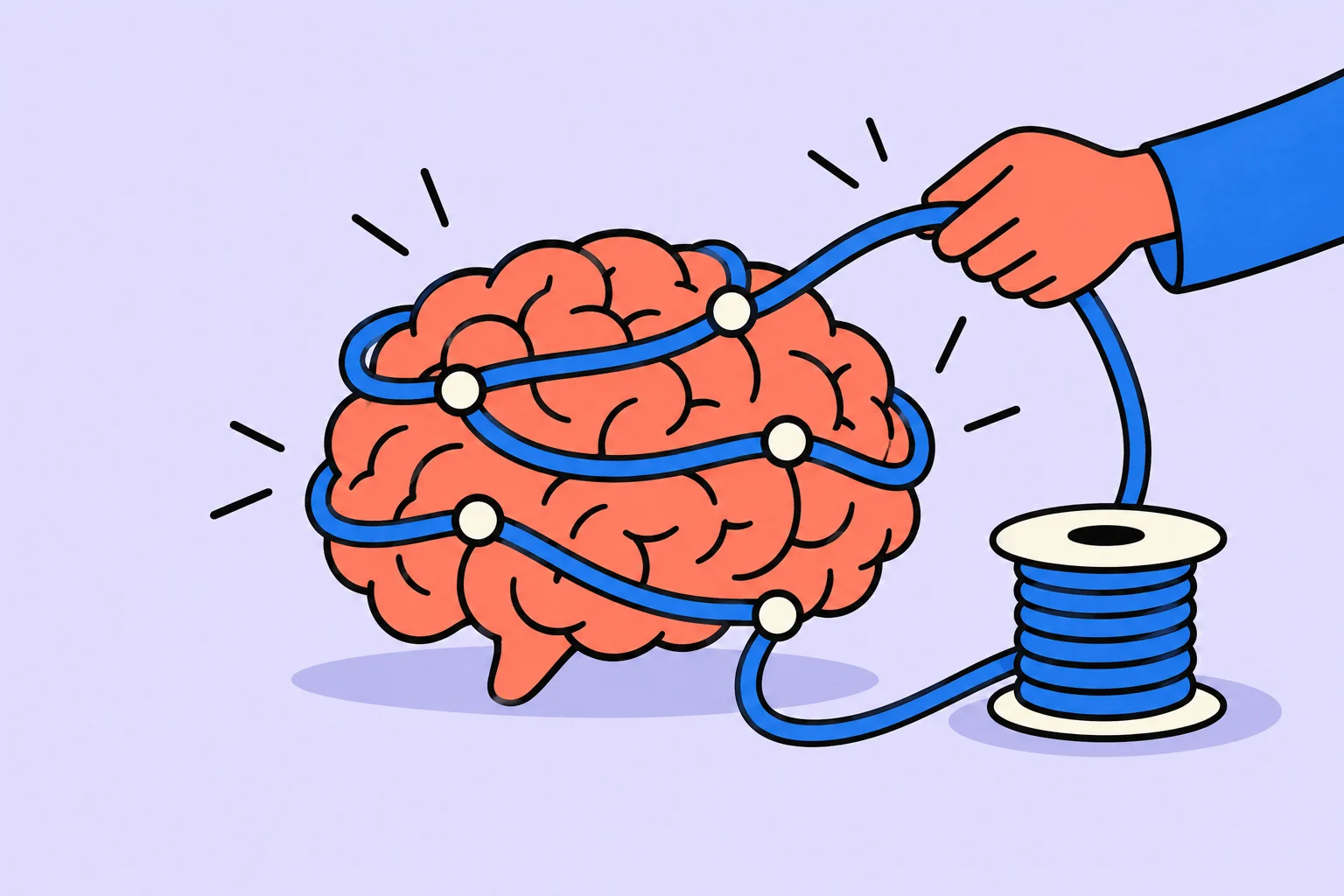
Every time you repeat an action, whether morning exercise or checking your phone, real physical changes occur in your brain. Neurons form new connections, become covered with myelin, and create “highways” for automatic behavior. According to research by Wendy Wood at USC, up to 43% of our daily actions are habits performed unconsciously. This article explores exactly how habits restructure the brain and how to use this knowledge to create beneficial behavioral patterns.
of actions are performed out of habit
days on average to form a habit
acceleration of signals through myelination
neurons in an adult brain
The basal ganglia: the brain's habit headquarters
Deep within the brain lie the basal ganglia, a group of neural structures that play a key role in forming and storing habits. When we first learn something new (such as driving), the prefrontal cortex, the region responsible for conscious thought and decision-making, is active. Every turn of the steering wheel requires attention and effort.
But with repetition, something remarkable happens: control of behavior gradually shifts from the prefrontal cortex to the basal ganglia. The action becomes automatic: you drive without thinking about every movement. This is an established habit at the neural level.
Neuroscientist Ann Graybiel at MIT has spent decades studying this process. Her animal experiments showed that basal ganglia activity follows a characteristic pattern: high activity at the beginning and end of an action (the trigger and reward), and minimal activity during the behavior itself. The brain literally puts the habit “on autopilot.”
Interestingly, the basal ganglia consist of several substructures: the striatum, globus pallidus, subthalamic nucleus, and substantia nigra. Each plays a role in processing habitual behavior. The striatum receives signals from the cortex and decides whether to “launch” a habitual action. The substantia nigra produces the dopamine needed for learning and reinforcement.
Patients with Parkinson's disease, which damages the basal ganglia, often lose the ability to perform familiar actions automatically. They have to consciously think about every step when walking, a process a healthy brain controls without conscious involvement. This clearly demonstrates how critical the basal ganglia are for habitual behavior.
The habit loop: trigger, action, and reward at the neural level
Neuroscience describes a habit as a loop with three elements: trigger (cue), action (routine), and reward (reward). Charles Duhigg popularized this model in The Power of Habit, but its roots lie in decades of MIT research.
A trigger is a signal from the environment or an internal state that initiates behavior. An alarm, the smell of coffee, boredom, or a particular time of day are all potential triggers. When the basal ganglia recognize a familiar trigger, they automatically launch the associated action, bypassing conscious control.
The action is the behavior that follows the trigger. It can be anything from meditation to scrolling a social media feed. The brain does not distinguish between “good” and “bad” habits: the neural mechanism of formation is the same.
The reward is the reinforcement that strengthens the connection between trigger and action. This is where dopamine comes in: a neurotransmitter signaling to the brain, “this is worth repeating.” A reward can be external (praise or tasty food) or internal (a sense of accomplishment or the pleasure of movement).
How the habit loop forms in the brain
A trigger
An external or internal trigger activates the striatum in the basal ganglia
Pattern recognition
The striatum checks whether a familiar behavioral pattern exists for this trigger
Automatic action
If a pattern is found, the action starts automatically, bypassing the prefrontal cortex
Evaluating the result
After the action, the brain evaluates the outcome (reward)
Dopamine signal
The dopamine signal strengthens or weakens the neural connection depending on the reward
Strengthening the connection
With every repetition, the connection strengthens and myelin thickens, making the habit stronger
The role of dopamine in habit neuroscience
A common misconception is that dopamine is the “pleasure hormone.” In fact, dopamine signals anticipated reward. In a series of experiments, neuroscientist Wolfram Schultz at the University of Cambridge showed that dopamine is released when the brain predicts a reward, rather than at the moment it receives one.
What does this mean for habits? When you repeatedly follow the “trigger → action → reward” loop, dopamine begins to be released as soon as the trigger appears, long before the reward itself. This creates a motivational impulse: the brain “wants” to perform the action because it already anticipates a reward. You have not started running yet, but the sight of your running shoes already brings a surge of energy.
Schultz also discovered the “reward prediction error” effect. If a reward is greater than expected, dopamine rises sharply and the connection strengthens. If the reward is smaller than expected, dopamine falls and the brain begins to become “disappointed” in the habit. This is why beneficial habits need to provide tangible satisfaction.
This is precisely why habits are so difficult to break: every time you see a trigger, the brain releases dopamine and creates a desire. You can deliberately use this mechanism to form beneficial habits by creating clear triggers and immediate rewards. The Sinqly AI coach helps design these loops around your dopamine system.
Social media, video games, and fast food exploit the dopamine system through powerful, unpredictable rewards. Variable reinforcement (when rewards arrive irregularly, as in slot machines) creates the most persistent neural pathways. Understanding this mechanism is the first step toward redirecting dopamine toward beneficial habits.
Myelination: how the brain builds “highways”
When you repeat an action, the neurons involved in that behavior begin to be covered with a myelin sheath : fatty insulation that speeds electrical signal transmission by up to 100 times. This process is called myelination and forms the physical basis of habit formation.
Imagine a neural connection as a dirt road. Every repetition adds a layer of asphalt. The more repetitions, the wider and faster the “highway.” Eventually, the signal travels so fast that the action happens automatically, without conscious involvement. Myelination explains why an experienced musician can play a complex piece while talking: the neural pathways are so well “paved” that they need no conscious control.
Daniel Coyle described this process in The Talent Code: mastery results from deliberate repetition that literally builds myelin “highways” in the brain, rather than magic. Oligodendrocytes, the cells that produce myelin, respond to how frequently signals pass along a neuron. More frequent signals mean more myelin.
It is important to understand that myelination works both ways. Bad habits also get “paved.” The strategically sound approach is therefore to start forming beneficial habits as early as possible and repeat them regularly. A habit tracker helps maintain this consistency by providing visual feedback on progress.
acceleration of nerve impulses with full myelination
signal speed along a myelinated neuron
signal speed without a myelin sheath
Neuroplasticity: the brain changes at any age
For a long time, the adult brain was thought to be a fixed structure incapable of change. Modern neuroscience has disproved this myth. Neuroplasticity, the brain's ability to form new neural connections and reorganize existing ones, continues throughout life.
The famous study of London taxi drivers (Maguire et al., 2000) found that drivers with many years of experience had a significantly larger hippocampus, the brain region responsible for spatial navigation, than the control group. The brain had physically changed in response to repeated activity.
For habit formation, this means it is never too late to start. Regardless of age, every repetition of a new behavior creates and strengthens neural connections. Neuroplasticity is indeed greater in youth, but it does not disappear. Studies of older people who began learning music after age 60 showed significant structural changes in the motor cortex after just a few months of regular practice.
The brain changes when you give up old habits as well as when you form new ones. When you stop performing a habitual action, the corresponding neural connections gradually weaken (but do not disappear completely, which is why “relapses” are possible even years later). This phenomenon is called synaptic pruning: “neurons that no longer work together stop being connected.”
The prefrontal cortex versus basal ganglia autopilot
The prefrontal cortex is the brain's “boss,” responsible for conscious decisions, planning, and self-control. But it has a serious limitation: it tires quickly. Conscious control is a finite resource, which psychologists call “ego depletion” or “decision fatigue.”
Habits are the brain's way of conserving prefrontal cortex resources. When behavior is automated and controlled by the basal ganglia, conscious attention is free for new tasks. According to Wendy Wood at USC, up to 43% of daily actions are habits performed on “autopilot.” The percentage is even higher in highly productive people.
This is precisely why effective daily planning includes automating as much routine work as possible. The more beneficial actions become habits, the more cognitive resources remain for creativity, strategic thinking, and complex decisions.
Barack Obama and Mark Zuckerberg are known for wearing the same clothes every day. This is a strategy rather than a whim: removing one decision from the daily routine preserves prefrontal cortex resources for genuinely important tasks. Building morning routines works on the same principle.
How stress affects habits and neural pathways
Stress is one of the most powerful influences on habitual behavior. Chronic stress increases cortisol, which has opposite effects on two brain systems: weakening the prefrontal cortex (conscious control) and strengthening the basal ganglia (automatic patterns).
In practice, this means the brain “reverts” to old habits under stress. If you quit smoking three months ago but experience severe stress, the risk of relapse increases sharply. This happens because cortisol literally switches off the part of the brain that controls behavior, rather than because you lack willpower.
A study by Lars Schwabe (Schwabe et al., 2011) found that stressed participants returned to old behavioral patterns 2.5 times more often, even when they knew the new behavior was more beneficial. Stress literally switches the brain from “goal-directed” to “habitual” mode.
This is why stress management is an integral part of working on habits. Meditation, physical activity, and sufficient sleep all lower cortisol and support prefrontal cortex function.
Applying habit neuroscience in practice
Understanding neural mechanisms provides more than interesting theory. It gives specific tools for forming beneficial habits and breaking harmful ones. Here are neuroscience-based strategies:
Create clear triggers
The more specific and consistent the signal, the faster the basal ganglia will “learn” to recognize it. “After my morning coffee, I meditate for 5 minutes” is better than “I will meditate in the morning.”
Provide an immediate reward
A checkmark in a habit tracker, praise from an AI coach, a growing streak, or a small celebration: micro-rewards that the dopamine system uses to reinforce the loop.
Minimize cognitive load
The simpler an action is at the start, the sooner it becomes automatic. Micro-habits of 2 minutes instead of 30 are an ideal starting point for myelination.
Repeat in the same context
A stable environment accelerates myelination. Keep the time, place, and preceding action consistent so the brain forms the association faster.
Manage stress
High cortisol switches off conscious control and returns the brain to old habits. Meditation, sleep, and movement protect your prefrontal cortex.
Be patient with the process
Myelination is a physiological process that takes time: 66 days on average. Every repetition adds a new layer of myelin, bringing you closer to automatic behavior.
Why bad habits are so powerful from a neuroscience perspective
The same mechanism that forms beneficial habits also works for harmful ones, often even more effectively. Bad habits usually provide a powerful immediate reward(sugar, nicotine, or a dopamine surge from social media) with minimal effort. From the dopamine system's perspective, this is the ideal combination for rapid learning.
Myelinated pathways for bad habits, formed through years of repetition, are extremely strong. The good news is that although an old neural pathway cannot be erased, it can be “redirected.” The most effective way to break a bad habit is to replaceit with another behavior using the same trigger, rather than suppress it. This approach is supported by research published in the journal Neuron.
For example, if the trigger is stress and the action is smoking, the replacement could be stress → 5 deep breaths → a feeling of calm. Over time, the new neural pathway strengthens and becomes dominant, although the old pathway remains, which is why “slips” are possible in stressful situations. Habit maintenance strategies help minimize this risk.
Another neuroscience-based tip is changing the context. Research shows that people who move to a new city find it easier to break bad habits. The reason: triggers from the old environment disappear, and the basal ganglia no longer receive familiar signals. You can use a smaller version of this approach: change your route, rearrange furniture, or remove visual triggers.
Sleep and habit consolidation in the brain
Sleep plays a crucial and often overlooked role in habit formation. During deep sleep (slow-wave sleep), the brain “replays” the day's experiences, a process called memory reactivation. Neural circuits used during the day are reactivated at night, strengthening synaptic connections.
A University of Chicago study found that people who slept sufficiently after practicing a new skill performed 20-30% better the following day than those who slept little. Sleep literally “cements” neural pathways formed during the day.
For habit formation, this means insufficient sleep does more than reduce motivation. It physically slows myelination and weakens synaptic connections. If you are forming a new habit, 7-9 hours of sleep are essential rather than optional. Sinqly helps track sleep quality alongside habit progress so you can see the relationship.
To accelerate habit formation, perform the new action in the evening before bed. This gives the brain “fresh material” for overnight consolidation. Morning habits work too, but they have to survive an entire day before sleep reinforces them.
The stages of habit formation in neuroscience
Habit formation is not instantaneous. Neuroscience identifies several successive stages, each with its own characteristics at the brain level:
4 neural stages of habit formation
Initiation (days 1-7)
The prefrontal cortex is highly active, and every repetition requires willpower. Dopamine is released only when the reward is received. Myelination is minimal.
Learning (days 8-21)
The basal ganglia begin recognizing the pattern. Dopamine shifts toward the trigger. Less conscious effort is needed, but the habit is still fragile.
Stabilization (days 22-66)
The neural pathway is actively myelinating. The action becomes semiautomatic. Missing one day does not destroy the habit, but two or three consecutive days are a danger zone.
Automaticity (66+ days)
The basal ganglia fully control the behavior. The prefrontal cortex is barely involved. The habit runs on autopilot, and it takes effort NOT to do it.
Understanding these stages helps you avoid giving up at the hardest point: the first two weeks. Knowing that difficulties are a normal part of the neural process, rather than a sign of your “weakness,” makes it easier to continue.
Tools for building neural habits
Knowing the neuroscience gives you an advantage, but practical application requires tools. Modern technology makes it possible to create an optimal environment for habit formation based on how the brain works:
- Habit tracker — visual feedback activates the dopamine system. A growing streak and micro-habit tracking create a predictable reward that accelerates loop formation.
- Contextual reminders — push notifications tied to a specific time or event create a reliable trigger for the basal ganglia.
- AI coaching — a personal AI coach helps design habit loops and choose optimal triggers and rewards based on your lifestyle.
- Wheel of life — an assessment of life areas shows where habits are needed most, helping set priorities.
- Reflection journal — writing about progress activates metacognitive processes and helps the prefrontal cortex maintain control during learning.
Frequently asked questions about habit neuroscience
Which part of the brain is responsible for habits?
Automatic habits are controlled by the basal ganglia, subcortical structures deep within the brain. They take over repetitive actions, freeing the prefrontal cortex for new tasks. The striatum plays a key role: this part of the basal ganglia decides whether to initiate habitual behavior.
Can you reprogram the brain through habits?
Yes. Neuroplasticity allows the brain to form new neural connections at any age. Regular repetition of new behavior literally changes the brain's structure, as confirmed by MRI studies. Reprogramming takes 18 to 254 days, depending on the habit's complexity.
What role does dopamine play in habit formation?
Dopamine signals anticipated reward rather than being a “pleasure hormone.” When the brain predicts a reward, dopamine is released before the action, creating motivation to repeat the behavior. As a habit forms, dopamine begins to be released when the trigger appears rather than when the reward is received. This is a key mechanism for reinforcing the habit loop.
How long does the brain need to form a new neural pathway?
From 18 to 254 days, averaging 66 days according to a UCL study (Phillippa Lally, 2009). The neural pathway begins strengthening with the very first repetition: each performance adds a layer of myelin and makes the connection stronger. Complex habits take longer than simple ones.
What is myelination, and how does it relate to habits?
Myelination is the process of covering neurons with a fatty sheath (myelin), which speeds nerve impulse transmission by up to 100 times. The more often you repeat an action, the thicker the myelin sheath and the faster and more automatically the habit is performed. This is the physical basis of the transition from conscious effort to automaticity.
Can you eliminate a bad habit at the brain level?
An old neural pathway cannot be erased completely, but you can create a stronger alternative pathway. The most effective way is to replace the harmful action with a beneficial one using the same trigger. Over time, the new pathway strengthens and becomes dominant, although severe stress can cause a “reversion” to the old pattern.
How does stress affect habit formation?
Chronic stress increases cortisol, which weakens the prefrontal cortex (conscious control) and strengthens the basal ganglia (automatic patterns). As a result, the brain “reverts” to old habits even when you know the new behavior is better. Managing stress is therefore a crucial part of working on habits.
Turn an idea into action
Was this helpful?
Rate the article and tell us what was missing. Your feedback goes to the Sinqly team and will not be published on the site.
21 Days to Build a Habit: Myth or Reality?
Are 21 days really enough to build a habit? Exploring the UCL study, the neuroscience of automatic behavior and realistic timelines.
Atomic Habits: A Summary of James Clear’s Book
A summary of Atomic Habits: the 4 laws of behavior change, the 1% principle, the habit loop, and practical ways to apply Clear’s ideas.
Dopamine and motivation with ADHD: using neurochemistry for productivity
How the dopamine system works with ADHD. 7 strategies for managing motivation through neurochemistry: gamification, stacking, micro rewards, and physical activity.