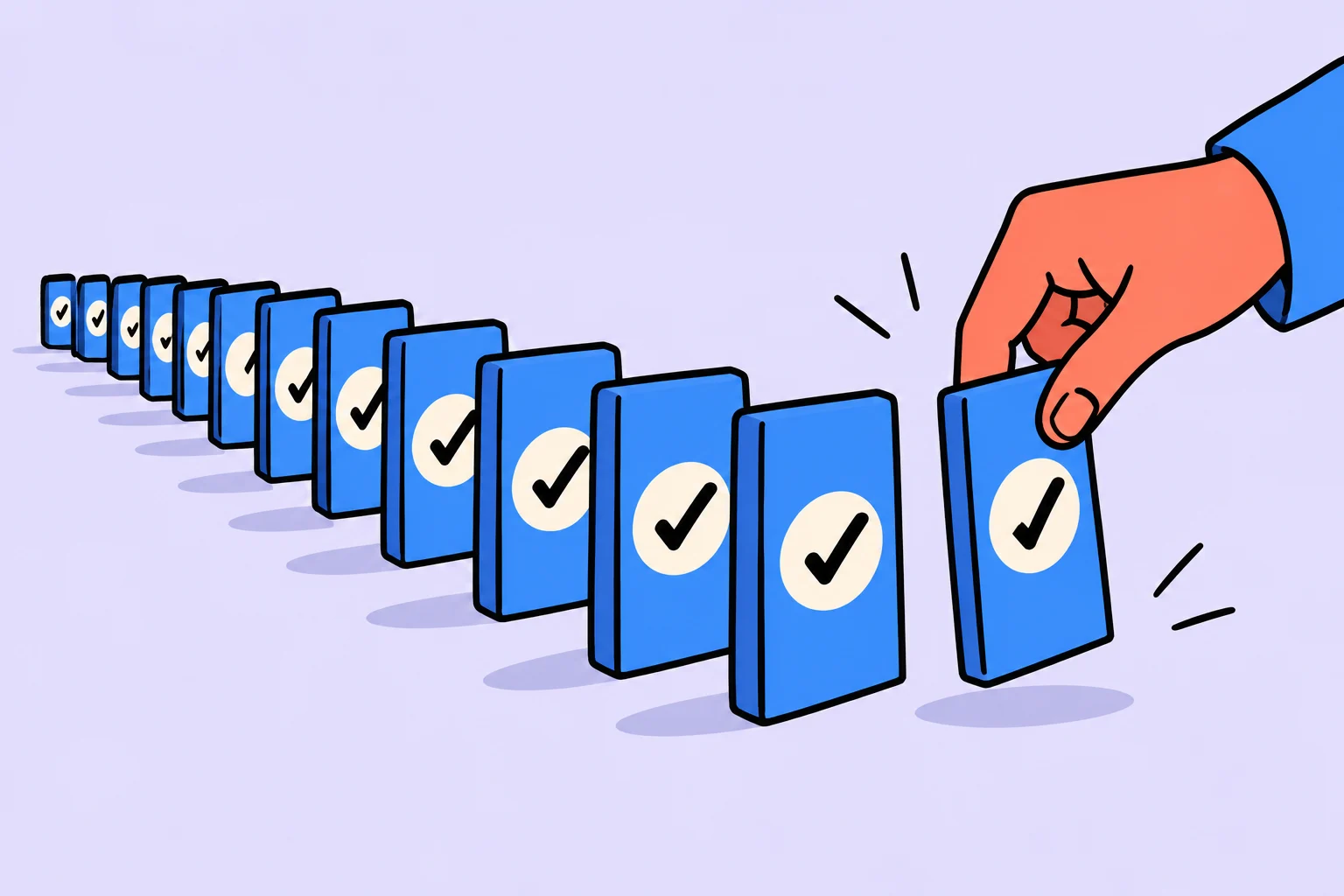
A habit streak is an unbroken sequence of days on which you complete a planned action. Meditating for 30 consecutive days. Going 100 days without sugar. Journaling daily for 365 days. Streaks have become one of behavioral psychology's most powerful motivational tools, supported by substantial neuroscience. In this article, we examine why habit streaks work, when they become harmful, and above all, how to keep a streak going even on the hardest days.
You probably know the situation: you maintained a habit for 20 days, missed once, and everything fell apart. Research shows this is neither your fault nor a character weakness. It is a predictable psychological mechanism. Understanding it lets you build a strategy that protects your habit streak from breaking.
more intense is the feeling of losing a streak than the joy of building one
of Duolingo users are motivated by streaks
days on average to establish a lasting habit
increase in the likelihood of establishing a habit when tracking streaks
What is a habit streak, and why does it work?
A habit streak counts consecutive days on which you complete a particular action. The concept is simple: check a box every day, watch the number grow, and motivation grows with it. But this simplicity conceals several powerful psychological mechanisms.
The dopamine loop. When you see a growing habit streak, your brain releases dopamine, the neurotransmitter of pleasure and motivation. Each new day in the streak is a small victory that reinforces the behavior. According to neuroscientist Wolfram Schultz's research, dopamine is released both when receiving a reward and when anticipating it, meaning that maintaining the streak itself becomes a source of pleasure.
The accumulated investment effect. The longer your streak, the more you have “invested” in it. Losing a 50-day streak means losing 50 days of effort. This creates a powerful incentive to continue even when motivation drops. Economists call this the “sunk cost effect.” Although it is a cognitive bias in investing, it works in your favor when building habits.
Visual feedback. The human brain processes visual information 60,000 times faster than text. An unbroken chain of green checkmarks or a growing number is instantly recognized as progress. Jerry Seinfeld used this principle to write jokes every day: he marked each working day with a red X on a calendar and aimed not to “break the chain.”
The neuroscience of habit streaks: what happens in the brain
Specific neurobiological processes underlie the appeal of habit streaks. Understanding them will help you use streaks deliberately rather than becoming their prisoner.
The basal ganglia and automatic behavior. When you repeat an action day after day, control gradually shifts from the prefrontal cortex (where conscious decisions happen) to the basal ganglia (where automatic behaviors reside). A habit streak accelerates this transition by ensuring daily repetition, the most effective pattern for forming neural connections.
Loss aversion: the fear of losing. Psychologists Kahneman and Tversky demonstrated that people feel a loss twice as strongly as an equivalent gain. Losing a 30-day streak feels like a genuine loss, and that fear motivates you to continue. This is the streak's most powerful mechanism, but it can also become destructive, as discussed below.
Cortisol and anxiety about interruption. When you realize you might lose a long habit streak, cortisol (the stress hormone) rises. In moderate amounts, this mobilizes you: you find time for the habit despite being busy. But excessive cortisol causes anxiety and burnout. Configure your streak to motivate rather than pressure you.
University College London research found that forming an automatic habit requires an average of 66 days of daily repetition, with a range of 18 to 254 days. One missed day did not erase progress: the habit continued becoming automatic if the person returned to it the following day. This is a crucial finding for anyone afraid of breaking a streak.
The Zeigarnik effect: why habit streaks are compelling
Soviet psychologist Bluma Zeigarnik discovered a surprising phenomenon: unfinished tasks are remembered 90% better than completed ones. The brain keeps an “open tab” for unfinished business and returns to it repeatedly.
A habit streak is a perpetually unfinished task. While the streak continues, the brain treats it as an open loop that needs to continue. This explains why Duolingo's streaks are so compelling: you simply cannot forget an unfinished streak because your brain reminds you automatically.
Practical application: if you want a habit to stay on your mind, start tracking a streak. After just 3-5 days, the streak will begin serving as an automatic reminder. You will remember the habit without alarms or notifications, simply because the brain cannot let go of an unfinished chain.
When a habit streak helps: 5 ideal scenarios
Not all habits are equally suited to streaks. Here are five situations where habit streaks work best:
1. Building new habits (the first 66 days). A streak creates external motivation before internal motivation has formed. It acts as training wheels for a habit. If you are just starting to meditate or keep a journal, a streak will help you get through the first difficult weeks.
2. Daily habits. Streaks are ideal for actions you need to do every day: morning exercises, reading, and morning rituals. For habits practiced 3-4 times a week, a percentage format works better.
3. Habits of abstaining. Avoiding alcohol, cigarettes, and sugar: streaks are especially effective for these habits because every day without the harmful behavior is a concrete, countable victory.
4. Creative habits. Writing, drawing, or playing an instrument every day: creative habits often stall because of perfectionism. A streak lowers the bar: what matters is the daily action rather than its quality. Write 100 words, and your streak survives.
5. Periods of low motivation. When internal motivation falls, as it does for everyone, a habit streak becomes an external anchor. “I don't want to meditate, but I have a 45-day streak, so I'll keep it going” is a strategy that works.
When a habit streak harms: the dark side of streaks
Streaks are a powerful tool, but like any tool, they can cause harm when used incorrectly. Here are four situations where a habit streak becomes destructive:
Perfectionism and anxiety. Someone is ill but forces themselves to run 5 km to preserve the streak. Or they skip sleep because they “need to finish 30 pages for the streak.” When a habit streak becomes an end in itself and damages health, it is a problem.
The “what-the-hell effect.” After one missed day, someone thinks, “That's it, I've failed, the streak is gone,” and abandons the habit entirely. Researchers Janet Polivy and Peter Herman described this effect in dieting: one piece of cake became “Since I've started, I might as well eat the whole thing.” The same happens with habits: one missed day leads to giving up completely.
Doing it just to check a box. When the streak becomes more important than the habit, people start cheating: formally marking completion without actually doing anything. Open a meditation app for 10 seconds, and the streak survives. This devalues both the habit and the streak.
Rigidity instead of flexibility. Life is unpredictable. Illness, business trips, and family circumstances can all prevent daily completion. If a habit streak allows no exceptions, it creates constant stress and guilt.
A streak has become a problem if you: (1) sacrifice sleep, health, or important commitments to preserve it; (2) feel intense anxiety at the thought of missing a day; (3) perform the habit merely to check a box; (4) feel like a failure after a break and abandon the habit entirely. In these cases, switch to a flexible tracking format.
12 strategies for maintaining a habit streak
Now for the main point: specific strategies to help you maintain a habit streak even during the hardest periods. These methods are based on behavioral psychology and have been tested by thousands of users.
The “minimum version” rule
On a difficult day, do a tiny version of the habit. One minute of meditation instead of twenty. Do 5 push-ups instead of a full workout. Write 50 words instead of 1000. This preserves the streak and the neural “trigger-action-reward” connection. Stanford professor BJ Fogg calls these “tiny habits,” and this is the most powerful strategy for protecting a streak.
A flexible streak with allowed missed days
Allow yourself 1-2 missed days a month without resetting the streak. This relieves perfectionist pressure and lets you be human rather than a robot. Many habit trackers support this feature: look for “allowed skips” or “grace days.”
Connect the habit to an anchor
Link the habit to an existing daily action: “after my morning coffee, 5 minutes of meditation” or “before bed, 10 pages of a book.” The anchor acts as a trigger and makes forgetting the habit less likely, protecting your streak.
Prepare your environment in advance
Lay out your yoga mat the evening before. Put a book on your pillow. Leave running shoes by the door. The less effort starting requires, the more likely you are to follow through. Research shows that reducing initial friction increases the likelihood of action by 20-30%.
Use the “two-minute rule”
If the habit feels difficult, tell yourself, “I'll just start and do 2 minutes.” In most cases, you will continue longer, but even 2 minutes is enough to preserve the streak and neural connection.
Track visually
A physical calendar with red Xs, an app with a chain of green days, or a notebook with checkmarks: visual tracking increases streak motivation 2-3 times compared with simply remembering it mentally.
Here are six more strategies that work over the long term:
7. Multiple progress metrics. Do not fixate on a single number. Track your current streak, all-time best streak, and total completion days. This way, breaking a streak does not erase all progress: you can see that you practiced the habit on 87 out of 100 days. That is 87%, an excellent result even if your longest streak was 34 days.
8. Streak challenges with a finish line. An endless habit streak creates pressure. A defined goal motivates. Set a target of 21, 30, or 66 days. Reached it? Celebrate and start a new challenge. This creates “challenge-achievement-reward” cycles that sustain motivation.
9. A streak partner. Find someone practicing the same habit and maintain your streaks together. Social pressure is a powerful motivator. Research shows that having a partner increases the likelihood of establishing a habit by 65%.
10. Reminders at critical moments. Set reminders for the time you usually skip, rather than the planned completion time. If you skip in the evenings when tired, set a reminder for 20:00 saying “Minimum version: 2 minutes.”
11. The “never miss twice” rule. One missed day is an exception. Two in a row are the beginning of a new habit: the habit of not doing it. If you miss one day, the following day becomes critical. It determines whether you return to your habit streak.
12. Use an AI tracker with intelligent support.
How to start a habit streak properly: a step-by-step plan
Starting a streak is a strategic decision rather than a burst of inspiration. Here is how to prepare so your habit streak has the best chance of success:
Step 1: Choose ONE habit. Not three or five: one. Dividing attention among several streaks reduces each one's chance of success. Once the first habit becomes automatic (after 30-66 days), add a second.
Step 2: Define the minimum version. Before starting the streak, decide what counts as completed in the smallest form. This is your safety net for difficult days. For small habits , it can literally be 30 seconds.
Step 3: Choose a trigger and anchor. “After my morning coffee, I will meditate for 10 minutes.” A clear trigger reduces the likelihood of skipping by 40% because you do not have to decide when and where all over again each day.
Step 4: Prepare your environment. Remove barriers to the habit. Put your book somewhere visible, install a meditation app, and prepare workout clothes. Every removed barrier adds 10-15% to the likelihood of completion.
Step 5: Set your first goal—7 days. Not 30 or 100: seven. This feels psychologically comfortable and achievable. After a week, you will notice the first results and want to continue. Then set a goal of 21 days, followed by 30, then 66.
What to do after breaking a streak: step-by-step recovery
Breaking a habit streak is not the end. It is a normal part of the process. Research in the British Journal of Sports Medicine shows that one missed day does not affect a habit's long-term automaticity. Your response to that missed day does.
Step 1: Acknowledge the missed day without drama. “I missed a day. That's normal. A 47-day streak means I completed the habit 47 times. One missed day does not erase that progress.”
Step 2: Understand the cause. Why did you miss it? Illness? An emergency? Forgetfulness? Laziness? Understanding the cause helps prevent a repeat. If you forgot, add a reminder. If you did not feel like doing it, simplify the habit.
Step 3: Return IMMEDIATELY. The day after a lapse is the most important. Do the habit, even in its minimum form. Remember the rule from habit retention strategies: “Never miss twice in a row.”
Step 4: Restart your streak with pride. A new streak is not starting from zero. It is a new attempt informed by your previous streak. You know more about your weak points and can prepare better.
Step 5: Analyze and adapt. Every broken streak is information. Perhaps the habit is too difficult, the timing inconvenient, or you need flexible streaks that allow missed days. Use analytics in your habit trackerto identify patterns in missed days.
Instead of the binary “streak alive/streak dead,” use the 90% rule. If you completed the habit 27 times in the past 30 days, that is 90%, an excellent result. Even 80% (24 out of 30 days) represents a consistent habit. Switching to percentages reduces anxiety and allows flexibility without guilt.
The ideal habit streak length for different goals
How many days should a habit streak last? It depends on your goal. Here are scientifically grounded recommendations:
7 days: trying out a habit. A week-long streak helps you understand whether a habit suits you. In 7 days, you will feel whether the timing and format are comfortable and appropriate. If the habit brings only negative feelings after a week, reconsider your approach.
21 days: basic reinforcement. The “21 days to form a habit” myth is not quite accurate (it actually takes 66 days), but 21 days is a good first goal. By then, the action will feel familiar, though not yet automatic.
30 days: a standard challenge. Monthly challenges are popular for a reason: 30 days feels psychologically comfortable. It is long enough for noticeable progress and short enough to see the finish line. A streak is an ideal motivational tool for a 30-day challenge.
66 days: becoming automatic. According to Phillippa Lally's research, a habit becomes semiautomatic after 66 days. You will no longer need to force yourself: the action will become part of your routine. By this point, tracking a streak may become optional.
100+ days: mastery. A three-digit habit streak is a serious achievement. By 100 days, the habit is usually fully automatic, and the streak becomes a pleasant bonus rather than a necessity. Continue tracking if it motivates you, but do not pressure yourself.
Habit streaks in digital trackers: what to look for
Choosing the right habit tracker is critical for streak success. Here are features that help maintain a habit streak:
Prepare a simple way to resume a habit after a missed day instead of resetting the entire plan. Create a task in Sinqly: registration is free.
The psychology of long streaks: what changes on days 30, 60, and 100
A habit streak is more than a growing number. You pass through different psychological phases at different points in the streak:
Days 1-7: beginner's euphoria. Motivation is high and enthusiasm is overflowing. This is the easiest time for a streak. The trap: you may set the bar too high to maintain later. The solution: deliberately choose a minimum format for the first week.
Days 8-21: the valley of disappointment. The euphoria has passed, but automatic behavior has not yet formed. This is the most dangerous period for breaking a habit streak. Minimum versions, anchors, and reminders help most here. Every day you get through in this phase is a genuine victory.
Days 22-45: growing confidence. The habit becomes familiar, and the streak substantial. You begin to feel proud of it and protect it. Loss aversion works at full strength. The trap: perfectionism and doing it merely to check a box.
Days 46-66: transitioning to automatic behavior. The habit begins running on autopilot. You do it without thinking, like brushing your teeth. The streak becomes a pleasant bonus rather than your main motivation. This indicates that the habit is established.
Days 67+: a stable habit. The habit streak continues through momentum. You can stop actively tracking it: the habit sustains itself. Or continue for the pleasure of watching the number grow. Both are excellent outcomes.
How to maintain a streak while traveling or changing environments
Travel, business trips, and moving are the main streak killers. Your familiar environment changes, anchors disappear, and the streak is threatened. Here is how to protect it:
Prepare a “travel version” of the habit. Instead of a full workout, do 10 minutes of exercises in your room. Instead of meditation with an app, do 5 minutes of mindful breathing. Instead of reading a paper book, listen to an audiobook through headphones. Every habit should have a portable version.
Transfer the anchor. If you meditate after coffee at home, link the habit to coffee while traveling too, even if you drink it at a different time and place. The anchor (the triggering action) matters more than the precise hour.
Tell your streak partner. If you track habit streaks with someone, tell them about your trip. Ask them to remind you: social support is especially important in unfamiliar surroundings.
Use the “time zone rule.” When changing time zones, decide whether a day counts according to home or local time. Set this in advance to prevent tracking confusion. Most trackers let you configure when a “new day” begins.
Habit streaks for different areas of life
Habit streaks work in any area, but the approach needs adapting. Here are recommendations for the areas of the wheel of life:
Health and exercise. Streaks for workouts, healthy eating, and 7+ hours of sleep. Important: always include rest days in exercise plans. An “exercise every day” streak can lead to injury. A better format is “5 out of 7 days” with a flexible streak.
Personal development. Streaks for reading, language learning, and keeping a reflection journal. Minimum version: 1 page of a book, 1 lesson in an app, or 3 sentences in a journal.
Productivity. Streaks for planning your day, completing your main task, and reviewing the week. These habits form your productivity's “operating system,” and a streak helps build them into your daily routine.
Mental health. Streaks for meditation, gratitude, and outdoor walks. Particularly effective for people with anxiety: regular practice lowers baseline anxiety by 30-40% after 8 weeks.
Finances. Streaks for budgeting, recording expenses, or days without unnecessary purchases. Financial habits work especially well with streaks because the outcome—money saved—is visible and measurable.
Frequently asked questions about habit streaks
What is a habit streak, and why do you need one?
A streak is an unbroken sequence of days on which you complete a habit. A habit streak is a motivational tool: seeing the chain grow releases dopamine, reinforcing the behavior and helping make the habit automatic. Research shows that tracking streaks increases the likelihood of establishing a habit by 40%.
How many days does it take to establish a lasting habit?
According to University College London research (Phillippa Lally, 2009), establishing a lasting habit takes an average of 66 days, although the range is 18 to 254 days depending on complexity. Simple habits (a morning glass of water) form faster; complex habits (daily workouts) take longer.
How can you maintain a habit streak on difficult days?
Use the “minimum version” rule: on a difficult day, do a tiny version of the habit. Instead of a 30-minute workout, do a 5-minute warm-up. Instead of 20 minutes of meditation, do 2 minutes of breathing. This preserves the habit streak and neural connection, even when motivation is at zero. Flexible streaks with allowed missed days also help.
What should you do after breaking a streak?
Avoid the “what-the-hell effect,” when one lapse makes you want to abandon everything. Acknowledge the missed day, forgive yourself, and return to the habit the very next day. One missed day does not affect long-term results: your response does. Remember: never miss twice in a row.
What is the ideal first streak for a beginner?
For a beginner, the ideal first streak is 7 days, followed by 21 days. This is long enough to feel progress and short enough to seem achievable. After a successful 21-day streak, move to 30 days, then 66. Each completed challenge builds confidence for the next.
Are streaks harmful to mental health?
Streaks can be harmful if they become a source of anxiety. Signs of an unhealthy streak include sacrificing health or sleep for it, feeling intense anxiety at the thought of missing a day, and doing the habit only formally. In these cases, switch to flexible streaks with allowed missed days or a percentage format (90% of days in a month).
Which apps are best for tracking habit streaks?
For effective habit streak tracking, choose apps with flexible streak settings, progress visualization, and smart reminders.
Was this helpful?
Rate the article and tell us what was missing. Your feedback goes to the Sinqly team and will not be published on the site.

How to Stick With a Goal: 8 Strategies and Reviewing Your Plan
How to keep moving toward a goal: manageable steps, support, working conditions and progress reviews. Learn when to change your plan and workload.

How to stick with a habit: 8 science-based strategies
Why 80% of people abandon habits within 2 weeks and how to avoid it. 8 strategies for maintaining habits supported by neuroscience and behavioral psychology.

How to Track Habits Effectively: The Complete 2026 Guide
Science-based habit tracking: habit diaries, habit journals and digital trackers. 7 methods and step-by-step instructions.