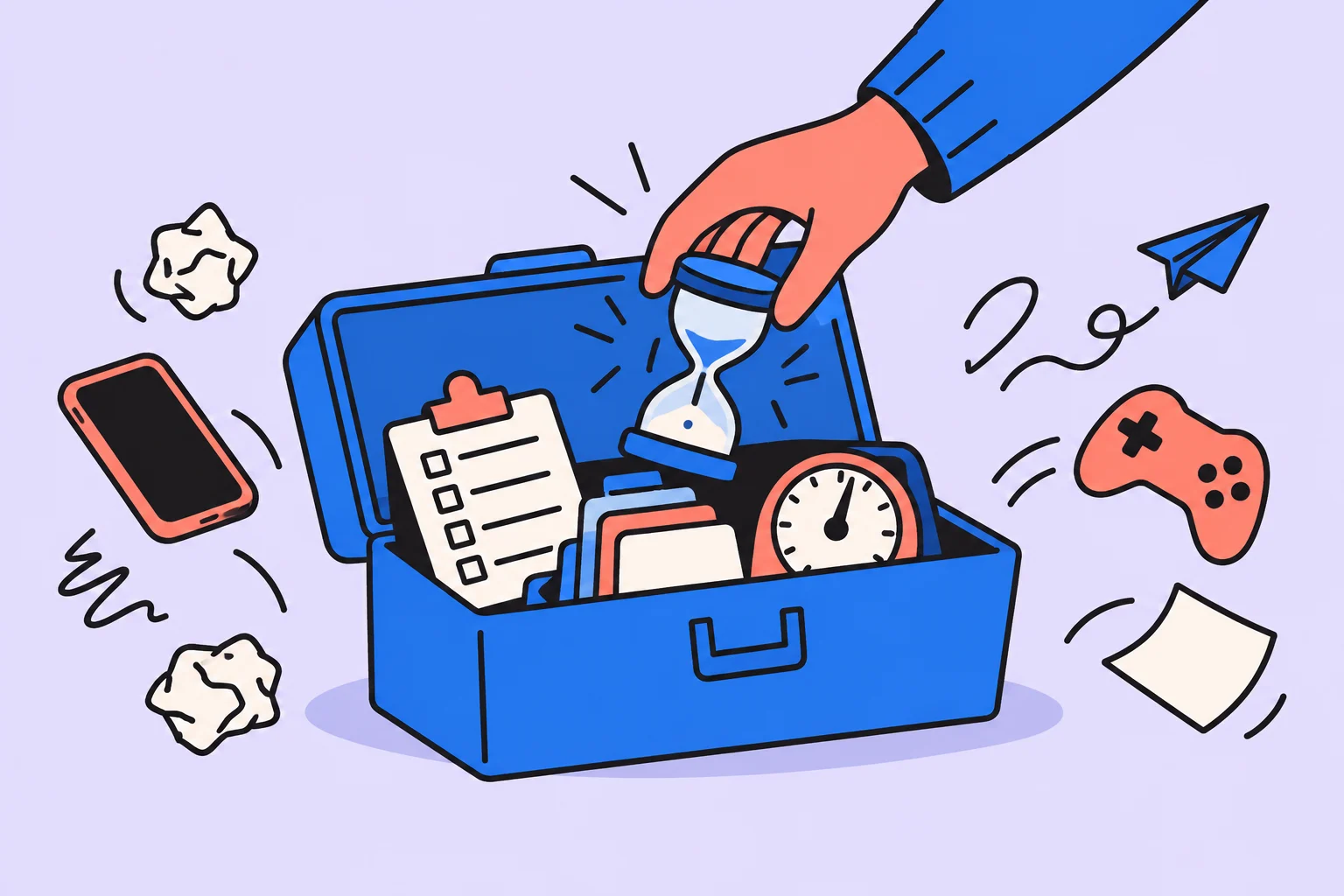
Time management with ADHD is not about “better planning” or “more discipline.” It means working with a brain that perceives time differently, lives in “now” and “not now,” can lose 3 hours watching videos or forget to eat during hyperfocus. This guide presents 10 adapted time-management systems that account for ADHD's neurobiological characteristics.
of people with ADHD underestimate task duration
actual time usually exceeds ADHD estimates
improvement in punctuality with visual timers
ADHD time blindness: why time “disappears”
Time blindness is one of ADHD's most underestimated yet crucial symptoms. It is more than “poor time planning”: it is a neurobiological inability to sense time passing. Subjectively, 5 minutes and 2 hours feel the same.
With ADHD, the brain's internal clock, linked to the dopamine system, is disrupted. A study by Neuropsychologia (2011) found that people with ADHD consistently underestimate time intervals by 40-60%. This is not carelessness: it reflects how the brain works.
Time blindness appears as difficulty estimating how long a task will take, feeling you “just started” when 4 hours have passed, chronic lateness despite trying to leave on time, and panic about deadlines that are “suddenly” tomorrow.
A University of Cincinnati study (2019) found that 78% of adults with ADHD underestimated task duration by an average factor of 2.4. Overestimation occurred in only 12% of cases: the ADHD brain is almost always optimistic about timing.
ADHD time-management principles: work with your brain rather than against it
Effective ADHD time management starts with understanding a neurodivergent brain. Rather than trying to “fix” ADHD characteristics, create systems that account for and compensate for them.
External structure: ADHD weakens internal time regulation, so external supports are needed—timers, reminders and visual indicators. Flexibility: rigid hourly schedules cause anxiety and a sense of failure; adaptive systems work better.
Energy-based planning: plan around energy and concentration rather than the clock. People with ADHD have clear productive windows; use them as effectively as possible.
Identify your time blindness
For a week, record estimated versus actual task durations. Find your error multiplier, usually 2-3x.
Create external time anchors
Timers for every task, reminders every 30 minutes and an analog clock within view.
Plan in energy blocks
High energy for difficult tasks, medium for communication, low for routine work. Do not tie yourself to specific hours.
Use buffer time
Add 25% of planned time as a buffer. With ADHD, something always goes off plan.
System #1: Energy blocks instead of hourly planning
ADHD energy and concentration fluctuate in waves throughout the day. Rigid hourly schedules create stress and a sense of failure. Energy blocks adapt to the ADHD brain's natural rhythms.
Three types of energy blocks: high energy for creative work, analysis and writing; medium energy for meetings, calls, planning and learning; low energy for routine tasks, organizing, email and cleaning.
Each morning, assess your current energy and choose matching tasks. Do not attempt creative work in a low-energy state or process email at peak concentration.
System #2: Three priorities to combat overload
With ADHD, long to-do lists cause “choice paralysis.” The brain sees 20 tasks and cannot choose where to start. The three-priority system solves this: choose no more than 3 important tasks each day.
The structure: 1 large task requiring peak focus, 1 medium task for a normal state and 1 small task you can do automatically. Finishing all three makes the day successful. Anything beyond that is a bonus.
A productivity study found that people with ADHD using three priorities completed 47% more important tasks than those planning 10+ tasks daily. Less planning means more completion.
System #3: Modified Getting Things Done for ADHD
David Allen's classic GTD is too complex for most people with ADHD: many lists, contexts and weekly reviews. But its basic principles can be adapted: get everything out of your head, process incoming items and separate planning from doing.
Simplified GTD for ADHD: one capture point, two lists (do today / do someday) and one processing rule (if it takes less than 2 minutes, do it now). No contexts, projects or multilevel hierarchies.
The key difference: replace the weekly review with a daily quick check, 5 minutes each evening. With ADHD, keeping the system simple matters more than organizing it perfectly. Read more about the GTD method in simple terms.
System #4: Time blocking with flexible boundaries
Time blocking—allocating specific blocks to tasks—can work with ADHD if adapted to a neurodivergent brain. The main rule: flexible boundaries instead of rigid time limits.
Adapt it for ADHD: plan 90-120-minute blocks with 15-minute buffers between them. If a task finishes early, use the remaining time for small items on a buffer list. If it takes longer, do not panic: shift the next block.
Color-coding helps you navigate blocks quickly: red for deep work, blue for meetings and green for routine work. Visual structure compensates for weak working memory with ADHD.
Energy blocks
Plan around energy rather than hours. High energy for difficult tasks, low energy for routine work.
Three priorities
A maximum of 3 tasks per day. Avoid choice paralysis and gain a sense of control over plans.
Simplified GTD
One inbox, two lists and simple rules. GTD's power without cognitive overload.
Flexible time blocking
Time blocks with buffers. Planning structure plus adaptability to ADHD reality.
System #5: Time anchors and external reminders
With ADHD, the internal clock works poorly, making external time anchors crucial: signals that remind you of the time and bring you back to reality. They compensate for time blindness and help you avoid getting lost in tasks.
Time anchors include visual timers (Time Timer, with a shrinking colored segment), audible reminders every 25-30 minutes for a “reality check,” and a wristwatch—yes, a physical one, because checking your phone is risky.
The anchor-event technique: attach tasks to external events rather than abstract times. Not “call the client at 14:00,” but “call the client after lunch.” An ADHD brain remembers events better than times.
Tip: put an analog clock with a large face on your desk. Moving hands create the subconscious sense of time missing with ADHD. Digital clocks present time as a static number; analog clocks show a moving process.
System #6: Reverse planning from the deadline
With ADHD, motivation often activates only near a deadline because the dopamine system responds to urgency. Reverse planning uses this characteristic: plan backward from the final date to the present.
Reverse planning steps: define the final deadline, divide the project into stages, set an intermediate deadline for each, add 50% buffer time because ADHD plans often go awry, and create external reminders for every stage.
The key: intermediate deadlines must be external. Agree to show someone an interim result. The ADHD brain ignores internal deadlines but not external ones.
System #7: Pomodoro 2.0 — adapted intervals
The classic Pomodoro technique (25 minutes of work + a 5-minute break) does not account for ADHD attention. The brain may not engage within 25 minutes or may enter hyperfocus that is risky to interrupt.
Pomodoro 2.0 for ADHD: flexible intervals of 15 to 45 minutes depending on the task and your current state. Difficult tasks use shorter intervals of 15-20 minutes; familiar tasks use longer ones of 30-45 minutes. Listen to your brain rather than the timer.
Active breaks are essential: physical movement rather than sitting on your phone. Stand up, walk or exercise. Research suggests physical activity during breaks resets ADHD attention 35% more effectively than passive rest.
System #8: Templates and routines to reduce cognitive load
With ADHD, every decision consumes cognitive energy. Planning each day from scratch quickly exhausts the brain. Planning templates and standard routines save mental resources for important tasks.
Template examples: “Monday: weekly planning + administrative tasks” or “Morning: 1 large task; afternoon: meetings; evening: routine work.” You do not need to invent a plan daily: use established templates.
Routines reduce the need for self-control. A morning sequence—wake up → coffee → plan the day → first task—becomes automatic. Each action triggers the next without an effort of will.
System #9: Eat the elephant in pieces through micro-planning
Large projects paralyze an ADHD brain. This is “task paralysis”: a project seems so huge that you cannot even start. Eating the elephant in pieces breaks any project into micro-tasks lasting 5-15 minutes.
Micro-planning: divide each task into concrete actions. Not “write a report,” but “open the document” → “write the heading” → “find 3 sources” → “write a 2-paragraph introduction.” Each step should be so simple that postponing it feels impossible.
The psychology of micro-tasks: each completed one provides a small dopamine reward. Instead of one large reward at the end—which may never arrive—you receive a series of small wins along the way.
System #10: Digital detox and managing distractions over time
Digital distractions are especially treacherous for ADHD planning. One notification can lead to an hour on social media and collapse the entire plan. Managing your digital environment is crucial for effective time management.
Digital detox techniques: Do Not Disturb during peak hours, website blockers such as Cold Turkey or Freedom for deep work, a phone in another room or on silent, and designated email/social-media checks, for example at 12:00 and 17:00.
Batch similar tasks: instead of replying to messages throughout the day, allocate 2-3 communication windows. Switching between task types consumes substantial mental energy with ADHD. Read more about digital detox.
Choose 2-3 systems to begin
Do not introduce all 10 at once. Start with energy blocks, three priorities and time anchors.
Test for 2 weeks
Allow time to adapt. New habits take longer with ADHD: at least 66 days rather than the standard 21.
Track effectiveness
Keep a simple log: planned versus completed, actual versus estimated duration, and which systems work at which times.
Iterate and adapt
No perfect system suits everyone. Keep what works, discard what does not and adapt it to your characteristics.
ADHD time-management tools and apps
Choosing tools is crucial with ADHD. Complex systems are quickly abandoned because maintaining them takes more energy than they provide. The best ADHD tools are simple, fast and low-friction.
Selection criteria: adding a task in 3 seconds or less, syncing across all devices, simple reminders without complicated settings, a visually clear interface and quick plan editing.
The system-hunting trap: ADHD can bring a tendency to keep searching for the “perfect planning system.” This is a form of procrastination. Consistently using a simple system is better than occasionally using a perfect one.
Working with deadlines and external pressure with ADHD
ADHD motivation often activates only under external pressure. The dopamine system responds to urgency and importance but ignores things that are merely important. Effective ADHD time management uses this characteristic.
Create external pressure through public commitments (tell colleagues your deadline), accountability partners (weekly progress reports), artificial deadlines (finish a day early), or bets on task completion.
Body doubling for planning: plan in another person's presence or during an online session. Social accountability helps with planning as well as execution. Many people with ADHD say they plan more realistically around others.
ADHD time management in teamwork
Teamwork creates extra ADHD time-management challenges: badly timed meetings, coordinating with others and external deadlines that do not account for your planning characteristics.
Adaptation strategies: request meeting agendas in advance because an ADHD brain needs time to engage, block your productive windows in the shared calendar, use a “deep work—do not disturb” status and explain your work rhythms to colleagues.
If you feel comfortable, discuss ADHD openly. Many companies now practice neuroinclusion through flexible hours, quiet workspaces and deadlines adapted to employees' needs.
Seasonality and energy cycles in long-term planning
ADHD involves longer energy cycles as well as daily ones: weekly, monthly and seasonal. Effective long-term time management considers these rhythms instead of expecting uniform performance throughout the year.
Weekly cycles: many people with ADHD describe Monday and Tuesday as high-energy days, Wednesday and Thursday as medium-energy, and Friday as low-energy. Plan difficult projects early in the week and routine work toward the end.
Seasonal characteristics: winter depression intensifies ADHD symptoms; spring brings energy and new projects; summer heat can reduce concentration; autumn is a time for structure and review. Adapt long-term plans to these cycles.
Frequently asked questions about ADHD time management
Why can I not stick to plans with ADHD?
This reflects how the brain works rather than a lack of discipline. ADHD weakens executive functions: following plans and controlling impulses. Use external structures such as reminders and accountability partners, alongside flexible planning systems.
Which planning system is best for beginners with ADHD?
Start with energy blocks plus three priorities. This provides structure without overload. Identify productive windows, plan no more than 3 tasks daily and use timers for each activity.
How long does adjusting to a new planning system take?
New habits take longer with ADHD: 66 days rather than the standard 21. Do not expect instant results. The first 2 weeks will be difficult, with improvements noticeable by month-end. Consistency matters more than perfect execution.
How do I handle perfectionism in ADHD planning?
Perfectionism is a common ADHD trap. The 80% rule: a simple system used consistently is better than a perfect one abandoned after a week. Focus on progress rather than perfection.
Should I use many planning apps?
No: this leads to constant searching for the perfect tool. Choose 1-2 simple apps and use them consistently. The best ADHD apps are simple, fast and require minimal setup.
How do I plan with irregular working hours?
Plan energy blocks rather than fixed hours. Identify typical energy patterns and adapt to the current situation. Flexibility matters more than a rigid schedule. Use templates for different scenarios: workdays, days off and deadlines.
What if I miss my plans and feel guilty?
This is normal and happens to everyone with ADHD. Instead of spending energy on self-criticism, analyze what went wrong and how to adapt the system. With ADHD, plan for setbacks as part of the process rather than exceptions.
How do I estimate task durations with time blindness?
Use the multiplier rule: multiply your intuitive estimate by 2-3. Keep a time log for 1-2 weeks to find your personal error multiplier. Estimates will gradually improve, but always include buffer time.
Turn an idea into action
Was this helpful?
Rate the article and tell us what was missing. Your feedback goes to the Sinqly team and will not be published on the site.

Deep Work: a complete guide to deep, focused work
A complete guide to Cal Newport's Deep Work. How to practice deep work, 4 strategies, focus rituals, and the science of concentration.
Focus techniques for ADHD: what really works in 2026
Scientifically grounded methods for improving focus with ADHD. 12 proven concentration techniques, exercises, and tools for people with attention deficits.

How to organize life with ADHD: a complete guide to systems and practical tips
A complete guide to organizing life with ADHD. Proven planning systems, practical tips, tools, and habits for people with attention deficit hyperactivity disorder.