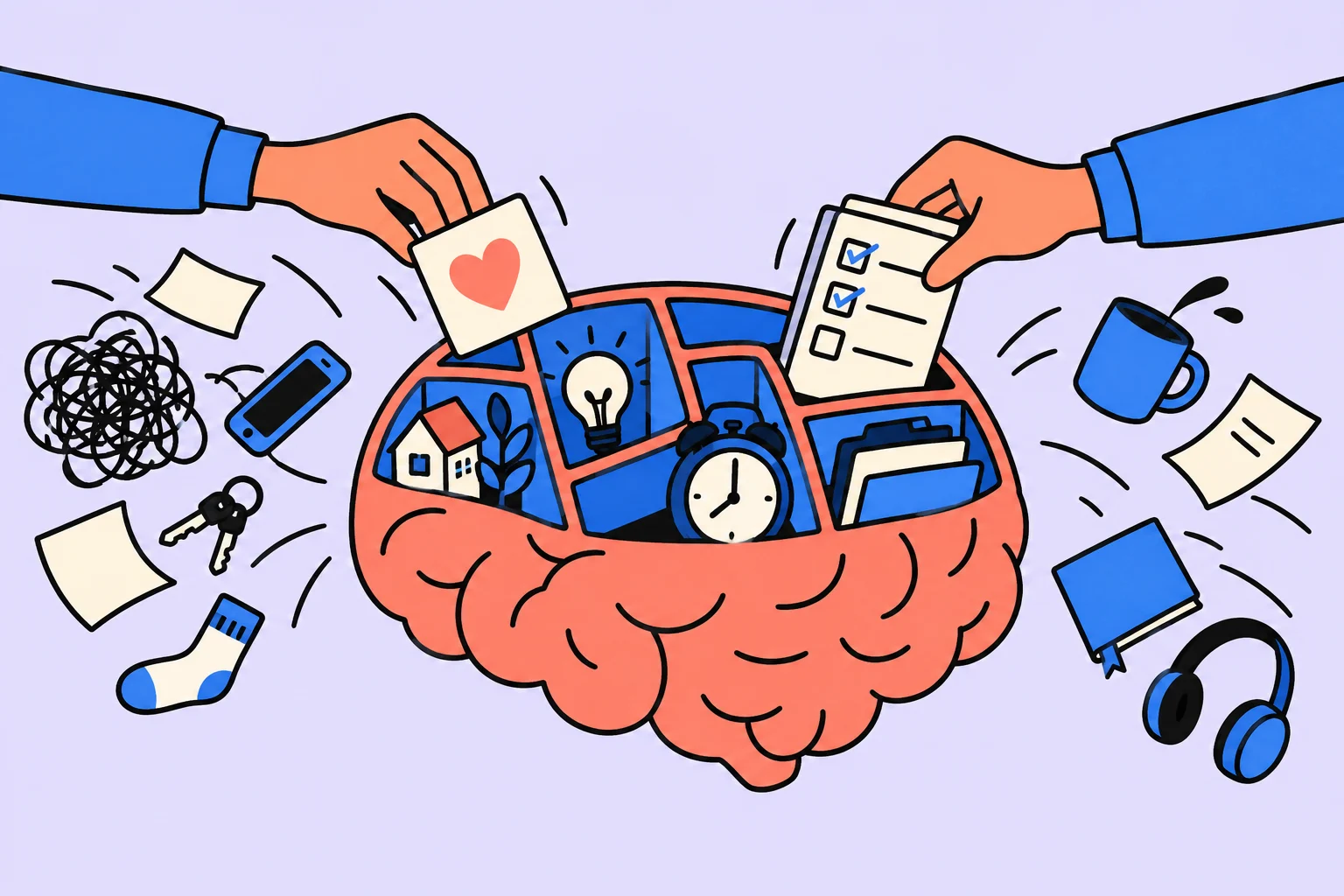
How to organize life with ADHD is a question millions of people around the world ask themselves. Forgotten meetings, lost keys, unpaid bills, piles of laundry, and chaos at home and work: if this describes you, you are not alone. And no, it is neither laziness nor irresponsibility. It results from executive dysfunction, an impairment in the brain's prefrontal cortex that lies at the core of ADHD.
The good news: life with ADHD can be organized. External systems, rituals, and tools can compensate for executive function difficulties, without relying on willpower that is already in short supply with ADHD. In this guide, we have collected proven strategies, practical ADHD tips, and specific steps to help bring chaos under control.
of adults with ADHD experience serious difficulties organizing household life
more often lose things compared with neurotypical people
reduction in forgotten tasks when using one unified digital system
Why organization is the main challenge with ADHD
Executive functions are cognitive processes responsible for planning, organization, prioritization, time management, and impulse control. According to Barkley's research (2012), published in Journal of Clinical Psychology, ADHD impairs all these functions to varying degrees. This is a matter of neurobiology rather than motivation.
A neurotypical person automatically organizes information, sets priorities, and follows a plan. This is a background process, like breathing. Someone with ADHD has to do it consciously, requiring enormous cognitive effort. Imagine manually controlling every breath: after an hour, you would be exhausted. That is how a person with ADHD feels when trying to “just be organized.”
This is precisely why external systems are needed to take on some cognitive load. External structure, rather than internal discipline, is the key to organizing life with ADHD. Read more about how ADHD affects daily productivity in ADHD and productivity.
It is important to understand that ADHD involves difficulty managing attention rather than a lack of attention. Someone with ADHD can play video games with intense focus for hours (hyperfocus) but cannot make themselves pay a bill that takes 2 minutes. Organizational systems need to account for this characteristic.
The “one system for everything” principle for ADHD organization
The most common ADHD organization mistake is using many disconnected systems. Notes on your phone, sticky notes on your monitor, lists in a notebook, calendar reminders, tasks in email, and voice messages to yourself. Information gets scattered among systems, and an ADHD brain simply cannot keep track of where everything is.
Research by the ADHD research center at Harvard Medical School found that switching between tools increases cognitive load by 40% in people with ADHD. One tool for everything—tasks, habits, goals, notes, and reminders—reduces this load and increases the likelihood of using the system regularly.
A system of morning and evening rituals for life with ADHD
Rituals are sequences of actions that become automatic over time. For people with ADHD, rituals are a real lifeline. When an action is automatic, it requires no decision, so it does not burden limited executive functions and will not be forgotten.
A morning ritual (30 minutes): get up at the first alarm (put your phone across the room), shower, dress (with clothes prepared the evening before), have breakfast, open your habit tracker and check the day's plan, then choose 3 priority tasks. Just three, not ten. Three tasks that will make the day successful.
An evening ritual (15 minutes): review the day (mark completed actions in your tracker), prepare tomorrow's clothes and belongings, set up a “launch pad” by the door, write a morning plan, and put your phone away 30 minutes before bed. An evening ritual is an investment in a calm morning.
Write the rituals on cards and display them in the bathroom (morning) and on the refrigerator (evening). After 2-3 months, they will become automatic, and you will no longer need to think about the sequence: your body will know what comes next.
Practical tips for organizing life with ADHD
ADHD tips are small environmental adjustments that reduce cognitive load rather than magic tricks. Here are proven strategies that work for most people with ADHD:
The “two-minute rule.” If a task takes less than two minutes, do it immediately. Do not write it down, postpone it, or schedule it. Just do it. Paying a bill, answering a message, and putting something away are all two-minute tasks that accumulate into an avalanche if postponed.
Habit stacking. Connect a new habit to an existing one. “After I pour my coffee, I will write down three tasks for the day.” “After I brush my teeth, I will prepare tomorrow's clothes.” The existing habit triggers the new one, so your brain does not have to remember it separately.
Body doubling. Many people with ADHD find they can concentrate much better when someone nearby is working. The other person simply needs to be present, without helping or supervising. This might be a friend in a café, a colleague in a coworking space, or even a virtual partner on video. Entire body-doubling communities exist for people with ADHD.
Visual reminders. Out of sight means forgotten. With ADHD, this is literal: if a task is not in front of you, it does not exist. Use clear containers instead of opaque ones, keep work documents visible, and place reminders at eye level by the door.
The “count backward” tip: when you need to leave home by a particular time, calculate backward from the end. You need to arrive at 10:00, travel takes 30 minutes, getting ready takes 20 minutes, and the buffer is 15 minutes. That means starting to get ready at 8:55. Set an alarm for that time labeled “START GETTING READY.” People with ADHD chronically underestimate preparation time.
How to organize a workspace with ADHD
A workspace with ADHD is more than a desk and chair. It is an environment that either helps concentration or constantly distracts. Research shows that visual noise (desk clutter) reduces concentration much more strongly in people with ADHD than in neurotypical people.
The “clear desk” rule: keep only what you need for the current task on your desk. Everything else goes into drawers, onto shelves, or into boxes. Spend 2 minutes clearing the surface before work. This creates an environment where an ADHD brain can function, rather than being an exercise in pedantry.
Zoning: if possible, divide the space into work, rest, and creative areas. An ADHD brain switches tasks better when physically moving between areas. Work at the desk, rest on the couch, and draw at an easel. Each area triggers a particular mode.
The sound environment: silence often hinders rather than helps with ADHD. The brain starts seeking stimulation and becomes distracted by every sound. Background white noise, lo-fi music, or nature sounds create a steady acoustic backdrop that meets the need for stimulation and helps concentration. Read more about ADHD productivity in our article ADHD and productivity: strategies that work.
Managing belongings: “a home for every item”
People with ADHD lose things because they put them in random places. Your brain does not register the moment you put your keys on a bathroom shelf: it was occupied with another thought. The solution is simple but needs initial setup: every item should have a home, a fixed place it always returns to.
Keys go in a bowl by the door (only there, never in a pocket). Your phone goes on the charger beside your bed. Your wallet goes in a jacket pocket (the same pocket). Headphones go in a small container on the desk. Start with the 5 items you lose most often and create homes for them. Add another 5 after a month.
The “launch pad” principle: designate one place near the front door—a shelf, tray, or basket—for everything you need to take when leaving home. Every evening, as part of your evening ritual, gather tomorrow's essentials there: keys, wallet, documents, bag, and umbrella. In the morning, simply pick everything up and leave, without panic or searching.
Time management: time blindness in ADHD
Time blindness is difficulty sensing time passing, a characteristic of ADHD. Dr. Russell Barkley, a leading ADHD researcher, calls it “nearsightedness toward the future”: 15 minutes and 2 hours feel almost the same. This leads to chronic lateness, missed deadlines, and constant stress.
The first tool is an analog clock. Its round face visualizes time passing as a hand moving around a circle. Digital clocks show numbers but do not provide a sense of how much time has passed or remains. Hang an analog clock in every room where you spend substantial time.
The second tool is a visual timer, such as Time Timer. It shows remaining time as a shrinking colored segment. Set a timer for every activity: 25 minutes of work, 15 minutes of cleaning, or 10 minutes of getting ready. A timer makes time visible and predictable.
The third principle is the “one-and-a-half allowance rule.” Add a 50% time buffer to every estimate. If you think a task will take an hour, plan an hour and a half. If travel takes 30 minutes, allow 45. People with ADHD systematically underestimate time, and a buffer compensates for this error.
A study in Journal of Attention Disorders (2021) found that using one unified digital organizational system reduces forgotten tasks among people with ADHD by 58% and anxiety by 34% within the first 3 months. Combining digital reminders and visual timers produced better results than either tool alone.
Digital organization: apps and tools for ADHD
Digital tools are an ADHD person's best friend. They do not forget or get tired, remind you on time, and are always available. But there is a trap: people with ADHD often get drawn into an endless search for the perfect app. They try dozens of tools, spend hours configuring them (hyperfocus!), and abandon them a week later. You can find a detailed review of tools in The best apps for ADHD.
Criteria for choosing an ADHD organization app: quick task entry (no more than 2 taps), reminders with adjustable frequency, minimal visual noise, the ability to combine tasks and habits in one place, and phone access (where you spend the most time).
The Sinqly Telegram bot solves the problem of an extra action: you do not need to open a separate app to record a task. Write it in Telegram, and the task is captured. This is critical for ADHD: every additional step is a barrier the brain uses as a reason to do it later.
Another important digital organization principle: automate everything you can. Automatic utility payments. Automatic file renaming. Templates for recurring tasks. Each automation removes one decision you no longer need to make. And the number of decisions an ADHD brain can make in a day is limited.
Gather upcoming commitments in one list and identify one action for today. Create a task in Sinqly: registration is free.
Organizing eating and sleep with ADHD
Eating and sleep are often overlooked foundations of organizing life with ADHD. Yet according to the World Health Organization, sleep disturbances affect 50-75% of adults with ADHD, and irregular eating worsens attention deficit symptoms.
Organizing sleep. Keep bedtime and wake-up time fixed, even on weekends. An ADHD brain loves “just 5 more minutes” in the evening, especially after finding an interesting video, and those 5 minutes turn into 3 hours. The solution: set a bedtime alarm 30 minutes before your target sleep time. At that signal, put away all screens and begin your evening ritual.
Organizing food. Cooking requires planning, grocery shopping, and many sequential steps: everything an ADHD brain struggles with. Practical tips: prepare food for 2-3 days in advance (meal prep) on Sunday. Use grocery delivery subscriptions with a fixed selection to remove the need to choose. Keep emergency food at home (grains, frozen vegetables, and canned goods) for times when you have no energy to cook.
Regular mealtimes deserve attention too. People with ADHD often forget to eat when absorbed in something and overeat when bored. Set meal reminders: breakfast, lunch, dinner, and two snacks. Stable blood sugar directly affects concentration and emotional regulation. Read more about dopamine and motivation in Dopamine and motivation in ADHD.
Avoid caffeine after 14:00. With ADHD, sensitivity to stimulants is often heightened, and afternoon coffee can delay sleep by 1-2 hours. If you need an afternoon boost, try a 10-minute outdoor walk: it raises dopamine as effectively as a cup of coffee without affecting sleep.
Managing information: inbox zero for life with ADHD
With ADHD, information is easily lost because working memory is limited. A neurotypical person can hold 7 items mentally; someone with ADHD usually holds 3-4. Anything not written down is lost. Inbox zero addresses this problem.
The idea: immediately record every new thought, task, or idea in one inbox. This can be an app, notebook, or voice note: capturing it should be as quick as possible. Once a day, as part of your evening ritual, process the inbox: either complete each item (if it takes less than 2 minutes), schedule it for a specific day, or delete it.
Financial organization with ADHD
Impulsive purchases, forgotten bills, lost receipts, and uncontrolled subscriptions: ADHD and finances often clash. According to research in CHADD (Children and Adults with ADHD), adults with ADHD have an average of 30% more debt than neurotypical peers with similar incomes.
The main principle is automation. Set up automatic payments for every regular expense: rent, utilities, internet, phone, and subscriptions. Set up an automatic transfer to savings on payday so the money saves itself without relying on willpower.
Introduce a “24-hour rule” for purchases over 3000 rubles: record the wish in your inbox, wait a day, then decide. Research shows that 70% of impulsive purchases fall away on their own if you allow a cooling-off period. This protects you from the heightened impulsivity associated with ADHD rather than simply restricting you.
Organizing social life with ADHD
ADHD often causes relationship difficulties: forgotten birthdays, missed meetings, inattentive conversation, and unfulfilled promises. This is not indifference: an ADHD brain simply does not retain social information in working memory. If you are interested in ADHD in adults and its signs, we have a separate in-depth article.
Solutions: use a calendar with reminders a day and an hour before every meeting. Keep a separate list of people to remember, and review it weekly: message someone, call, or suggest meeting. Make a habit of recording promises immediately after making them rather than relying on memory.
If you have a partner, create a shared system: a shared calendar, shared shopping list, and division of responsibilities that accounts for ADHD. Your partner should not have to manage you, but they can be an ally who helps the system work.
A first-month plan for organizing life with ADHD
Week 1: One system and a morning ritual
Choose one app for every task, such as Sinqly. Start recording absolutely everything in it. Create a simple 3-4-step morning ritual and display a card describing it in the bathroom.
Week 2: A launch pad and evening ritual
Set up a launch pad by the door. Define homes for the 5 items you lose most often. Add an evening ritual: reviewing the day, preparing tomorrow's belongings, and planning the morning.
Week 3: Managing time and finances
Hang an analog clock. Start using task timers. Set up automatic payments for all regular expenses. Introduce the “24-hour rule” for major purchases.
Week 4: Review and adjust the system
Review the month: what works and what does not. Remove unnecessary elements and strengthen what helps. Add food and sleep reminders. Share the system with loved ones so they understand your approach.
Do not try to introduce everything in one day. With ADHD, overload causes paralysis: instead of doing anything at all, the brain shuts down and does nothing. Small changes that stick are always better than a major reorganization that lasts three days. If you feel motivation slipping, read our article about how ADHD relates to burnout and what to do about it.
ADHD organization mistakes everyone makes
Mistake 1: “The perfect system from day one.” You spend hours setting up Notion, creating 50 databases, attractive templates, and color coding, then abandon it a week later because the system is too complex. Start with the minimum: one task, one reminder, and one ritual. Add complexity gradually.
Mistake 2: “Copying neurotypical systems.” An organizational system that works for your colleague without ADHD probably will not suit you. Neurotypical systems rely on executive functions you have difficulty with. Look for systems created specifically for ADHD or adapt them to your needs. More adapted tools are available on ADHD: a complete guide.
Mistake 3: “Punishment for missed days.” You miss a day, feel guilty, and abandon the whole system. This is a vicious cycle: a lapse, guilt, abandonment, chaos, and more guilt. The right approach: a missed day is data rather than failure. Why did you miss it? What can change? Perhaps the ritual is too long or the reminder arrives at an inconvenient time.
Mistake 4: “Organization as an end rather than a means.” Some people with ADHD start spending more time organizing than living. Endless planner configuration, system rebuilding, and searching for a new app are procrastination disguised as productivity. An organizational system should be invisible: set it up once and forget it.
Mistake 5: “All or nothing.” Either perfect order or complete chaos. With ADHD, the middle ground is success. Completing 70% of tasks is excellent. Following a morning ritual 5 days out of 7 is great. Striving for 100% with ADHD guarantees burnout.
According to the US National Institute of Mental Health (NIMH), combining behavioral strategies (external organizational systems) with cognitive behavioral therapy produces the best results in managing adult ADHD symptoms. Organizational systems complement therapy rather than replacing it.
Frequently asked questions about organizing life with ADHD
Can you organize life with ADHD without medication?
Yes. External organizational systems, ritual-based habits, and digital tools significantly compensate for executive function difficulties. Medication helps but does not replace behavioral strategies: research shows that combining them produces the best effect. Many people with ADHD successfully manage symptoms using behavioral approaches alone.
Which app is best for organization with ADHD?
Apps with a unified interface for tasks, habits, and goals, few screens, and quick input work best.
How long does an organizational system take to start working with ADHD?
The first results become noticeable after 2-3 weeks of regular use. Lasting habits form over 2-3 months. Start small: introduce one habit a week rather than trying to rebuild everything at once. Patience is an investment that pays off.
How can I avoid abandoning my organizational system after a week?
Start with the minimum: 2-3 simple rituals. Use reminders and a habit tracker. Do not punish yourself for missed days; simply return. Connect new habits to existing ones (habit stacking). The system must be simpler than the chaos, or the brain will choose chaos.
How can I organize eating and sleep with ADHD?
Keep bedtime and wake-up time consistent, even on weekends. Prepare meals for 2-3 days in advance. Use grocery delivery subscriptions to remove repeated decisions. Set meal reminders. And always avoid caffeine after 14:00.
What if my partner does not understand my ADHD-related chaos?
Explain that the chaos is a consequence of neurobiology rather than a choice. Share specific information about ADHD (articles, videos, and books). Agree on a system: you take responsibility for using organizational tools, while your partner provides time and support without criticism. A shared system (a common calendar and lists) helps both of you.
Does exercise help with organizing life with ADHD?
Absolutely. Regular exercise raises dopamine and norepinephrine, neurotransmitters whose deficiency underlies ADHD. Doing 30 minutes of aerobic exercise improves concentration and executive function for 2-4 hours afterward. Morning exercises or a run can become the most effective part of your morning ritual.
Was this helpful?
Rate the article and tell us what was missing. Your feedback goes to the Sinqly team and will not be published on the site.
Dopamine and motivation with ADHD: using neurochemistry for productivity
How the dopamine system works with ADHD. 7 strategies for managing motivation through neurochemistry: gamification, stacking, micro rewards, and physical activity.
The best apps for people with ADHD in 2026
The best ADHD apps: task managers, habit trackers, and focus timers. A detailed review of 12 tools for people with ADHD.
ADHD and productivity: how to work effectively with ADHD
A practical productivity guide for people with ADHD. 10 strategies, tools, and techniques for working effectively with attention deficit hyperactivity disorder.