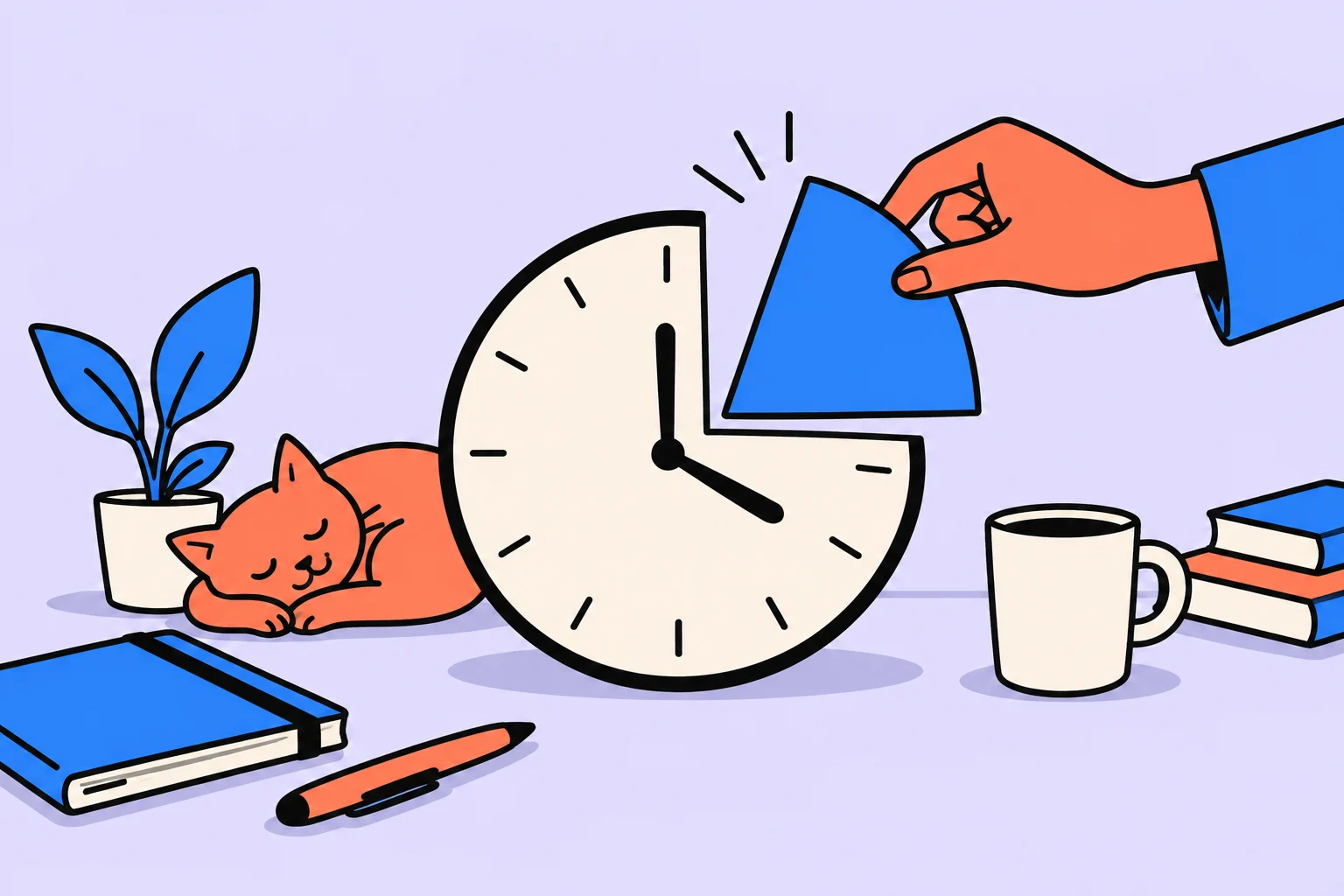
Millions of people ask how to increase productivity. The answer is surprising: it is not about working more hours. Neuroscience and behavioral psychology research shows that the most productive people work smarter, using specific techniques that increase output without increasing workload. This article presents 10 science-based ways to improve productivity, each with practical recommendations and research references.
efficiency lost through multitasking (APA)
of peak daily productivity for an average person
more tasks completed by people who plan their day in advance
1. How to increase productivity: start with what matters most
Mark Twain said: “Eat a live frog first thing in the morning and nothing worse will happen to you the rest of the day.” Complete the day's most important and difficult task first, while cognitive resources are at their peak. In the morning, the prefrontal cortex is most active, dopamine is high, and willpower has not yet been depleted by dozens of small decisions.
A University of Warwick study (2019) confirmed that people who complete their hardest task in the first third of the working day finish an average of 30% more high-priority projects per month. By evening, cognitive resources are depleted, a phenomenon called decision fatigue, and the brain automatically shifts to easy but unhelpful activities.
Practice: identify tomorrow's frog each evening. In the morning, start with it immediately, without email, social media, or warming up on small tasks. Planning your day the night before is one of the simplest and most powerful productivity tips.
2. Block time: time blocking for greater efficiency
Time blocking assigns each hour of the day to a specific task or type of work in advance. Replace a task list without times with a schedule: 9:00–11:00 deep work, 11:00–12:00 meetings, and 13:00–14:00 email and routine tasks. Elon Musk plans in 5-minute blocks; Bill Gates uses 15-minute blocks.
Why it works: time blocking removes choice paralysis. You do not have to keep deciding what comes next. The plan is ready and your brain follows it. This is especially valuable in the afternoon, when cognitive resources fall and choosing becomes harder.
Start simply: divide the day into 3 blocks: deep work for 2–3 morning hours, communication and meetings in the middle of the day, and routine tasks and planning at the end. Add detail gradually. Use a task manager with calendar integration for automatic allocation.
The buffer rule: leave 10–15 free minutes between blocks. Tasks almost always take longer than planned. Buffers prevent the domino effect in which one delayed block shifts the entire day.
3. The Pomodoro technique: productivity in intervals
25 minutes of focused work, followed by 5 minutes of rest. After four cycles, take a longer 15–30-minute break. The Pomodoro technique, developed by Francesco Cirillo in the late 1980s, remains one of the most popular and effective productivity techniques.
Why it works: limited time creates an artificial deadline, following Parkinson's law that work fills the available time, while frequent breaks prevent cognitive exhaustion. Knowing a break is coming, the brain is willing to tolerate a boring task for 25 minutes, though not for 3 hours.
Adapt it to yourself: the classic 25/5 does not suit everyone. Some prefer 50 minutes of work with a 10-minute break, a modified Pomodoro. For tasks requiring deep immersion, try 90/20: 90 minutes of work and 20 minutes of rest, matching the brain's ultradian rhythms. The key is alternating focus and recovery.
4. Remove distractions: 23 minutes for every interruption
Research by Professor Gloria Mark at the University of California found that fully returning to a task after an interruption takes an average of 23 minutes 15 seconds. One phone notification can cost half an hour of deep work. Over a day, that means hours of lost productivity.
Practical steps: turn off all phone notifications while working using Do Not Disturb, close email and messaging apps during deep work, use website blockers such as Cold Turkey, Freedom, or Focus during work sessions, wear headphones even without music to signal that you should not be disturbed, and keep your phone out of sight. A University of Texas study found that even a switched-off phone in view reduces cognitive capacity.
Set communication windows: fixed periods for checking email and replying to messages, such as 11:00 and 16:00. Focus fully outside those windows. Read more in Digital minimalism: a practical guide.
A Stanford University study (2009) found that people who regularly switch between tasks filter information less effectively, shift attention more slowly, and use working memory less well. The brain cannot fully perform two cognitive tasks simultaneously: it switches rapidly, losing up to 40% efficiency. Multitasking is a productivity myth.
5. Deep work: a twenty-first-century superpower
Deep Work is a concept developed by Cal Newport, a computer science professor at Georgetown University. Its essence is that long periods of focused, uninterrupted work create real value. Emails, meetings, and Slack are shallow work that creates an illusion of busyness without real results.
In a world of constant notifications, the ability to work deeply becomes a competitive advantage. Newport's formula is: “High-quality productive work = Time × Intensity of focus.” 2 hours of deep work can deliver more than 6 hours of shallow activity.
How to practice: reserve at least 2 hours a day for deep work, ideally in the morning when cognitive resources peak. During the session, isolate yourself completely from communication. Start with 45 minutes and gradually increase to 90–120. Train your concentration muscle: like a physical muscle, it strengthens with practice.
6. Manage energy rather than time: productivity tips
Most people try to manage time, but everyone has the same 24 hours. The real resource is energy. Each person has 2–4 hours of peak cognitive energy daily when the brain works at its best. Planning around energy rather than hours is one of the most powerful productivity tips.
Find your peak hours by rating concentration from 1 to 10 every 2 hours for a week. After 7 days, a pattern appears, usually 2–3 morning hours from 9–12, or 20–23 for night owls. Schedule hard tasks for the peak and routine email, calls, and administration for the dips.
Four pillars of energy: sleep, with 7–9 hours as the foundation; nutrition, with a protein-rich breakfast, minimal sugar, and enough water; movement every hour, since even 5 minutes of walking raises concentration by 15–20%; and recovery through breaks, walks, and meditation). A habit tracker helps build these basic habits.
7. The two-minute rule: small actions, big results
From David Allen's GTD method : if a task takes less than 2 minutes, do it immediately without adding it to a list. Answering a short email, recording an idea, sending a file, or wiping a desk is quicker now than writing it down, remembering it, and returning later.
Why it works: small tasks postponed until later accumulate into cognitive debt, a mental load that occupies working memory and reduces concentration. Researchers call this the Zeigarnik effect: unfinished tasks occupy mental resources even when you are not thinking about them. More about the two-minute rule.
Extend the rule with a five-minute rule for tasks you put off. Tell yourself you will work on it for exactly 5 minutes. Once you begin, your brain often engages and work continues through momentum. Starting is the hardest part; 5 minutes is a barrier the brain will accept.
8. Delegate and automate: do not do everything yourself
Before every task, ask whether you personally need to do it. If not, delegate or automate. In 2026, AI tools can handle email drafts, data processing, presentations, route planning, translations, meeting summaries, and report generation.
Automate routine work with bill autopay, templates for recurring emails, IFTTT/Zapier for automatic actions between apps, and email autoresponders outside working hours. Every automated task frees cognitive resources for important work.
9. Rest strategically: recovery as a productivity tool
The productivity paradox is that more quality rest produces more quality results. The brain keeps working during rest: processing information, finding solutions, and consolidating memories. Archimedes made his discovery in the bath rather than at his desk. Einstein played the violin when stuck on a problem.
Types of restorative rest: microbreaks every 25–50 minutes to stand, walk, or stretch; a 15–20-minute outdoor walk, which restores attention according to the University of Michigan; a 10–20-minute power nap, raising productivity by 34% according to NASA; and meditation for 5–10 minutes to lower cortisol and improve focus.
Scrolling social media is not rest for the brain. It changes the type of stimulation and creates further fatigue. Real rest reduces cognitive load: a walk without a phone, looking out of a window, or talking with a colleague about something unrelated to work.
10. The weekly review: productivity through reflection
Spend 30 minutes each week analyzing what worked, what did not, and next week's priorities. This practice comes from David Allen's GTD methodand prevents accumulated chaos while providing strategic direction.
Clear your inboxes
Process every inbox: email, messaging apps, notes, and bookmarks. Delete, delegate, schedule, or complete each item if it takes <2 minutes.
Review completed work
Look at what you accomplished this week. Acknowledge wins: the brain needs recognition of progress to maintain motivation.
Review current projects
For each active project, identify the next concrete step, blockers, and any help needed.
Priorities for the week
Define 3–5 key results for next week, with a maximum of 5 rather than 10 or 15. If everything is a priority, nothing is.
Plan buffers
Make sure the schedule has empty slots for the unexpected. If every hour is full, the first surprise will destroy the plan.
Without regular reflection, you risk being busy without being productive: doing many things, but the wrong ones. A reflection journal helps structure the review process.
Bonus: physical activity as a productivity booster
Physical activity is one of the most underrated productivity tools. 20–30 minutes of aerobic exercise raises BDNF, brain-derived neurotrophic factor, dopamine, and serotonin, improving cognitive function for 2–4 hours afterward.
A British Journal of Sports Medicine study (2023) found that employees exercising during lunch were 21% more productive in the afternoon than those who stayed at their desks. Even a 10-minute walk significantly improves concentration.
Build movement into the working day: alternate sitting and standing at your workstation, walk during calls, take stairs instead of the lift, go for a morning run or exercise. The brain is an organ that needs oxygen and blood flow to work optimally.
How to build your personal productivity system
Trying to adopt all 10 tips simultaneously guarantees failure. Choose 2–3 techniques that resonate and practice them for 2–3 weeks. Once they become habits, add the next ones.
Suggested sequence: Weeks 1–2: eat the frog, starting with the most important task, and remove distractions. Weeks 3–4: time blocking and the two-minute rule. Weeks 5–6: deep work and a weekly review. Then add Pomodoro, delegation, and physical activity.
Choose the day's main action and check whether it fits among your other commitments. Create a task in Sinqly: registration is free.
Frequently asked questions about productivity
How can you increase productivity without burning out?
Manage energy rather than time. Identify your 2–4 peak hours and schedule difficult tasks then. Include breaks in your schedule. Physical activity and quality sleep are the foundation. Trying to be productive for 8 consecutive hours leads to burnout.
Which productivity techniques are most effective?
According to research: time blocking, the Pomodoro technique, GTD's two-minute rule, deep work and a weekly review. Choose 2–3 techniques and practice them consistently rather than trying everything.
Why does multitasking reduce productivity?
The brain cannot fully perform two cognitive tasks simultaneously. It switches rapidly between them, losing up to 40% efficiency with each switch. Every interruption costs 15–25 minutes to regain deep focus. One task at a time is the key to productivity.
How many hours a day is a person actually productive?
On average, people achieve 2–4 hours of deeply productive work daily. The rest goes to communication, routine tasks, and recovery. Trying to maximize productivity for 8 consecutive hours is counterproductive and reduces work quality.
How does a morning routine affect productivity?
A morning routine reduces early-day decisions and saves cognitive resources. Morning physical activity raises dopamine and norepinephrine for 2–4 hours, while daily planning provides direction. People with a morning routine are 25% more productive.
Which app best improves productivity?
The best app is the one you actually use.
Was this helpful?
Rate the article and tell us what was missing. Your feedback goes to the Sinqly team and will not be published on the site.
Deep Work: a complete guide to deep, focused work
A complete guide to Cal Newport's Deep Work. How to practice deep work, 4 strategies, focus rituals, and the science of concentration.

12 Financial Habits That Will Change Your Life
12 financial habits of wealthy people. Expense tracking, the 50/30/20 budget, compound interest and an emergency fund: step-by-step instructions and research.

Procrastination: 12 science-based ways to stop putting things off
Why we procrastinate and how to stop putting things off. 12 scientifically grounded methods for tackling procrastination, from the two-minute rule to cognitive therapy.