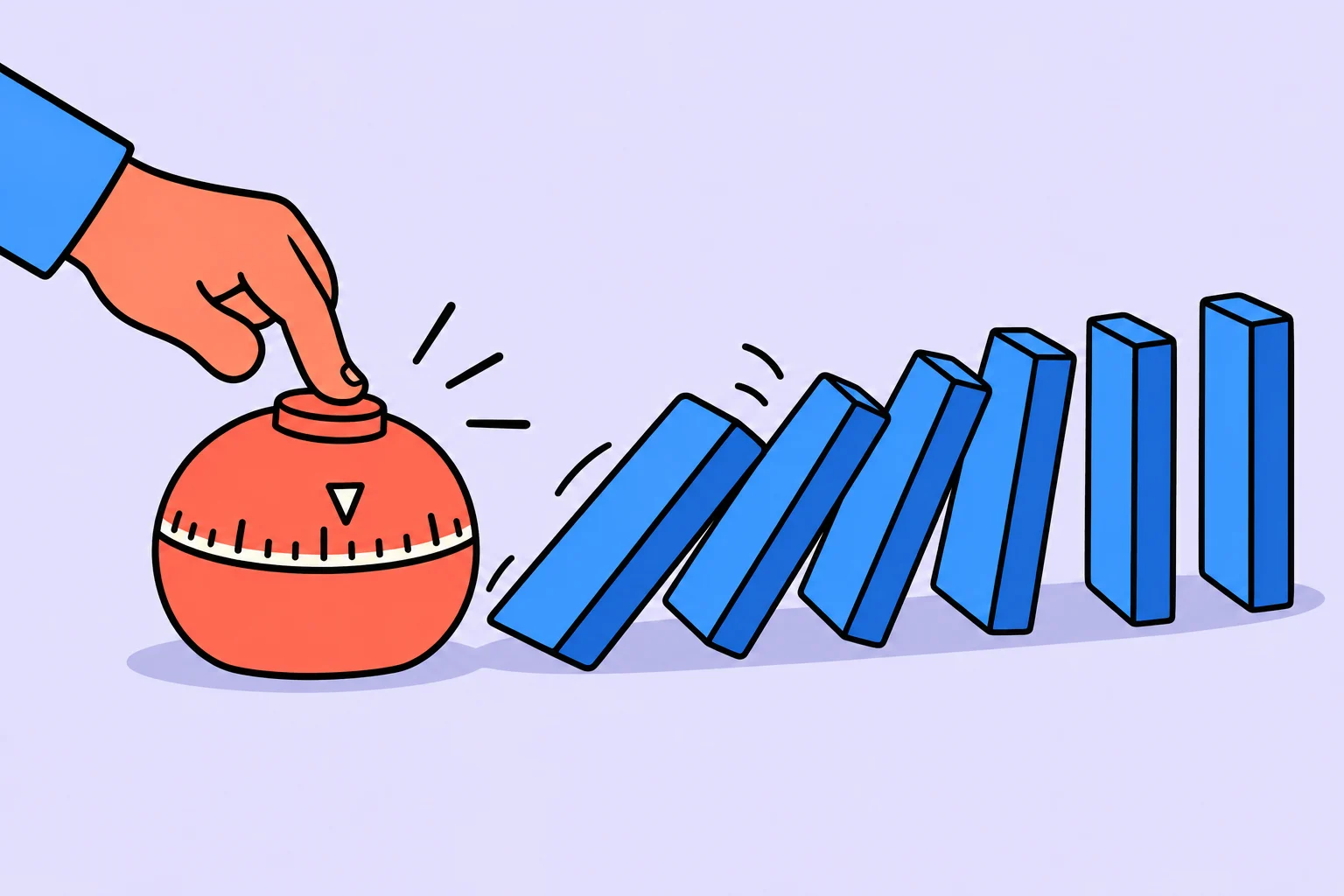
The to-do list in your head grows faster than it shrinks. A dirty mug on the desk, an unanswered email, an overdue doctor's appointment, an unread message and unsorted photos. Each small item consumes a drop of attention, leaving you exhausted by evening even though you supposedly “didn't do anything major.” The two-minute rule is an elegant principle that breaks this vicious cycle.
Threshold for doing a task immediately (GTD)
Daily tasks that can be completed in 2 minutes or less
Average time to return to a task after switching (UC Irvine)
Where the two-minute rule came from
David Allen, the creator of the Getting Things Done (GTD)methodology—one of the world's most influential productivity systems—developed the rule. In Getting Things Done (2001), he described a simple way to process incoming items: if an action takes less than two minutes, do it right now rather than postponing it.
Allen's reasoning: recording a task, organizing it, setting a reminder and returning to it later often take longer than doing it. Why put “wash the mug” on a to-do list when it takes 30 seconds? Why postpone replying to an email if the answer is one sentence?
An important nuance: Allen did not mean jumping at every minor task and interrupting important work. Apply the rule while processing incoming items—reviewing email, sorting notes or planning your day. If you encounter a 2-minute task, complete it immediately and move on.
Two applications: tasks (Allen) and habits (Clear)
The two-minute rule has two versions from two different authors, and both are incredibly useful.
Allen's version (for tasks): if you can do a task in 2 minutes, do it now. Do not record, schedule or overthink it: just do it. This prevents small tasks from accumulating and consuming cognitive resources.
Clear's version (for habits): to start a new habit, reduce it to a 2-minute action. Not “read for 30 minutes,” but “open the book and read one page.” Not “run 5 km,” but “put on running shoes and step outside.” The idea is that starting is the hardest part. Once you begin, continuing becomes natural. Read more in our Atomic Habits review.
Use Allen's rule for existing tasks: replying to an email, clearing your desk or confirming a meeting. Use Clear's rule for habits you are developing (meditation, exercise, reading or a gratitude journal). Two rules, one number: 2 minutes.
Why the two-minute rule works: neuroscience
Three research-supported psychological mechanisms underpin the rule's effectiveness.
Lowering the starting threshold. Procrastination is usually caused by imagined difficulty rather than a task's real difficulty. The brain overestimates the effort and underestimates the time. When you tell yourself “this will take only 2 minutes,” the brain stops resisting: the threshold is too low to trigger procrastination's defensive mechanism.
The Zeigarnik effect. Unfinished tasks occupy mental space: the brain keeps “open processes” in working memory. Each unfinished small task is a background process consuming cognitive resources. Completing 2-minute tasks frees working memory for important work.
Behavioral momentum. Physics applies to behavior: a body at rest tends to remain at rest, while a body in motion keeps moving. Completing one small task creates momentum. The first leads to a second, then a third. After 10 minutes, you have finished 5 small tasks and feel productive, which fuels larger tasks.
A study by Baumeister and Masicampo (2011, Journal of Personality and Social Psychology) found that unfinished tasks literally reduce cognitive capacity. The brain holds 4-7 items in working memory, and each unfinished small task occupies one slot. Finishing or planning a task frees a slot, improving the quality of thinking by 20-30%.
Work examples: what you can do in 2 minutes
Here are typical work tasks that fit the rule:
Reply to a short email (30 sec–2 min). Forward a document to a colleague (15 sec). Capture an idea in your notes (30 sec). Update a task's tracker status (20 sec). Confirm a calendar meeting (10 sec). Send a document link (30 sec). Add a task comment (1 min). Read and process a notification (30 sec). Fill in a report row (1 min). Save a file in the correct folder (20 sec).
Do the math: 10 tasks of 30-60 seconds take 5-10 minutes. But if you postpone each one, returning to its context takes 23 minutes (UC Irvine research), plus the task itself. In total, 10 postponed small tasks can consume up to 4 hours.
Everyday examples
Wash your mug immediately after coffee (30 sec). Hang up clothes instead of throwing them onto a chair (20 sec). Book a doctor's appointment online (1-2 min). Pay a bill through your banking app (1 min). Reply to a friend's message (30 sec). Wipe the table after eating (30 sec). Put something away (10 sec). Make the bed (1 min). Throw expired food out of the fridge (15 sec). Sign a document (30 sec).
Each action is insignificant on its own. But 20 accumulated small tasks create a sense of chaos and lost control. Your apartment looks untidy, unfinished tasks linger and you spend energy on guilt instead of productive work. The two-minute rule stops small tasks piling up, just as daily tidying prevents the need for a deep clean.
The two-minute rule for habit formation
James Clear's version is especially powerful for new habits. The key principle: make the habit so easy that you cannot say no. Instead of the ambitious “meditate for 20 minutes,” try “sit down and close my eyes for 2 minutes.” Instead of “keep a journal,” try “write one sentence.” Instead of “exercise for an hour,” try “put on workout clothes.”
When a habit starts with a 2-minute action, the entry barrier disappears. Not in the mood? 2 minutes is no reason to refuse. Tired? You have enough energy for 2 minutes. No time? You can always find 2 minutes. And once you begin, momentum takes over. After putting on running shoes, you will probably go for a run. After opening your journal, you will write more than one sentence.
Clear calls this a “gateway habit.” The 2-minute version is an entry point to the full habit. Over time, you naturally increase the amount: 2 minutes of meditation → 5 → 10 → 20. But you always start with two. Micro-habits — a detailed exploration of this approach.
Define your target habit
For example: “I want to meditate for 20 minutes every morning.”
Reduce it to 2 minutes
The 2-minute version: “Sit on a cushion and close my eyes for 2 minutes.” This is not silly; it is a strategy.
Practice for 2 minutes for 2 weeks
Do not increase it. The aim is to establish the cue and the habit of sitting down. This is the foundation.
Increase by 2 minutes every 2 weeks
2 → 4 → 6 → 8 → 10 → 15 → 20. After 3 months, you meditate for 20 minutes, and it feels easy.
Pitfalls of the two-minute rule
Pitfall #1: Getting stuck in small tasks. If you spend all day completing 2-minute tasks, no time remains for important work. Set aside 2-3 windows of 15-20 minutes to batch-process small tasks: morning, after lunch and evening. The remaining time is for Deep Work.
Pitfall #2: The illusion of productivity. Finishing 20 small tasks gives a pleasant sense of a “productive day.” But if none moved you toward your goal, the day is lost. The two-minute rule complements a prioritization system (MIT, the Eisenhower matrix), rather than replacing it.
Pitfall #3: Blurring the boundary. “This will take 2 minutes”—but it actually takes 15. Estimate honestly. If a task takes more than 2 minutes, put it on your list and allocate time. Do not deceive yourself, or the rule loses its power.
Do not interrupt yourself for 2-minute tasks during Deep Work or a Pomodoro session. Record the task and return to it after your focused work block. Switching attention costs 23 minutes: too high a price for a 2-minute task.
The two-minute rule in GTD
In the GTD system, the two-minute rule belongs to the “Clarify” step. Process each incoming item as follows: “Does this require action?” → If not: delete, defer or save as reference → If yes: “Can I do it in 2 minutes?” → If yes: do it immediately → If not: delegate or schedule it.
The rule is built into the system as a filter, removing small tasks before they reach your lists. Without it, GTD lists expand to hundreds of items, and the system becomes overwhelming instead of liberating. The two-minute rule is a valve that stops small tasks clogging the system.
The two-minute rule in Atomic Habits
James Clear incorporated the rule into his habit-formation model: cue → craving → response → reward. The two-minute rule works at the “response” stage by making the action so easy that “craving,” or motivation, is barely needed.
Clear gives an example of someone who wanted to start running. Instead of “5 km every day,” he began with “put on running shoes and go outside.” During the first week, he literally stepped outside, stood for a minute and returned. In the second, he walked to the intersection. In the third, he ran one block. After 3 months, he was running 5 km. The key: he never skipped, because “put on running shoes” was impossible not to do.
Practical scenarios
Morning email processing. Open your inbox. For each email: read → reply within 2 minutes OR move it to “Requires action.” After 15-20 minutes, your inbox is empty and your mind clear.
Evening tidy: a 2-minute whirlwind. Set a timer for 2 minutes. Do whatever you spot: wash a mug, put away clothes or wipe the table. It is surprising how much 120 seconds of purposeful action can accomplish. Do this every evening and your apartment stays tidy.
Work breaks. Between Pomodoro sessions or tasks, spend 5 minutes on 2-3 two-minute jobs. This is more productive than scrolling a feed and creates a sense of progress. The Pomodoro technique + the two-minute rule = a powerful combination.
How to adopt the rule: a one-week plan
Day 1: Take stock
Write down every small task you have been postponing. Check your apartment, desk, email and phone. A list of 20-30 items is normal.
Day 2: A completion blitz
Set aside 30 minutes and finish every task on your list that takes less than 2 minutes. Cross each one off: the feeling will be incredible.
Days 3-5: In real time
Apply the rule in real time. When you encounter a 2-minute task while processing incoming items, do it immediately. Do not record or postpone it.
Days 6-7: Evaluate
Are there fewer loose ends? Do you feel more in control? If so, the rule has become part of your system. If not, establish fixed windows for processing small tasks.
The two-minute rule and procrastination
The two-minute rule is one of the most effective antidotes to procrastination. Procrastination arises when the brain considers a task “too difficult,” “too long” or “too unpleasant.” A 2-minute version bypasses all three barriers: it is clearly easy, clearly brief and does not trigger negative emotions.
For example, you have postponed your tax return for weeks. The 2-minute version: “Open the tax authority's website and find the right form.” That is all: no filling in or calculations, just open and find. Tomorrow: “Fill in the first 3 fields.” The day after: “Fill in 5 more fields.” After a week, the return is complete, and it never felt intimidating.
Combining the rule with other productivity methods
2-minute rule + GTD: use the rule as an inbox-processing filter so small tasks never reach your lists. 2-minute rule + Pomodoro: between Pomodoro sessions: 2-3 two-minute tasks instead of scrolling. 2-minute rule + time management: morning and evening batch-processing sessions for small tasks, 15 minutes each. 2-minute rule + morning routine: reduce every new ritual to 2 minutes for a painless start.
Process short incoming tasks at a separate time, and turn larger ones into next steps. Create a task in Sinqly — registration is free.
Frequently asked questions about the two-minute rule
What is the two-minute rule?
Two versions: Allen (GTD)—do a task taking <2 minutes immediately. Clear (Atomic Habits)—reduce a new habit to 2 minutes to get started. Both approaches address inertia, for tasks and habits respectively.
Why does the rule work?
Three mechanisms: lowering the starting threshold (the brain does not resist), the Zeigarnik effect (finished tasks free memory) and behavioral momentum (one task leads to the next). Read more in our explanation of the Zeigarnik effect.
When should you not use it?
During Deep Work or a Pomodoro session. The rule is for processing incoming items, not interrupting focused work. Record small tasks and complete them in a batch after a deep-work block.
How does it relate to procrastination?
A 2-minute version bypasses all barriers to procrastination: too difficult? No, it takes 2 minutes. Too long? No, 2 minutes. Intimidating? No, it is a minimal action. Momentum often follows once you start.
How many tasks can you finish in a day?
Around 50% of daily tasks take 2 minutes. But do not spend all day on small tasks: use 2-3 windows of 15-20 minutes and reserve the rest for important work. Balance responsiveness with focus.
How does Allen's version differ from Clear's?
Allen: do the small task now. Clear: reduce the habit to 2 minutes to start. Allen tackles task inertia; Clear tackles habit inertia. Together, they provide a versatile weapon against putting things off.
Was this helpful?
Rate the article and tell us what was missing. Your feedback goes to the Sinqly team and will not be published on the site.
Atomic Habits: A Summary of James Clear’s Book
A summary of Atomic Habits: the 4 laws of behavior change, the 1% principle, the habit loop, and practical ways to apply Clear’s ideas.

Procrastination: 12 science-based ways to stop putting things off
Why we procrastinate and how to stop putting things off. 12 scientifically grounded methods for tackling procrastination, from the two-minute rule to cognitive therapy.

How to finish tasks: completion criteria and the final step
Review nearly finished work: define a verifiable result, separate improvements, prepare the handoff, and close the remaining commitments.