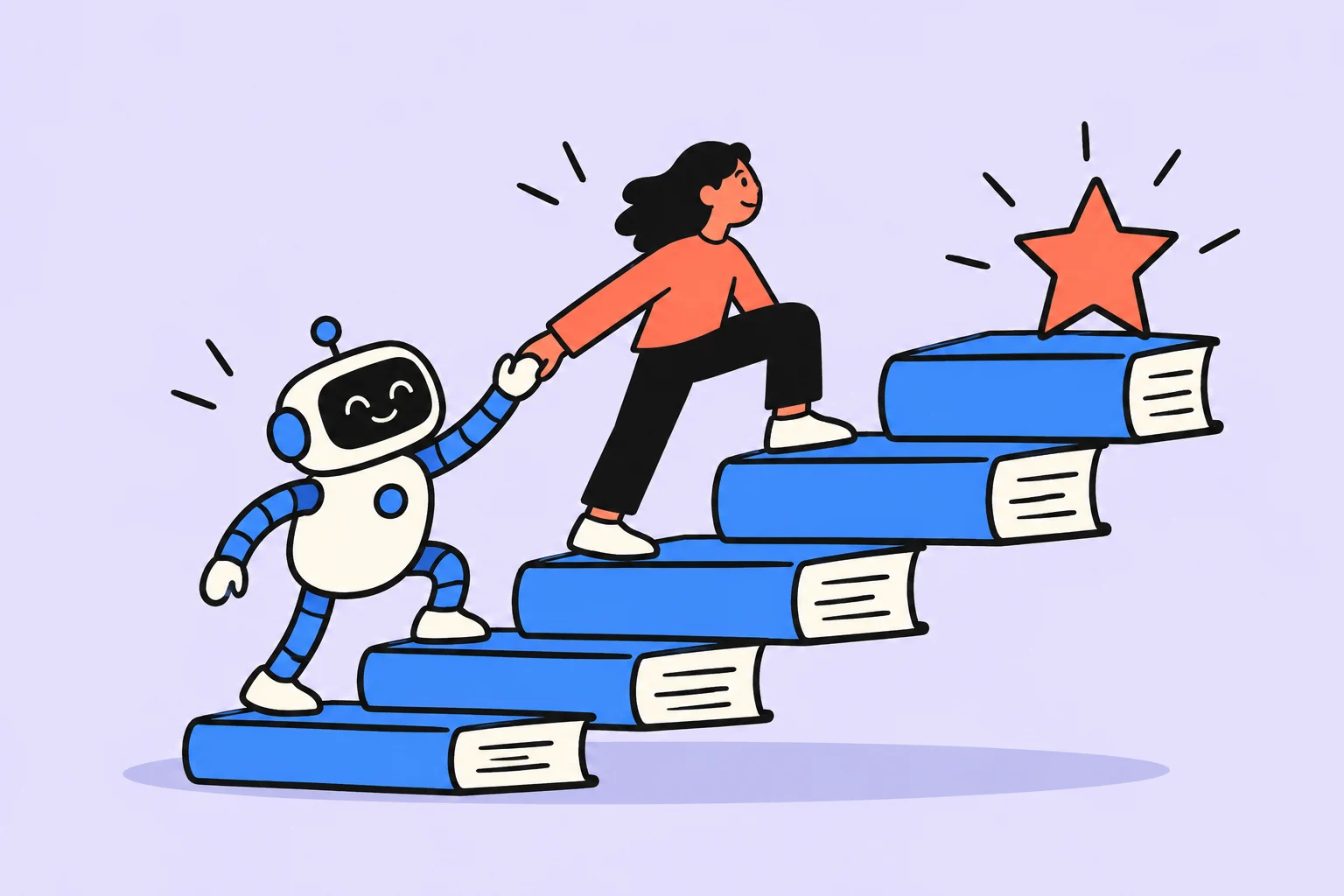
Artificial intelligence for life is a reality of 2026. AI is changing every field, from medicine to education, and personal development has become one of the areas where it delivers the greatest practical benefit. Millions worldwide already use AI tools for goal setting, habit formation, emotional management, and career growth.
But how exactly does AI help us develop? Does it turn a person into a technology-dependent robot? Which ways of using AI for personal development actually work, and which are merely marketing noise? In this guide, we examine 10+ proven approaches supported by scientific research and show how to integrate artificial intelligence into your everyday life without losing your humanity.
greater likelihood of goal achievement with an accountability partner (ASTD)
more often reach goals with AI coaches (Frontiers in Psychology)
availability of an AI coach for reflection and support
more effective personalized learning compared with standard learning
Why AI personal development became mainstream in 2026
Five years ago, an AI coach seemed exotic. Today it is one of the fastest-growing EdTech segments. According to Grand View Research, the global AI personal-development market reached $4.8 billion in 2025 and continues growing by 35% annually.
Three factors made AI personal development mainstream. First, language models became capable enough to hold meaningful conversations about life goals and problems. Second, AI service costs fell many times over, making them affordable to ordinary people. Third, COVID-19 accustomed people to digital support, from online therapy to virtual workouts.
AI for life amplifies your own development efforts. It works when convenient for you and adjusts to your pace and style, while human relationships retain their place.
AI coaching: a personal mentor available 24/7
Traditional coaching costs 5,000–50,000 rubles per session and is available 1–2 times a week. AI coach is available around the clock and costs many times less. It powerfully complements a human coach, helping with daily reflection, goal setting, and overcoming internal obstacles.
Modern AI coaches use methods from cognitive behavioral therapy, motivational interviewing, and positive psychology. They ask useful questions, help reveal blind spots, and suggest concrete actions. Unlike ordinary ChatGPT, specialized AI coaches have context about your life and goals.
A key advantage of AI coaching is the absence of judgment. Many people hesitate to tell a human coach about failures. With AI, you can be completely honest: admit you missed your plan, share fears, or discuss ideas that seem silly. AI helps you analyze and move forward without judging.
When choosing an AI coach, pay attention to three factors: 1) whether it retains context between sessions (remembers your goals), 2) whether it uses scientifically grounded methods, 3) whether it offers specific actions rather than generic advice. Sinqly combines all three qualities in one tool.
Personalized development plans with artificial intelligence
AI analyzes your answers, habits, and progress to create a plan suited to you. Instead of generic advice to wake at 5 a.m., it gives specific recommendations considering your chronotype, current workload, strengths, and growth areas.
Machine-learning algorithms find patterns that you may not notice yourself. For example, AI may discover that your productivity falls after a particular type of task, or that you succeed more with new habits when you begin them in the middle of the week. This personalization makes recommendations significantly more effective.
A study by Stanford HAI found that personalized AI recommendations increase habit adherence by 40% compared with generic advice. Recommendations are easier to follow when they account for your context.
How to create a personal-development plan with AI
Identify 1–3 key development areas, such as career, health, or relationships
Have an initial AI-coaching session about your current situation and goals
Receive a personalized plan with specific daily actions
Complete the actions and record progress in an AI tracker
Analyze results with AI weekly and adjust the plan
Hold a deeper monthly review: what works, what does not, and what to change
Analyzing emotions and mental state through AI
AI can analyze text and identify emotional patterns. When you journal or talk to an AI coach, algorithms identify your emotional state, stress level, and potential problems. This helps you notice concerning trends and act before the situation worsens.
Modern NLP (natural language processing) models identify not only basic emotions such as joy, sadness, and anger, but also subtler states: burnout, anxiety-driven procrastination, perfectionism, and impostor syndrome. AI may notice that the tone of your entries has become more negative over the last two weeks, even if you are not aware of it yourself.
It is important to remember that AI does not diagnose conditions or replace a psychotherapist. But it can be an effective tool for self-observation and initial reflection. If AI notices persistent signs of depression or anxiety, it will recommend consulting a specialist. That may provide the nudge you would not have received without daily reflection.
Smart habit tracking with artificial intelligence
Ordinary habit trackers record done or not done. AI trackers go further: they analyze factors affecting habits, predict high-risk days, and adapt difficulty. If you miss a workout, AI suggests a lighter alternative rather than skipping completely.
This approach follows the minimum viable habit concept from B. J. Fogg's Tiny Habits: doing 5 push-ups is better than nothing. AI helps maintain continuity, a key habit-formation factor. Read more about habit science in our guide to building habits.
AI also considers relationships between habits. If you begin meditating regularly, it might suggest breathing exercises: habits in the same cluster are easier to form together. James Clear described habit stacking in Atomic Habits, and AI can implement it effectively.
A 2025 Frontiers in Psychology meta-analysis examined 47 studies of AI personal-development tools. AI-coaching users reached their goals 31% more often, and life satisfaction rose 18% over 3 months. The key factor was daily reflection with feedback, which AI provides automatically.
Generating ideas and solving life problems with AI
AI is a useful brainstorming partner. When you are stuck, it can suggest unexpected solutions, ask guiding questions, or help organize thoughts. This is especially helpful for creative tasks, career planning, and conflict resolution.
Programming's rubber duck debugging technique also works in life: simply describing a problem, even to AI, often leads to insight. Unlike a rubber duck, AI can respond with an analytical framework, psychological examples, or a question you would not think to ask yourself.
Try describing your problem in as much detail as possible, then ask AI for 5 clarifying questions. Your answers often contain the solution; you simply had not articulated it. AI supports personal development by helping you think systematically rather than by being smarter than you.
Personalized learning with AI for life
AI adapts learning content to your knowledge, learning style, and goals. Instead of a course identical for everyone, you get a personalized route that identifies and focuses on knowledge gaps while skipping familiar material.
This applies to languages, professional skills, financial literacy, and other fields. Studies show personalized learning is 30–50% more effective than standard learning. AI also uses spaced repetition, a scientifically supported method for long-term retention.
For personal development, AI can create a personalized reading program, select courses and resources for specific goals, and then check understanding. It is like having a tutor who knows your learning history and adjusts to your pace.
Automating routine work: freeing time for growth
Time is the main personal-development resource. AI helps automate email sorting, reports, scheduling, and information processing. Invest the time freed in learning, health, and relationships.
According to McKinsey Digital, AI can automate up to 30% of an average worker's tasks. That means 10+ hours weekly, an entire working day available for development. Specific examples include an AI email assistant saving 45 minutes daily, an AI planner saving another 30 minutes, and a meeting summarizer saving 20 minutes.
Automation is not limited to work tasks. AI also helps automate everyday routines: planning weekly menus, planning workouts, and managing finances. Every automated routine frees cognitive resources for more important decisions. Read more about AI planner in the features section.
Accountability: AI as an accountability partner
AI creates an accountability system through reminders, progress checks, and weekly reports. The American Society for Training and Development, ASTD, found that having an accountability partner increases the likelihood of achieving a goal by 95%. An AI coach fills this role without judgment or social pressure.
Share your goals with AI, and it will regularly ask about progress, help overcome obstacles, and celebrate achievements. This creates stable support available anytime. For people who find asking for help difficult, AI can be an ideal first step toward a support system.
AI for developing emotional intelligence
Emotional intelligence (EQ) is one of the key skills for success in life and career. According to Daniel Goleman’s research, EQ explains up to 80% of success in leadership positions. But how can you develop emotional intelligence? AI offers several practical approaches.
The first is an emotional diary with AI. Describe situations, reactions, and feelings, and AI helps identify patterns: triggers for anger, defensive reactions, and communication blind spots. Over time, you begin noticing these patterns in real time.
The second approach is role-playing with AI. Rehearse a difficult conversation with your boss, practice active listening, or learn to give constructive feedback. AI simulates different conversation partners and provides feedback on your communication style.
The wheel of life and AI analytics for personal development
One powerful combination for AI personal development is the wheel of life with AI analytics. Rate 8 key areas: health, career, finances, relationships, development, rest, environment, and meaning. AI analyzes imbalances and suggests concrete actions to improve weaker areas.
AI identifies correlations as well as displaying charts. It might find that a decline in rest consistently precedes a decline in health by 2–3 weeks, or that career growth comes at the expense of relationships. Such insights support informed decisions about time and energy.
AI coach 24/7
A personal AI mentor that remembers your context, goals, and progress, available anytime for reflection and support.
Smart habit tracking
AI analyzes patterns, adapts habit difficulty to your current state, and predicts high-risk days.
Personal plans
Individual recommendations based on your chronotype, goals, and learning style: your own strategy rather than generic advice.
Emotion analysis
AI identifies emotional patterns, warns of burnout, and helps develop emotional intelligence.
AI's limits in personal development: what to know
Despite its advantages, AI has limits. It does not replace human relationships, professional psychotherapy, or medical consultations. It can make mistakes, offer generic advice, or miss context. Use AI as a tool rather than an oracle.
Major limitations include no genuine empathy, since AI simulates understanding without feeling; limited training data that can reproduce biases; and inability to account for every cultural, family, or medical nuance. AI also cannot motivate like a real person who believes in you.
The best approach combines AI tools with human support: AI for daily reflection and tracking, and a human coach or therapist for deeper work. Sinqly AI coach follows this philosophy: a useful complement to human contact.
An AI coach does not replace psychotherapy, medical care, or crisis counseling. If you have serious mental health problems, suicidal thoughts, or are in crisis, contact a professional. Helpline: 8-800-2000-122, free and available around the clock.
How to start using AI for personal development: a step-by-step plan
If you decide to try AI personal development, begin with one tool and one area rather than everything at once. Here is a beginner's plan:
Your first 30 days with an AI personal-development coach
Week 1: Define one main monthly goal and tell the AI coach
Weeks 1–2: Have daily 5-minute AI check-ins, with a morning plan and evening reflection
Week 2: Add 1–2 goal-related habits to the AI tracker
Week 3: Hold your first weekly AI review and analyze what works
Weeks 3–4: Try AI for idea generation or a specific problem
Week 4: Review the month and adjust the plan for the next period
The main rule is not to expect AI to do everything for you. AI is a mirror and navigator, but you must walk the path. As coach Tony Robbins says: “Knowledge is not power. Knowledge is potential power. Action is real power.” AI helps turn knowledge into systematic action.
The future of AI personal development: 2026–2030 trends
AI technologies for life continue developing rapidly. Over the next 3–5 years, several key trends will emerge. Multimodal AI coaches will analyze voice, facial expressions, and wearable physiological data as well as text, providing a much more accurate picture of your state.
The second trend is integration with the health ecosystem. AI will receive data from fitness trackers and sleep and nutrition apps for holistic recommendations. If sleep worsens, an AI coach will suggest adjusting workload, meditation, and social activities as well as your schedule.
Read more about the outlook in our review of the future of AI coaching. If you are ready to begin, try a free AI-coaching session.
Frequently asked questions about AI personal development
Can AI replace a human personal-development coach?
AI complements rather than fully replaces a human coach. It is available 24/7 for daily reflection, goal tracking, and quick consultations. Deep therapeutic work, crises, and complex life decisions still require a human professional. The optimal strategy uses AI for daily support and a human coach for key moments.
Which personal-development tasks does AI handle best?
AI is most effective at habit tracking, personalized development plans, emotional-pattern analysis, idea generation, and accountability. Research indicates a 31% increase in goal-achievement likelihood. It is less effective for deep trauma, crises, and decisions requiring complex ethical judgment.
Is sharing personal information with an AI coach safe?
Reliable AI platforms encrypt data and do not share information with third parties. Choose services with transparent privacy policies.
How much does an AI coach cost compared with a regular coach?
Human coaching costs 3,000–50,000 rubles per session. AI coaching costs 500–2,000 rubles monthly with unlimited sessions, making professional coaching accessible to a wider audience. Some platforms, including Sinqly, offer a free trial.
How should a beginner start using AI for personal development?
Begin with one specific area: habit tracking, journaling, or goals. Choose a specialized tool rather than general-purpose ChatGPT, define 1–2 goals, and engage daily for at least 5–10 minutes. Results usually become noticeable after 2–3 weeks of regular use.
How do AI personal-development tools differ from ordinary productivity apps?
Ordinary apps are passive tools: to-do lists, timers, and calendars. AI tools for personal development actively analyze your behavior, adapt recommendations, ask questions for reflection, and predict problems before they appear. It is the difference between a calculator and a financial adviser: both work with numbers, but one understands your goals.
What scientific evidence supports AI's effectiveness for personal development?
A 2025 Frontiers in Psychology meta-analysis of 47 studies found AI-coaching users reached goals 31% more often. Stanford research found personalized AI recommendations raised habit adherence by 40%. AI accountability increases the likelihood of goal achievement by 95%, according to ASTD. Practical experience from tens of thousands of users supports these results.
Turn an idea into action
Was this helpful?
Rate the article and tell us what was missing. Your feedback goes to the Sinqly team and will not be published on the site.
The future of AI coaching: trends for 2026-2030
An overview of AI coaching trends for 2026-2030. Multimodal models, emotional AI, hybrid coaching, and integration with wearable devices.
Digital detox: a complete guide
A complete guide to digital detox. Signs of information overload, dopamine dependence, weekend and week-long plans, and a family detox.
Deep Work: a complete guide to deep, focused work
A complete guide to Cal Newport's Deep Work. How to practice deep work, 4 strategies, focus rituals, and the science of concentration.