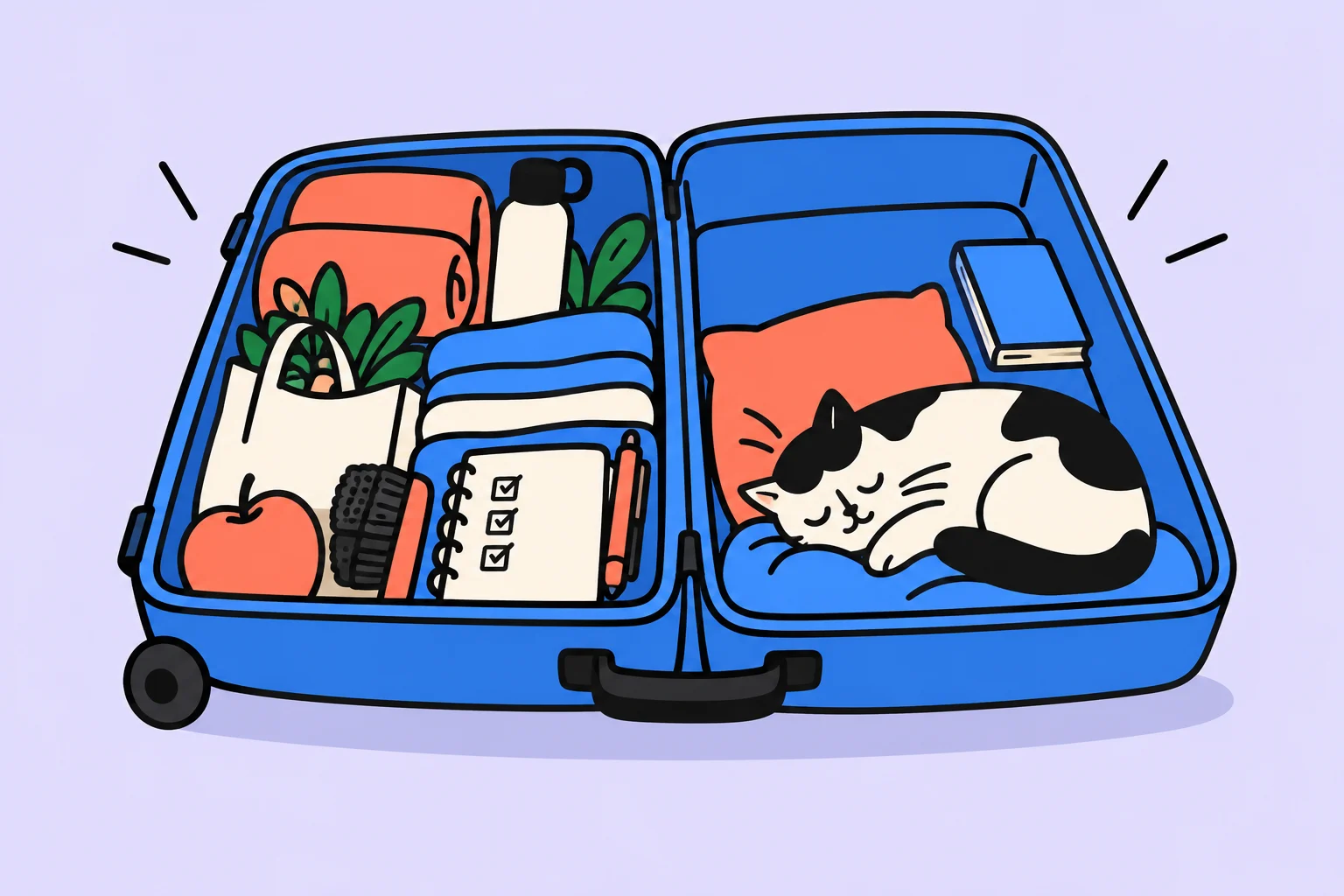
A day off starts with choosing, rather than a list
A day-off plan easily becomes a list of everything that did not fit into the week: shopping, cleaning, learning, repairs, meetings, and a walk. The problem is not its length alone but the absence of choice: every task seems obliged to fit into one day. Rest remains a reward after the final item, which may never be finished.
First decide what this day off is for. Recovery after a demanding period, seeing loved ones, one large household task, or a short trip? You can combine purposes, but name the main one. If family time comes first, cleaning needs a boundary. If you need to finish repairs, do not promise yourself a full entertainment program as well.
Find the essential household minimum
List tasks without which the next few days will become noticeably harder. Buying basic groceries may be necessary; sorting every cupboard probably is not. Preparing a child’s required items for Monday may be essential, while choosing kitchen decorations can wait. Identifying the minimum does not devalue other wishes: they simply do not receive equal priority for one day.
For each required task, clarify what counts as enough. ‘Tidy up’ is endless; ‘clear the kitchen table, take out rubbish, and load the washing machine’ has an endpoint. When sharing a household, agree on who takes which tasks. If one person plans shared relaxation and another plans deep-cleaning, discuss the mismatch before morning rather than discovering it midday.
Choose a plan format suited to the day
Every day off does not need a minute-by-minute schedule. If there is a train, appointment, or event, mark its exact time and travel. Plan the rest in broad blocks: a household morning, lunch together, a free afternoon. Open University considers time management among different commitments; here that principle is applied to a day off without turning it into a work shift.
Leave intervals between blocks for getting ready, food, or travel. If you like spontaneity, the plan can contain one required action and a boundary: ‘shopping before lunch; no new tasks after lunch’. That is a plan too. Its quality depends on whether it fits your circumstances, rather than the number of calendar cells.
- Purpose
What matters most on this particular day: rest, a meeting, or one large task.
- Minimum
Which required tasks are genuinely necessary and where they end.
- Boundary
Which time stays free and what is removed first if delayed.
Combine travel and errands into one route
If there are several trips, check addresses, opening hours, and whether you need to travel at all. One coordinated route is often more convenient than three separate outings. But do not add every possible place simply because it is ‘almost on the way’. Each stop takes time and can turn a small errand into a large expedition.
Account for returning home: groceries need putting away, and after a walk you may want food and a change of clothes. These transitions must not vanish from the plan. Delivery can be an option if its terms and price suit you, but it is not a mandatory recommendation. The decision depends on your budget and preferences. Count the entire block honestly, rather than only the minutes inside the store.
A Saturday example without an evening of catching up
An illustrative example: Marina wanted to buy groceries, clean the entire apartment, meet a friend, and spend the evening at home. After checking, she realizes that unbounded cleaning would occupy most of the day. She keeps the household minimum, messages her friend a suitable meeting time, and combines shopping with travel to the meeting. She postpones the rest separately rather than retaining hidden debt on Saturday’s list.
In the morning, Marina completes a short household block, then leaves for the meeting. On returning, she puts away the shopping and adds no more household tasks. If the meeting runs late, she cancels an optional stop on the way instead of cutting the entire quiet evening. This illustrates a choice, rather than the correct schedule for everyone. Someone with children, shift work, or another load will need different blocks, but the boundary principle remains.
Decide in advance what to cancel if delayed
A plan often changes for a clear reason: a long queue, travel, an unexpected request, or a tired child. A fallback is more useful than trying to speed everything up at once. Name the first task to postpone and what must be preserved. If free time is always cut first, it was a chance remainder rather than a protected part of the plan.
Check before starting: what happens if a mandatory task takes longer? Can you simplify food preparation, remove an extra trip, or postpone cleaning? Agree on these decisions with loved ones. You do not need a large reserve in every hour. Avoid building a continuous chain where any delay makes everything afterward impossible.
A one-page day-off template
The template helps you quickly choose a sufficient plan. Fill it in the evening before or in the morning if there are no early commitments. Do not add details that do not affect the decision. Keep a separate wish list for later: an idea that does not fit today need not disappear or become guilt.
- Main purpose of the day: what you want to preserve by evening.
- Required minimum: actions with a clear boundary.
- Fixed times: appointments, meetings, trips, and travel.
- Free block: no new household requests.
- Agreements: who participates and who takes what.
- First postponement: which task I remove if delayed.
- End of planning: when I stop adding to the list.
In Sinqly, you can record the household minimum as separate tasks and mark completed work. A walk or free hour need not become a checkpoint. If you prefer paper, visually separate the task list from the free block. It helps to see that this empty space is intentional.
Mistakes and a calm end to the day
Do not assign a mandatory result to every enjoyable activity. A book may remain unfinished, a walk may be short, and a conversation may have no photos. Do not compare your day off with someone else’s packed program. General NHS advice for tiredness includes sleep, regular food, and manageable movement, but that does not create an obligation to have a perfect wellness day.
In the evening, check only whether the minimum was done, the needed free time remained, and which task should have been removed in advance. Do not conduct a detailed productivity assessment. A workday needs a different plan, with handoffs and deadlines. Do not automatically transfer that logic to all free time. A day-off plan helps protect the chosen day and finish necessary work while leaving room to rest.
Sources
Frequently asked questions
Should I plan a day off by the hour?
Exact times help with appointments, transport, and meetings. Leave the rest in broad blocks or use one limit on chores. Choose detail according to real commitments.
What if all household tasks are necessary?
Check whether each task’s full scope is genuinely needed. Simplify the result, distribute responsibilities, and discuss timing. If the whole day is objectively occupied, do not promise yourself a full rest program on top.
How can I avoid guilt about a postponed task?
Name the reason and new agreement. Postponement becomes a deliberate choice when you know what matters more today and when to return to the task. Do not keep it both postponed and mandatory for the evening.
Turn an idea into action
Was this helpful?
Rate the article and tell us what was missing. Your feedback goes to the Sinqly team and will not be published on the site.

How to recover after a demanding week
A practical plan for ordinary rest: remove unnecessary demands, simplify household work, leave free time, and check what needs reviewing.

Manager productivity: how to manage time and people
A productivity guide for managers: time management, delegation, planning, and team motivation. Practical tools and methods.
Stress Management: 12 Everyday Practices
Research-based stress-management practices: breathing techniques, meditation, cognitive reappraisal and physical activity. How to relieve stress quickly and for the long term.