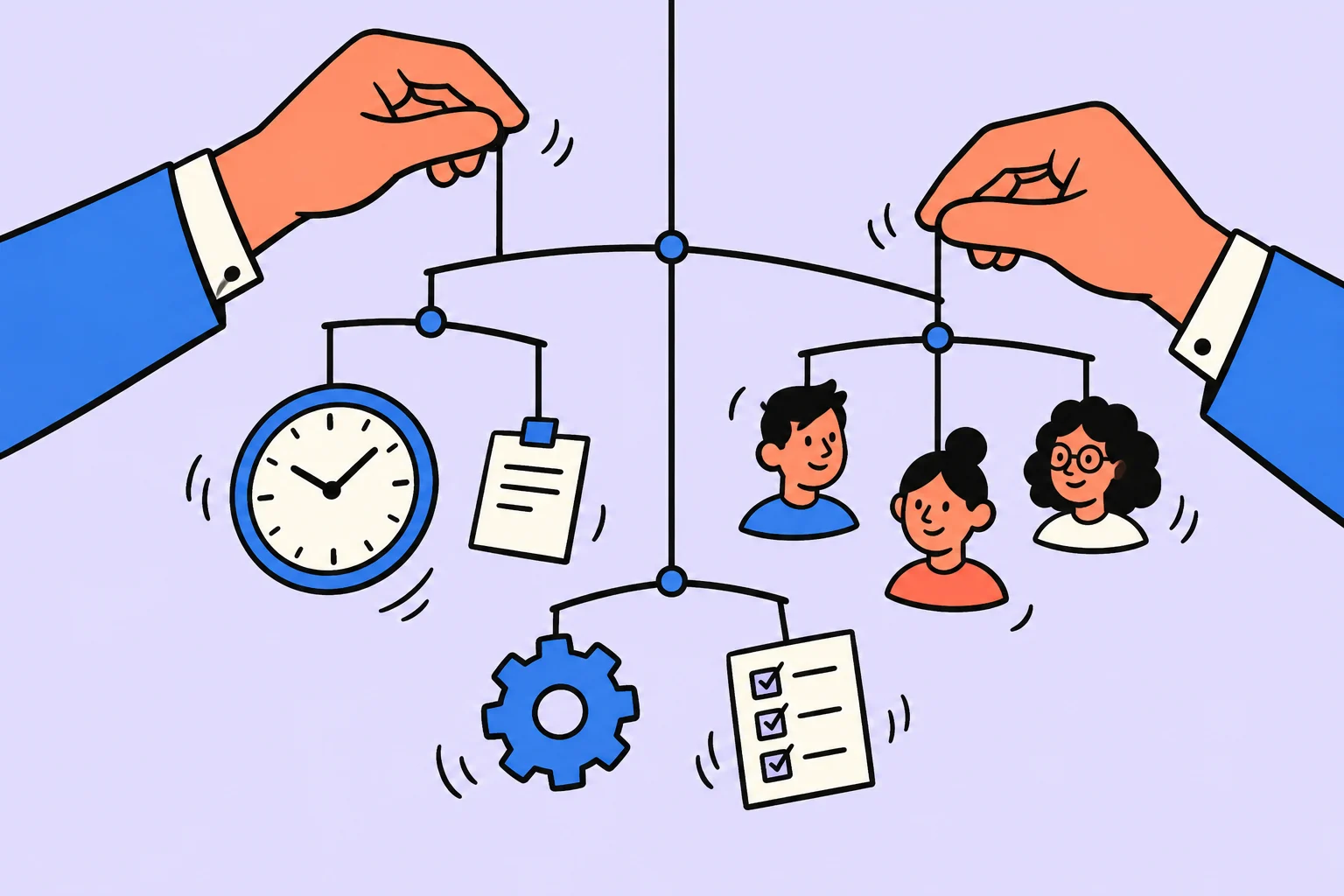
A manager is a productivity multiplier. Your effectiveness directly influences an entire team's results, sometimes the whole company's. Yet the paradox of management is that the higher your position, the harder your own time is to control. Constant meetings, urgent questions, strategic planning, and developing people all demand attention at once. How can you stay productive while managing people as well as tasks? This article offers a systematic approach to leadership productivity based on management research and leadership neuroscience.
of a manager's time goes to meetings and communication (MIT 2025)
of leaders experience burnout (HBR)
increase in team productivity with effective leadership
The unique productivity challenges managers face
Manager productivity differs fundamentally from individual contributor productivity. While a programmer can shut the door for 6 hours and write code, a leader constantly multitasks: making decisions, developing people, coordinating processes, and planning the future.
Interruptions as part of the job
A Harvard Business School study found that senior managers switch activities every 9-12 minutes. This is not a sign of poor organization: it reflects the nature of management work. People come to leaders with questions they cannot resolve independently. Rejecting every request would block the team.
The key is to structure interruptions: allocate time for the team, establish urgency priorities, and teach people to resolve issues independently. You cannot eliminate interruptions completely, but you can manage their flow.
Balancing operations and strategy
Constant firefighting draws managers into operations. But a leader's main value lies in strategic thinking, team development, and building systems. Without investing in strategy, a manager becomes an "expensive individual contributor".
The 70/20/10 principle for managers: 70% of time on current operations, 20% on strategic planning and development, and 10% on experiments and innovation. Without deliberate planning, operations crowd out strategy.
The "ask three questions" rule: When someone brings a problem, first ask: "What possible solutions do you see?", "What would you do in my place?", and "What information do you need to make a decision?" This develops team independence and frees your time.
Time management for leaders: a time-blocking system
Ordinary time management techniques do not suit leaders because their work is highly unpredictable. They need a more flexible system that accounts for management's nature.
The architecture of a manager's day
6:00-8:00 — Strategic time. Early morning, when nobody disturbs you. Planning, analysis, strategic tasks, and reading reports. This is the only time of day entirely under your control.
8:00-10:00 — Deep work. Complex tasks requiring concentration: preparing presentations, analyzing data, and writing documents. Notifications are off, the door is closed, or your status is "Do not disturb".
10:00-12:00 — Team time. One-on-one meetings, answering questions, and employee coaching. This is when you are fully available to the team.
12:00-13:00 — Lunch break. Do not work during lunch. Your brain needs recovery for a productive afternoon.
13:00-16:00 — Meetings and discussions. Group meetings, presentations, and negotiations. Energy drops in the afternoon, but communication skills remain stable.
16:00-17:00 — Administrative time. Email, planning the next day, and routine tasks. These do not require high concentration.
17:00-18:00 — Buffer time. For unexpected tasks, revisiting important issues, and preparing for tomorrow.
Flexibility versus structure
Schedule only 70% of your time. The remaining 30% is a buffer for unexpected tasks, urgent questions, and opportunities. Overly rigid planning creates stress and reduces your ability to respond quickly to change.
Time audit
For a week, record how you spend time every 15 minutes. Identify patterns: when interruptions peak, which tasks consume time, and when you are most productive.
Identify priority blocks
Identify 2-3 activities creating the most value: strategic planning, developing people, or key projects. Protect their time in the calendar.
Create buffers
Leave at least 15 minutes between meetings, at least an hour free each day, and half a day for the unexpected each week. Buffers prevent delays from causing a domino effect.
Set availability rules
Set clear hours when you are available to the team. Use calendar and messenger statuses. Train an assistant or deputy to filter requests.
The art of delegation: multiplying your productivity
Delegation is the main tool for scaling a manager's productivity. But most leaders delegate ineffectively: either too little, doing everything themselves, or without adequate support, leaving people to fend for themselves.
The psychology of delegation
Why do managers resist delegation? Research identifies several reasons: perfectionism, "I will do it better"; distrust, "they will not cope"; loss of control, "I will not know what is happening"; and fear of becoming unnecessary, "then what will I do?"
Effective delegation is not simply offloading tasks: it develops the team and frees time for strategic work. Every properly delegated task increases the system's overall productivity.
The CLEAR delegation model
Context: Explain why the task is needed, how it fits overall goals, and which problem it solves. People do tasks better when they understand their purpose.
Level of authority: Clearly define what the person can decide independently, what requires consultation, and what requires your approval.
Expected results: Specific, measurable success criteria. Instead of "do it well", say "increase conversion by 15% in a month".
Agreement: Ensure the person understands the task, agrees to deadlines, and has the necessary resources and knowledge.
Resources: Provide everything needed: information, tools, budget, access permissions, and connections with other people.
What to delegate and what to keep
Delegate: Routine tasks you can explain in 10 minutes. Projects that help people develop. Tasks where others have greater expertise. Operational decisions with clear criteria.
Do not delegate: Strategic decisions affecting the whole team. Confidential matters such as HR and finances. Tasks requiring your unique experience or connections. Crises where the cost of error is critical.
The reverse delegation trap: When an employee returns a task, saying "I do not know how" or "I cannot do it", coach them toward a solution instead of taking the task back. Otherwise, you teach the team that any difficult task can be returned to the manager.
Managing meetings: turning time killers into a productivity tool
Meetings are a manager's main working tool, but often become time consumers. A Microsoft study found that the average manager spends 23 hours a week in meetings, yet considers only 37% productive.
The anatomy of an effective meeting
Purpose: Every meeting needs a clear, achievable purpose. Instead of "discuss the project", say "decide the project's Q2 budget". Without a clear purpose, the meeting is unnecessary.
Agenda: A structured plan with time limits. Send it 24 hours beforehand. Every item needs an owner and expected outcome.
Participants: Only people who can influence the decision or must carry it out. Amazon's rule: if the team cannot eat two pizzas, it is too large for effective discussion.
Time: Limit duration: 25 minutes instead of 30, 50 instead of 60. Parkinson's law: discussion fills all available time.
Actions: Every meeting should end with specific action items, owners, and deadlines.
Alternatives to meetings
Not everything needs a meeting. Consider alternatives:
Asynchronous decision-making: A proposal document with comments and voting. Saves every participant's time.
Written stand-ups: Daily updates in Slack or email. Faster than gathering everyone at once.
Recorded video updates: Short video summaries instead of information meetings. People watch at a convenient time.
Walking meetings: For creative discussions and one-on-ones. Walking stimulates creativity and reduces formality.
Meeting audit
Analyze every recurring meeting: purpose, effectiveness, and whether an asynchronous format could replace it. Cancel or shorten ineffective ones.
Quality standards
Create an effective meeting checklist: purpose, agenda, limited time, the right participants, and action items. Apply it to every meeting.
Meeting-free time
Set meeting-free days or hours for deep work. Protect them like important meetings with yourself.
Feedback
Regularly ask the team about meeting quality. What can improve? Which meetings are excessive? What adds value?
Team development as a productivity investment
A manager's biggest mistake is thinking that developing people takes time away from "real work". In reality, investing in team development is the best way to increase your own productivity. A strong team solves problems independently, proposes ideas, and takes responsibility.
One-on-one meetings: the cornerstone of development
Regular individual meetings with every direct report are essential. A Gallup study found that managers holding weekly one-on-ones have teams that are 2.9x more engaged.
The structure of an effective one-on-one:
5 minutes — How are you? Genuine interest in the person, beyond a formal question. Emotional state affects productivity.
15 minutes — What is happening with projects? Progress, blockers, and whether help is needed. Focus on outcomes rather than activity.
10 minutes — Development and career. What they want to learn, which challenges interest them, and how they see their growth.
5 minutes — Feedback in both directions. What works and what could improve for the employee and for you as manager.
Creating a culture of independence
The goal of team development is to make yourself less necessary for operational decisions. Teach people to think like managers: analyze situations, consider alternatives, assess risks, and make decisions.
Gallup research (2025): teams with high decision-making autonomy are 23% more productive and experience burnout problems 18% less often. Time invested in developing independence pays off within 3-6 months.
Strategic thinking: finding time for what matters
Operations always seem more urgent than strategy. Email needs an answer now, meetings cannot wait, and problems require immediate resolution. Without investing in strategic thinking, managers become "firefighters", constantly solving problems without preventing them.
The 70/20/10 rule for managers
70% — Operational management: Current projects, problem-solving, team coordination, and client meetings.
20% — Strategic planning: Analyzing trends, planning 3-6 months ahead, developing processes, and addressing systemic problems.
10% — Innovation and experiments: Exploring new approaches, pilot projects, and investigating opportunities.
Without deliberate planning, the ratio becomes 90/7/3: operations crowd out everything else.
Strategic planning tools
A weekly strategic hour: Every Friday from 16:00 to 17:00: review the week and plan the next. What worked, what did not, which trends do you see, and what decisions are needed?
A monthly strategic day: One day a month devoted entirely to strategy: analyzing metrics, quarterly planning, and working on systemic improvements.
OKR (Objectives and Key Results): A goal-setting system that helps focus on what matters. Quarterly objectives with measurable results.
Team motivation: systems versus emotional management
Many managers try motivating teams through personal example, charisma, and constant motivational speeches. This works briefly but exhausts the leader. Sustainable motivation rests on systems rather than the manager's emotions.
Self-determination theory in management
Motivation psychology research identifies three basic human needs:
Autonomy: A sense of control over work, the ability to influence decisions and choose methods for completing tasks.
Mastery: A sense of growth, skill development, overcoming new challenges, and moving toward expertise.
Purpose: Understanding why the work is done, how it affects shared goals, and what value it creates.
Systems satisfying these needs create a self-motivated team.
Motivation systems vs. emotional leadership
Clear goals and metrics
Everyone knows what they are pursuing and how success is measured. Transparency creates motivation
Development opportunities
Regular challenges, learning, and project rotation. Growth is the best motivator for talent
Recognition of achievements
Systematic, timely recognition of contributions. Alongside money, status and reputation matter
Fair processes
Equal opportunities, transparent evaluation criteria, and fair workload distribution
Managing information flow
Managers sit at the center of company information flows. Email, reports, presentations, summaries, and industry news can become overwhelming. Ineffective information management turns the leader into a bottleneck.
The PARA system for managers
Tiago Forte's information organization method, adapted for leaders:
Projects: Active initiatives with deadlines. All related information in one place.
Areas: Ongoing responsibilities without specific deadlines: team management, budget, and strategic planning.
Resources: Information that may be useful later: best practices, industry research, and contacts.
Archive: Completed projects and outdated information that must be retained.
Email management for leaders
The average manager receives 120+ emails daily. Without a system, email becomes a source of stress and procrastination.
The two-minute rule
If a reply takes less than 2 minutes, respond immediately. If longer, transfer it to a task manager or calendar.
Batch processing
Check email in batches: morning, after lunch, and evening. Do not keep it open constantly.
Delegating email
An assistant or deputy can handle some correspondence. Define which messages require your personal response.
Response templates
Create templates for common questions. This saves time and ensures communication consistency.
Decision-making: improving speed and quality
Managers make dozens of decisions daily. Decision speed and quality directly affect the whole team's productivity. Slow decisions block people; poor decisions create extra work.
Decision types and approaches
Type 1 decisions (irreversible): Strategic decisions with long-term consequences. Require careful analysis, consultation, and time to think.
Type 2 decisions (reversible): Operational decisions that can be changed. Make them quickly and adjust along the way. Most decisions are Type 2.
Jeff Bezos (Amazon): "Most decisions should be made quickly, even with only 70% of the information. Waiting for 90% is too slow".
The WRAP framework for difficult decisions
A method from researchers Chip and Dan Heath:
Widen your options: Look beyond a "yes or no" choice. What other options exist? What would your competitor do?
Reality-test your assumptions: What facts support each option? Where might you be wrong?
Attain distance before deciding: What would you advise a friend in this situation? How will this decision look a year from now?
Prepare to be wrong: Which indicators will show the decision was wrong? How quickly can you change course?
The 40-70-90 rule: With 40% of the information, a decision is too risky. At 70%, it is the optimal time for most decisions. At 90%, you are late: competitors are already acting. Aim for the 60-80% information zone.
Technology for manager productivity
The right tools can significantly increase leadership productivity. But technology amplifies both good and bad habits. Processes first, tools second.
An effective manager's tool stack
Planning and tasks: Sinqly for personal tasks, Asana or Monday for team projects. Calendar integration is critical.
Communication: Slack for internal communication, Zoom for video calls, and Calendly for meeting scheduling. Automate routine communication.
Analytics and reporting: Dashboards with key team metrics, automated weekly summaries, and data integration from different sources.
Knowledge and documentation: Notion or Confluence for a knowledge base, Obsidian for personal notes, and Google Drive for collaborative documents.
AI assistants for managers
AI tools are particularly useful for management work:
Meeting preparation: Analyzing previous discussions, generating questions, and structuring agendas.
Data analysis: Identifying trends in team metrics, proposing hypotheses, and creating summaries.
Communication: Email drafts, presentation preparation, and translations for international teams.
Strategic planning: Competitor analysis, idea generation, and structuring plans.
Managing a manager's energy
Management is emotionally demanding: constant decisions, responsibility for people, and pressure for results. Without energy management, even the most effective productivity techniques will not help.
A leader's four energy types
Physical energy: Sleep, nutrition, and physical activity. The foundation for every other energy type.
Emotional energy: Managing stress, maintaining a positive outlook, and handling conflicts.
Mental energy: The capacity for concentration, decision-making, and strategic thinking.
Spiritual energy: Connection with goals and values, meaning in work, and motivation to develop others.
Restoring energy
Microbreaks: 2-3 minutes between meetings: deep breathing, looking out the window, or gentle stretching.
Switching activity types: Communication after analytical work, routine tasks after difficult decisions.
Physical activity: Walking during solo calls, stairs instead of elevators, and standing meetings.
Disconnecting: Clear working-hour boundaries, no evening work emails, and work-free weekends.
Measuring manager effectiveness
Individual contributor productivity is easy to measure: code volume, requests processed, or units sold. Manager effectiveness is harder to measure: it appears through team outcomes and long-term changes to the system.
Key management effectiveness metrics
Team outcomes: Meeting plans, work quality, and problem-solving speed. A manager is effective when the team achieves its goals.
People development: Internal promotions, increased competence, and talent retention. A good manager develops successors.
Systemic improvements: Implemented processes, routine automation, and solutions to recurring problems. Strategic impact.
Team engagement: Motivation levels, willingness to take initiative, and internal communication quality.
Personal productivity metrics
Strategy time: How much time you spend on planning, analysis, and systemic work. Target: at least 20%.
Quality time with the team: Time for developing people, coaching, and deep discussions, beyond administrative meetings.
Decision-making speed: How quickly you resolve issues blocking the team. Accumulating unresolved questions reduces everyone's productivity.
Work-life balance: Overtime, stress levels, and rest quality. Manager burnout affects the whole team.
Developing productive management skills
Management skills need continuous development. Techniques that worked for a team of 5 do not scale to 20. Methods effective in stable conditions do not suit a rapidly growing company.
Continuous learning for managers
Reading: 1-2 management books a month, a Harvard Business Review subscription, and successful leaders' blogs.
Courses and certifications: Executive education, online leadership courses, and specialized programs for your industry.
Mentorship: More experienced leaders as mentors, and peer groups with other managers.
Experiments: Testing new approaches with part of the team, measuring results, and scaling successes.
Feedback as a growth tool
Regularly gather feedback from your team, colleagues, and leadership. Use 360-degree feedback every six months. Run anonymous team surveys on management quality: what works, what could improve, and what support people need.
Common manager productivity mistakes
Studying mistakes is a fast way to improve effectiveness. Most manager productivity problems fit a few common patterns.
The micromanagement trap
Trying to control every detail of the team's work. It reduces motivation, turns the leader into a bottleneck, and prevents independence. The result is a dependent team and an overloaded manager.
Inability to say "no"
Accepting every request and suggestion. This diffuses focus, overloads the team, and leaves key priorities unmet. Managers must protect the team from excessive tasks.
Ignoring systems
Focusing only on current tasks without investing in processes and systems. Creates constant "firefighting" without addressing root causes.
Neglecting people's development
Treating team development as "nice to have". This leads to skill stagnation, reduced motivation, talent turnover, and dependence on particular people.
Frequently asked questions about manager productivity
How can a manager plan the day effectively?
Use time-blocking: 2-3 morning hours for deep work, meeting blocks, and team time. Schedule no more than 70% of your time, leaving buffers. Start with priority tasks and finish by planning the next day.
How do you delegate tasks properly?
Choose the right person based on skills and workload. Clearly explain the goal, expectations, deadlines, and success criteria. Provide resources. Set intermediate checkpoints. Trust and support them without micromanaging.
How can you combine operational management and strategic planning?
Set fixed strategy time: at least 20% of working hours. Use early mornings or dedicated days. Automate routine work. Delegate operational decisions. Revisit priorities regularly.
How can you motivate the team without burning out yourself?
Focus on systems rather than emotional leadership. Create clear goals, fair evaluation, and growth opportunities. Recognize achievements regularly. Invest in people's development. Delegate motivation responsibilities to leaders within the team.
How do you organize effective meetings?
Every meeting needs a clear purpose and agenda. Limit duration to 25-50 minutes and attendance to a maximum of 8. Start and finish on time. Record decisions and assign owners. Consider alternatives: email and asynchronous discussions.
How do you handle constant interruptions?
Set office hours for the team. Use availability statuses. Teach the team to resolve issues independently. Group similar questions. Delegate some decisions. Block deep work time in your calendar.
How do you measure team productivity?
Focus on outcomes rather than activity. Use OKR or KPIs for progress toward goals. Track work quality, deadlines, and customer satisfaction. Get feedback regularly. Measure both what people do and how they work.
Turn an idea into action
Was this helpful?
Rate the article and tell us what was missing. Your feedback goes to the Sinqly team and will not be published on the site.
Personal OKRs: setting and achieving goals with Google's method
Apply OKRs to personal goals: step-by-step instructions, 20+ examples, templates, and progress-tracking tools.

Productivity for People with ADHD: The Complete 2026 Guide
A complete ADHD productivity guide. 15 established strategies, tools and techniques for people with attention difficulties, from ADHD experts.

Productivity and burnout: how to work effectively without burning out
Sustainable productivity without burnout: signs, prevention, and recovery. A scientific approach to balancing effectiveness and well-being.