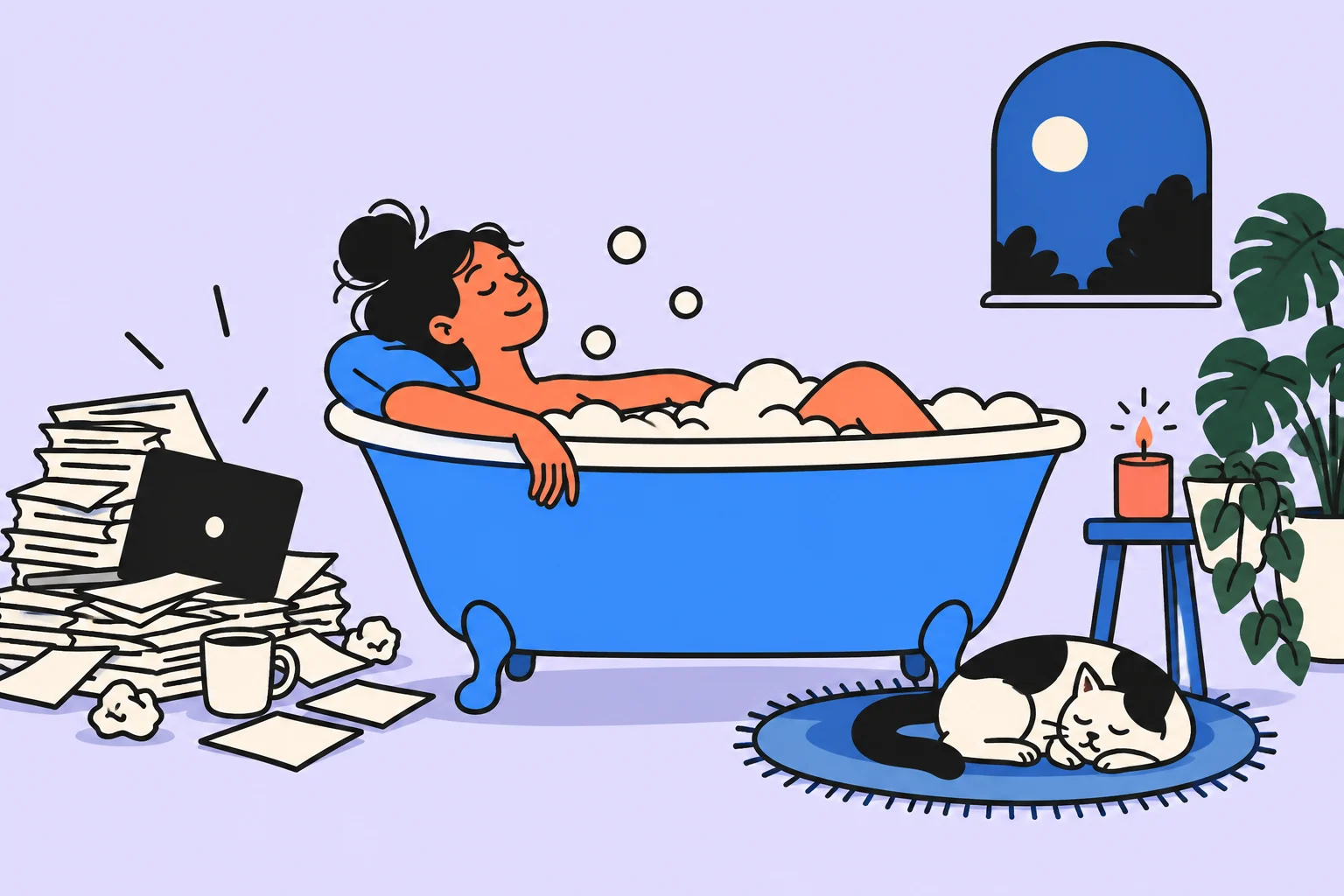
Do not turn rest into a new project
After a demanding week, you may want to recover quickly and catch up on everything postponed. Another schedule appears: cleaning, exercise, meetings, shopping, a course, and an early start. It looks useful but retains the same volume of obligations. For ordinary tiredness, the first practical question is ‘what load can I remove over the next few days?’ rather than ‘what should I add?’
This concerns everyday rest after a recognizable workload, rather than treatment. You do not need to choose an ideal recovery method immediately. It is more useful to name two signs you want to notice: for example, stop ending evenings with work messages and spend part of the weekend without rushing. These observations do not measure health, but they help assess your schedule.
Identify what tired you out
List the week’s most demanding episodes. Sometimes the difficulty was work volume; sometimes travel, noise, many conversations, or uncertainty. ‘Tired of everything’ is emotionally understandable but does not suggest what to change. If you communicated all day, meeting a large group may be another demand. After sedentary work, a quiet walk may be more appealing than another hour at a screen.
You do not need to find one correct cause. Choose something you can influence without a complicated project. Separate your obligations from other people’s expectations: ‘I need to buy groceries’ and ‘I must host everyone this Saturday’ differ in how binding they are. Agreeing to reschedule a meeting sometimes frees more space than a new list of ways to rest.
Remove at least one optional demand
Divide upcoming tasks into necessary, postponable, and optional. Even necessary work can be simplified: clear walkways and a work surface instead of deep-cleaning; prepare familiar food for two meals instead of an elaborate menu. Canceling an attractive but optional plan does not mean you are spending the weekend badly.
When sharing a household, discuss specific redistribution: who shops, when noisy work should finish, and which tasks can wait. Do not expect others to guess from your appearance. State a request and timing: ‘I am not repairing the shelf today; let us return to it next Saturday.’ This is clearer than a general promise to catch up on everything later.
| Original plan | Lighter option | What remains protected |
|---|---|---|
| Clean the whole apartment | Clean what is necessary; postpone the rest | A free part of the day |
| Three shopping trips | One list and one route | Less travel and fewer decisions |
| Work all evening | Share status and agree on the next work window | Time without work messages |
Restore simple everyday support
Prepare conditions that usually help you get through a normal day: accessible food, water, a comfortable sleeping space, and a calm end to the evening. Do not start an elaborate routine if you lack energy for it now. Putting the laptop away, preparing breakfast, and ending correspondence may be more manageable than creating a new life system.
Among general measures for tiredness, the NHS mentions regular meals, a familiar sleep routine, and movement suited to your abilities. These are general guidelines, rather than a promise of recovery within a specified number of hours. Choose what fits your circumstances in an everyday plan. A walk need not become a workout, and rest at home need not be earned by completing tasks first.
Leave room without a program
An unoccupied hour can easily look like a gap that urgently needs filling. But if the aim is to reduce load, some time may remain undecided in advance. Agree only on boundaries: during this period, you take no new household requests and do not open work unnecessarily. Choose what to do within it according to how you feel.
Rest can be active or quiet, solitary or shared. Do not compare it with other people’s attractive weekends. After a noisy week, silence may be more pleasant than an event; after long solitude, a conversation with someone close may suit you. The practical criterion here is modest: the chosen activity has not added obligations you are unprepared to carry now. If it becomes tiring, allow yourself to finish early.
Example: two days after a deadline week
An illustrative story: Sergey has had several late work evenings. He plans cleaning, a long trip to friends, and presentation preparation for the weekend. On Friday, he notices that the entire plan consists of obligations. He agrees on Tuesday as the presentation deadline, postpones the trip, and keeps only grocery shopping and a small household minimum.
On Saturday, Sergey makes one trip, eats lunch at home, and leaves the afternoon free. On Sunday, he prepares clothes and a list of upcoming commitments, then stops planning. This is not a treatment scheme or a universal routine. The example shows that free time appeared because the load changed. If the presentation cannot be postponed, Sergey needs to remove another task rather than quietly adding work on top of rest.
A recovery plan template
Make a short note that can be read without additional tables or apps. Specify the immediate period and minimum necessary obligations. Do not list ten beneficial habits: the task now is to make rest accessible, rather than assess your efficiency. If you use Sinqly, tasks for necessary work and a separate reminder to review the load are enough; the same plan works in a notebook.
- This week’s recognizable load: what exactly was demanding.
- Necessary over the next few days: one or more genuinely mandatory tasks.
- I am postponing or canceling: a specific task and a new agreement.
- I am simplifying: food, shopping, cleaning, or travel.
- Free interval: when I take no additional requests.
- Before the new week: what must stop recurring automatically.
Also specify who depends on a postponement. If a task involves another person, tell them about the new decision in advance. Reducing your load at someone else’s expense without agreement is unsustainable: conflict and another task will follow.
When to review the plan and when to seek help
If rest keeps becoming a catch-up workday, find the recurring source of overload: too many obligations, underestimated travel, or a lack of agreed deadlines. One free Saturday does not fix a schedule that overflows again every week. Discuss available work capacity and your boundaries, rather than only ways to rest better.
Ordinary tiredness after a recognizable workload and prolonged unexplained tiredness are different situations. The NHS recommends seeing a doctor if tiredness lasts several weeks, its cause is unclear, or it affects everyday life. Do not explain this state solely as a lack of discipline or choose treatment through a task list. An everyday plan can reduce obligations but cannot explain every cause of tiredness. Keep that distinction when assessing your state.
Sources
Frequently asked questions
How can I recover quickly in one evening?
Remove optional tasks, simplify food and the end of the day, and leave quiet time. Do not set a deadline by which you must feel different. One evening can reduce the load but does not guarantee recovery.
Must I force myself to rest actively?
Choose a manageable activity according to the week’s context. Walking, silence, or conversation may suit different days. Rest need not be a workout or cultural program.
What if I have no energy even after the weekend?
Check whether the load actually decreased. For prolonged unexplained tiredness or a noticeable impact on ordinary life, seek medical assessment; do not treat an everyday plan as a substitute for that help.
Turn an idea into action
Was this helpful?
Rate the article and tell us what was missing. Your feedback goes to the Sinqly team and will not be published on the site.
A day-off plan: tasks that fit and time to rest
Choose a household minimum, agree with loved ones, combine errands into a convenient route, and leave part of your day off free without a sense of unfinished work.

Productivity and burnout: how to work effectively without burning out
Sustainable productivity without burnout: signs, prevention, and recovery. A scientific approach to balancing effectiveness and well-being.
Work-Life Balance: Myth, Reality or Something Else?
Does work-life balance exist? Scientific research, alternative models and practical advice for balancing work and life.