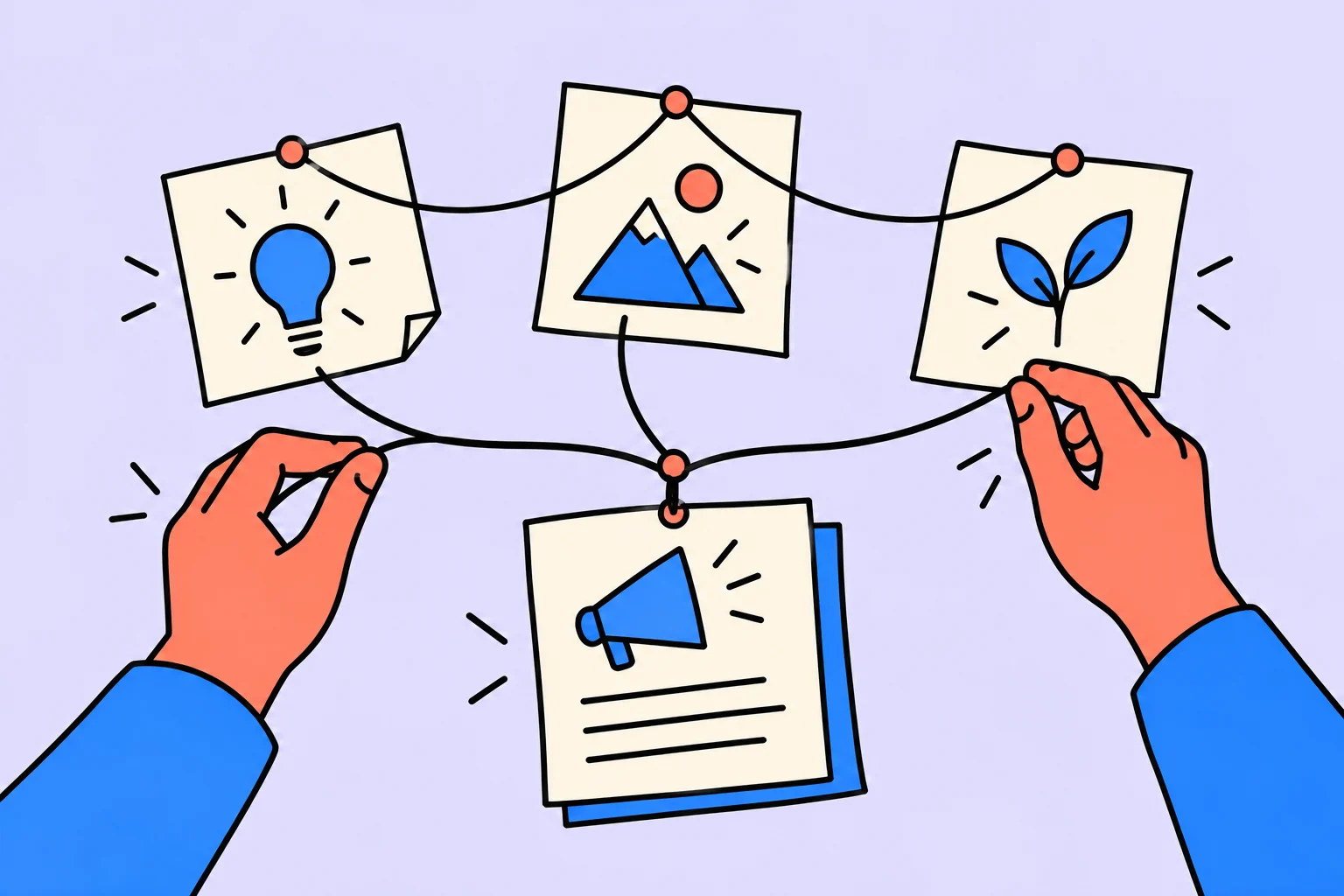
How the Zettelkasten method works
Zettelkasten supports working with ideas through connected notes: formulate a thought in your own words, give the note a permanent address, and explain its relationship to another thought. For a first trial, create three notes, label their links, and assemble a short argument. Paper or an ordinary text document is enough.
A meaningful connection answers what one note adds to another. It may clarify a condition, show an objection, or apply an idea in a new context. The shared topic ‘work’ does not yet explain why two notes should be read together.
In his account of his slip box, Niklas Luhmann highlights permanent note numbers, links and backlinks, a retrieval index, and bibliographical entries. We use these supports in a small exercise. One-main-thought guidance and the three-note example are practical editorial starting choices rather than an exact reproduction of Luhmann’s entire slip box.
What makes a note self-contained
A self-contained note can be understood without the neighboring paragraph of the source. Instead of ‘this prevents agreement’, state exactly what prevents it, for whom, and under which conditions. Brevity helps while meaning is retained: a complex thought may need several sentences.
- Address: a permanent number or another unique label, such as Z01.
- Heading: a claim or question that identifies the contents.
- Main thought: your own formulation with the necessary condition and example.
- Origin: a source and location within it, or ‘own observation’ or ‘hypothesis’.
- Link: another note’s address and an explanation of why to follow it.
If a note contains two thoughts you want to discuss separately, split it and link the parts. Keep quotations with author and location; label your own conclusion separately. A link helps trace reasoning but does not itself prove it true.
Start with three connected notes
Choose one question, create three permanently addressed notes, and express one distinct thought in each. Then label forward links and backlinks: what the neighboring entry clarifies and which condition it adds. Follow the links to write a paragraph with your own conclusion; check whether it follows from the notes and where additional grounds are needed.
- Name the question. In our exercise: ‘What should be agreed if a delivery date can change?’
- Record three distinct thoughts. Each must be understandable alone and have an address.
- Read notes in pairs. Find clarification, a condition, or an objection; do not link them merely through a shared topic.
- Add a short explanation to each link and record a backlink in the other note.
- Build a paragraph plan: initial thought, its limitation, and a proposal accounting for that limitation.
- Check the conclusion. Mark assumptions and the data needed before using it as a general rule.
Below is an invented work example. It demonstrates note and link structure rather than proving that flexible deadlines or reports improve effectiveness.
Z01. A flexible deadline needs a review condition. If our illustrative team permits changing a delivery date, the agreement remains incomplete without stating when the change is communicated. Own assumption: agree on a date-review condition before starting. Link to Z02: the decision depends on whether another participant awaits the result.
Z02. Waiting for a result is part of another person’s plan. In the example, a colleague starts reviewing after receiving the draft. Moving the draft changes her available time even if the new date suits the author. This is a condition of the chosen situation rather than a universal effect of every postponement. Link to Z01: dependency limits freely changing the deadline. Link to Z03: a status-update agreement is needed.
Z03. A promise to report should be separate from a promise of completion. In our example, the author can promise to report on Wednesday whether the draft is ready and what remains without promising to finish by Wednesday. This gives the colleague information to review her plan but does not replace the draft. Link to Z02: addresses the waiting participant’s information need. Link to Z01: proposes a separate point for discussing the deadline.
| Link | Link label | Backlink entry |
|---|---|---|
| Z01 → Z02 | Clarifies the boundary of flexibility: another participant awaits the draft. | Z02 → Z01: account for dependency when reviewing the date. |
| Z02 → Z03 | Proposes reporting status to the person whose plan depends on the result. | Z03 → Z02: the report supports reviewing the waiting participant’s plan. |
| Z03 → Z01 | Separates the status-report date from the completion date. | Z01 → Z03: a separate reporting point helps discuss a deadline change. |
How links produce your own argument
Follow Z01 → Z02 → Z03. The first note raises the changeable-deadline question. The second adds a dependency: a colleague needs the result. The third distinguishes two agreements, delivery and status reporting. You can now write a proposal accounting for all three thoughts.
The author’s argument: ‘If the draft date can be reviewed and a colleague plans to check it after receipt, agree separately on a status-report date. On that day, the author states whether the draft is ready, what remains, and whether the deadline needs review. A reporting agreement does not replace a delivery agreement.’
The conclusion arises from relationships between notes but remains a proposal for an illustrative situation. Claims about this process’s effectiveness would need separate grounds. The note network organizes reasoning; you check facts and applicability.
A useful connection lets you explain what changed in the reasoning after following it. Removing Z02 removes the basis for considering the colleague’s plan. Removing Z03 leaves dependency as a problem without the two-agreement proposal. This checks each note’s contribution.
How to find and extend notes
Retain a note’s address when changing its heading or text so links keep reaching the intended thought. Use card numbers on paper, labels beside document headings, or stable internal links in a digital editor if supported.
Create a small entry-point index: ‘Deadline review — Z01’, ‘Work dependency — Z02’, ‘Status reporting — Z03’. It starts retrieval; meaningful links lead onward. You do not need to classify all future ideas in advance.
When a new thought appears, check what it adds to existing notes. For example, ‘reporting also takes time’ can become a separate note linked to Z03 as a limitation. If there is no basis for a connection yet, save the question and return at the next use.
Check the first network
- Each of the three notes is understandable independently.
- Every entry has a permanent address.
- Own assumptions are separate from quotations and verifiable facts.
- The link label explains the relationship between thoughts.
- A backlink restores the context of the connection.
- The final paragraph uses connections rather than merely repeating three notes in sequence.
- Conclusion limits are stated; links do not replace missing grounds.
The first trial ends when you have three clear entries, labeled links, and a paragraph with your own conclusion. If a link does not help reasoning, clarify or remove it. Card and arrow counts do not themselves establish usefulness.
Method boundaries and related material
This process suits developing thoughts through clarifications, conditions, and objections. Formulation and link review take time. Luhmann’s slip-box description documents his working method rather than proving guaranteed memory, writing-speed, or outcome improvements for every reader.
For choosing where files and materials belong according to their current role, read ‘The PARA method’: https://sinqly.ru/blog/metod-para-organizatsiya-materialov
For lecture or reading notes with understanding questions, read ‘How to take notes’: https://sinqly.ru/blog/kak-delat-konspekt
For retaining work information and returning to it for a task, read ‘A personal knowledge base’: https://sinqly.ru/blog/lichnaya-baza-znaniy-dlya-raboty
Other approaches to organizing work are collected in ‘Productivity’: https://sinqly.ru/topics/produktivnost
Sources
Frequently asked questions
Do I need a special Zettelkasten app?
No. Three paper cards or one document suffice for a first attempt. You need permanent note addresses, clear wording, and explained connections.
How does a linked note differ from study notes?
Study notes help reconstruct and learn source material. In this exercise, a note expresses a distinct thought that can connect with ideas from other contexts and support your own reasoning.
Should I connect every note to all similar ones?
Add a connection when you can explain its role: clarification, condition, objection, or application. A shared topic is insufficient. Link count is not a quality criterion.
Can I record hypotheses?
Yes, if labeled as hypotheses. Retain the verification question and separate assumptions from facts. Even a detailed link network does not turn a hypothesis into a proven conclusion.
Turn an idea into action
Was this helpful?
Rate the article and tell us what was missing. Your feedback goes to the Sinqly team and will not be published on the site.

The 1-3-5 method for planning your day
The 1-3-5 method: a simple daily planning system. 1 main task, 3 medium tasks, 5 small tasks. How to use it, examples, and integration with trackers and AI planners.

The ALPEN method: a daily plan with a buffer and review
Five ALPEN steps in a complete example: estimate tasks, leave a buffer, revise overload, and compare the plan with actual results in the evening.

The PARA method: organize notes, projects, and materials
Four PARA categories, six worked material examples, and a decision tree. Organize one folder and decide what to retain after a project finishes.