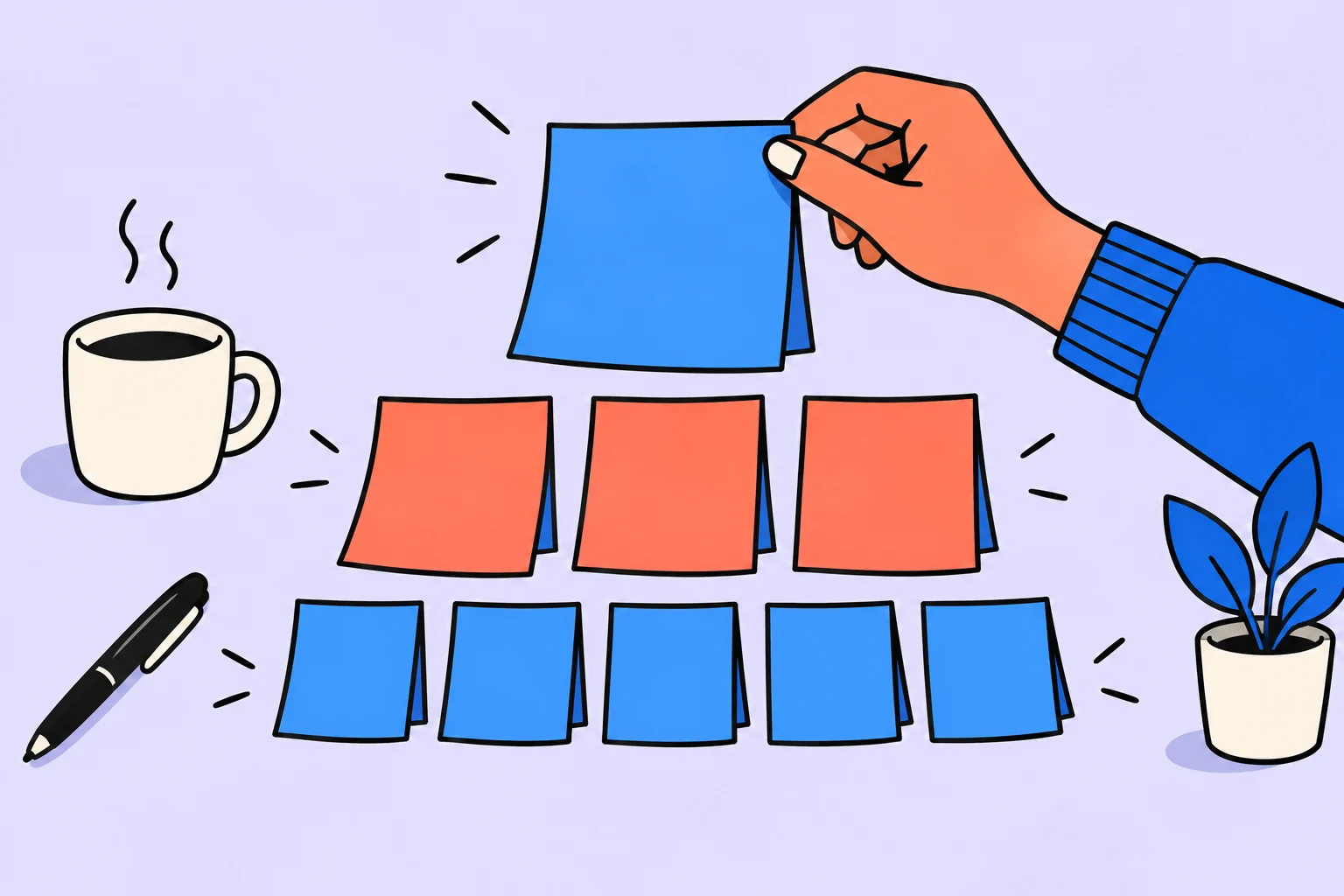
You start the day with a list of 20 tasks and finish feeling you achieved nothing, even though you were busy all day. Sound familiar? The problem is your planning approach. The 1-3-5 method is an elegant system that limits your list to 9 tasks and makes you set priorities before starting work. Let's explore how it works and why it is so effective.
What is the 1-3-5 method?
The 1-3-5 method is a daily planning system in which you choose exactly 9 tasks every day: 1 large, important task, 3 medium tasks, and 5 small tasks. Exactly 9, rather than 10, 20, or however many you can fit in. This limit is the method's main strength.
The idea was popularized by Alex Cavoulacos, cofounder of The Muse. She noticed that standard to-do lists create an illusion of control without helping people focus. When a list has 15 equally sized tasks, the brain cannot identify priorities and starts with the easiest, which rarely matches the most important.
The 1-3-5 method solves this through enforced prioritization. You have to choose one main task for the day. This decision determines whether the day will be productive. Even if you complete only the large task and nothing else, the day will still be successful.
tasks per day: the optimal number in the 1-3-5 method
of to-do list tasks are never completed (iDoneThis)
greater likelihood of completing a plan with a limited list
How to divide tasks into categories
1 large task
This task moves you toward your main goal. It requires concentration, takes 1–3 hours, and often creates internal resistance, which is why it is important to do it first. Examples include writing a report, preparing a presentation, holding a strategic meeting, or making a key client call.
To choose it, ask yourself: if I do only one thing today, what would make the day successful? The answer is your large task.
3 medium tasks
These are important tasks that do not require maximum concentration. Each takes 30–60 minutes. Examples include answering important emails, preparing meeting materials, holding a short call, or updating project documentation.
5 small tasks
These are quick actions taking 5–15 minutes. They often accumulate and feel like unfinished business if left open. Examples include paying a bill, booking a medical appointment, answering a message, ordering stationery, or updating a task's status in a tracker.
Fill the list the evening before or in the morning before starting work. Do not add tasks during the day: this undermines the priority system. If something urgent appears, replace an existing task instead of adding a 10th.
Examples: what a daily plan looks like
Let's consider three different ways to use the 1-3-5 method.
For a freelancer
- 1 large: Write 3 chapters of a client's book
- 3 medium: Call a new client; prepare a business proposal; review an editor's changes
- 5 small: Send February's invoice; answer 3 emails; update the portfolio; register for a conference; order office coffee
For a student
- 1 large: Prepare a course-project presentation
- 3 medium: Read 2 textbook chapters; solve math problems; write a 500-word essay
- 5 small: Submit a scholarship application; buy a notebook; reply to an adviser; book a study room; update the timetable
For a manager
- 1 large: Hold a quarterly review with the team
- 3 medium: Prepare a management report; hold 1-on-1s with three direct reports; review the project budget
- 5 small: Approve leave; answer tickets; update Jira; contact HR about an intern; order lunch for a meeting
Why the 1-3-5 method works: the psychology
Several psychological mechanisms underpin the method's effectiveness. The first is Parkinson's law: work expands to fill the available time. With an endless list, every task stretches out. With a limited list, you work faster.
The second is the Zeigarnik effect: unfinished tasks occupy mental space. A long to-do list creates constant background noise in your head. 9 tasks are a manageable amount that does not overload working memory.
The third is a dopamine reward. Crossing a task off a short list makes progress visible. 1 out of 9 is 11%; 1 out of 30 is 3%. The same action creates a different emotional response depending on context. A short list creates a sense of achievement.
Common mistakes when using the method
- An overly ambitious large task : if you cannot finish it in a day, divide it into subtasks. Every day should bring a sense of completion.
- Small tasks replacing medium ones : it is tempting to fill all 9 slots with easy tasks. Be honest with yourself: the 3 medium tasks should genuinely be medium in difficulty.
- Adding a 10th task : just one more small task undermines the system. If something new appears, replace rather than add.
- Skipping evening planning : planning in the morning uses your morning energy deciding what to do instead of doing it.
The 1-3-5 method in Sinqly
An additional advantage: the AI coach analyzes the tasks you regularly leave unfinished and suggests solutions. Perhaps you consistently overestimate how many medium tasks you can manage, or keep postponing the large one. AI notices these patterns and helps adjust your approach.
Combined with a habit tracker , the 1-3-5 method becomes even more powerful. Habits act like background processes: they support productivity without entering the 9-task list. Meditation, exercise, and reading are habits. Work tasks belong in 1-3-5.
Adapting the method to different situations
You can adapt the basic 1-3-5 method to your needs. On especially busy days, use the minimal 1-2-3 version. For a day focused on one project, use 1-1-3: one large task, one medium task, and three small ones. Managers whose days revolve around communication can use 1-3-5 with meetings as medium tasks and follow-ups as small ones.
Some people use a weekly version: 5 large tasks, one for each working day, 15 medium tasks, and 25 small tasks. This helps you see the bigger picture and distribute workload evenly.
Conclusion
The 1-3-5 method works because it is simple. It is easy to understand and start using right now. Take a sheet of paper or open your notes and write down 1 large task for tomorrow, 3 medium tasks, and 5 small ones. Evaluate the result tomorrow evening. It will probably be one of your most productive days in a while.
Turn an idea into action
Was this helpful?
Rate the article and tell us what was missing. Your feedback goes to the Sinqly team and will not be published on the site.

The ALPEN method: a daily plan with a buffer and review
Five ALPEN steps in a complete example: estimate tasks, leave a buffer, revise overload, and compare the plan with actual results in the evening.
The Ivy Lee method: six tasks for tomorrow without promising to do everything
Choose a short list for tomorrow, decide its order and review unfinished items. The limits of the popular Ivy Lee method.
GTD: a planning system explained simply, with a diagram and example
How the GTD planning system works: a five-step diagram, processing your inbox, and a project example. Where to start, where to record the next action, and when you need a calendar.