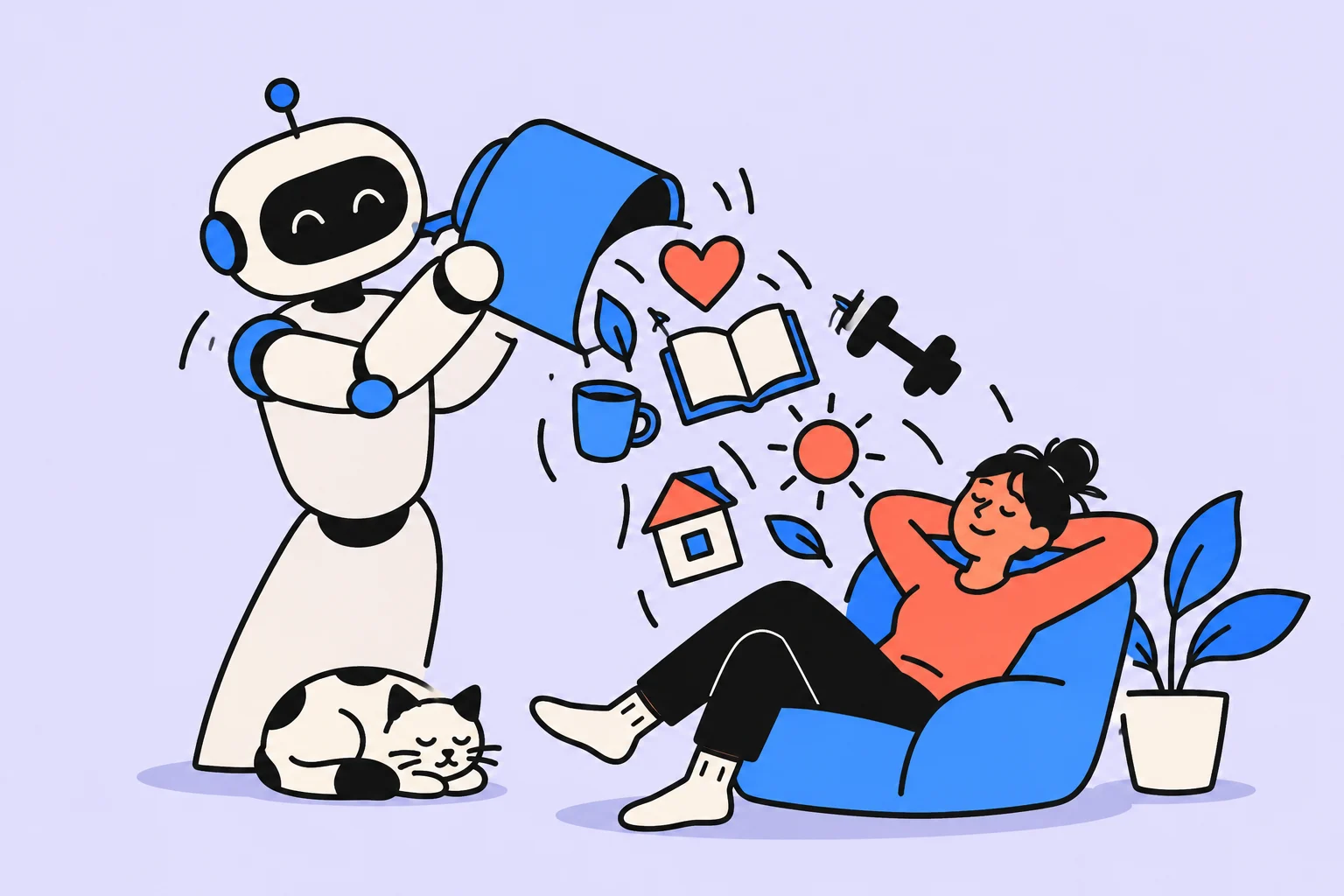
Artificial intelligence has moved from science fiction to an everyday tool for millions of people. Yet most still use AI only for work and entertainment. What if you directed the power of artificial intelligence toward the most important area: your own life? In this guide, we explore how to use AI in everyday life, from planning your day to building habits, and from managing emotions to achieving long-term goals. You will learn specific steps, see real examples, and understand where to begin today.
The AI revolution in personal development: why 2026 is a turning point
Over the last two years, AI has made enormous progress in personal productivity. Previously associated with industrial tasks and scientific calculations, it now helps ordinary people plan days, build habits, and work on their emotional state. The global market for AI personal-development apps, according to forecasts from McKinsey, will reach 12 billion dollars by the end of 2026.
AI's key difference from ordinary apps is adaptability. A classic habit tracker checks boxes. An AI tracker analyzes patterns and offers personalized recommendations. It is the difference between a textbook and a tutor: the book is the same for everyone, while a tutor adapts to your pace and learning style.
It is important to understand that AI in everyday life does not mean replacing human thinking. It means strengthening your own decisions with data and patterns that are impossible to see with the naked eye. You still make the decisions, but AI gives you information you simply did not have before.
of smartphone users use AI assistants daily (McKinsey, 2026)
greater likelihood of reaching goals with AI support
time saved on planning with AI tools
forecast market size for AI personal development
How to use AI in everyday life: 6 key areas
Technical specialists and ordinary people seeking a more intentional life now ask how to use AI. Tools for life fall into several categories, each solving a different class of problems.
Planning and tasks
AI analyzes your history and creates a realistic schedule considering energy peaks and habits
Habit tracking
An adaptive tracker analyzes context, finds patterns, and adjusts difficulty to workload
AI coaching
A personal coach asks useful questions, tracks progress, and helps maintain motivation 24/7
Health and sleep
AI finds connections between sleep, nutrition, activity, and mood that you miss
Emotional intelligence
An AI mood diary identifies stress triggers and helps develop emotional awareness
Financial habits
AI expense analytics finds spending patterns and helps build financial discipline
Integrating these areas into one platform is a major 2026 trend. Instead of six separate apps, you get an ecosystem where AI sees relationships across every area. For example, the platform Sinqly combines these tools to provide a full picture of life.
AI planning: how artificial intelligence structures your day
Planning a day takes considerable energy: prioritizing, considering deadlines, allowing rest, and remembering habits. A study by Harvard Business Review found that people spend an average of 28 minutes each morning planning, then still fail to follow the plan because it is unrealistic.
An AI planner addresses this using your history: when you are most productive, how many tasks you actually finish daily, and which habits are established or need reminders. It uses these data to build an achievable plan.
If you consistently miss evening meditation, AI might suggest moving it to the morning when discipline is stronger. If Tuesdays are regularly overloaded, it might suggest spreading tasks more evenly. This is called adaptive planning, and it is significantly more effective than a rigid schedule.
Begin with one area, such as daily planning or habit tracking, rather than handing every aspect of life to AI at once. Expand gradually once you see benefits. Trying to automate everything immediately causes information overload and disappointment.
AI coaching: a personal trainer for development
Traditional coaching costs 5,000–30,000 rubles per session, making it inaccessible to most people. AI coaching changes the rules: you receive personalized support 24 hours a day. It is not a replacement for a human coach, but a fundamentally new form of support available to everyone.
An AI coach differs from an ordinary chatbot. A chatbot simply answers questions. An AI coach knows your context: goals, habits, problems, and recent progress. It asks useful questions at the right moment. After your third missed workout, it does more than remind you: it asks what happened and helps find the root cause.
cost of one human coaching session
AI-coach availability without appointments or waiting
Write down your desired result and discuss the next step with an AI coach
AI habit tracking: from checkmarks to deeper analysis
A classic tracker records done or not done. An AI tracker goes deeper, analyzing timing, context such as weekday or weekend and morning or evening, connections between habits, and external factors. This produces insights you would never notice yourself.
For example, you notice that you abandon your evening runs every 2–3 weeks. An AI tracker analyzes the data and discovers that this coincides with work deadlines. The solution: during periods of high workload, automatically replace the run with a 15-minute walk to preserve the habit of movement without overloading yourself. This is an example of adaptive tracking.
Many start tracking 10–15 habits at once. Research suggests an optimal 3–5. AI helps identify which habits provide the greatest benefit and focus on them.
How to use AI to manage emotions and stress
Emotional well-being is a promising everyday AI application. An AI mood diary analyzes entries, identifies patterns, and helps you understand influences on your state. It supports everyday emotional hygiene without replacing therapy.
In practice, record your mood and briefly describe events daily. After several weeks, AI may notice mood dropping consistently on Mondays or anxiety after contact with a particular person. These insights are a first step toward change.
According to the World Health Organization, one in four people worldwide experiences mental health problems. AI tools do not resolve clinical cases, but can help millions needing daily support with stress, anxiety, and emotions.
Step-by-step guide: starting to use AI for life
Moving to AI tools requires no technical knowledge. This plan helps you start today and get results in two weeks.
Identify a problem area
What concerns you most: lack of time, habit difficulties, no goals, or stress? Choose one area where AI will help most.
Choose a platform
Choose one platform meeting your core needs instead of assembling 5 separate apps. Sinqly combines a habit tracker, AI coach, analytics, and planner.
Set up your profile and goals
The more AI knows about you, the more accurate its recommendations. Complete your profile, name 2–3 main goals, and record habits daily.
Follow recommendations for 14 days
Recommendations will initially be general. After 7–10 days, AI starts offering personalized solutions based on your data. Allow time to adapt.
Analyze weekly reports
Review which habits are stable or slipping and how mood changes each week. Use this information to adjust your strategy.
Expand gradually
Once the first area is stable, add another. After a month, AI will see cross-area connections and offer comprehensive recommendations.
AI for setting and reaching goals
One powerful everyday AI function is setting and breaking down goals. Most people set vague goals such as getting healthier, reading more, or starting to run. AI helps turn these intentions into a concrete plan with measurable steps.
For example, AI breaks starting to run into an 8-week plan from 10-minute walks to running 5 km continuously. Each step has a specific day, considers current fitness, and adjusts automatically if workouts are missed.
Risks and limitations of AI life assistants
Discussing only advantages would be dishonest. AI tools have real limits to consider before using them for serious life tasks.
AI does not replace professional help. For serious mental health problems, including depression, anxiety disorders, or ADHD, consult a psychologist or psychiatrist. An AI coach may complement therapy without replacing it. Read our article on adult ADHD for more.
The risk of excessive dependence. AI should be a tool rather than a crutch. The goal is to develop your own awareness and self-management skills, not to hand every decision to a machine. A good AI coach gradually develops your independence rather than creating dependence.
Data privacy. You share highly personal information about habits, goals, emotions, and health. Choose services that take protection seriously. Check privacy policies, encryption, and data-storage servers.
Algorithmic bias. AI can reinforce existing patterns instead of suggesting new approaches. If you always choose one type of solution, it may strengthen that tendency. Periodically question recommendations and try alternatives.
Sinqly stores all data on secure servers, encrypts data in transit, and does not share information with third parties. You can export or delete all your data at any time.
AI tools versus ordinary apps: key differences
Understanding why to use AI tools requires seeing the fundamental differences in approach.
Reactive versus proactive. An ordinary app waits for your request. An AI tool notices problems and offers solutions. If a habit streak weakens, AI warns you before you notice.
Templates versus personalization. An ordinary app gives everyone the same experience. AI adapts to your rhythm, personality, and situation. A plan for a child-free early bird will not suit a night owl with two toddlers, and AI considers this.
Data versus wisdom. An ordinary app shows numbers: 7 of 10 habits completed. AI interprets them: you consistently miss evening habits, so try moving them to the morning when your discipline is 40% stronger.
AI tools are not a cure-all. But for those serious about personal development, the difference between an ordinary app and an AI platform is like the difference between a notebook and an intelligent life-management system.
AI's future in everyday life: trends for 2026–2028
AI technology continues to develop, and significant changes await in the coming years. Multimodal models that analyze text, voice, and visual data simultaneously will make AI assistants even more aware of context. Imagine an AI coach that understands from your tone of voice that today is not the best day for difficult tasks.
Wearable integration is another trend. Smartwatch data on pulse, sleep, and activity will enable recommendations based on objective biometrics as well as subjective reports.
Predictive models will learn to forecast states before they occur. Rather than responding to burnout, AI will warn of it a week ahead through subtle changes in sleep, productivity, and mood.
Conclusion: start using AI today
AI for improving your life is not a technological fad but a fundamental shift in the approach to personal development. Personalization, adaptability, and constant availability make AI tools a powerful complement to your efforts. You do not need technical expertise to begin: simply choose one area and give AI two weeks to adapt.
Start small with one AI tool for one life area. Most users notice a difference within 7–10 days. AI is a smart assistant amplifying your own efforts rather than a magic solution. The more you put into the process, the more you gain from the technology.
Frequently asked questions about AI in everyday life
How can you use AI in everyday life?
AI can help with daily planning, habit tracking, setting and breaking down goals, mood analysis, financial management, and personalized learning.
Does an AI coach replace a human psychologist?
No. An AI coach provides daily support for goals, habits, and motivation. Serious problems such as depression or an anxiety disorder require a qualified professional. AI may complement therapy but does not replace it.
Is sharing personal data with an AI platform safe?
It depends on the service. Choose transparent privacy policies, encryption, and complete data deletion. Avoid services that train models on your data without consent.
How much does an AI personal-development assistant cost?
Free and paid options exist. Free tools have limited basic features. Paid platforms, costing 300–2,000 rubles monthly, offer deeper analytics, AI coaching, and full personalization.
How long before AI starts making accurate recommendations?
AI usually needs 7–14 days of regular use to gather enough data for good personalization. More active habit tracking, journaling, and goal setting help it adapt faster.
Can AI track habits?
Yes. AI trackers significantly outperform ordinary apps by analyzing context, finding connections between habits, and automatically adapting difficulty. Read about habit formation in our separate article.
Which life areas can AI improve?
Almost any area: health and fitness, productivity, emotional well-being, finance, learning, and relationships. AI works best for pattern analysis, personalized recommendations, and long-term goal support. See the wheel of life for a visual assessment of every area.
Turn an idea into action
Was this helpful?
Rate the article and tell us what was missing. Your feedback goes to the Sinqly team and will not be published on the site.
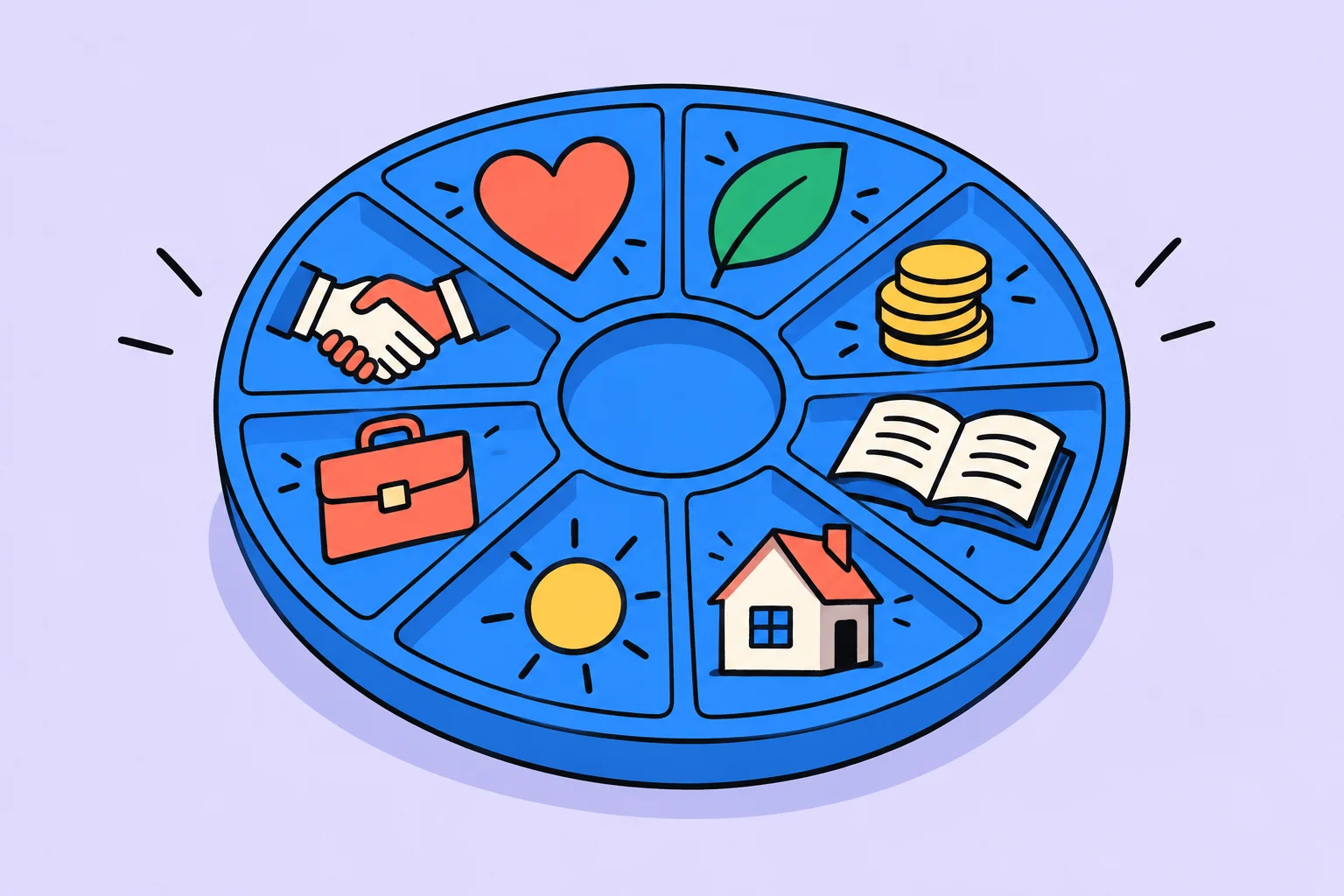
8 life areas: a complete guide to each area with examples and exercises
Explore all 8 life areas: health, finances, career, emotions, relationships, growth, creativity, and home. The 8-area wheel of life, exercises, and an action plan.

Dopamine and motivation with ADHD: using neurochemistry for productivity
How the dopamine system works with ADHD. 7 strategies for managing motivation through neurochemistry: gamification, stacking, micro rewards, and physical activity.
How to track progress and keep going
Why is tracking progress crucial for achieving goals? Visualization methods, habit tracking, metrics, and tools. A practical guide.