
The concept of 8 life areas provides a systematic approach to assessing and developing every key area of life. Rather than concentrating only on career or finances, you work on balance across areas. This underpins the Sinqly methodology and helps thousands live fuller, more harmonious lives.
This guide explores each of the 8 areas of a person's life, gives concrete goal examples and exercises, shows how to use an 8-area wheel of life for self-assessment, and explains why a systematic approach works better than chaotic self-improvement.
key life areas for harmonious development
of people have imbalances in 3+ areas simultaneously
faster goal achievement with a systematic approach
increase in satisfaction from working across every area
What the 8 life areas are and why they matter
The 8 life areas model is based on the idea that life satisfaction depends on harmonious development across areas rather than success in one. You have probably met people with brilliant careers but damaged health or relationships, or people completely absorbed in family who lose their sense of identity and feel increasingly frustrated.
The eight areas form a map of your life. Rating each from 1 to 10 gives an objective picture of your current state. Visualize it using the wheel of life , which shows imbalances and where to direct energy first.
This model comes from coaching and positive psychology. Coaches worldwide use it, from individual consultants to corporate development programs. Research by Gallup shows that people intentionally working on several life areas simultaneously have 41% higher work engagement and 33% greater overall well-being.
It is important to understand that balance does not mean all 8 areas of a person’s life must score 10 out of 10. Balance means consciously choosing priorities and understanding that no area should fall below a critical level. If you deliberately decide to spend more time on your career this quarter, that is fine: the main thing is not to forget the other areas entirely.
The 8-area wheel of life: how it works
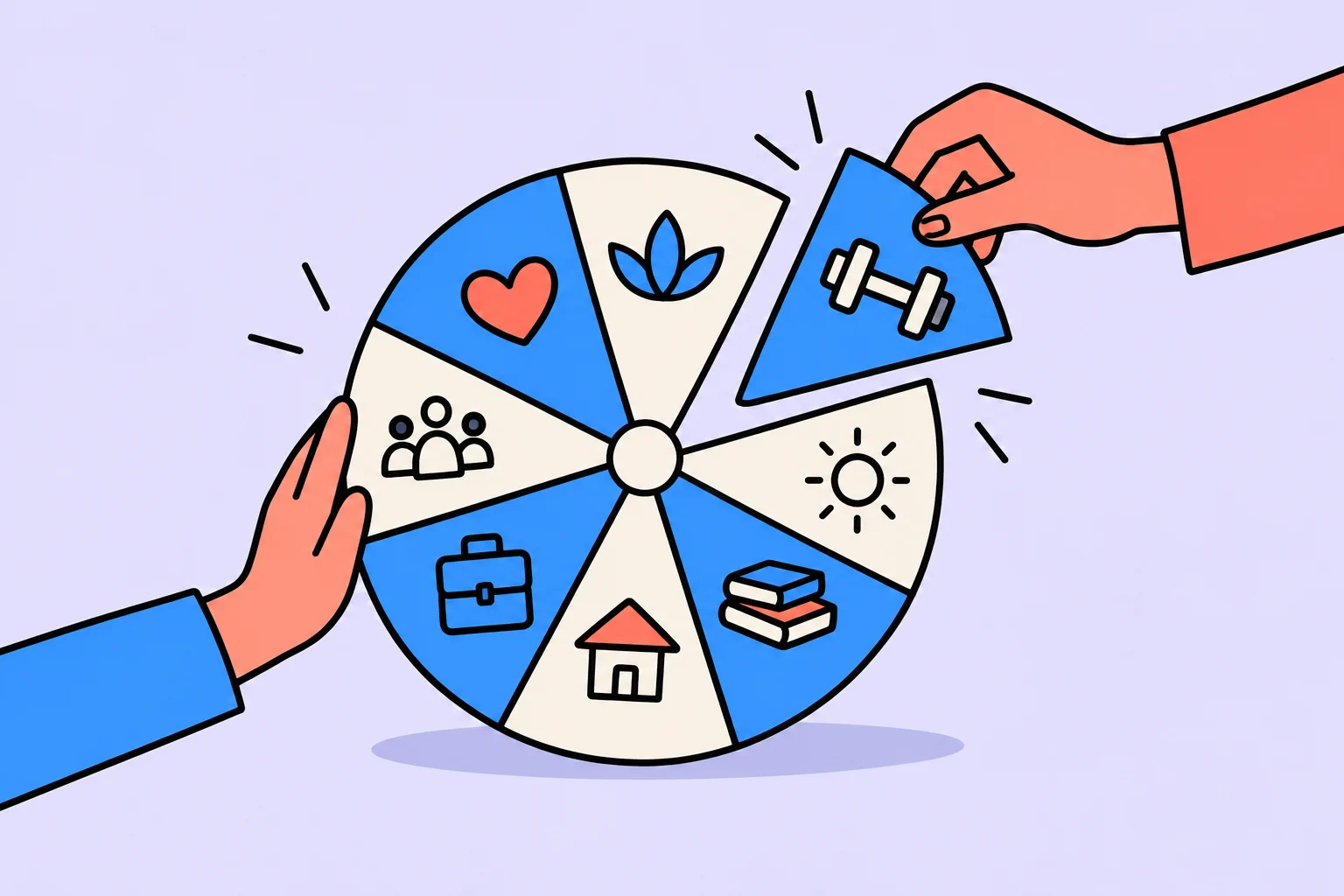
An 8-area wheel of life is a visual tool that presents your life areas as a circular chart. Each sector corresponds to one of the 8 areas, and the length of the spokes (from the center to the edge) shows your score from 1 to 10. Connecting the endpoints creates a shape: the closer it is to a perfect circle, the more harmonious your life.
In practice, almost nobody has a perfect circle, and that is completely normal. The wheel of life is not intended to bring every area to a perfect ten, but to reveal imbalances you may overlook amid everyday busyness. For example, you might think your relationships are going well, but an honest assessment reveals that you have not seen close friends for six months.
Try the interactive wheel of life now. Assessment takes only 5 minutes and gives a clear understanding of your situation.
1. Health and fitness: the foundation of life areas
The health area is the foundation of every other life area. Without physical and mental health, it is impossible to work effectively, build relationships, or pursue creativity. This area includes physical activity, nutrition, sleep, medical examinations, and your general well-being.
According to the World Health Organization, insufficient physical activity is the fourth most significant risk factor for mortality worldwide. But this is not only about longevity: regular exercise improves cognitive function by 20%, improves mood, and increases productivity in a person’s other life areas.
Example goals: exercise 3 times weekly, sleep at least 7 hours, drink 2 liters of water daily, and have an annual checkup. Start small: even a 15-minute after-lunch walk affects health significantly. Track habits to see progress. Read more about building healthy habits.
2. Finances: a resource for every life area
The finance area includes income, expenses, savings, investments, and financial literacy. Money is not a goal but a resource that gives you freedom of choice. Financial stress is among the top three causes of anxiety and directly affects health, relationships, and your emotional state.
An American Psychological Association (APA) study found that 72% of adults experience financial stress at least sometimes. Financial instability reduces cognitive ability to a degree comparable to losing one night of sleep. That is precisely why finances are one of the first areas to examine when you discover an imbalance.
Example goals: build a 6-month emergency fund, invest 10% of income, understand tax deductions, or increase income 20% in a year. Track expenses for at least a month: many are surprised by unnoticed spending. Create a financial plan linked to specific habits.
3. Career and work: the professional life area
The career area includes professional fulfillment, job satisfaction, skill development, and career growth. Work occupies a third of life, so it should provide meaning as well as income. Gallup finds only 23% of workers worldwide are engaged; the rest passively put in time or actively burn out.
Example goals: get a promotion, change professions, launch your own project, or take a course on a new technology. If you feel stuck in one place, start by examining your values: what really matters to you at work? Autonomy? Recognition? Creative freedom? Your answers will help determine your direction for development.
4. Emotions and mental health: your inner life area
The emotional area includes managing emotions, stress resilience, self-esteem, inner harmony, and psychological well-being. It means recognizing, accepting, and constructively expressing feelings rather than always being positive. Emotional intelligence, EQ, is a key predictor of career and relationship success.
Modern neuroscience research shows that emotional regulation is a skill you can train. Mindfulness practices, keeping an emotion journal, and working with cognitive distortions all improve your ability to manage your inner state. Well-developed EQ helps in every life area, from negotiations to family relationships.
Example goals: start keeping an emotion journal, learn cognitive reappraisal, learn to say no without guilt, or take an emotional intelligence course. Try recording 3 emotions you experienced during the day and their causes every evening: within a week, you will begin to notice patterns.
5. Relationships: the social life area
The relationship area includes family, friendships, romantic relationships, and social connections. An 80-year Harvard study found close-relationship quality is the main factor in happiness and longevity, ahead of money, fame, and career achievements.
Example goals: have a phone-free evening with your partner once a week, call your parents every Sunday, organize a gathering with friends once a month, or find a mentor in your professional field. Relationships require regular investments of time and attention: like any other area, they deteriorate without deliberate work.
The Harvard Study of Adult Development, which lasted more than 80 years, found that the quality of close relationships is the main predictor of happiness and longevity. People with strong social connections live an average of 7–10 years longer and suffer from dementia and depression significantly less often. The depth of your connections matters more than their number: 3–5 close relationships are enough for a high level of well-being.
6. Personal growth: development and learning
The growth area means learning, developing skills, broadening your horizons, reading, traveling, and self-reflection. A person who stops growing begins to decline: this is a law of psychology. A sense of progress and development is one of the key sources of motivation and satisfaction with life.
The growth mindset concept described by Stanford’s Carol Dweck shows that believing you can develop your abilities is a key factor in achieving goals. People with a growth mindset treat failures as lessons rather than a verdict. This is one of the most underestimated areas of a person’s life.
Example goals: read 24 books in a year, learn a new language to B1 level, take an online course on a subject that interests you, or build a daily reflection habit. Make a list of skills you want to acquire this year and set aside at least 30 minutes a day for learning.
7. Creativity and hobbies: self-expression
The creative area means self-expression through art, music, writing, cooking, or any other hobby. Creativity activates the right hemisphere of the brain, reduces stress, and creates a sense of flow: the state described by Mihaly Csikszentmihalyi in which time flies unnoticed and you are completely absorbed in the process.
The important thing is that the creative area is about the process rather than the result. You do not need to be a professional artist or musician. Cooking a new dish, photographing nature, writing poems in a notebook, or building a construction set: any activity in which you create something new nourishes this area.
Example goals: draw for 30 minutes every day, write a short story, learn to play the guitar, or cook a new dish every week. Do not wait for inspiration: start doing it, and inspiration will come during the process. Put a creative block in your schedule just as you would a work meeting.
8. Home and environment: everyday life
The home area includes your living space, home organization, order, comfort, and quality of everyday life. The environment we live in strongly influences mood and productivity. Research shows that clutter increases cortisol (the stress hormone) and reduces the ability to concentrate.
Example goals: organize your home using the KonMari method, set up your workspace, create a pleasant morning routine, or automate household tasks. Small improvements at home have a disproportionately large effect on overall well-being. Try the two-minute rule: if a task takes less than two minutes, do it immediately.
How to work with life areas: a step-by-step process
Knowing the 8 life areas is only the beginning. Real transformation happens when you begin working systematically on each area. Here is a proven process used by professional coaches and built into the Sinqly platform.
Rate every area from 1 to 10
Be honest with yourself. Do not score based on a vague sense that everything is fine: use specific criteria. For health, for example: how often do you exercise? How good is your sleep? When did you last see a doctor?
Build an 8-area wheel of life
Plot your scores on the wheel and look at the resulting shape. Pay attention to the most indented sectors: these are areas for growth.
Choose 2–3 areas to work on
Do not try to improve everything at once: that leads to overload. Choose 2–3 areas with the lowest scores, or those that most affect your current state.
Set specific goals for every area
Use the SMART format: specific, measurable, achievable, relevant, and time-bound goals. For example: “Exercise 3 times a week for 45 minutes over the course of a month.”
Define daily micro-actions
Break each goal into minimal daily steps. Small actions form habits, and habits lead to big results.
Reassess monthly
Reassess all 8 areas every month. Compare the scores with your previous results. Adjust your goals and switch to other areas as you make progress.
Common mistakes with the 8 life areas
Even when people know the model of a person’s life areas, many make mistakes that undo all their efforts. Here are the most common ones.
Perfectionism. Aiming to bring all 8 areas up to 10 is an unrealistic goal that leads to disappointment. Scores of 7–8 in most areas are an excellent result. Different areas will take priority at different stages of life.
Trying to change everything at once. Working on 8 areas simultaneously scatters your attention and energy. Focus on 2–3 areas, make progress, and then switch. Sequential improvements are more effective than parallel ones.
Ignoring connections. Life areas interact: better health improves career productivity, and good relationships lower stress and improve emotions. Use these synergies: one action may improve several areas.
No systematic tracking. Without tracking progress, it is easy to lose motivation. Keep a habit journal, use the wheel of life monthly, and record small wins.
A useful tip: start with the area that will pull the others along with it. For most people, that is health or their emotional state. When you get enough sleep and move regularly, productivity automatically rises, your mood improves, and you gain energy to work on your other life areas.
Connections between life areas: how one affects another
A key benefit of the 8 life areas model is understanding how all the areas depend on each other. When you improve one area, it has a cascading effect on others. Conversely, problems in one area inevitably spill into neighboring ones.
Here are some examples of these connections. Regular exercise (health) improves cognitive function and energy, which benefits your career. Financial stability reduces anxiety (emotions) and strengthens relationships (fewer conflicts over money). A creative hobby provides relief from work stress and supports personal growth.
Understanding these connections helps you choose high-impact actions: ones that improve several areas at once. For example, a morning run with your partner simultaneously supports health, relationships, and your emotional state. Blogging about your professional experience supports career, creativity, and personal growth.
An 8-area wheel of life
Rate all 8 life areas from 1 to 10 and visualize your current balance.
An AI coach for every area
A personal AI coach helps create a development plan and recommendations for each area.
Progress tracking
Track changes in every area through monthly reassessments of the wheel of life and clear charts.
Ready-made checklists
Use goal checklists for each of the 8 areas rather than starting from scratch.
Using the 8-area model for goal setting
The life areas model is an ideal framework for annual and quarterly planning. Instead of haphazardly writing down “I want to lose weight, earn more, and learn English,” you organize goals across 8 areas and see the complete picture.
Set 1–2 key quarterly goals per area. Prioritize 2–3 requiring the greatest growth. For others, set maintenance goals: minimal actions preventing decline. Use the SMART method to phrase each goal.
Hold a brief review every week: what worked, what did not, and whether adjustments are needed. Reassess the 8-area wheel of life every month. Revisit your goals and priorities every quarter. This rhythm creates a systematic approach without a sense of overload.
Life areas and life stages
The priority of life areas changes across stages. At 20, career and growth often lead as you build a professional foundation. At 30–40, relationships, family, and financial stability become prominent. After 50, health, creativity, and spiritual development may lead. These are general trends, not strict rules.
It is important to revisit your priorities regularly rather than live on autopilot. If you continue putting your career first at 45 while ignoring your health, the consequences can be serious. The 8-area wheel of life helps reveal these blind spots and adjust course in time.
Frequently asked questions about the 8 life areas
What are the 8 life areas?
The 8 life areas model divides a person’s life into 8 key areas: health, finances, career, emotions, relationships, personal growth, creativity, and home. Working on every area helps achieve a harmonious balance and increase overall satisfaction with life.
How do you assess balance across 8 life areas?
Rate each of the 8 areas on a scale from 1 to 10, where 1 means complete dissatisfaction and 10 means maximum fulfillment. Plot the scores on the 8-area wheel of lifeto see imbalances and growth areas.
Why develop every life area?
Research shows that overemphasizing one area while ignoring others leads to burnout and lower satisfaction. Harmonious development across all 8 life areas increases overall happiness, productivity, and resilience to stress.
Which life areas matter most?
All 8 life areas matter, but health is often called the foundation: without it, you cannot fully fulfill your potential in the other areas. Your priorities depend on your current situation: begin with the areas receiving the lowest scores on the wheel of life.
How often should you reassess life areas?
Reassessing the 8-area wheel of life every month is recommended. This lets you track progress, adjust goals, and notice new imbalances in time. A deeper quarterly analysis helps you reconsider your strategic priorities.
Can the 8-area model support goal setting?
Yes, the 8-area model provides an excellent foundation for goal setting. Set 1–2 goals for each area, define daily actions, and track progress using the wheel of life and a habit journal.
How does the 8-area balance wheel differ from the wheel of life?
The 8-area balance wheel is a specific model with 8 fixed life areas. The wheel of life is a broader term in which the number of sectors can vary from 6 to 12. The 8-area model is considered optimal: sufficiently detailed without being overloaded.
Turn an idea into action
Was this helpful?
Rate the article and tell us what was missing. Your feedback goes to the Sinqly team and will not be published on the site.

How to find your purpose: a complete path to ikigai and meaning in life
A step-by-step guide to finding your purpose through ikigai. Exercises, self-reflection questions, scientific evidence, and practical tools.

A Habit in 21 Days: What the Research Says and How to Start
Why 21 days does not guarantee a habit. The limits of Lally's research, a practical plan and a completed example for tracking actions and missed attempts.
The Wheel of Life: What It Is, How to Complete It and How to Use It
A complete Wheel of Life guide. 8 areas, step-by-step instructions, life-area ratings, interpreting results and a free online assessment.