Where to start
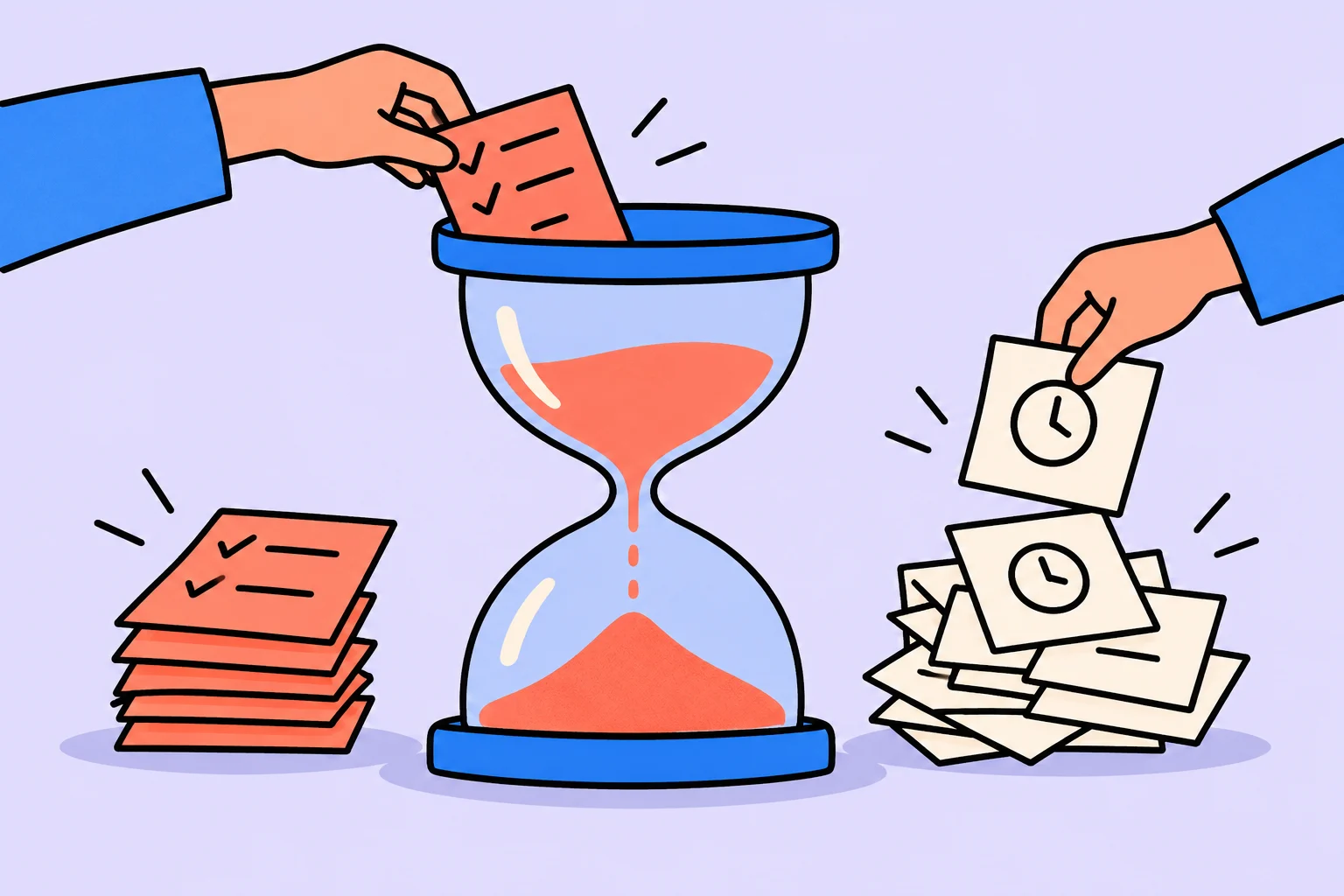
Time tracking is useful when it answers a specific question: why work does not fit, how long a stage usually takes or where waiting occurs. It does not have to become continuous minute-by-minute observation. Start with a short record of one process and decide beforehand what decision the data will support.
Why keep a record?
Track time to answer one workload question, rather than control every minute of life. Define the question before creating the table. For example: “What does preparing a proposal consist of?” or “Do the available windows accommodate current commitments?” Different questions require different records. If you do not know what will be decided, detailed tracking can add information you still do not know how to use.
Choose the observation boundary: one process, several ordinary days or similar recurring tasks. Do not treat a day with an emergency or a rare large meeting as normal. Record unusual events separately. Measuring something does not make that case representative of all your work.
What should you record?
Record the start, finish, context and a noticeable interruption; rounded blocks are enough for some decisions. Record when a suitable block started and ended, its purpose and any noticeable interruption. Rounding is often sufficient for a workload decision. Do not add too many categories in advance: the first records will clarify what needs distinguishing. Reconstructing some blocks in the evening is acceptable if their accuracy is explicitly marked as approximate.
It is particularly important to separate your own work from elapsed waiting time. The calculations took a work block, but the client’s reply came a day later. These are different quantities for your workload; both matter for a promised date. Mixing them can lead you to conclude incorrectly that the work always requires a full day of effort.
Working through an example
The following situation is invented for illustration; it is neither a user story nor a measurement of product effectiveness. Michael thinks preparing a business proposal takes an hour. Three observations reveal separate blocks: data, calculations and approval. He sees that waiting for a reply differs from his own working time and changes his promise to the client to account for the dependency.
Michael separates the elapsed pause before the client’s reply from his own calculation blocks. He accounts for both when promising a date; when distributing workload, he does not record the entire waiting day as active work. This distinction explains the decision he began the record to make.
| Block | Observed time | Meaning |
|---|---|---|
| Gathering data | A rounded interval | Own work |
| Calculations | A rounded interval | Own work |
| Waiting for approval | An elapsed pause | A dependency, rather than active work |
| Conclusion | Different types of time | Do not add them without a purpose |
How should you read the data?
Read categories in relation to available time, separating observations from guesses about causes. Interpret the records through the question. To change a promised deadline, look for a duration range and dependency on input data. When a week is overloaded, compare commitments with available windows. A sum of minutes without that context does not identify useful or unnecessary actions.
The meta-analysis by Aeon and colleagues examines time management in different types of studies. It does not prove that continuous tracking benefits everyone. Here, recording time is a tool for gathering local information. It may lead to a clearer deadline, a changed sequence or recognition that there is not enough data yet.
When should you stop?
Stop detailed tracking once you have the information needed for a decision: continuous measurement need not become the goal. After deciding, stop detailed tracking or reduce it to the checkpoints needed. If the question arises again, run another short period. Measuring continually for its own sake can consume attention and complicate work even though the original uncertainty has been resolved.
Store the record with privacy in mind. Workload calculations do not usually require message texts, client names or the contents of personal calls. A safe category name and block duration are enough. If discussing the data with a manager, explain the limits and approximate accuracy of the records in advance.
Checking the decision in your own situation
| Entry | For workload | For the promised deadline |
|---|---|---|
| Gathering data | Own work window | Before calculations begin |
| Calculations | An active block | After the data arrives |
| Client reply | Not Michael’s active work | The dependency may delay sending |
| Checking | A work window needed | Before final handover |
Name one time-related question and choose a process to observe. Record several blocks, marking active work, waiting and interruptions separately. Then make the decision that prompted the record. If it does not help answer the question, revise the categories or stop unnecessary measurement.
Sources
Turn an idea into action
Was this helpful?
Rate the article and tell us what was missing. Your feedback goes to the Sinqly team and will not be published on the site.

How to stop being late: plan backward from arrival
Work backward from a meeting through arrival, travel, departure, and preparation. A worked calculation, a record of actual delays, and fallback rules.

How to use a planner: tasks, appointments, and a short review
Set up a planner without elaborate decoration: distinguish appointments and tasks, mark rescheduling, and review open notes weekly. A practical example.

Time sinks: find unnecessary actions without total surveillance
Notice a recurring delay, distinguish it from rest and test one process change. A worked example of finding work documents.