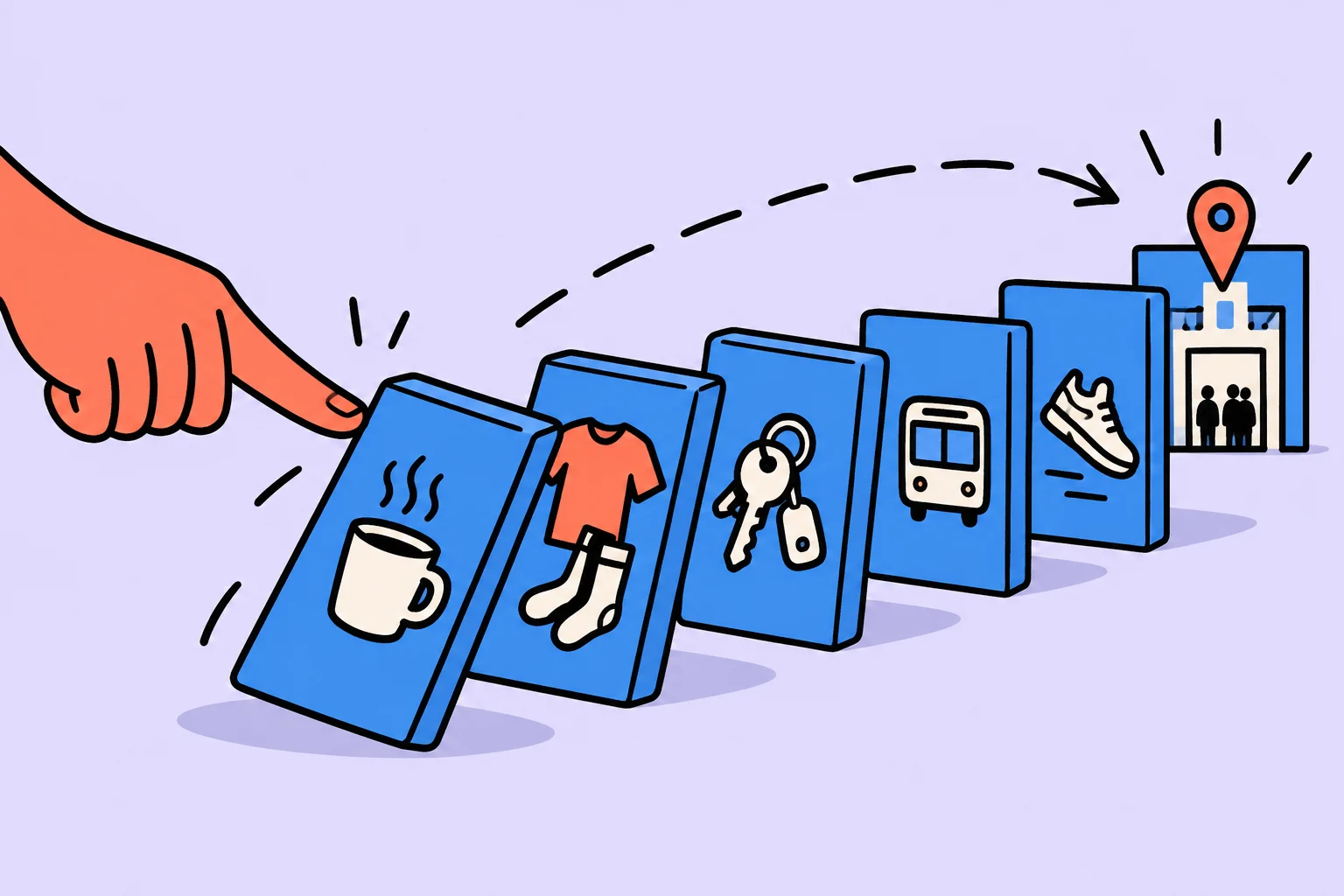
Plan arrival rather than only the meeting start
How can you stop being late when you have an alarm and know the route, but still leave late? Calculate backward: when you must be there, how long travel and entry take, and when preparation and the previous activity must end. Lateness often develops before leaving home, so a reminder for the meeting itself arrives too late.
Record the arrival point precisely: ‘at the meeting room’, rather than ‘near the office’; ‘at the right platform’, rather than ‘at the station’. Different points require different time. Clarify whether you must show documents, find an entrance, or prepare materials. These actions belong to the route even if navigation does not display them.
A backward plan does not guarantee punctuality in every circumstance. It helps identify your own contribution to delays and prepare a response to external ones. Start with one recurring route where lateness actually causes difficulty for you or others.
Find where minutes disappear
Review the last few trips: planned departure, actual departure, arrival, and reason for the difference. You need not reconstruct every second. Separate preparation, travel, and actions after arrival. If the delay is always at home, adding transport buffer may conceal the real cause.
The APA defines the planning fallacy as underestimating the time a future action takes because of optimistic scenarios. The practical implication is to rely on completed similar trips rather than the luckiest case. This does not mean everyone errs equally or that a buffer must have a fixed size.
Distinguish ordinary delays from rare exceptions in the log. Two traffic-light stops are part of normal travel; a complete traffic shutdown is an exception. Mixing them without analysis makes the schedule either too tight or excessively early. Compare trips at similar times and along similar routes.
Build the chain backward from arrival
Start with the required time at the location. Subtract the walk from transport to the destination, then travel duration, then preparation. Add separate allowances for uncertainty where it occurs. Do not use one overall reserve without understanding which stage needs it.
The time for stopping previous work is particularly important. ‘Leave at 9:00’ is hard to follow if a call lasts until 9:00 and you must change afterward. Set an earlier boundary: finish the activity, save the result, close materials, and start preparing. Make this transition visible.
Departure time is not a request to start looking for keys. Everything necessary should already be ready. If preparation takes longer than expected, start earlier or move some preparation to the evening. Do not compensate for delays through actions that make travel unsafe.
Example: a meeting at 10:00
The author’s example: Pavel must be at the meeting room at 10:00. Walking from the stop to the room takes 10 minutes. Similar morning trips usually take 35 minutes, and he allows another 15 for waiting for transport and small delays. He must therefore leave no later than 9:00: 10:00 minus 10, 35, and 15 minutes.
Morning preparation after breakfast takes 25 minutes, starting at 8:35. Pavel likes answering work messages beforehand, so he ends correspondence at 8:30, allowing five minutes to close the laptop. He puts meeting materials and documents into his bag the evening before.
If the bus has not arrived at 9:00, Pavel checks an acceptable alternative route and its arrival time. If it is already clear that he cannot arrive on time, he says so immediately. A buffer reduces some risk but does not remove the need to warn someone of an actual delay.
| Stage | Time or duration | Calculated result |
|---|---|---|
| Be at the meeting room | 10:00 | Target point |
| Enter and walk | 10 minutes | At the building at 9:50 |
| Travel and buffer | 35 + 15 minutes | Leave at 9:00 |
| Preparation | 25 minutes | Start at 8:35 |
| Finish correspondence | 5 minutes before preparation | Stop at 8:30 |
Set reminders for changing actions
Reminders can say ‘finish correspondence’, ‘start getting ready’, and ‘leave’, rather than only ‘meeting in an hour’. The text should tell you what to do now. But a dozen signals may become background noise; keep only the transitions you usually miss.
For a recurring route, create a regular preparation event. Google Calendar supports recurrence and changes to an individual event or a series. Check this technical capability in your chosen calendar. Do not make a series indefinite if the schedule changes after a course or project ends.
Do not postpone a departure signal repeatedly without recalculating. Postponing it by ten minutes removes ten minutes from the buffer. Check whether the journey fits the remaining time and warn of delay immediately if needed. A reminder must not replace a decision.
Remove recurring obstacles in advance
If you regularly search for documents, choose a permanent place for them. If choosing clothes delays you, prepare them the night before. If the phone is flat, charge it before getting ready. These simple environmental changes reduce decisions before leaving.
But do not move your entire life into the evening. Prepare only what actually causes delay and check the result. A ready bag helps if materials are usually forgotten; it changes little if the problem is a call without a fixed end.
For shared departures, agree on one readiness point. ‘We leave at 9:00’ should mean everyone can already leave, rather than someone beginning to get ready. Discuss preparation duration without labeling each other: you need a shared plan rather than an argument about who is more organized.
A recurring-trip template
Record: time at the precise destination; entry and walking; usual travel; allowance for typical delays; departure time; preparation; end of the previous activity; alternative route; whom to notify of lateness and how. Update estimates from actual trips rather than one unpleasant case.
- The arrival point is specified precisely.
- Travel time comes from similar conditions rather than a record trip.
- Preparation finishes before departure time.
- The previous activity has its own stopping boundary.
- Frequent delay causes are removed before preparation.
- Timely notification is planned if arrival on time becomes impossible.
For a new route, the buffer usually needs separate consideration: you do not yet know the entrance location or usual waiting. Check the address, entry rules, and materials beforehand. Do not present an unconfirmed estimate as a reliable route: update the template after the first trip.
Test the method over several departures
After several trips, compare calculation with facts. If you leave on time but arrive late, change the travel estimate. If preparation timing keeps slipping, seek the cause before the door. If you arrive much too early, gradually reduce excessive buffer while retaining a comfortable boundary.
Count warning about a delay separately from actual punctuality. Timely communication helps the other person but does not erase lateness. This honesty helps change conditions without self-deception. Do not promise that one successful week means the habit is permanently formed.
Start with one meeting and calculate the real stopping time for the previous activity. After the trip, compare the plan with facts and update the estimate.
Sources
Frequently asked questions
Should I set my clock ahead?
If you know the offset, it is easy to keep subtracting it mentally. A real departure time with visible preparation and buffer is more transparent.
What about unpredictable transport?
Use similar trips, plan an acceptable alternative, and decide in advance when to warn of delay. External uncertainty cannot be eliminated completely.
How can I avoid arriving too early?
Compare the calculation with several actual trips and reduce excessive buffer where it is genuinely unnecessary. For a new address, retain time to find the entrance.
Turn an idea into action
Was this helpful?
Rate the article and tell us what was missing. Your feedback goes to the Sinqly team and will not be published on the site.
A business plan with AI: inputs, calculations, and assumption checks
Prepare a business plan with AI: a complete educational service model, break-even calculation, scenarios, and cash balances. Assumptions are separated from verified data.

How to stick with a habit: 8 science-based strategies
Why 80% of people abandon habits within 2 weeks and how to avoid it. 8 strategies for maintaining habits supported by neuroscience and behavioral psychology.
A Habit in 21 Days: What the Research Says and How to Start
Why 21 days does not guarantee a habit. The limits of Lally's research, a practical plan and a completed example for tracking actions and missed attempts.