Where to start
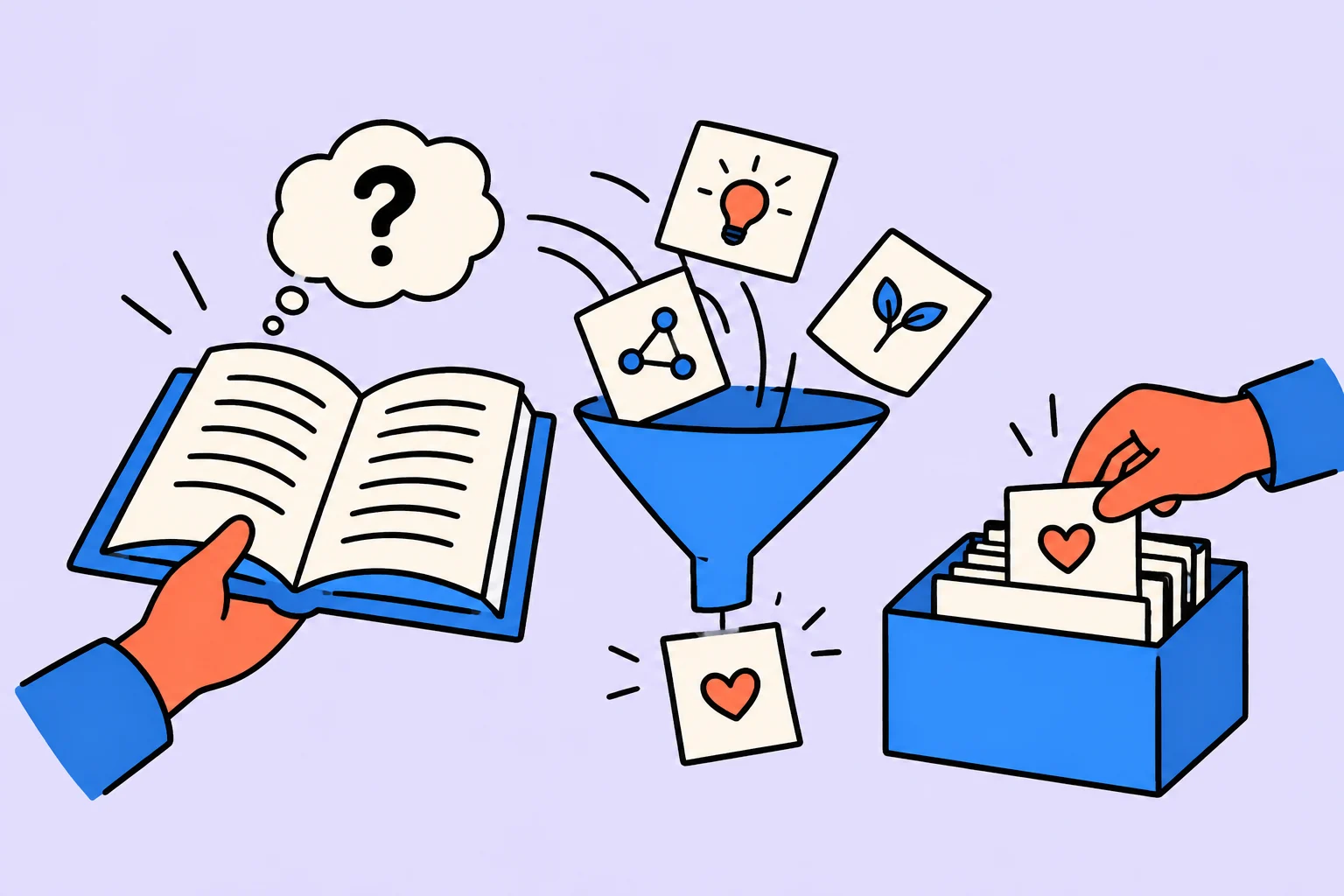
To remember reading, it helps to know beforehand why you need the text and to check understanding after a small section without the page open. The goal is not a promise to retain any book after one reading. Choose an idea you want to explain or use, and organize reading around that check.
What should you choose before reading?
Before reading, choose the question the text should answer and the intended use of that answer. Set a working question first: what to clarify with a client, how to choose a chart type or how two concepts differ. This does not prohibit reading for pleasure. For material you need to use, a question simply helps identify what matters without making every note equally mandatory.
Look at the structure: title, sections, examples and conclusions. Do not turn this into an all-evening ritual. You need to see where the answer lies and what explanation to expect. If the text does not answer the chosen question, another source may be more useful than diligently memorizing unnecessary information.
What should you do after a small section?
After a small section, close the source, state the idea in your own words, then check and correct your explanation. After a manageable portion, close the text and formulate its main idea yourself. If you can only repeat the heading, clarify the content. If your explanation contradicts the author’s example, return and correct it. The attempt should not become punishment for every forgotten word.
In retrieval research discussed by Roediger and Karpicke, the attempt to reproduce information and the testing conditions matter. Here, a small version is used: recall the meaning before checking. This does not promise the same effect for every book, language and type of information.
Working through an example
The following situation is invented for illustration; it is neither a user story nor a measurement of product effectiveness. Sasha reads a negotiation chapter for an upcoming call. After a section, he closes the book and explains the distinction between a client’s position and interest. He then records his own example and checks the wording against the text. Later, before the call, he recalls the question he wants to ask.
Sasha does not assert that the client requests a discount specifically because of the budget. This is his example of a possible difference between position and interest. On the call, he asks an open question and tests the hypothesis. The idea read becomes an action rather than a confident conclusion about another person without data.
| Moment | Action | Check |
|---|---|---|
| Before reading | Choose a working question | Why is the text needed? |
| After a section | Explain without the text | Is there a gap? |
| Cross-check | Correct the explanation | Is the meaning preserved? |
| Later | Apply to your own case | Is the idea being used? |
How do you preserve connections?
To preserve connections, record your own example, a difference from existing knowledge and a question, rather than only a quotation. Record the link to your situation. For negotiation, that might be a client question; for a technical text, an application of a rule. Keep the author’s idea separate from your conclusion. A quotation without context or practice may be easy to recognize but offer little help with a decision.
If the text contains a disputed claim, do not memorize it as truth simply because it is conveniently phrased. Preserve the source and limitation. Medical, legal or technical decisions require the relevant current verification, rather than merely a good memory of a chapter.
How should you return later?
When returning later, try recalling the key idea and applying it without promising immediate permanent memory. Return to the note after a pause and first try to recall the question and answer. Then check and apply it to a new case. The interval depends on the reading goal and when the information is needed; no universal repetition schedule is set here. Material needed tomorrow requires a different check from long-term exploration of a subject.
Do not promise to remember everything. Sometimes reading produces one good question, a changed prior belief or recognition that another source is needed. If building a personal knowledge base, save only what you have a reason to return to. It supplements memory but does not replace understanding the text.
Checking the decision in your own situation
| Field | Content | Check |
|---|---|---|
| Question | What lies behind the client’s demand? | The question relates to the next call |
| Idea in my own words | Position and interest may differ | Check against the author’s text |
| My example | A discount request may reflect a limited budget | This is a hypothesis, rather than a client fact |
| Application | Ask which condition matters most | Do not impose a cause chosen in advance |
Choose a small section and one question about it. Read, close the source, explain the idea and check discrepancies. Add your own application example. Later, return to the question without a prompt. This cycle reveals what is actually available to you, rather than merely familiar on the page.
Sources
Turn an idea into action
Was this helpful?
Rate the article and tell us what was missing. Your feedback goes to the Sinqly team and will not be published on the site.

How to delegate tasks: outcomes, authority and checks
Hand over a task with completion criteria, a deadline and decision-making authority. A completed assignment example and a check before the deadline.
Flashcards: questions, answers and checking memory
Write memory questions, check answers and return to difficult cards. Examples covering definitions, distinctions and applications.

An exam preparation plan: topics, practice and checks before the deadline
Distribute the syllabus before an exam using initial gaps and available windows. A completed plan for six topics, mixed practice and error checks.