Where to start
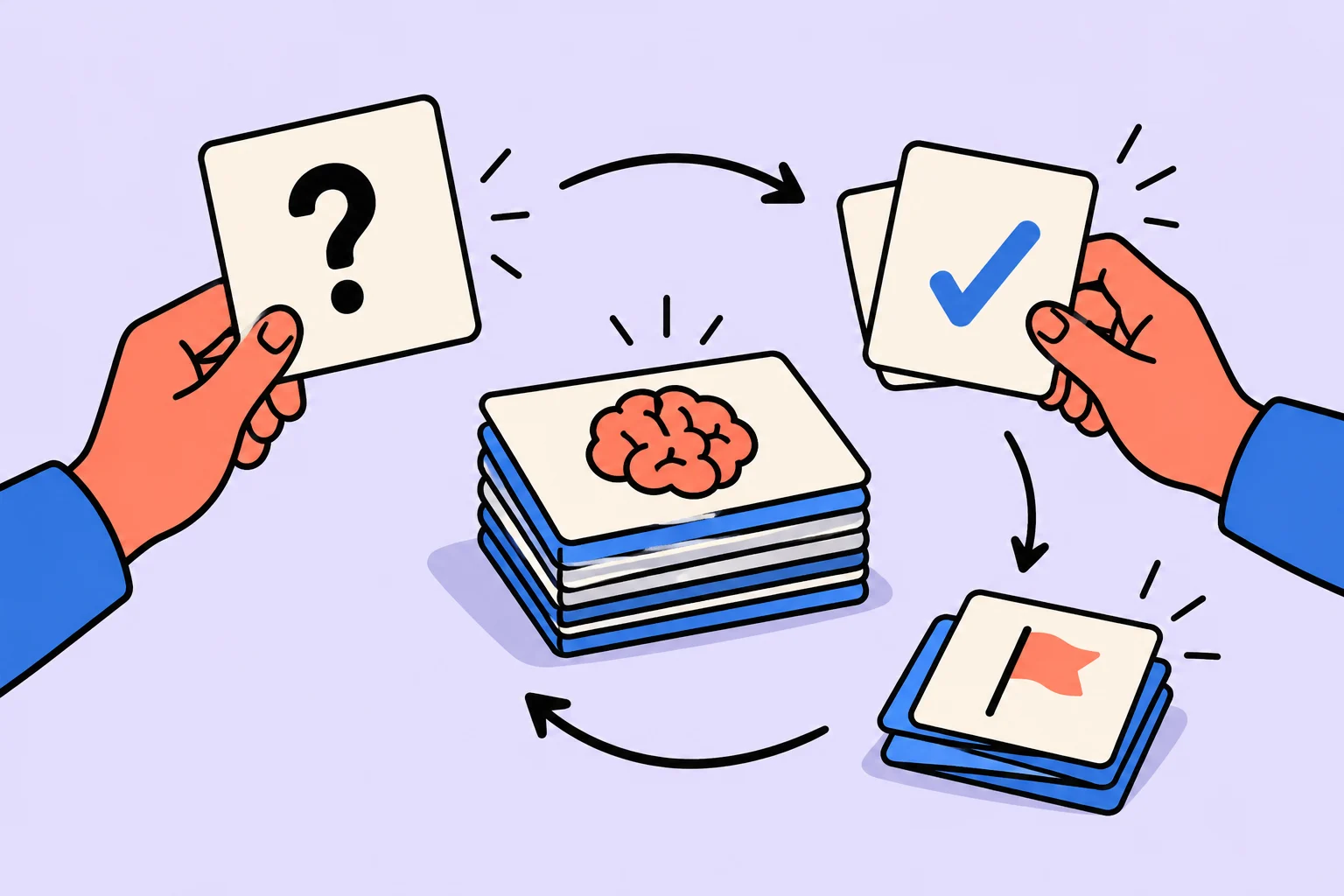
Flashcards act as small questions for memory. They are useful when you need to return to terms, distinctions and application rules. A neatly copied paragraph on the back does not itself create a check: first try answering without a prompt, then compare with the source.
What makes a flashcard useful?
A useful card contains one specific question and a verifiable answer: attempt recall first, then check. Start with material you will actually need. For an accounting course, this might mean cost definitions, differences between similar measures and simple choice situations. Do not turn every textbook sentence into a card: the deck grows faster than understanding of why each fact needs repeating.
A good question is specific enough for its answer to be checked. “Tell me everything about marketing” does not fit one card. “How does revenue differ from profit?” defines a distinction. For more complex material, create several connected questions and separately retain a complete task that requires applying the knowledge.
How do you make cards from material?
When making cards, identify concepts, distinctions and applications rather than put lengthy paragraphs on the back. The back should contain the answer and, if necessary, a brief explanation of an error. Keep a link to the learning source, especially where rules depend on a document version or legislation. A card without provenance can easily turn imprecise wording into memorized certainty.
Alternate definition, distinction and application questions. Knowing a rule’s name and choosing it in a situation are different checks. If cards repeat only terms, add your own example. If the answer can always be guessed from the card’s appearance, change its wording or order to remove the extra clue.
Working through an example
The following situation is invented for illustration; it is neither a user story nor a measurement of product effectiveness. Ilya studies cost fundamentals. “What are variable costs?” checks a definition; a second card asks him to distinguish rent from a payment-service commission; a third asks what changes with a new price. He does not copy the answer from an open lecture.
After the variable-cost question, Ilya must answer before turning the card over. If he confuses a fixed payment with a commission on every order, he returns to the example and corrects the definition. The discount card requires stating “Other things remain equal”; otherwise, the answer is too broad. The three cards test different aspects of understanding. No financial figures are calculated here: these are learning questions about concepts, rather than pricing advice for a particular business.
| Question | Verifiable answer | Check type |
|---|---|---|
| What depends on order volume? | Variable costs | Concept |
| Commission or rent? | Commission is linked to a sale | Distinction |
| What changes with a discount? | Margin per order, other things equal | Application |
How should you review?
For review, return to questions later, mix familiar and difficult material and adjust the interval through observed errors. During review, first hide the answer and genuinely try to recall it. Even an unsuccessful attempt reveals a gap that checking can correct. Simply flipping cards creates familiarity with the text but does not establish whether you can reproduce it independently.
Roediger and Karpicke’s review examines retrieval research. Dunlosky and colleagues’ review distinguishes the usefulness of learning techniques and the conditions for applying them. These papers do not imply that every deck or app is equally useful: question content, an attempted answer and the subsequent check matter.
What do flashcards not replace?
Cards do not replace explanations of connections, practical tasks and understanding context. Return to questions after a pause. Specific intervals depend on the material, when it is needed and errors; there is no single mandatory sequence of days here. Mark difficult questions and reconsider their meaning. If an answer repeatedly fails to come, the concept may need clarification rather than simply pressing “Repeat”.
Cards do not replace solving problems and reading a connected explanation. You can quickly name negotiation stages and still be unable to conduct a conversation. After several reviews, test the knowledge in a new case. This reveals where the deck helped and where practice, discussion or a return to the primary source is needed.
Checking the decision in your own situation
| Weak question | Why it obstructs checking | Revised question |
|---|---|---|
| Everything about costs | Too much for one answer | How do variable costs differ from fixed costs? |
| How was it in the lecture? | Checks familiarity with the example | What cost type is a commission per order? |
| What is on page two? | An incidental location clue | What happens to margin with a discount, other things equal? |
Start with three cards for one small section: a definition, distinction and application. Put the source away, answer and check yourself. Try again later. Expand the deck only when its purpose is clear; the number of cards does not itself measure learning.
Sources
Turn an idea into action
Was this helpful?
Rate the article and tell us what was missing. Your feedback goes to the Sinqly team and will not be published on the site.
How to take notes: main ideas, connections, and checking questions
Lecture or reading notes that support learning: what to record, how to mark uncertainty, and how to turn material into questions. A complete worked example.

How to delegate tasks: outcomes, authority and checks
Hand over a task with completion criteria, a deadline and decision-making authority. A completed assignment example and a check before the deadline.
How to remember what you read: check understanding and return to ideas
Understand and remember reading through a question beforehand, an explanation without the text and your own example. A completed note for applying an idea.