Where to start
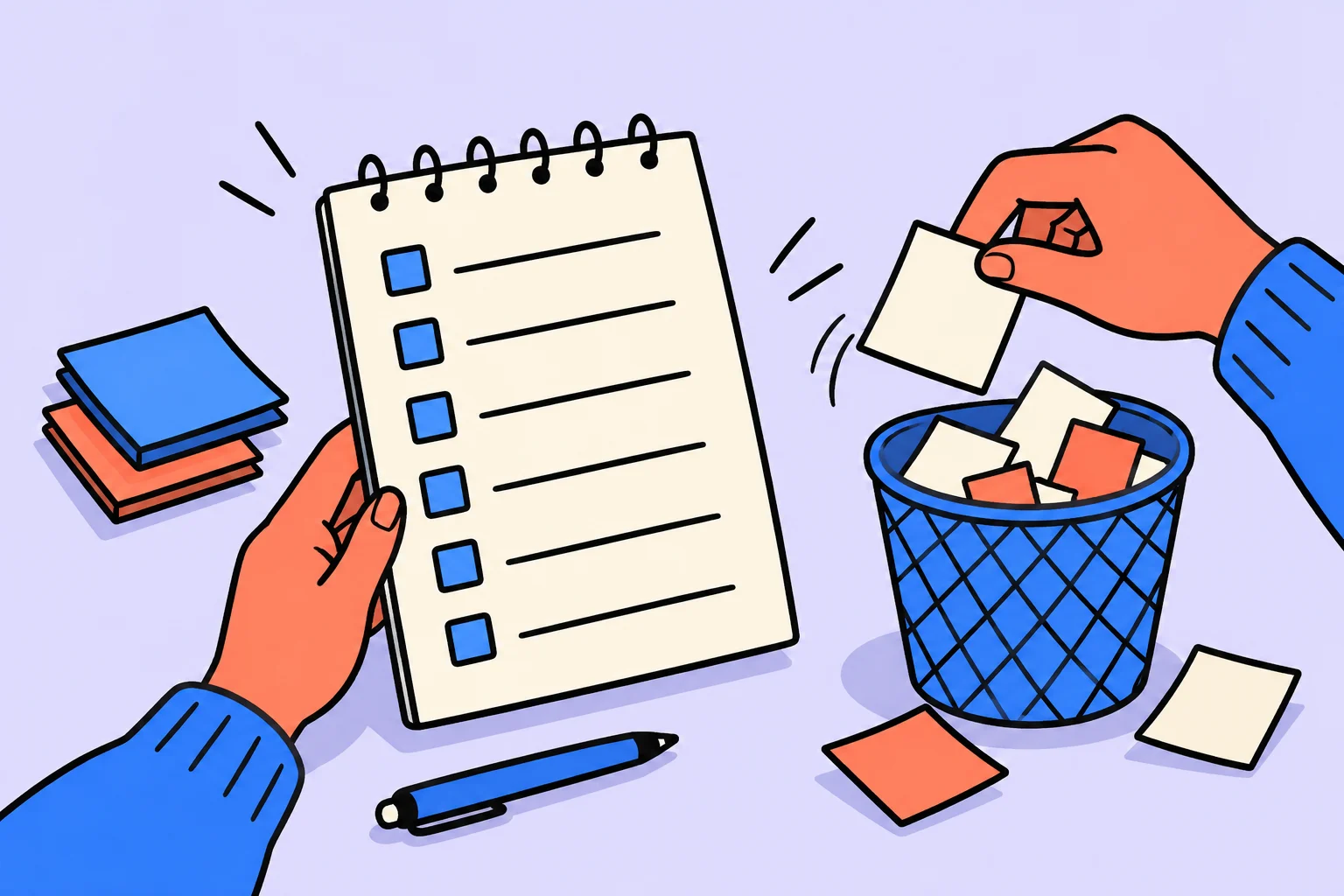
The Ivy Lee method offers a simple choice: make a short list of important tasks for tomorrow in the evening and put them in order. It suits situations where the start of the day disappears into repeatedly choosing the next task. The list does not promise to accommodate every commitment or cancel meetings, urgent events and the actual workload.
How does the procedure work?
In the popular procedure, you choose up to six important tasks in the evening, put them in order and start with the first available item in the morning. The popular account specifies six tasks. Do not treat this number as a scientifically established standard: a task lasting several hours and a short call differ in size. If three outcomes fit your day, there is no need to add three more items artificially.
Clarify each item’s meaning. “Work on the proposal” does not identify where to stop. “Prepare an estimate for one option for approval” defines a result. Before ranking, separate fixed meetings from tasks you choose and check dependencies between items.
Why does order matter more than quantity?
Order limits choices, while six remains a rule of the popular account, rather than a scientifically optimal number of tasks. Put first the work that unlocks the next step or has the most significant consequences if delayed. Lena needs the price calculation before the call, or the conversation will remain general. The order therefore follows the work, rather than simply whichever task feels most appealing.
If commitments compete, do not hide the conflict in the numbering. Two outcomes with the same deadline may not fit into a day. Clarify expectations or reduce the scope. The method helps choose an action, but does not create extra hours or authorize silently breaking a promise.
Working through an example
The following situation is invented for illustration; it is neither a user story nor a measurement of product effectiveness. Tomorrow, Lena has a price calculation, a client call and mockup revisions. She puts the calculation first because the proposal depends on it. When an urgent request arrives, she distinguishes the real deadline from the habitual wish to reply immediately. In the evening, she rechecks the remaining item rather than treating it as failure of the entire day.
In the evening, Lena sees that the calculation is done, the conversation happened and the mockup still depends on agreed terms. She carries forward a specific revision after the client’s reply, rather than the entire old list. The item count does not matter by itself: three clear outcomes were more honest for this day than six oversized promises.
| Order | Task | Why now |
|---|---|---|
| 1 | Price calculation | Needed for the proposal |
| 2 | Client call | Check the terms |
| 3 | Mockup revision | Uses the agreed terms |
| Carryover | Unfinished work | Check relevance first |
What should you do about an interruption?
When interrupted, check urgency, preserve your return point and choose the first available item again. In the morning, start with the first available item. If it lacks input data, record a request and move to the next useful action rather than waiting beside the list indefinitely. Dependence on a reply is part of the situation and needs to be visible.
During an interruption, check whether the new matter needs immediate attention. If it does, preserve your return point: what is done and what to check next. Otherwise, put the request in your inbox and return to the current item. This avoids changing the order merely because a message appeared.
How should you carry over unfinished items?
Carry over remaining items after checking relevance, rather than copying the entire list automatically. In the evening, mark completed work and review the remainder. Remove outdated items, include important ones in the next plan and clarify oversized ones. Automatically copying every unfinished commitment turns a short list into a growing queue where the morning choice becomes unclear again.
James Clear published one available account of the method. It is a practical description with a historical story, rather than a controlled effectiveness study. No specific productivity gain is promised here, and the historical accuracy of the implementation anecdote is not asserted.
Checking the decision in your own situation
| Remaining item | Decision | Reason |
|---|---|---|
| Mockup after the calculation | Keep for tomorrow | Agreed terms are needed |
| An old client request | Clarify whether it is still relevant | The request may have changed |
| A new design idea | Do not put it first | It does not unlock the next stage |
| An urgent commitment | Agree on a revised order | It affects a promised deadline |
This evening, choose a few genuinely important outcomes for tomorrow. Check whether they fit around fixed events and number them by dependencies and consequences. Start with the first available step in the morning. At day’s end, review the remainder rather than mechanically carrying over the whole list.
Sources
Turn an idea into action
Was this helpful?
Rate the article and tell us what was missing. Your feedback goes to the Sinqly team and will not be published on the site.
The 1-3-5 method for planning your day
The 1-3-5 method: a simple daily planning system. 1 main task, 3 medium tasks, 5 small tasks. How to use it, examples, and integration with trackers and AI planners.

The ALPEN method: a daily plan with a buffer and review
Five ALPEN steps in a complete example: estimate tasks, leave a buffer, revise overload, and compare the plan with actual results in the evening.
The PARA method: organize notes, projects, and materials
Four PARA categories, six worked material examples, and a decision tree. Organize one folder and decide what to retain after a project finishes.