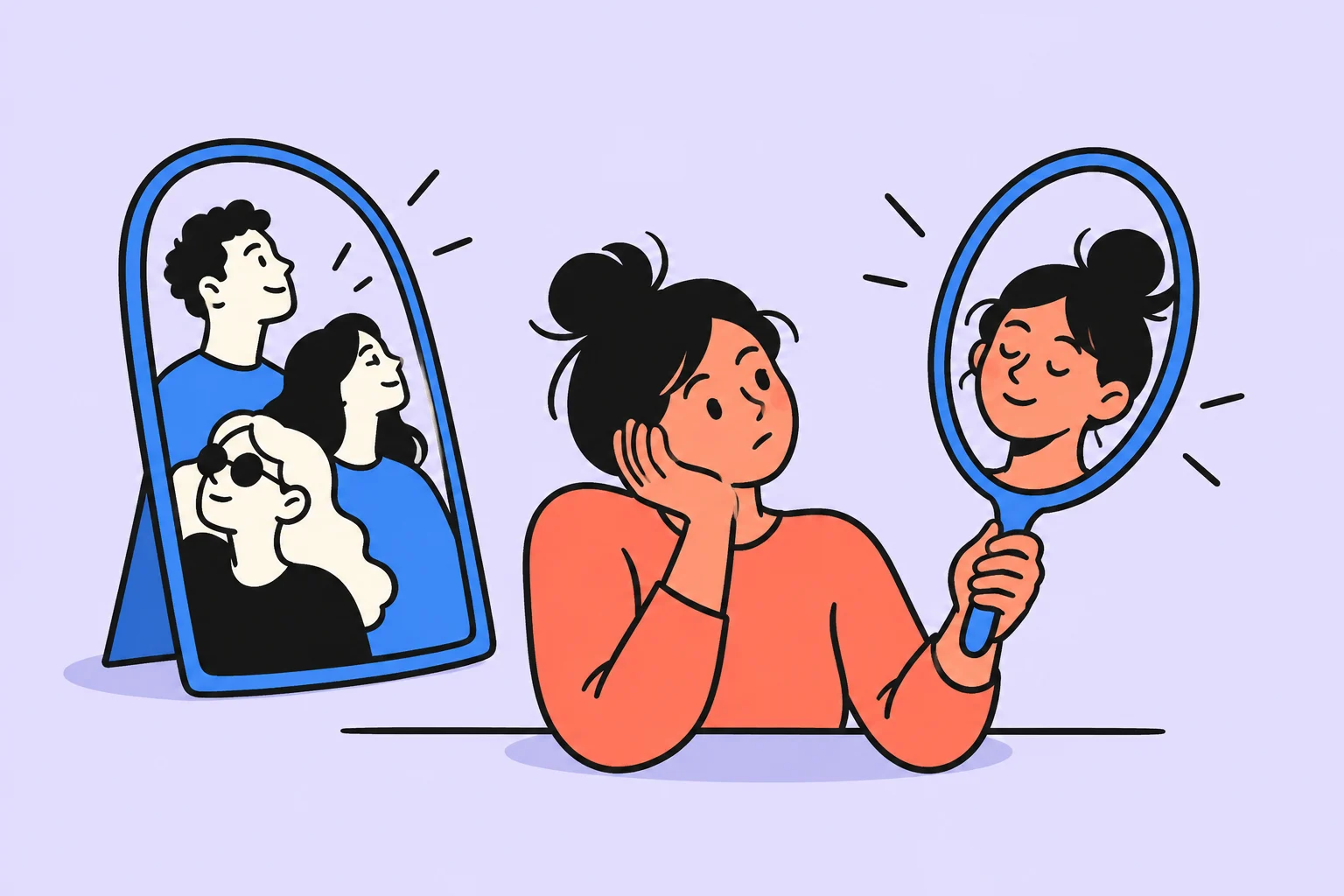
You open Instagram and see a former classmate traveling in Bali, a colleague buying an apartment, and a friend running a marathon. Something tightens inside. “Why does everyone succeed except me?” This is not weakness: it is an evolutionary mechanism that has become a trap in the social media age. Comparing yourself with others is among the most toxic and widespread thinking patterns, yet you can break free. This article explores comparison psychology, its consequences, and 10 science-based strategies to focus on your own path.
Why we compare ourselves with others: the psychology
Social comparison is an evolutionary feature rather than a bug. Social comparison theory, proposed by psychologist Leon Festinger in 1954, explains that humans have a fundamental need to evaluate abilities and opinions. Without objective criteria, we use other people as reference points.
Comparison was useful in tribal society: it helped establish status, adapt behavior, and survive. If your neighbor hunts better, learn from them. If worse, you can relax. The problem is that our brains evolved for groups of 50-150 people, Dunbar's number, while today social media exposes us to millions. The scale has changed by orders of magnitude, while the mechanism remains the same.
Festinger identified two comparison types: upward , with people who are “better” by some criterion, and downward , with those who are “worse.” Upward comparison causes envy but theoretically can motivate. Downward comparison temporarily boosts self-esteem, yet brings no development and often involves guilt. The problem begins when upward comparison becomes chronic, automatic, and paralyzing: when someone else's success makes you feel worthless, beyond simply noticing it.
of social media users regularly compare themselves with others (APA study, 2023)
of people feel worse after 15 minutes of Instagram scrolling
reduction in envy among gratitude journal keepers (University of California)
maximum people with whom the brain can maintain relationships (Dunbar's number)
The social media trap: distorted reality and self-esteem
Social media is today's main catalyst for unhealthy comparison. The problem lies not in the platforms themselves, but in exactly what we see. People post carefully selected moments: travel without the depression afterward; promotions without preceding years of burnout; perfect relationships without nighttime arguments. This is not lying in the usual sense, but a systematic distortion of reality.
Research from the UK's Royal Society for Public Health (RSPH) found Instagram to be the most toxic social network for young people's mental health. The visual format creates an especially convincing illusion of a perfect life. The brain perceives images as reality, even when we rationally understand that photos are filtered and staged.
Algorithms worsen the problem. They show emotionally powerful content, and envy and admiration are powerful emotions. The longer you linger on others' achievements, the more similar content the algorithm offers. A vicious cycle forms: comparison creates envy, envy holds attention, attention feeds the algorithm, and the algorithm intensifies comparison.
A separate problem is numerical metrics. Likes, followers, and views literally digitize “popularity,” making comparison objectively measurable. You have 500 followers; a colleague has 50,000. Numbers do not lie. But they do not tell the whole story either: 50,000 followers do not equal happiness, health, or deep relationships.
We compare our whole lives — failures, routine, doubts, and boring Tuesdays — with others' highlights. It is like comparing your draft with someone else's published bestseller. The result always disadvantages you, not because you are worse, but because the comparison is fundamentally unfair. You never see sleepless nights, panic attacks, and disappointments in someone else's feed.
The consequences of chronic comparison with others
Constant comparison is not harmless. It has serious consequences for mental health, relationships, and quality of life. Understanding these consequences is the first step toward motivation to change.
Lower self-esteem. When you chronically focus on others' achievements, your own seem insignificant. You ran 5 km, but someone ran a marathon. You got promoted, but someone founded a company. Every achievement loses value through the lens of another person's more impressive result.
Procrastination and action paralysis. If you already believe you cannot reach “those people's” level, why try? Comparison kills motivation before action begins. This is particularly dangerous for overcoming procrastination , adding another layer of resistance to the already difficult process of starting.
Chronic envy. Small amounts of envy are normal, but chronic envy corrodes relationships. It is hard to be sincerely happy for a friend when their success hurts. Over time, you avoid successful people or discount their achievements. Both destroy connections.
Loss of authenticity. You start copying someone else's path. You choose a career because “all successful people work in IT.” Buy things because “this is how normal people live.” Move to a city because “everyone builds careers here.” After 10 years, you discover you have lived someone else's life. Finding yourself begins with abandoning other people's standards as your guide.
Impostor syndrome. Chronic comparison feeds the belief “I do not deserve what I have.” Seeing only others' successes, without their journeys, you conclude your achievements are accidental and you will soon be “exposed.” According to the International Journal of Behavioral Science, up to 70% of people have experienced impostor syndrome at least once.
Financial decisions under pressure. Comparison drives unjustified spending: a new iPhone because a colleague has one; a Thailand trip because everyone travels; a car loan because “that is expected.” Federal Reserve Bank of Philadelphia research found that people living near wealthy neighbors go bankrupt more often because they spend to “keep up,” rather than because they lack money.
Burnout from the race. Constantly chasing an imagined standard set by others' achievements means you can never stop and rest. Each achievement loses value immediately because “someone did more.” This leads directly to professional burnout , a condition the WHO officially included in the International Classification of Diseases.
Cognitive biases when comparing yourself with others
Comparison is intensified by cognitive biases: systematic thinking errors that make our reality assessments inaccurate. Knowing these traps helps you catch your brain in the act and adjust automatic reactions.
Survivorship bias. We see only those who succeeded: entrepreneurs who became millionaires, rather than the 95% of startups that failed. Social media has no “I tried and failed” accounts. You compare yourself with the surviving 5%, assuming they are normal. For every successful blogger with a million followers, thousands posted for years without results.
The halo effect. If someone succeeds in one area, we automatically attribute success elsewhere. A businessman with an expensive car seems happy, healthy, and loved, although we know nothing about his life beyond one photo. This bias makes us believe someone else's whole life is perfect, while ours is not.
Anchoring. The first example becomes the “norm.” If the first person in your feed has visited 50 countries, every later comparison uses that standard. Your 3 trips annually seem insignificant, although objectively that exceeds 80% of people on the planet.
Black-and-white thinking. The brain simplifies reality into binary categories: “successful / failure,” “beautiful / ugly,” “rich / poor.” Reality is a spectrum, but comparison puts others into “successful” and ourselves into “failure.” Recognizing this bias helps reveal nuances and gradations instead of extremes.
Negative filter. In comparison, we notice areas where we lose and ignore those where we win. A colleague earns more, but you have better health. A friend travels more, but you have deeper relationships. The brain filters information toward a negative conclusion because negative emotions are evolutionarily stronger than positive ones.
We tend to explain others' success through personal qualities, “she is talented” or “he is persistent,” and our own failures through circumstances, “I was unlucky” or “my conditions are different.” Yet we also explain others' failures through personal qualities and our own successes through circumstances. Double standards always work against us. Recognizing this bias is the first step toward fairer self-assessment.
10 strategies to stop comparing yourself with others
Social comparison cannot be eliminated entirely: it is part of our nature. But we can manage the process and reduce its destructive influence. Here are 10 science-based strategies.
Awareness: catch yourself in the moment
Notice when you compare. Tell yourself: “I am comparing right now. That is normal. But I choose another focus.” Mindfulness creates a pause between stimulus and response.
Digital hygiene: limit social media
Set a 30-minute daily limit. Unfollow accounts triggering envy. Follow people who inspire without making you feel inferior.
Gratitude journal
Every evening, write down 3 things you are grateful for. Professor Robert Emmons's UC Davis research found this practice reduces envy by 40%.
Compare yourself with your past self
The only productive comparison is with yesterday's self. Track your progress using specific metrics: health, skills, and finances.
Define your values
When your values are clear, others' achievements in unrelated areas lose their power. Do you value freedom? Someone else's corporate career will not hurt you.
Reframing envy
Use envy as information: “What does this envy teach me? What do I actually want?” Turn a destructive emotion into a compass.
Practicing self-compassion
Treat yourself as you would a close friend. Kristin Neff's research found self-compassion more effective than self-esteem for mental health.
Mindfulness meditation
10 minutes of daily meditation reduce the brain's reactivity to comparison triggers. Practice trains the ability to observe thoughts without getting involved.
Limit your comparison circle
Compare yourself only with people in similar circumstances. Comparing your first year in business with someone else's tenth is an unfair game.
Track progress numerically
With objective data about your own growth, comparison with others loses its meaning. Numbers do not deceive.
Gratitude journaling: a scientifically proven method against envy
Gratitude journaling deserves special attention because dozens of peer-reviewed studies support its effectiveness. Professor Robert Emmons of the University of California, Davis, has studied gratitude for more than 20 years and reached impressive conclusions.
Participants keeping gratitude journals for 10 weeks reported a 25% increase in happiness, better sleep, greater motivation to exercise, and, crucially here, a significant reduction in social comparison. Gratitude literally shifts the brain's attention from scarcity to abundance: from “I lack what someone else has” toward “I already have so much.”
The neurobiological mechanism is simple: gratitude activates the prefrontal cortex and stimulates dopamine and serotonin, neurotransmitters responsible for satisfaction and good mood. A brain trained in gratitude automatically notices positive aspects of life, including personal achievements. This is the direct opposite of chronic comparison.
How should you keep a gratitude journal? Every evening, record 3-5 specific things you are grateful for. Instead of abstract “I am grateful for health,” write specifics: “Today I am grateful for a warm conversation with Mom,” “For completing a difficult work task,” or “For 20 quiet minutes with a book.” Specificity strengthens the effect 3 times compared with general phrases because it makes the brain relive the moment.
An important nuance: do not make the practice an obligation. If you feel no gratitude today, write honestly: “Today was hard, and I am grateful at least that it is over.” That counts too. Regularity matters more than “perfect” entries.
Comparing yourself with your past self: the only productive comparison
The only comparison moving you forward is with yesterday's self. Not Elon Musk, an Instagram blogger, or a classmate, but the person you were a month, six months, or a year ago.
The problem is that our progress is often invisible to us. We get used to a new level and forget our starting point. You speak English fluently but forget stumbling over every word 3 years ago. You speak calmly in meetings but forget trembling with fear the first time.
That is why recording progress is critically important.
Practical tip: create a “victory jar.” Record one small win every day, however insignificant. After a month, you have 30 pieces of evidence of progress. After a year, 365. When comparison washes over you, open the jar and reread them.
Once monthly, ask: “What can I do, know, or practice now that I could not a month ago?” Even small progress is progress. Learned a new dish? Read a book? Got through a difficult conversation without conflict? Record it. Over time, the list becomes your personal growth story.
The values anchor: how values protect against comparison
When your values are clear, others' achievements stop hurting because they stop defining your success. If freedom is your core value, someone else's golden-handcuff corporate career will not hurt you. If deep relationships matter most, someone else's material success will not upset you.
Most people have never consciously defined their values. Instead, they live by “default values”: money, status, appearance, and followers, the success measures society imposes. Comparison hurts most on precisely these metrics.
Working with values forms the foundation of stable self-esteem. When you know what truly matters to you, beyond what “should” matter, you build an internal compass independent of others' achievements.
Exercise: list 10 things you value in life. Reduce them to 5, then 3. These 3 values are your anchor. Whenever you catch a comparison, ask: “Does what I envy connect with my top-3 values?” If not, let it go. If so, use it as motivation rather than self-punishment.
Reflection: turning envy into a growth tool
Harvard psychologist Susan David offers a revolutionary approach: use envy as information instead of fighting it. Envy signals an unmet need. It is an emotional GPS pointing toward where you want to go but are afraid to admit it to yourself.
Envy of someone's business may indicate a need for autonomy and control over your life. Envy of travel may mean freedom and new experiences. Envy of relationships may mean closeness and acceptance. Envy points precisely toward the emptiness you are trying not to notice.
Instead of “I am worse,” ask three questions: (1) “What exactly do I envy?” (2) “What need lies behind it?” (3) “What can I do right now to move toward meeting that need?” Turn a destructive emotion into constructive action.
Distinguish “inspiring envy” from “paralyzing envy.” The first says, “I want that too, and I can get there.” The second says, “I will never manage that, so why try?” Your attitude to your own capabilities is the key difference. If envy motivates action, it is useful information. If it paralyzes, the pattern needs changing.
A useful technique is “deconstructing success.” Break an envied achievement into components. A business with a million in revenue represents 5 years without weekends, 3 failures, a parental loan, good market timing, and 10,000 working hours. Seeing the whole path instead of only the result naturally reduces envy and increases understanding.
Self-compassion as an antidote to comparison
University of Texas professor Kristin Neff's research found self-compassion a more reliable mental-health foundation than high self-esteem. Self-esteem is fragile, depending on successes, failures, others' approval, and especially comparisons. Self-compassion is stable: it rests on unconditional acceptance rather than self-evaluation.
Self-compassion has three components: (1) self-kindness instead of self-criticism: talk to yourself as you would to a close friend; (2) common humanity , understanding that suffering and failure belong to human experience, rather than being your personal anomaly; everyone goes through them; and (3) mindfulness , observing thoughts and emotions without identifying with, suppressing, or amplifying them.
Why does self-compassion counter comparison? It removes the root cause: needing to be “good enough” by external criteria. Accepting yourself with flaws and being kind simply because you are a living person, rather than for achievements, means others' success no longer threatens your self-worth.
Practical exercise: when you catch a painful comparison, put a hand over your heart and say: “This hurts right now. That is normal; many people feel the same. I treat myself with kindness.” These three phrases match the three components of self-compassion. It may seem naive, but research confirms that the physical gesture, a hand over the heart, activates the parasympathetic nervous system and lowers cortisol.
Another powerful exercise is a “letter to yourself from a compassionate friend.” Imagine your kindest, wisest friend writing about your situation. What would they say? Write that letter. Reread it when comparison overwhelms you.
The practice of mindfulness directly connects with self-compassion: it teaches noticing thoughts without judgment, reducing automatic reactivity to comparison triggers. Even 5-10 minutes of daily meditation build neural connections that help catch comparison before it becomes an emotional spiral.
A practical 30-day plan for giving up comparison
Theory without practice is useless. Here is a specific 30-day plan to change the thinking pattern. Each week has its focus, progressing from observation to active change.
Week 1: Observation
Track every comparison. Record when, with whom, how you felt, and the trigger. Simply observe and collect personal data without trying to change it yet.
Week 2: Digital hygiene
Limit social media to 30 minutes daily. Unfollow 10+ envy-triggering accounts. Start a gratitude journal: 3 items every evening before bed.
Week 3: Shifting focus
Start a “victory jar”: record 1 win daily. Identify your top-3 values. Practice 5 minutes of mindfulness meditation in the morning.
Week 4: Reframing
Whenever you catch a comparison, ask: “What need lies behind this envy?” Record your 3 main insights from the month. Make an action plan.
Important: do not expect perfect execution. If you miss a day, avoid criticizing yourself, which would compare you with an “ideal self.” Simply continue the next day. Habit formation research shows a new pattern takes 21-66 days to establish, so 30 days can start transformation but will not make it automatic. Continue practicing after the plan ends.
How your environment affects the comparison habit
We do not exist in a vacuum. Family, friends, and colleagues can strengthen or weaken comparison. If your circle discusses “who earns what,” “who has which car,” or “whose child gets better grades,” escaping the cycle is much harder. Environment shapes norms, and norms shape behavior.
Social psychology research shows that people adopt the norms of those closest to them. If your 5 closest friends constantly compare, discuss others' incomes, and compete over achievements, you will too, without noticing. This is “social contagion”: unconsciously copying nearby people's emotional and behavioral patterns.
What should you do? You need not radically replace your whole circle. Start small: find at least one person who supports your authenticity without pulling you into competition. Join a community valuing each person's progress rather than competition. Discuss your values openly with loved ones: perhaps they too are tired of the endless race but afraid to admit it first.
Give your workplace special attention. Toxic competition strongly triggers comparison. Public KPIs, employee rankings on display, and promotion of “the best of the best” make comparison systematic and inevitable. If your company cultivates “survival of the fittest,” ask whether this matches your values. Developing willpower and inner resilience helps resist external pressure.
Family deserves particular attention. Many comparison habits start in childhood: “Why does Maria get top grades and you do not?” or “Look at the neighbor's Peter; he already plays violin.” If comparison was normal in your upbringing, changing the pattern takes more awareness and patience. It is entirely possible: the brain remains plastic at any age.
List the 10 people you communicate with most. Mark each “+” if supportive or inspiring, or “−” if competitive or triggering comparison. More minuses signal a need for deliberate change. You need not sever relationships: spend more time with pluses and less with minuses.
of people have experienced impostor syndrome associated with chronic comparison at least once
days needed to form a new thinking pattern (UCL, 2009)
increase in happiness with regular gratitude practice (UC Davis)
Frequently asked questions about comparing yourself with others
Why do I constantly compare myself with others?
Social comparison is an evolutionary mechanism described by psychologist Leon Festinger in 1954. The brain uses others as reference points for abilities and opinions. Today's social media intensifies this many times over, offering millions of “perfect” profiles that distort reality.
How does social media affect self-esteem and comparison habits?
Research shows that 60% of users feel worse after 15 minutes browsing Instagram. Visual content creates a convincing perfect-life illusion, while algorithms deliberately show emotionally powerful content: envy and admiration. Limiting social media to 30 minutes daily is among the most effective first steps.
Can you stop comparing yourself with others completely?
Eliminating social comparison entirely is impossible: it is human nature. But you can manage it: notice comparisons through mindfulness, refocus on personal progress, and use envy as information about unmet needs instead of a reason for self-criticism.
What are upward and downward comparison?
Upward comparison means comparing with those “above” by some criterion: more successful, wealthier, or more attractive. Downward comparison involves those “below.” Upward comparison causes envy but can motivate. Downward comparison temporarily boosts self-esteem without real development. A healthy approach is comparison with your past self alone.
How are comparison and impostor syndrome connected?
Chronic upward comparison intensifies impostor syndrome: seeing others' successes without their journeys, you discount your achievements and believe you “do not deserve” what you have. Research indicates up to 70% of people have experienced impostor syndrome at least once. A progress journal records real achievements and counters this distortion.
Which techniques help stop self-comparison?
Science-based techniques include gratitude journaling, reducing envy by 40% according to UC Davis; limiting social media; tracking personal progress; working with values; reframing envy as information; practicing self-compassion; and mindfulness meditation. Practice for at least 30 days to establish a new pattern.
How long does breaking the comparison habit take?
Habit formation research from University College London shows that a new thinking pattern takes 21-66 days to establish, depending on complexity and individual differences. Practice strategies for at least 30 consecutive days, gradually progressing from observation to active reframing. A complete transformation in your attitude toward yourself may take 3-6 months.
Conclusion: your path is unique, and that is its greatest value
Comparison is a habit, and habits can change. Not in a day or a week, but steadily and consistently. Shift attention from outside to inside: from others' achievements to your values, from their path to your progress, from their life to yours. This is a healthy focus on what you can actually control, rather than selfishness.
Remember: every social media “success” is one photograph out of thousands. Behind every beautiful moment are invisible hours of doubt, failure, and hard work. Someone doing things differently does not make your life less valuable. The universe is big enough for everyone: success is not a limited resource.
Let us recap. You learned why the brain makes us compare, through Festinger's theory; how social media turns a natural mechanism into a trap through highlights and algorithms; which biases intensify comparison, including survivorship bias, the halo effect, and anchoring; and the consequences of chronic comparison, including low self-esteem, procrastination, and impostor syndrome. Most importantly, you now have 10 specific strategies and a 30-day action plan.
Start today: choose one strategy from this article and practice it for a week. Just one. Trying to change everything at once would be perfectionism, and perfectionism feeds on comparison. One small daily step creates major changes over months. Use the wheel of life balanceto assess your current life across 8 areas: an excellent starting point for comparing with yourself rather than others. Focus on your own path: it is the only one that matters.
Turn an idea into action
Was this helpful?
Rate the article and tell us what was missing. Your feedback goes to the Sinqly team and will not be published on the site.

Procrastination: 12 science-based ways to stop putting things off
Why we procrastinate and how to stop putting things off. 12 scientifically grounded methods for tackling procrastination, from the two-minute rule to cognitive therapy.

How to find yourself and your purpose
A practical guide to self-discovery: methods for finding purpose, the Ikigai concept, working with values, and life experiments. A step-by-step plan from Sinqly.

How to Organize the Space Around You
A practical guide to organizing your space: the KonMari method, 5S at home, tidying habits and minimalism. How order affects productivity and mental health.