
“Who am I? What do I really want? What is my purpose?” Everyone asks these questions, usually during a crisis or change, or when achieved goals fail to bring the expected satisfaction. Finding yourself is a practical process with established methods and tools, rather than esotericism or abstract philosophy. This article provides specific steps.
Why “finding yourself” is so difficult
The idea of “finding yourself” suggests a complete instruction manual hidden inside, waiting to be discovered. Reality is more complex. Research shows that identity is a dynamic process rather than a fixed entity. You “create” yourself through actions, choices, and experience rather than “find” yourself.
Several factors make it harder. Social pressure imposes templates for success: career, family, house, and car. Information noise creates the illusion of endless opportunities, making every choice feel like missing other options. Fear of mistakes paralyzes: “What if this is not for me?” As a result, people become stuck in an endless search without taking specific steps.
of adults have experienced an identity crisis at least once
years: the age of peak “meaning crisis” (APA research)
times on average a person radically changes direction in life
The Ikigai method: a Japanese concept of purpose
Ikigai (生き甲斐) is a Japanese concept meaning “a reason to live” or “what makes it worth getting up in the morning.” It became popular through studies of Okinawan longevity, where people live significantly longer than average, partly because they have a conscious Ikigai.
The Ikigai model consists of four overlapping circles: what you love doing; what you are good at; what people are willing to pay you for; and what the world needs. Your purpose lies at the intersection of all four.
Practical exercise: take a sheet of paper and draw four circles. Write at least 10 items for each. Do not filter or judge: write everything that comes to mind. Then look for overlaps. The most interesting ideas usually emerge where two or three circles meet.
Fill the circles over a week rather than in one sitting. Add new items daily. The brain generates different ideas in the morning and evening. By the end of the week, you will have a rich map of possibilities.
Working with values: what truly matters to you
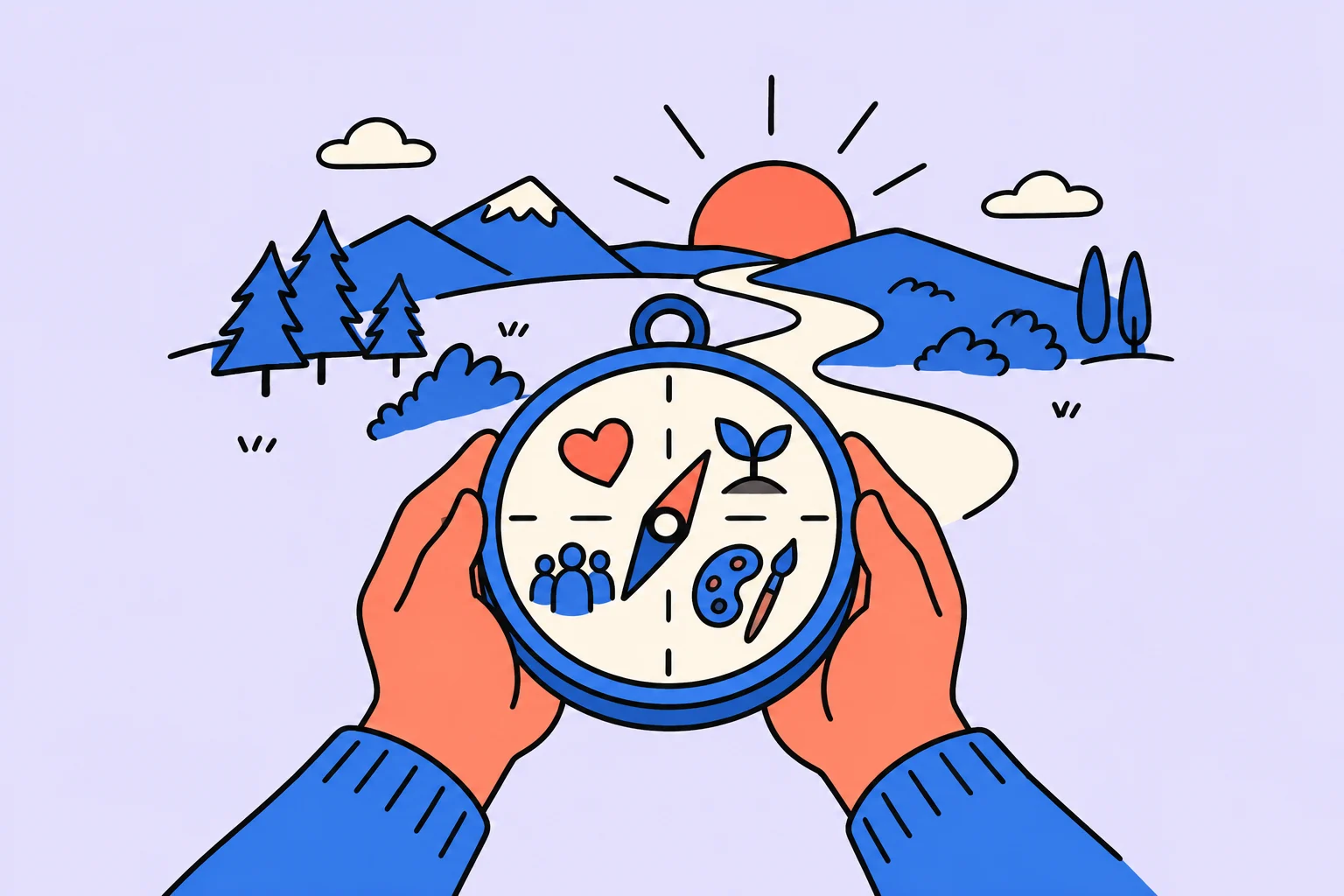
Values are a compass showing direction when there is no map. The problem is that most people do not know their true values. They confuse values with goals (“I want to earn a lot of money” is a goal rather than a value) or adopt others' values as their own (those of parents, society, or social media).
There is an established method for identifying values. Imagine you have exactly one year left to live. You are healthy and have money. What would you do? The answer usually reveals your true priorities. If you imagine traveling, your value is freedom. If you spend time with family, it is connection and love. If you create a project, it is creativity and contribution.
Another method is analyzing peak experiences. Recall 5-7 moments when you felt the greatest fulfillment, energy, or “flow.” What do they share? Which values were expressed? The pattern that emerges is your core set of values.
Life experiments: actions instead of reflection alone
The main self-discovery trap is endless thinking without action. A person spends years thinking “perhaps I should try X,” but never does. Stanford's Bill Burnett and Dave Evans proposed an alternative approach: design thinking for life.
The method replaces searching for the “one correct path” with a series of short experiments. Want to try design? Take an evening course rather than quit your job. Considering a move? Live in a new city for a month while working remotely. Dreaming of your own business? Test the idea on weekends.
Each experiment lasts 2-4 weeks and provides specific information: whether you enjoy it, are willing to spend time on it, and have an aptitude for it. In a year, you can run 12-15 experiments and gain more clarity than in 10 years of thinking.
The body and emotions as a compass
The rational mind often confuses us. It weighs pros and cons and builds comparison tables, yet cannot choose because options seem equally valuable. In these situations, turn to the body and emotions: they contain information unavailable to logic.
Neurologist Antonio Damasio demonstrated that emotions play a key role in decision-making. His studies of patients with damage to the brain's emotional centers showed that without emotions, people cannot make even simple decisions despite fully intact intelligence.
In practice, pay attention to bodily reactions. When you imagine a particular future, how does your body respond? Does it contract or expand? Do you feel energy or fatigue? These signals are valuable information to consider alongside logical arguments.
The main obstacles to finding yourself
Self-discovery is not linear. Predictable obstacles arise along the way, and it is better to prepare for them.
- Fear of disappointment — “what if I find my calling and later realize it is wrong?” Remind yourself that nothing is set in stone. You can always adjust course.
- Other people's opinions — “what will my parents/friends/partner say?” Respect others' opinions, but remember that it is your life to live.
- Financial constraints — “I cannot afford to change careers.” Start experiments alongside your main job. No abrupt moves are necessary.
- Perfectionism — waiting for the perfect moment, perfect certainty, or perfect plan. That moment will never arrive. Act with what you have.
- Comparison with others — social media creates the illusion that everyone has already found themselves. In reality, most people are searching just as you are.
Tools for self-discovery
Alongside the methods above, specific tools help structure the process. Wheel of life — a visual assessment of 8 areas: career, health, finances, relationships, personal growth, rest, surroundings, and contribution. This provides a snapshot of your current situation and reveals imbalances.
A reflection journal is a daily practice of recording thoughts, observations, and insights. You do not have to write much: 5-10 sentences before bed are enough. After a month, rereading entries will reveal patterns that are invisible in the moment.
A step-by-step plan: where to start right now
- Week 1: Audit — complete the wheel of life and write what satisfies you and what does not in each area.
- Week 2: Values — do the “one year to live” exercise and analyze peak experiences. Identify 5-7 key values.
- Week 3: Ikigai — fill the four circles. Look for overlaps and record hypotheses.
- Weeks 4-8: Experiments — choose 2-3 hypotheses and launch small experiments. Record observations in your journal.
- Week 9: Reflection — what worked? What did not resonate? Which values were confirmed? What is the next step?
Conclusion: finding yourself is a journey rather than a destination
Do not wait for everything to fall into place. Purpose is a direction of movement rather than a fixed point on a map. It becomes clearer with each step, experiment, and new experience. The most successful and fulfilled people continue exploring rather than “find themselves” once and for all.
Start small: ask yourself one question today, do one exercise this week, and launch one experiment this month. The path to yourself begins with the first step, and you are already taking it by reading this article.
Turn an idea into action
Was this helpful?
Rate the article and tell us what was missing. Your feedback goes to the Sinqly team and will not be published on the site.

8 life areas: a complete guide to each area with examples and exercises
Explore all 8 life areas: health, finances, career, emotions, relationships, growth, creativity, and home. The 8-area wheel of life, exercises, and an action plan.
How to find your purpose: a complete path to ikigai and meaning in life
A step-by-step guide to finding your purpose through ikigai. Exercises, self-reflection questions, scientific evidence, and practical tools.

How to stop comparing yourself with others
The psychology of social comparison: why we compare ourselves with others, how social media intensifies it, and 10 science-based strategies for breaking free.