Where to start
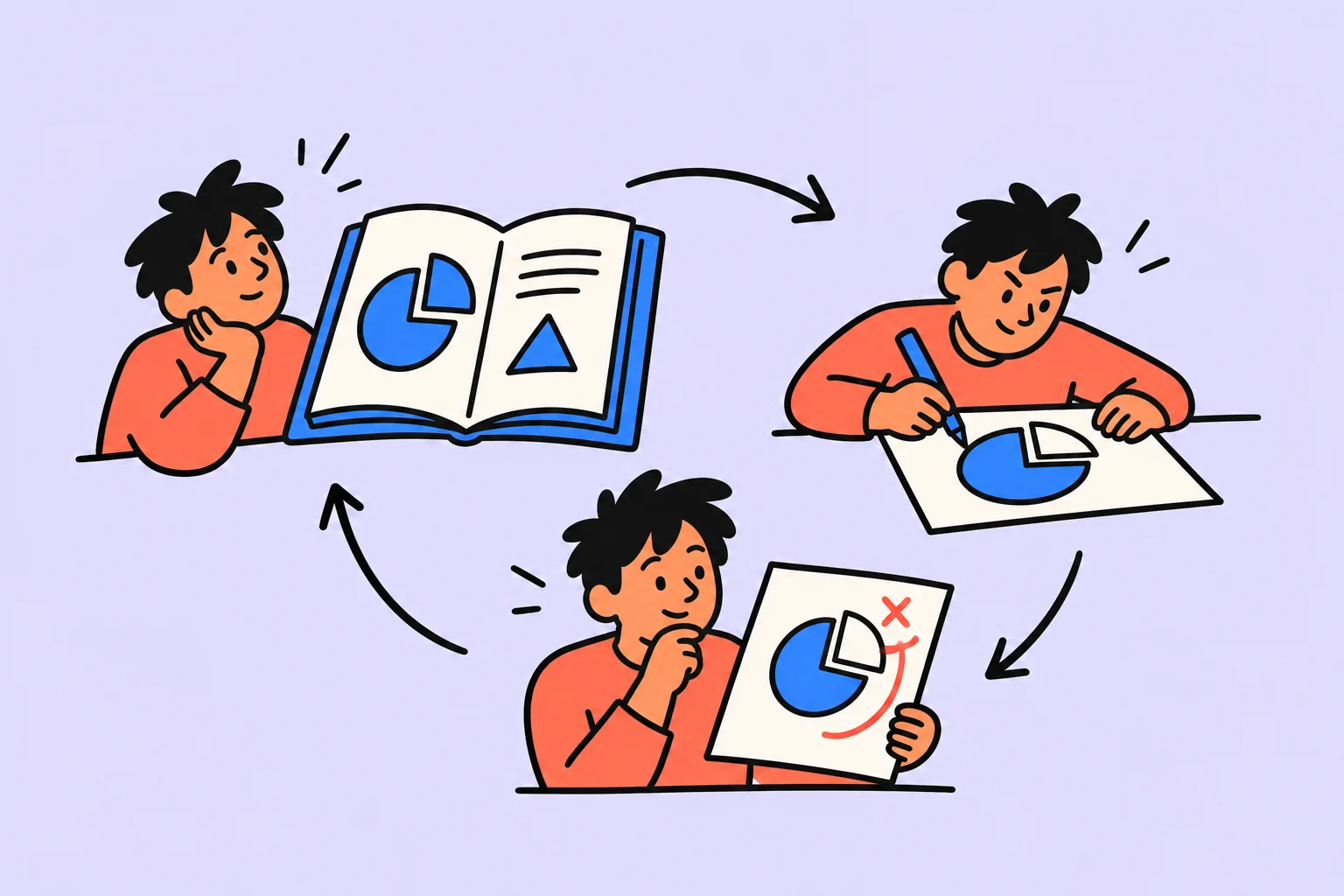
How can you learn effectively when reading seems clear but you cannot reproduce it in practice? Start with a testable skill. Then alternate studying, attempting recall, applying and correcting errors. This cycle reveals what is available without a prompt and what remains merely familiar from learning materials.
How does learning differ from familiarity?
Check learning through your ability to explain material without an open source and apply it, rather than only recognize familiar text. Define a session’s result as an action: build a chart, explain a rule, solve a certain problem type or write a short message in a new language. “Watch a course” describes consuming material. It may form part of learning, but does not identify the skill you want to use afterward.
Make a small initial attempt before a lengthy plan. If learning charts, try choosing a graph for a simple table. The result will show whether the tool itself, the scale’s meaning or the choice of form is unclear. Different gaps require different materials, so restarting the entire course is not necessarily needed.
How do you choose a learning cycle?
Build a session around brief study, attempted retrieval, error checking and an application task. Study a manageable portion after which you can explain or perform something. Then close the source and try reproducing the key steps. A blank in the answer is a useful signal for checking, rather than proof of inability to learn. Correct the specific gap while you still remember where the question arose.
Dunlosky and colleagues’ review discusses practice testing and distributed practice among useful techniques. Conditions and materials matter: the review does not imply that every session should become an exam. Your own cycle can use a short question or an independent action with feedback.
Working through an example
The following situation is invented for illustration; it is neither a user story nor a measurement of product effectiveness. Roman is learning to build charts. After studying a lesson, he closes the video, makes a graph from a new table himself, records a scale-selection error and returns to it later. Watching a second video does not replace checking whether he can repeat the action.
Roman compares a familiar example with a new one. In the familiar one, he remembers the button sequence; in the new one, he gets the scale wrong. The next lesson may therefore not be needed immediately: first examine scale selection and repeat with comparable data. This is a specific change to the learning plan based on an independent check.
| Step | Action | Check |
|---|---|---|
| Study | One chart example | Understand the task |
| Recall | Close the lesson and describe the steps | Find gaps |
| Apply | A new table | Build a graph |
| Return | Check the error later | Has the skill been retained? |
When should you repeat?
Return to material later according to difficulty and errors, without a universal interval formula. Do not repeat only the same example with the same numbers. Choose a new but comparable case to test whether the rule transfers. If the lesson showed sales, try a chart of incoming requests. When an error appears only in a new context, return to the explanation of the choice rather than simply the button locations.
Record an error alongside its correction. “Bad graph” does not help the next attempt. “For change over dates, I chose a form that hid the sequence” explains what to check. This clarification list should not grow into a self-criticism diary: keep what changes the next action.
How do you assess learning?
Assess the chosen skill on a comparable task rather than reading hours alone. Plan to return to the material after a pause. Choose the interval according to difficulty, when the skill is needed and observed errors; there is no mandatory day-by-day ladder for all knowledge here. On returning, first try to recall or perform, then open the source. The check will then reveal more than another reread.
Assess the session by the skill, rather than hours and open tabs. Sometimes one resolved gap matters more than a large block watched. If your workload leaves little study time, reduce the session’s result while retaining an attempt and check. That is more realistic than promising a perfect daily schedule.
Checking the decision in your own situation
| Check | Observation | Next action |
|---|---|---|
| Repeat a familiar example | The buttons can be used without the video | Take new data |
| Choose a scale | The new graph distorts the comparison | Study the scale rule |
| Explain the choice | The reason for choosing this type is unclear | Return to the problem conditions |
| Return later | The graph can be made without a prompt | Move to the next skill |
Choose one skill and a small check for it. Study the relevant section, perform without a prompt, compare the result and record a specific correction. Later, repeat with a new case. Only then decide whether the next lesson or more practice on the current question is needed.
Sources
Turn an idea into action
Was this helpful?
Rate the article and tell us what was missing. Your feedback goes to the Sinqly team and will not be published on the site.
How to Track Habits Effectively: The Complete 2026 Guide
Science-based habit tracking: habit diaries, habit journals and digital trackers. 7 methods and step-by-step instructions.
How to Work from Home Effectively: A Complete Guide
A complete remote-work guide: workspace setup, routines, boundaries, focus, tools, health and a weekly plan for productive remote work.
Productivity and burnout: how to work effectively without burning out
Sustainable productivity without burnout: signs, prevention, and recovery. A scientific approach to balancing effectiveness and well-being.