What to move out of memory
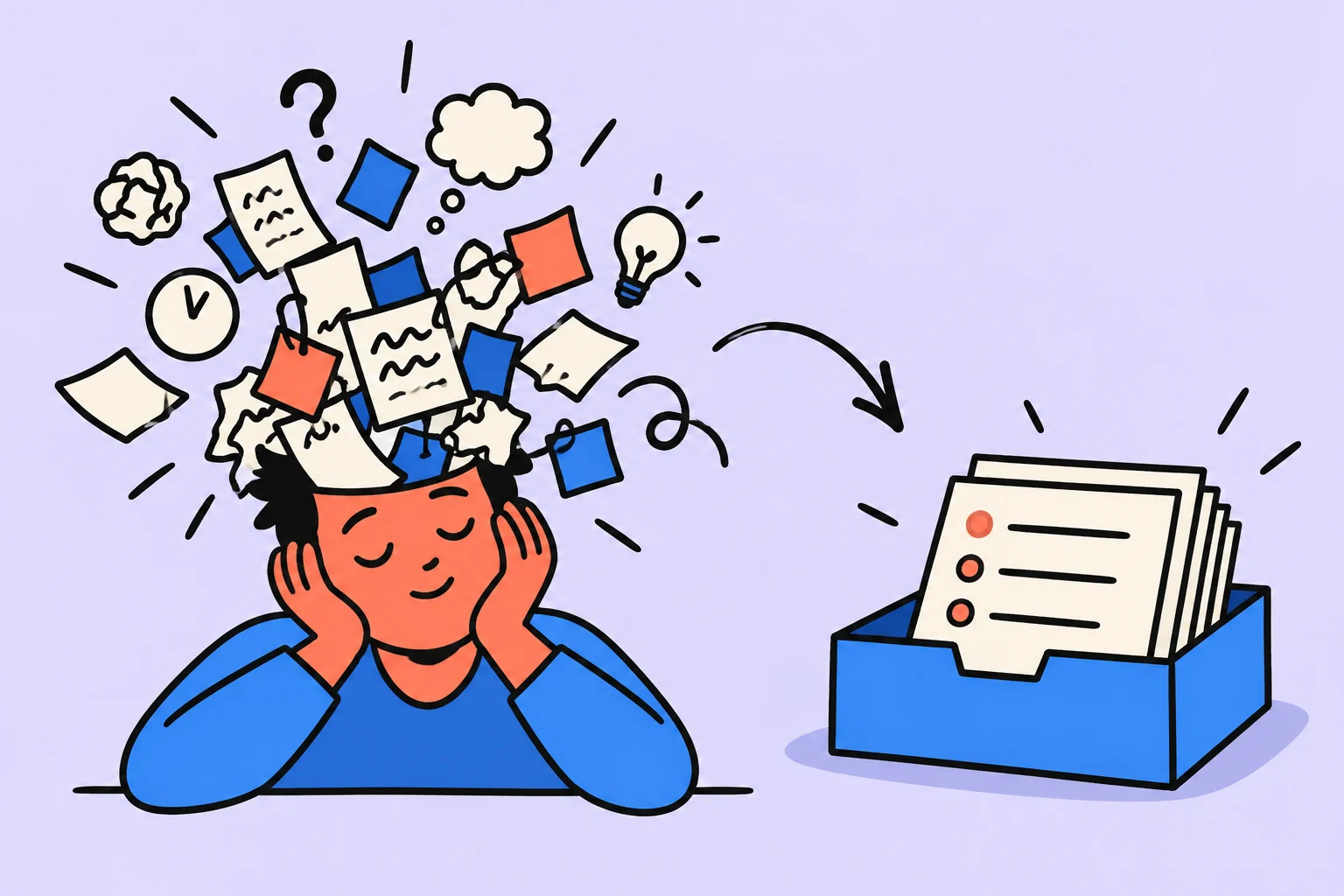
How do you clear your head when work tasks, shopping, and conversations all come to mind at once? Capture them in one place, then distinguish actions from questions, waiting, and ideas. The aim is a clear list and less reliance on remembering every request. This procedure does not promise to eliminate anxiety or solve every life difficulty.
Capture is useful when many unfinished tasks make choosing a next step difficult. Paper or an ordinary note is enough. Do not start by choosing the perfect system: ten minutes configuring folders can leave all the original questions unresolved.
Record ‘decide’, ‘find out’, and ‘wait for’, as well as ‘do’. Many items keep returning because they look like tasks although action is currently impossible. Distinguishing them helps stop demanding completion of something that first needs clarification.
First pass: record without correcting
Open one temporary list and write everything that comes to mind. Wording can be rough: ‘bill’, ‘reply to Masha’, ‘what about vacation’, ‘course idea’. Do not assess importance or assign dates yet. The first pass gathers material rather than finishing planning.
If thoughts run out, review a few contexts: home, work, study, promises to others, and expected replies. You can inspect the calendar and recent messages without reading every conversation. Choose a limited area where forgotten commitments may actually be found.
Stop when items repeat or no new ones come to mind. Completeness is unnecessary: add omissions later. A very long session can become a search for every possible problem, although a few clear actions suffice for today’s decision.
Second pass: identify the note type
For each line, ask: ‘Can this be done now, does it need a decision, must I obtain information, or am I waiting for someone else?’ Add a short label. If the note commits you to nothing, retain it as an idea or delete it. Every wish that occurs need not become a task.
The official GTD description separates capture from clarification: first record what needs attention, then determine what the note means and its next action. This is the source of the separate-stage principle. The four types and review sequence proposed here are the author’s adaptation for one small capture session, rather than a complete account of GTD.
Examine decisions especially carefully. ‘Choose a course’ may require criteria and checking schedules rather than immediate payment. ‘Repair’ may first require photos and a scope estimate. When information is missing, obtaining it becomes the next step rather than rereading the broad wording.
Example: seven notes after a workday
The author’s example: Svetlana has seven items on paper: ‘report’, ‘internet bill’, ‘Maxim has not replied’, ‘courses’, ‘broken shelf’, ‘gift’, and ‘article idea’. She does not try to do everything that evening. First she identifies the result behind each line.
‘Report’ becomes ‘collect September metrics from two tables’. ‘Internet bill’ becomes checking the payment date and amount. The Maxim note becomes waiting for a specific answer with a review date. Courses remain a decision: Svetlana will compare two programs’ schedules rather than enroll in both immediately.
The shelf needs a physical next step: measure the fastening and photograph it. For the gift, first find out the meeting date. She saves the article idea separately from commitments: she can return to it at the next review without being obliged to produce new text today.
| Note | Type | Next step |
|---|---|---|
| Report | Action | Collect metrics from two tables |
| Maxim has not replied | Waiting | Check the reply to a specific question on the agreed date |
| Courses | Decision | Compare two programs’ schedules |
| Broken shelf | Action | Measure the fastening and take a photo |
| Article idea | Idea | Keep separately until review |
The next action should start with a verb
Test the note by asking: ‘Is it clear what to open, whom to message, or which object to pick up?’ If not, reduce the action. ‘Handle the move’ is too broad; ‘ask the mover for an estimate for two addresses’ can be started. You do not need to describe the entire project to find one nearest step.
Add important context: who needs the answer, where the file is, and what counts as completion. But do not turn the note into a long report. An action name and one clarifying line are usually enough. Store confidential information with appropriate access and avoid copying unnecessary personal details.
Distinguish the next step from the desired outcome. ‘Obtain approval’ depends on someone else; ‘send the draft for approval’ is your action. After sending, the note changes type and moves to waiting. The list then does not blame you for a reply that has not arrived.
Give waiting and ideas separate places
Record waiting as: who, what they should send, and when checking makes sense. The review date does not always match the promised deadline: if an answer is needed to prepare for a meeting, check earlier so time remains for an alternative. Do not assign daily reminders without a reason.
An idea is stored separately because it is not a commitment. Mixing it with payments and promises makes the list look endless. During review, choose one idea, turn it into a project, or leave it without action. Dropping an idea is an acceptable outcome rather than an unfinished task.
Keep a decision open only until a clear event. For example: ‘choose a course after receiving the schedule on Thursday’. If there is no event, specify the missing information and how to obtain it. Otherwise, you merely move uncertainty from your head to a screen.
A short capture template
Use these fields: original thought; note type; nearest action; required information or participant; real deadline or review date. Mark the result for a completed item. For waiting, retain exactly what was requested so you do not message again without context.
- All new notes initially enter one place.
- An action has a clear verb and object.
- A decision states criteria or missing information.
- Waiting has a person, answer subject, and reasonable check.
- Ideas do not occupy the space of mandatory tasks.
- A deadline is assigned only where justified.
Choose one item you can actually start now. Put the others into working lists and close the capture session. If you keep sorting all evening, the system may have become another way to postpone action. Stop after processing the nearest commitments.
What to do with recurring thoughts
If one line returns repeatedly, check why an external list cannot yet be trusted with it. Perhaps the note is too broad, may get lost among notes, or has no review point. Fix that property instead of trying to forbid yourself from remembering the task.
If the cause is an unpleasant decision, recording it does not replace choosing. Schedule time to compare options and limit the criteria. If the cause is a missing reply, choose an appropriate follow-up date or fallback. If it is an experience that cannot be reduced to a request, do not promise to solve it with a task manager.
A successful review has a simple criterion: you know the next step and can find the other commitments when needed.
Sources
Frequently asked questions
Should I immediately do short tasks from the capture list?
Not necessarily. Doing them during capture can make you lose other notes. Finish the limited pass first, then choose actions.
How often should I do this?
When unrecorded commitments have accumulated or choosing the next step has become difficult. For ongoing order, a short review of incoming notes is more useful than rare hours-long cleanups.
Why do I not feel better after writing things down?
Recording does not guarantee a change in how you feel. Check whether commitments now have clear actions and storage places; difficult experiences may need other support rather than a more detailed list.
Turn an idea into action
Was this helpful?
Rate the article and tell us what was missing. Your feedback goes to the Sinqly team and will not be published on the site.

How to use a planner: tasks, appointments, and a short review
Set up a planner without elaborate decoration: distinguish appointments and tasks, mark rescheduling, and review open notes weekly. A practical example.

GTD: a planning system explained simply, with a diagram and example
How the GTD planning system works: a five-step diagram, processing your inbox, and a project example. Where to start, where to record the next action, and when you need a calendar.
The Two-Minute Rule: How to Stop Putting Things Off and Start Acting
The two-minute rule from GTD and Atomic Habits: how to use it for tasks and habits. Examples, scientific background, pitfalls and a step-by-step implementation plan.