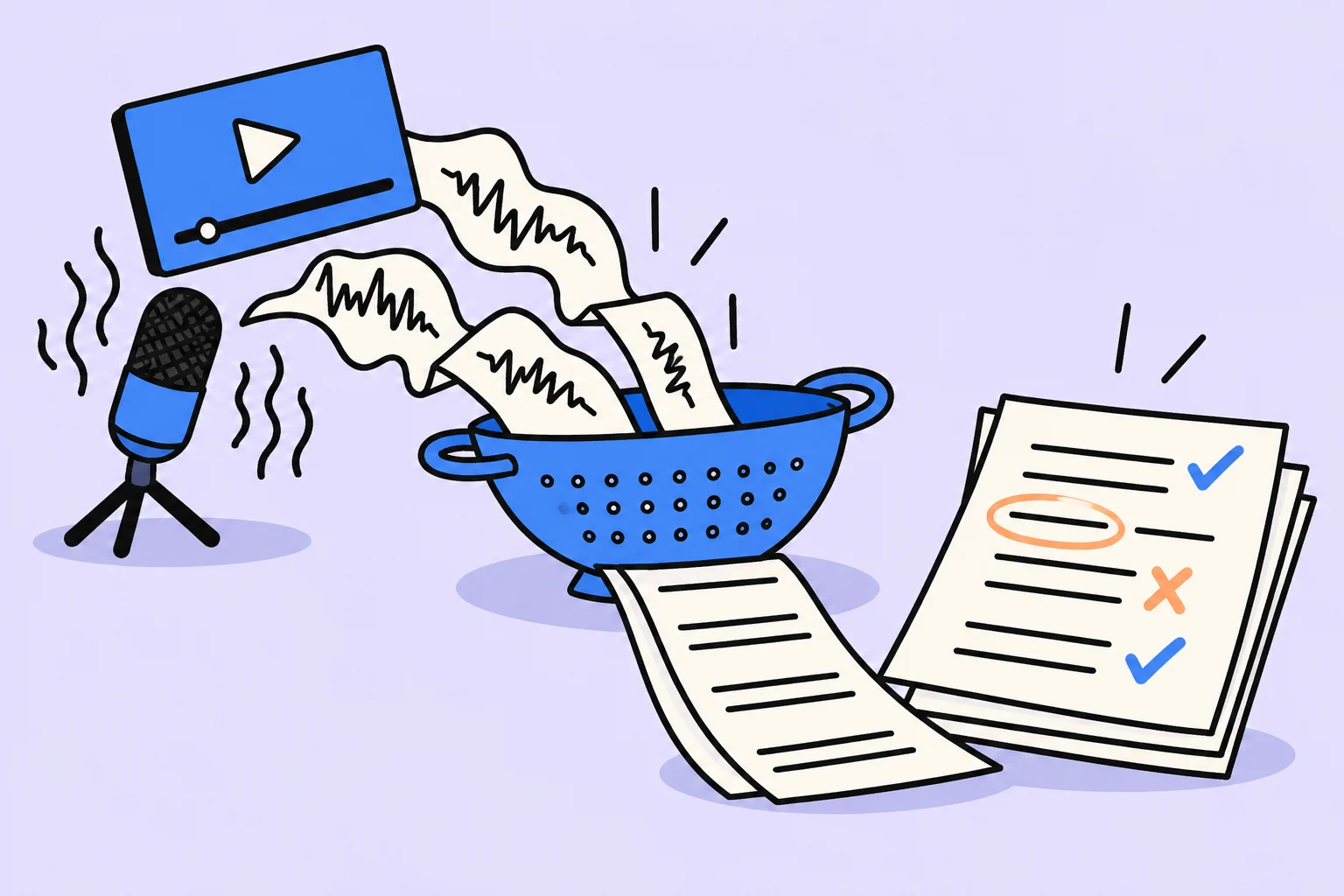
Choose a transcript rather than a retelling
AI audio transcription is useful when you need to recover spoken words and find the corresponding place in a recording. A summary selects the main points, while minutes record decisions. These outputs are related but do not replace one another. If someone says ‘we are not confirming the date yet’, an elegant summary saying ‘the date is confirmed’ changes the meaning and can lead to a wrong action.
To turn video into text, decide which information you need: spoken words or also captions and actions onscreen. Transcribing an audio track does not recover an order number shown silently. For an educational video, export audio with an available editor and preserve its link to the original video; do not change speed or cut pauses before checking times. Give the service only a format it actually accepts. Below is an educational route for a short recording: preparation, obtaining text, checking uncertain passages, and only then a separate summary. We do not upload audio to a service or claim measured accuracy. You can reproduce the example by recording invented lines in your own voice. For the first attempt, choose a clear short passage whose original words you know.
Prepare a control passage
Record these lines: ‘Anna: We are checking twenty boxes. Each costs three hundred rubles. Boris: We are not confirming delivery yet. Anna: We will return to the question on Friday at eighteen hundred. Boris: I will check availability, but I am not promising payment today.’ This is the author’s script, rather than a real meeting recording. Names are only for distinguishing two voices in the exercise; you can read both roles yourself.
Leave short pauses between lines. Do not intentionally add music or noise on the first pass. Save the original file and the script separately. Record the creation date, duration, and where listeners can find the recording. If testing several versions, name them so that an output cannot accidentally be matched with another file.
Check the service’s documented workflow
Google AI documentation describes transcription of uploaded audio files through the Gemini API, speaker labeling, and timestamps. Parameters are not freely compatible: a custom vocabulary cannot be enabled alongside speaker labeling or word timestamps. Enhanced formatting also has compatibility restrictions. Consult current documentation before running instead of enabling every useful switch at once.
For our example, the priorities are preserving words, distinguishing lines, and returning to an error’s location. If the chosen interface does not show timestamps, you cannot claim they are delivered merely because the API describes the feature. Note the limitation and use manual reference points while listening. Account access, cost, and processing of your file have not been checked here; the exercise does not promise free use.
A complete assignment for obtaining and checking text
For an interface accepting instructions alongside audio, use this assignment: ‘Transcribe the attached educational file in Russian. Preserve numbers, times, negations, and qualifications. Do not add guesses to the lines. Mark unintelligible words explicitly and identify their place in the recording if timestamps are available. Distinguish voices with neutral labels; do not guess people’s identities. Do not summarize or turn suggestions into confirmed decisions. After the text, list passages requiring listening. Do not claim verification against the original if you could not process the file itself.’
In a specialized API, this description of the goal is not a universal request parameter: use only the documented fields for that endpoint. After receiving the initial transcript, give a text assistant a separate assignment: ‘Find numbers, times, negations, and promises in this text. Make a list for manual checking. Do not correct them from context without audio.’ This second pass helps plan verification but does not listen to the recording for you.
Check values against the original recording
| Item | Expected from the script | Example error |
|---|---|---|
| Quantity | Twenty boxes | Twelve boxes |
| Price per item | Three hundred rubles | Three thousand rubles |
| Delivery | Not confirming yet | Confirming delivery |
| Next conversation | Friday, eighteen hundred | Friday, eight o’clock |
| Boris’s promise | Check availability; no promise of payment today | Promise payment today |
Listen to each table row and compare it with the text. The script supplies expected words; specific timestamps appear only after your recording. Do not put invented timecodes into the output. If one voice performs both roles, the service may not distinguish them as two people: this is a feature of the educational material, rather than evidence of an incorrect speaker count in someone else’s meeting.
Correct in a way that leaves a verification trail
When there is an error, locate the corresponding original segment, listen separately, and correct a checked copy. Keep the initial transcript. Beside the correction, you can record what changed and who checked the recording: ‘twelve replaced with twenty after listening’. A word you could not distinguish remains unintelligible; a contextually suitable option does not become a fact.
For numbers, check units together with values. ‘Three hundred rubles per box’ differs from ‘three hundred rubles for delivery’. If the final document loses what the price applies to, restore it from the line rather than a calculation. In our passage, twenty boxes at three hundred cost six thousand rubles, but that amount is your calculation: nobody in the script spoke it.
Create a summary only from checked text
After checking, create a new ‘Summary’ block. In the educational example, it might read: twenty boxes at three hundred rubles were discussed; delivery is unconfirmed; the next conversation is Friday at eighteen hundred; Boris will check availability and did not promise payment today. This is our retelling of the author’s script, rather than the output of an actual service run.
Keep a link to the original text alongside it. If an action list is needed, distinguish a proposed action from an explicitly spoken commitment. ‘Check availability’ was said; ‘book a vehicle’ was not. An assistant may suggest that step as a hypothesis but must not attribute it to Boris. This distinction is especially important when a transcript becomes the basis for an assignment.
Save the recording, checked text, and limitations
The final package contains the original file, initial transcript, checked version, and list of unresolved passages. For each output, specify the file used and processing date. If you checked only the first two minutes, say so: the rest of the recording remains unchecked. Finding no errors in a short section does not justify declaring the whole conversation accurate.
On the next attempt, make only one condition harder: add a second real voice, an uncommon name, or a longer conversation. Decide beforehand what you will evaluate. For a name, check exact spelling; for two voices, speaker changes; for a long recording, preserved meaning at selected places. Otherwise, the comparison mixes several different errors and fails to show which change helped.
If the recording contains other people’s data, first establish whether it may be sent to the chosen service and who can access the resulting file. Invented names and lines are enough for learning. Do not replace this check with a general model promise that ‘everything is confidential’: actual storage and access rules belong to the service and your organization.
A transcript is useful when you can return to a disputed word and check it. Knowledge-base work starts later, with checked material, its source, and limitations. Do not hide uncertainty behind a fluent retelling: it identifies where human checking is still needed.
Sources
Frequently asked questions
Can I obtain meeting minutes immediately?
You can request a separate summary, but decisions and assignments must be checked against a verified transcript. Confident model wording does not prove a decision was spoken.
What should I do with an unclear word?
Mark the passage, listen to the original, and retain uncertainty if the word cannot be distinguished. Do not substitute a probable option as an established fact.
Turn an idea into action
Was this helpful?
Rate the article and tell us what was missing. Your feedback goes to the Sinqly team and will not be published on the site.
How to take notes: main ideas, connections, and checking questions
Lecture or reading notes that support learning: what to record, how to mark uncertainty, and how to turn material into questions. A complete worked example.
A personal knowledge base: save information so you can use it later
What to save in a personal knowledge base, how to name a note and connect it to its source. A completed note structure for a work project.
The PARA method: organize notes, projects, and materials
Four PARA categories, six worked material examples, and a decision tree. Organize one folder and decide what to retain after a project finishes.