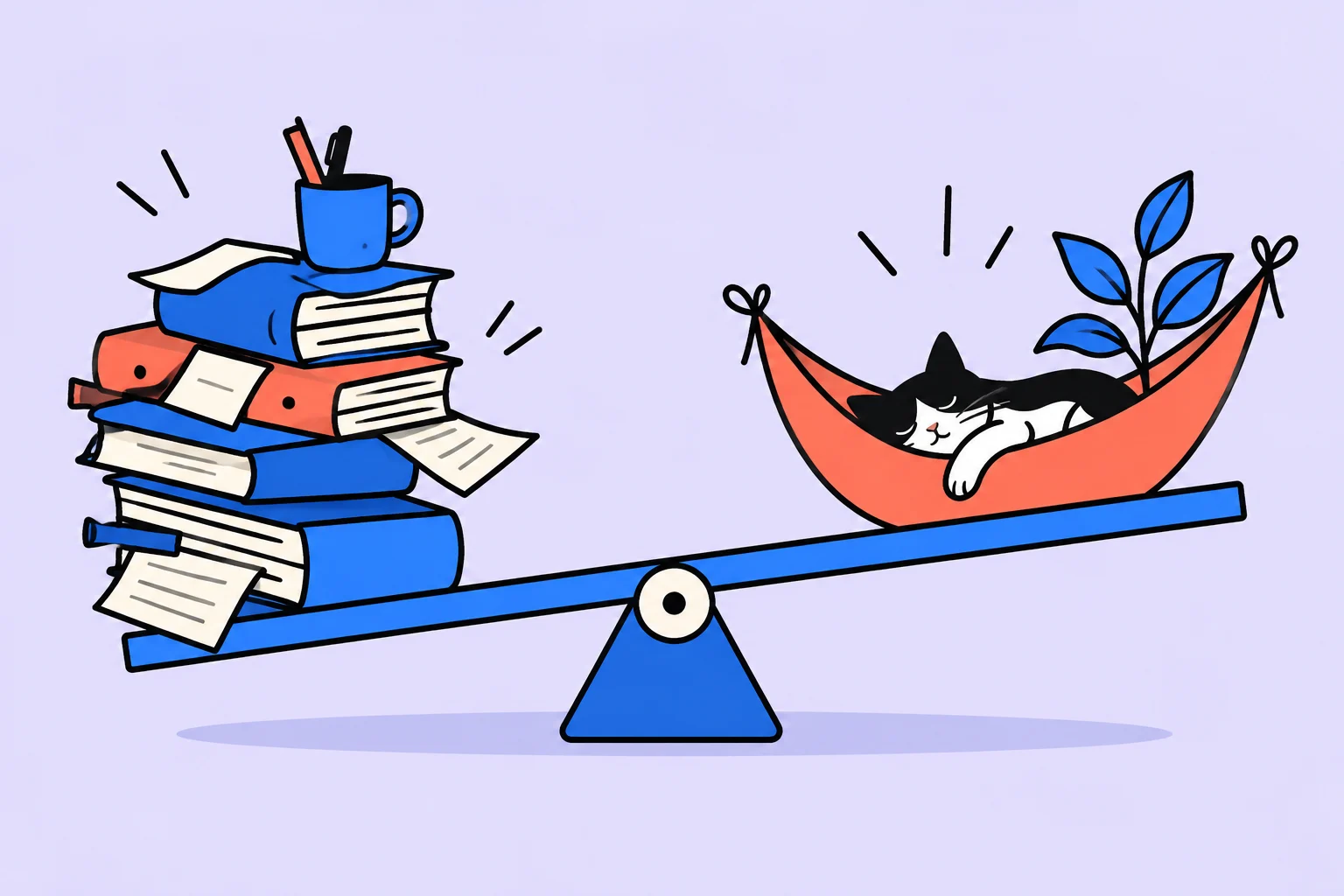
A pause should change the load
Work breaks involve more than stopping a timer. If you read a work chat on your phone after writing on a monitor, the main load may remain similar. If you open another discussion meeting after several difficult conversations, that changes the task but does not necessarily provide rest from communication. Start by asking: which part of the work do I want a break from now?
This article concerns ordinary mental work and choosing personal pauses. It does not establish requirements for a particular workplace, equipment, or contract. HSE guidance on screen work suggests breaks or changes of activity that allow movement and changes of posture. This general principle does not prescribe one schedule for every task. What follows offers practical adjustments, rather than a guarantee of restored attention.
Choose the moment according to the task and your state
A pause can follow a completed part: a sent reply, a checked section, or a finished meeting. Such a boundary helps you return without reconstructing the entire logic from scratch. But you do not need to wait until the end of a large project. If you reread a paragraph without grasping its meaning or increasingly make changes at random, stop earlier and check the load.
A timer is useful as a reminder if you regularly forget to step away. It need not command every action. If it rings during a short, important finishing step, you can first save the result and record the next action. But if postponement continues for hours, the timer is no longer doing its job. Choose a clearer boundary or discuss a break between meetings in advance.
Match the type of pause to the previous block
After prolonged sitting, standing up and changing position may be appropriate. After reading on screen, step away from the screen briefly. After intensive communication, leave a few quiet minutes without a new conversation. Choose an option available in your environment: a small office, home, library, and journey offer different possibilities.
You do not need to turn every pause into a wellness program. Getting water, walking to another room, or calmly looking out of a window may be enough to change activity. Avoid assigning yourself a new result that again demands hard work. If you enjoy a short conversation, that is an option, but silence may suit you better after several meetings.
| Previous work | What changes during the pause | What to avoid |
|---|---|---|
| Long screen reading | Step away from the screen and change posture | Continue the same kind of reading on your phone |
| Several video meetings | A quiet interval without discussion | Immediately open another optional meeting |
| Difficult editing | Simple movement without a new project | Start sorting through difficult correspondence |
| Repetitive short actions | Change the type of activity | Call another queue of small tasks rest |
Prepare your return before leaving
Before a pause, save your work and write one sentence about the next action. For example: ‘Check the total in the second table’ or ‘Expand the example in section three’. This reduces the need to search again for where you stopped. No detailed protocol is needed. A specific place to continue matters more than a general ‘return to the report’ note.
If you have found a problem that remains unresolved, record it separately. It will then not keep you at your desk merely through fear of forgetting. When working with others, briefly state your status if someone expects a reply. An agreed break is easier when others know that the result is saved and when you will be available again. A pause does not require disappearing without notice.
Example: editing a large document
An illustrative situation: Nina is preparing a document and notices that after a long block she keeps correcting the same sentences. She finishes the current paragraph, saves the file, and writes: ‘After the pause, check whether the example supports the conclusion.’ Then she briefly steps away from the screen. She chooses the duration according to current conditions; the example does not prescribe a mandatory interval for the reader.
On returning, Nina starts with the recorded check. If her thinking is clear again, she continues to the next part. If not, she checks whether the task itself is too uncertain: perhaps she needs a colleague’s answer rather than another rest. The pause helps change activity but does not replace missing information. Opening a difficult chat during the break could have required another switch on returning.
How to check your routine without complicated analytics
Choose several similar work blocks. Observe not only duration but your state on returning: whether the next action is clear, quality is maintained, and the pause avoids becoming a long unplanned distraction. Do not compare calm reading with an emergency meeting: different loads create different experiences.
Change one condition at a time: the type of pause, reminder, or next-step note. Changing the whole schedule at once makes the conclusion unclear. A few observations will not prove a causal effect, but they provide a basis for choosing a convenient option for next week. If the work environment does not allow a pause, the issue may require agreement about tasks and meetings rather than additional self-control.
A break and return card
Keep the card small, or observation itself will become a burden. Record the type of work, pause option, and one note after returning. Do not measure every minute for an attractive table. The goal is to understand recurring conditions and where the entire work block needs to change.
- Work before the pause: writing, calculation, communication, or another load.
- Stop signal: a section boundary or a noticeable sign of difficulty.
- Place to continue: one next action.
- Pause: how it differs from the previous block.
- Return: how clear the next step is.
- Interference: what distracted you and whether it was necessary.
- Decision: keep this option or try another condition.
In Sinqly, you can record a task for continuing work if it really belongs on the list. You do not have to mark every pause as a completed task. Rest does not become useful through the number of check marks; a record is needed only where it helps you return or agree on the plan.
Mistakes and the method’s limits
Common mistakes include resting only after complete exhaustion, spending every pause in work chat, searching for the one correct timer, and turning a break into another list of mandatory exercises. The opposite problem is starting endless entertainment during a pause without a clear return. Choose a simple boundary in advance if you know this format tends to draw you in.
Breaks do not fix excessive work volume or persistently unclear assignments. If every block ends in overload, review the schedule, requirements, and number of meetings. A fixed timer and long focused blocks are different ways of organizing work, each needing appropriate pauses. Start with one change in your next block and assess how easily you return, rather than conformity to someone else’s ideal routine.
Sources
Frequently asked questions
After how many minutes should I take a break?
This article does not establish a universal interval. Consider the task, conditions, and your own observations. A timer can remind you to stop but cannot replace agreement about workload.
Can I rest by scrolling on my phone?
You can choose that leisure activity, but check whether it changes the previous load and delays your return. After screen reading, try a pause without the same kind of screen reading.
What if work is still difficult after a break?
Check the assignment’s clarity, information availability, and total workload. A pause does not remove these causes. If difficulties recur, change work conditions rather than only the length of rest.
Turn an idea into action
Was this helpful?
Rate the article and tell us what was missing. Your feedback goes to the Sinqly team and will not be published on the site.

Deep Work: a complete guide to deep, focused work
A complete guide to Cal Newport's Deep Work. How to practice deep work, 4 strategies, focus rituals, and the science of concentration.
How to enter flow: prepare the task, challenge, and feedback
Conditions for focused work without promising a special state. Set up one session with a clear result, manageable challenge, and checks along the way.
The Pomodoro Technique: A Complete Guide to Interval Productivity
A complete guide to the Pomodoro technique. How the method works, its scientific basis, step-by-step instructions, adapting intervals, and the best timers.