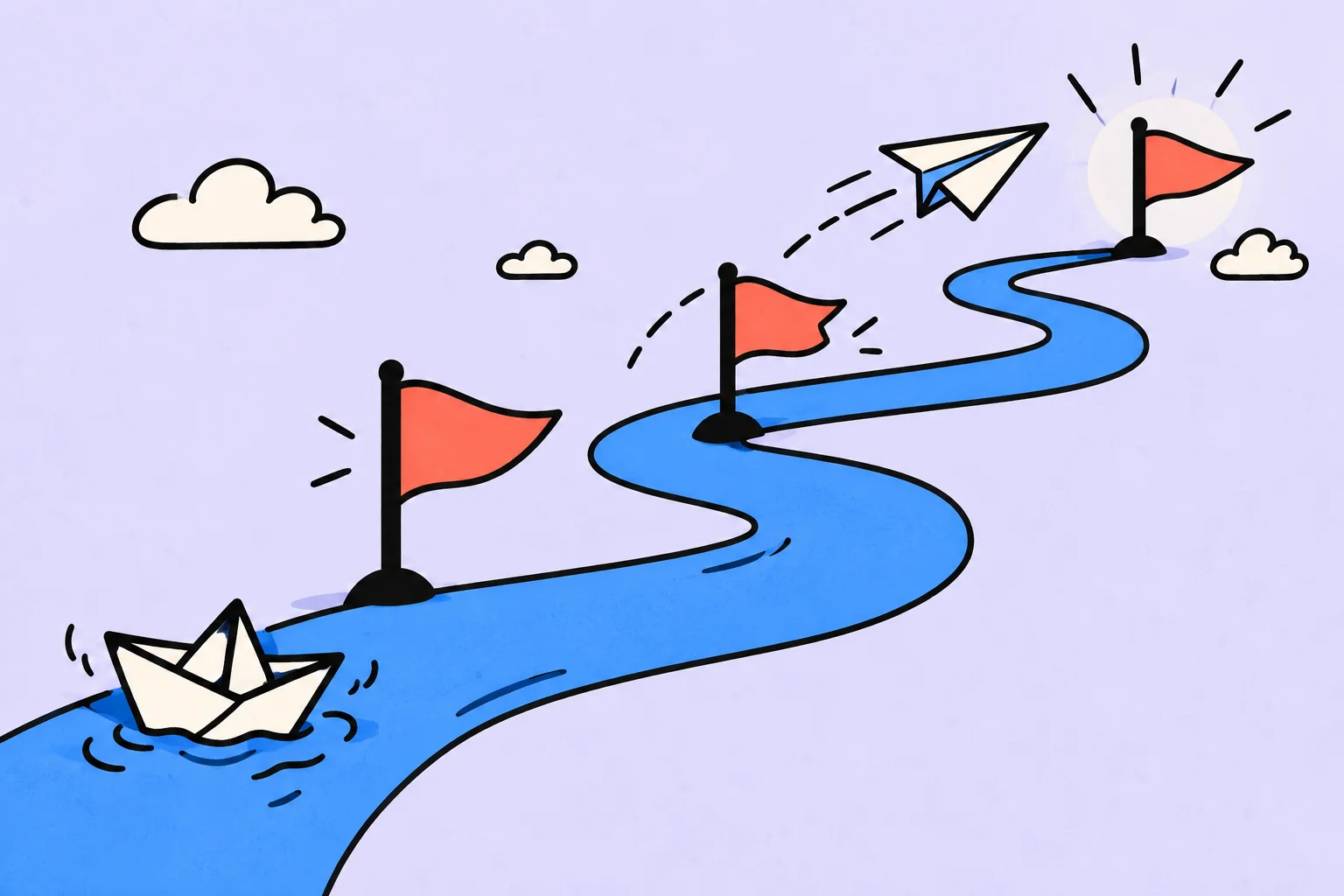
A roadmap answers “Where are we heading?”
A project roadmap is an overview of direction and major outcomes. It helps explain why the next stage matters rather than list every action assigned to contributors.
Suppose a studio wants to launch ongoing website support. It could immediately write thirty tasks: build a page, choose a price, prepare an agreement and find clients. But demand is not yet confirmed, nor is the team's ability to deliver what it promises. A roadmap first shows how to test the idea. All numbers and stages below are illustrative, not a launch standard.
For the project owner, the roadmap supports discussing choices. For the team, it provides work context. For the client, it offers an understandable sequence of outcomes. One document can serve all three if it avoids unnecessary internal details and false precision.
- Roadmap
Test demand → run a pilot → decide whether to expand the service.
- Action plan
Invite participants, prepare an offer, schedule conversations and record answers.
Example roadmap: Now / Next / Later
| Horizon | Outcome | Evidence for moving forward |
|---|---|---|
| Now | The first clients' needs are understood | Conversation notes and a selected problem are available |
| Next | The pilot is delivered within agreed boundaries | Time spent and feedback are recorded |
| Later | A decision on a repeatable service | Workload, pricing and support terms are checked |
“Later” does not mean “definitely.” If the pilot shows that support requires constant urgent intervention, the team can change the offer or abandon it. A roadmap should allow a reasonable decision after new facts rather than force completion of an outdated list.
Now / Next / Later is useful when uncertainty exceeds date accuracy. If a contract already requires an outcome by a specific day, show that constraint explicitly. Do not hide a commitment in an indefinite “later,” or turn uncertainty into an invented calendar.
Outcome first, initiative second
“Add a form” describes work but not its purpose. Perhaps the team wants to test interest in the service. The stage outcome is then inquiries suitable for a conversation, and the form is only one method. If personal invitations produce answers sooner, the roadmap should allow that choice.
- Observation
Clients regularly ask about support after launch.
- Check
Clarify which tasks recur and what clients are willing to pay for.
- Stage outcome
One problem is selected and the pilot's boundaries are agreed.
Ask three questions for every major initiative: what will change, which evidence will confirm the change, and which decision will become possible? If several adjacent items have the same answers, they may be parts of one stage rather than three independent milestones.
Who should agree on the roadmap, and how?
- Show a draft to those who provide resources, do the work and accept the result.
- List hard constraints separately: external deadlines, participant availability and dependencies on a reply.
- Discuss disputed assumptions as well as stage names.
- Record when you will revisit the roadmap and who gathers new information.
At a meeting, asking “What must be true before we move to the pilot?” is more useful than “Does everyone like the diagram?” The second invites polite agreement without shared understanding. The first reveals real conditions: a specialist is available, the cost of an error is understood, and the client has agreed on the format.
Do not demand equal detail across the roadmap. Describe the next stage specifically and a distant one as a direction or question. Greater uncertainty makes naming it more important than compensating with an attractive, precise date.
From a feature list to a decision roadmap: a detailed example
A studio is considering a website support service. Its initial roadmap says “build a page, launch advertising, hire a specialist.” This lists intended work but hides the main question: do clients need this version of the service, and can the team deliver it? Rebuild the roadmap around verifiable outcomes.
“Now”: understand recurring requests from existing clients. The evidence is conversation notes describing specific situations, rather than a meeting count. The decision afterward is to choose one type of problem for the pilot or reject the hypothesis. A sales page is not yet necessary: it will not resolve uncertainty about demand itself.
“Next”: run a limited pilot. Before starting, agree on request types, working hours and responsibility boundaries. The output must include actual workload and feedback. Decide whether the format can be repeated, what to change and which constraints to state explicitly. “Later”: prepare a repeatable offer only after that decision. Hiring and promotion may appear here, but are not promised in advance.
For each horizon, name the decision owner, evidence and dependency. Add dates where there is a real external commitment or confirmed plan. Now / Next / Later must not become a way to conceal a deadline already promised to a client.
Discussing roadmap changes with stakeholders
After the pilot, the team finds that routine requests fit the available time, but urgent failures require separate on-call cover. The roadmap changes: instead of scaling all support, the team offers a narrow package of scheduled work. Explain the change with a new observation and decision, rather than just a new diagram.
Show three things: what you learned, which earlier intention you revised, and which commitments are affected. Notify clients with existing agreements separately; changing a roadmap does not automatically cancel an agreement. Keep a version date and a short reason for revision so participants do not discuss different versions.
Before the meeting, check that every item explains movement toward the goal. “Improve the service” is too vague; “draw a button” is too detailed. A roadmap describes an outcome or major initiative with a clear purpose. A separate project plan breaks the chosen initiative into execution.
Use the roadmap as a basis for choosing rather than a promise to implement every idea. If a decision can be made without checking an item, it may be decorative. If nobody knows the condition for moving forward, the roadmap still describes a hope.
Turn the next stage into actions
Take the first stage: understand client needs. First record “Prepare questions for conversations.” In the description, state which decisions the answers should support. Set aside preparation time and create a separate action to invite participants. Distant stages do not need to fill the calendar yet.
Your description could say: “Five open questions about recurring support tasks are ready; the questions do not suggest the desired answer.” This is a verifiable preparation output. Five is chosen for the example, not a research standard.
After the conversations, add an action to review the answers. Otherwise information collection risks becoming activity that changes nothing. The product's role here is to retain the next steps rather than replace a strategic decision.
How to update a roadmap without losing trust
When changing the roadmap, explain three things: the new fact, the decision that follows and affected commitments. “We changed our minds” sounds arbitrary. “The pilot revealed twice the workload, so we are narrowing the service before expanding” explains the logic, although a real project's numbers still need measurement.
Keep a short record of substantial changes. This helps prevent returning to a rejected idea a month later without new grounds. You need not turn every wording edit into a meeting: the approval process should match its consequences.
A good roadmap helps you leave unnecessary work out. If it only permits adding stages without revising them, it is closer to a wish list than a tool for choosing.
More questions to clarify
How does a roadmap differ from a project plan?
A roadmap shows direction and major outcomes. A plan details work, dependencies, dates and controls. Both levels help with the next stage.
Are dates mandatory?
No, but you must not conceal real external commitments. With high uncertainty, use Now / Next / Later horizons and state hard deadlines separately.
Can we make a roadmap without a specialized service?
Yes. A document or simple table is enough for the first discussion. Quality depends on clear decisions rather than the drawing tool.
Was this helpful?
Rate the article and tell us what was missing. Your feedback goes to the Sinqly team and will not be published on the site.
Sources and notes
- Atlassian: roadmap purpose and audience
- The suggested process reflects editorial practice; it does not promise identical results for everyone.

User story mapping: how to build a map of user stories
A workshop example of user story mapping: the visitor's journey, action cards, a first end-to-end release and common mistakes when splitting releases.
Project plan: build it from the outcome to the next task
How to create a workable small-project plan: outcomes, activities, dependencies, dates and review points. An illustrative open-class launch without complex tools.
Project charter example: one page without bureaucracy
Record the goal, boundaries, participants and conditions for starting a project on one page. An illustrative small service launch and questions to resolve before planning work.