
Procrastination is not laziness. It is a problem with regulating emotions rather than managing time. Research over the past 20 years clearly shows that we put things off because a task causes negative emotions, rather than because we cannot or do not want to act: anxiety, boredom, fear of failure, and perfectionism. Understanding this mechanism is the first step toward a solution. Here are 12 scientifically grounded methods that really work.
People procrastinate daily (DePaul University study, Steel, 2007)
The time the brain needs to return to a task after a distraction (UC Irvine)
Higher chance of completing a task with an accountability partner (ASTD)
Why we procrastinate: the neuroscience of delay
Dr. Timothy Pychyl of Carleton University, one of the world's leading experts on procrastination, demonstrated that delay is a conflict between two brain systems. The limbic system (the emotional brain) demands pleasure right now. The prefrontal cortex (the rational brain) understands that we need to work for the future. When a task causes negative emotions, the limbic system wins, and we switch to something pleasant: social media, YouTube, food, or cleaning.
The key finding: procrastination is not a time-management problem. You can plan your day perfectly and still put things off, because the issue is emotions rather than time. A procrastinator is not a lazy person. A lazy person does not want to do anything and does not worry about it. A procrastinator wants to act, plans, and makes promises to themselves, but switches away when it is time to act. Then they suffer from guilt, which reinforces the cycle.
A 2023 meta-analysis (Psychological Bulletin, n=38 000 participants from 146 studies) confirmed that procrastination is primarily an emotion-regulation problem. Emotional regulation techniques (self-compassion and cognitive reappraisal) reduce procrastination by 35%, considerably more than time-management techniques (18%).
Types of procrastinators: which are you?
Procrastinators are not all alike. Psychologist Neil Fiore identifies several types, and different strategies work for each:
Perfectionist puts things off out of fear of doing them imperfectly. Solution: give yourself permission to create a draft. A "bad" first version is better than a nonexistent perfect one. Dreamer makes grand plans without acting. Solution: break them down into 5-minute micro steps. Crisis manager only works under deadline pressure. Solution: set artificial deadlines ahead of the real ones.
Rebel puts things off because "I don't want anyone telling me what to do." Solution: reframe "I have to" as "I choose to." Anxious procrastinator is paralyzed by fear of the consequences. Solution: use the "worst case scenario" technique. What will actually happen if you start and do a poor job? Usually, nothing terrible. The consequences of doing nothing at all are worse.
Method 1: The two-minute rule
If a task takes less than 2 minutes, do it right now. Don't write it down, plan it, or think about it. Just do it. This rule comes from GTD David Allen's methodology, but it also works as a powerful antidote to procrastination.
Why does it work? Every completed task delivers a micro dose of dopamine. Your brain receives a reward and wants more. One small task → a second → a third → momentum builds. Small wins get you moving. A detailed guide to the two-minute rule with real-life examples.
Extended version: start with 2 minutes even for large tasks. "Open the document and write a heading" takes 2 minutes. "Find one source for the article" takes 2 minutes. Once you start, your brain often enters a flow state, and stopping becomes harder than continuing.
Method 2: Micro Thrust — start with the minimum
Instead of "write an article," try "open the document and write one sentence." Instead of "exercise for an hour," try "put on your sneakers." Instead of "clean the apartment," try "wipe one shelf." Micro habits remove the fear of a large task because a minimal action does not trigger negative emotions.
The psychological mechanism: we procrastinate over the imagined scale of a task. "Write a business plan" causes anxiety. "Write one sentence about what we sell" does not. Once that first sentence is written, the barrier drops. The second comes more easily, and the third more easily still. After 20 minutes, you may discover you have written a whole page.
If procrastination is striking right now, use Mel Robbins's technique: count down 5-4-3-2-1 and act immediately. The countdown interrupts the "think → analyze → postpone" cycle and activates the prefrontal cortex in action mode. Don't wait for motivation: action creates motivation, rather than the other way around.
Method 3: The Pomodoro Technique against endlessness
Work for 25 minutes, then rest for 5 minutes. Your brain knows a break is coming and agrees to work. After 4 pomodoros, take a longer 15-30-minute break. The complete Pomodoro guide explains why this works at the neurochemical level.
Why is Pomodoro especially effective against procrastination? An endless task is paralyzing: "work on the project" sounds like "suffer for an unknown length of time." "One pomodoro (25 minutes)" is specific and bounded. Your brain agrees to a finite action. After the first pomodoro, momentum often appears: "All right, one more." Before you know it, 2-3 hours of productive work have passed.
Method 4: Visualize your future self
Neuroimaging research by Hal Hershfield at UCLA revealed a striking fact: the brain perceives the future self as a stranger. Literally, the same brain regions activate when we think about a stranger and about ourselves a year from now. That makes it easy to postpone things: let that "stranger" suffer.
Solution: picture yourself an hour after completing the task. Close your eyes for 30 seconds. How will you feel when it is done? Relieved, proud, calm. Now picture yourself if you keep postponing it: anxiety, guilt, deadline pressure. The contrast between these states is a powerful motivator.
Method 5: Remove distraction triggers
Procrastination requires an alternative: something pleasant to switch to. Without alternatives, there is nowhere to switch. Put your phone in another room, rather than a desk drawer. Close every tab except the one you need for work. Turn on a social media blocker. Work in "do not disturb" mode.
A University of Texas study (2017) found that simply having a smartphone in sight reduces cognitive performance, even when it is switched off. The brain spends resources suppressing the urge to check notifications. Removing the phone from the room literally raises your IQ while you work.
Create a "zero-resistance environment": a workspace with nothing distracting. A clear desk, a closed door, headphones with white noise. The fewer "should I get distracted?" decisions your brain makes, the more resources remain for work.
Method 6: Deconstruct the task
A large task is paralyzing. "Write a business plan" feels scary. "Describe the product in 3 sentences" feels manageable. "Move to another city" feels impossible. "Look at apartments on Avito in the new city" takes 5 minutes. Every big task is a sequence of small ones, and each small task on its own is not frightening.
The rule: if a task makes you want to postpone it, it is too large. Split it up. Then split it again, and again, until every step is so simple that starting feels easy.
Write the task in one sentence
For example: "Prepare a presentation for a client."
Break it into 5-7 steps
1) Identify the key points. 2) Find the data. 3) Create the slide outline. 4) Fill in the content. 5) Add visuals. 6) Review it. 7) Rehearse.
Every step should take ≤30 minutes
If a step is larger, break it down again. "Find the data" → "Find market statistics," "Collect customer case studies," "Prepare charts."
Start with the easiest step
Choose the step that creates the least resistance, rather than the first one in order. Momentum will help you continue.
Method 7: Swiss Cheese — make holes in the task
Alan Lakein, one of the pioneers of time management, proposed the "Swiss cheese" method: don't do the whole task. Instead, make one small "hole": 5 minutes of work anywhere in the task. Then another, and another. Gradually, the task becomes a "hole-filled cheese," with more done than left undone.
The psychological effect is powerful: the Zeigarnik effect, in which unfinished tasks occupy working memory, starts working for you. Once you have done 20% of a task, your brain wants to finish the rest. The unfinished work pulls like a magnet. Use this: start anywhere, make a "hole," and your brain will pull you toward completion.
Method 8: An accountability partner
Tell someone about your plan. Research by the American Society of Training and Development found that the likelihood of achieving a goal is 65% if you tell someone else about it, and 95% if you schedule regular meetings to report on progress.
A social commitment activates a different motivation system: reputation. We are willing to let ourselves down, but not someone else. Find an accountability partner: a friend, colleague, or coach. Or use Sinqly's AI coachas an accountability partner that asks about progress, notices missed steps, and celebrates successes. Without judgment, 24/7.
Method 9: Cognitive restructuring
Replace "I have to" with "I choose to." "I have to write a report" creates resistance: nobody likes being ordered around, even by themselves. "I choose to write the report so I can enjoy a peaceful weekend" is motivating because the focus shifts from obligation to benefit.
This technique comes from cognitive behavioral therapy (CBT). Other reframings: "This is too hard" → "This is a challenge, and I can start with a small step." "I don't want to" → "I dislike the process, but I will like the result." "What if it doesn't work?" → "A poor result is better than no result, and I can improve it as I go."
A University of Sheffield study (2021) found that cognitive restructuring reduces chronic procrastination by 42% over 8 weeks of practice, more than any other single technique.
Research by Sirois & Pychyl (2013), published in Social and Personality Psychology Compass, found that self-compassion is a more effective antidote to procrastination than self-criticism. People who forgive themselves for delaying procrastinate less in the future. Guilt reinforces the cycle; forgiveness breaks it.
Method 10: A ritual for starting work
Create a ritual: coffee + headphones + timer = work. After 2-3 weeks, your brain will automatically enter work mode when the ritual begins, without you needing to motivate yourself. This works by forming a neural habit: contextual triggers of place, time, and action activate automatic behavior.
Examples of rituals. Morning: wake up → drink a glass of water → do 5 minutes of breathing exercises → open Sinqly → your first MIT. Work: sit at your desk → put on headphones → start your "work" playlist → start the timer → work. Switching tasks: stand up → stretch for 2 minutes → drink a glass of water → the next task. The morning routine generator will help you create your ritual.
Method 11: Self-forgiveness — break the vicious cycle
Self-criticism after procrastinating can seem like the right response: "I'm procrastinating again; I'm hopeless." But a Carleton University study by Wohl, Pychyl & Bennett (2010) found the opposite: students who forgave themselves for procrastinating before their first exam procrastinated significantly less before their second.
The mechanism: guilt → low mood → a need for emotional comfort → procrastination as a way to get quick pleasure → even more guilt. Forgiveness breaks this cycle. Tell yourself, "Yes, I put it off. That's okay; everyone delays things sometimes. What can I do right now?" Then take one small step.
Method 12: Gamify action
Turn tasks into a game. XP for completion, streaks for consistency, achievements for records. It may sound frivolous, but neuroscience supports it: gamification activates the dopamine reward system, the very system procrastination exploits through social media and videos. You redirect the flow of dopamine from harmful entertainment toward useful actions.
A 7-day plan to tackle procrastination
Day 1: Awareness
Write down the 3 tasks you have been putting off the longest. Next to each, write the emotion it triggers: fear, boredom, perfectionism, or uncertainty.
Day 2: Micro Thrust
Choose the "scariest" task. Apply Micro Thrust: spend exactly 5 minutes on it, no more. Note what happens after 5 minutes.
Day 3: Pomodoro
Use the Pomodoro Technique for the second task. One pomodoro = 25 minutes. Continue if you want to; stop if you don't.
Day 4: An environment without triggers
Remove 1 distraction trigger: delete the most absorbing app from your phone or install a social media blocker for working hours.
Day 5: Deconstruction
Break the third task into 5-7 steps of ≤30 minutes each. Start with the easiest step.
Day 6: Accountability
Tell a friend or colleague about your plans for the next week. Agree to check progress in 7 days.
Day 7: Review and forgiveness
What worked? What didn't? Forgive yourself for setbacks and choose 2-3 methods to practice regularly. Make it a habit.
When procrastination is a symptom of something serious
Chronic procrastination can be a symptom of ADHDdepression, an anxiety disorder, or clinical-level perfectionism. If procrastination seriously interferes with work, studying, and relationships, and you put off critical tasks such as paying bills, seeing a doctor, or submitting documents, that is a reason to consult a psychotherapist.
With ADHD procrastination has a neurobiological basis: a dopamine deficiency makes ordinary tasks insufficiently stimulating to sustain attention. In this case, standard advice to "just start" does not work. External structures, medication support when needed, and adapted techniques are necessary.
Consult a psychologist or psychotherapist if procrastination lasts more than 6 months, interferes with your professional activity, causes significant stress and guilt, or has financial or social consequences. Cognitive behavioral therapy (CBT) is the most effective approach to chronic procrastination.
Reduce the postponed activity to its first observable action and write it down separately. Create a task in Sinqly; registration is free.
Frequently asked questions about procrastination
Why do people procrastinate?
Procrastination is a problem of emotion regulation rather than laziness. The brain postpones tasks that trigger negative emotions such as anxiety, boredom, and fear of failure. The limbic system chooses immediate pleasure, suppressing the rational part of the brain.
How can I stop procrastinating right now?
Count down 5-4-3-2-1 and act. Work for exactly 5 minutes, no more. Remove your phone from the room. Start with the easiest part of the task. Once you begin, the brain often enters a flow state.
Is procrastination an illness?
No, but chronic procrastination can be a symptom of ADHD, depression, or an anxiety disorder. If delaying seriously interferes with your life, consult a mental health professional.
How does procrastination differ from laziness?
A lazy person does not want to do anything. A procrastinator wants to, makes plans and promises, but switches away at the moment of action. Then guilt causes distress, closing the vicious cycle.
Which method is the most effective?
A combination: cognitive restructuring + micro actions + changes to your environment. No single method works in every situation. Start with Pomodoro and the two-minute rule: they produce quick results.
Does the Pomodoro technique help with procrastination?
Yes, it is one of the most effective tools. A short interval of 25 minutes turns an endless task into a bounded sprint. After the first pomodoro, momentum often appears.
Was this helpful?
Rate the article and tell us what was missing. Your feedback goes to the Sinqly team and will not be published on the site.
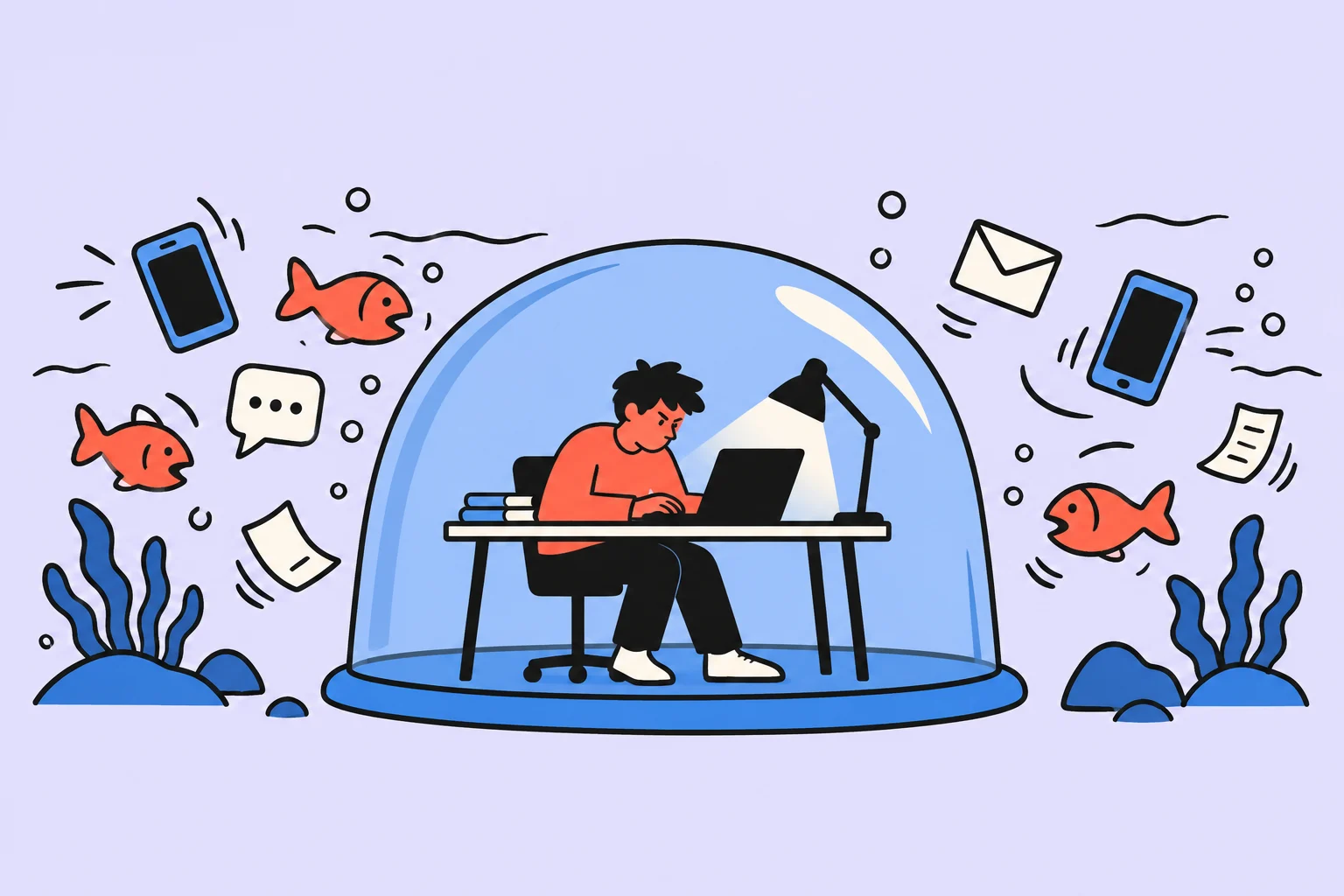
Deep Work: a complete guide to deep, focused work
A complete guide to Cal Newport's Deep Work. How to practice deep work, 4 strategies, focus rituals, and the science of concentration.
How to develop willpower: 10 scientific methods and exercises
Scientific methods for developing willpower: Baumeister's research, self-control strategies, and links between habits and discipline. Practical exercises and tools.
How to manage anxiety: 10 science-based methods for relief
Practical methods for tackling anxiety: cognitive techniques, breathing practices, and habits for reducing anxiety. A scientific approach and AI support from Sinqly.