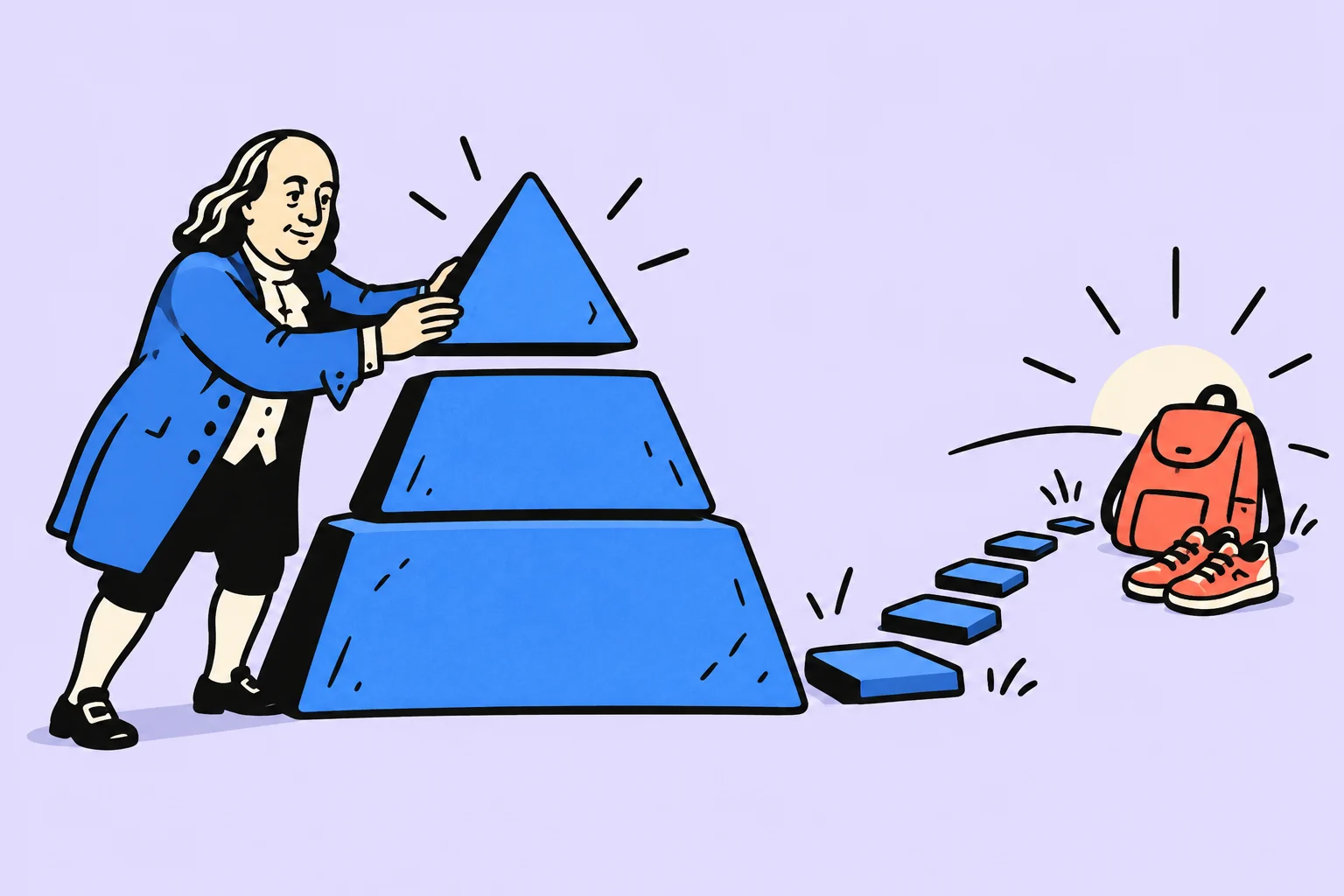
Where to start
Franklin’s pyramid is a popular name for a scheme connecting values, a long-term direction and immediate actions. Here, it is used as a modern model for checking whether plans align. Benjamin Franklin’s authorship of this particular six-level scheme is not established: his autobiography is a different source, and that distinction matters.
What model is called a pyramid?
The pyramid is a popular scheme linking values, goals, stages and actions across different time horizons; Franklin’s authorship is not established here. Different accounts vary in the number and names of levels. Usually, it moves from what a person considers important to a general direction, intermediate outcomes and short-term actions. You do not need the “true” diagram version to ask a practical question: does today’s action serve the chosen direction?
In his autobiography, Franklin describes work on virtues, order and routine. This allows discussion of his own practice using a primary text, but does not establish the origin of the later popular pyramid. Do not attribute specific modern level names to him without separate historical evidence.
What can you take from the scheme?
Use the scheme to check alignment between a chosen direction and daily action. Start with one value in your own words. Independence, for example, might mean the right to choose work, while care might mean regular attention to loved ones. The same word can hide different decisions. Clarify how it appears in your life before setting a large goal.
The direction should allow a trial. If independence matters, you need not immediately promise to open a business. You can investigate which skill a client needs and whether you want to practice it. This test connects the value with information rather than turning it into an unconditional commitment for years.
Working through an example
The following situation is invented for illustration; it is neither a user story nor a measurement of product effectiveness. Financial independence matters to Katya. She chooses a current result: test demand for a new skill rather than immediately write a ten-year plan. She schedules a conversation with a potential client for the week. Franklin’s autobiography helps discuss order but does not establish the modern pyramid’s origin.
Katya’s chain includes a testable step: talk to a potential client about the skill needed. If the conversation shows that the chosen direction does not fit, she changes the result or testing method. A daily action need not confirm a large goal chosen in advance; it can provide information to clarify that goal.
| Level | Working example |
|---|---|
| Value | Independence |
| Direction | An in-demand skill |
| Current result | Test demand |
| Weekly step | A client conversation |
| Daily action | Prepare three questions |
How can you fill it in without a perfect life plan?
For a first attempt, take one direction, one current result and one weekly step rather than drafting a perfect plan for your whole life. Move to one current result: learn about demand, master a specific action or agree on a format. Then choose a weekly step and daily action. Each lower level should explain its contribution to the level above. If you must invent the connection afterward, the action may not belong to the chosen direction.
The pyramid does not replace a calendar or resource plan. An action can make sense and still have no time available. After checking the connection, review the week’s commitments. If the step does not fit, reduce it or revise its deadline rather than quietly displacing sleep and existing promises.
When should you review the levels?
Review the levels when an action stops serving the goal or conditions change: a plan is not a permanent commitment. The scheme is useful as a question rather than an eternal personal plan. New data may show that a direction does not fit or a value is expressed differently. Dropping a trial step after testing it does not mean abandoning every belief. Record what you learned and why you are changing a lower or upper level.
Do not try to fit your whole life onto one sheet. One direction and a few connected lines are enough for a first attempt. If you need a detailed route with dependencies, use a separate goal achievement plan. If you need a result criterion, return to the goal’s wording; the pyramid does not resolve these questions automatically.
Checking the decision in your own situation
| Connection | Why it fits | What could change the decision |
|---|---|---|
| Independence → skill | The skill may expand work choices | Other priorities |
| Skill → demand test | Find out who benefits from it | No suitable audience |
| Test → conversation | The conversation provides input data | A different testing method is needed |
| Conversation → three questions | The questions prepare a specific meeting | The client’s context changed |
Write one value in your own words, one current result and the next action. For each connection, explain why the lower step serves the upper one. Then check whether the action fits a real week. Use the scheme to review decisions while distinguishing the modern model from Franklin’s historical text.
Sources
Turn an idea into action
Was this helpful?
Rate the article and tell us what was missing. Your feedback goes to the Sinqly team and will not be published on the site.
Monthly goals: choose results that fit your resources
Choose a few achievable results, check time and dependencies, and define month-end criteria and review conditions without chasing a target number of goals.

An achievement journal: notice results and useful effort
Record facts, your contribution and an outcome still unknown. An achievement-journal example after negotiations, without compulsory positivity.
The Zettelkasten method: connect notes and build your own argument
Create three self-contained notes, label meaningful links, and build your own argument. A step-by-step example and result check without an app.