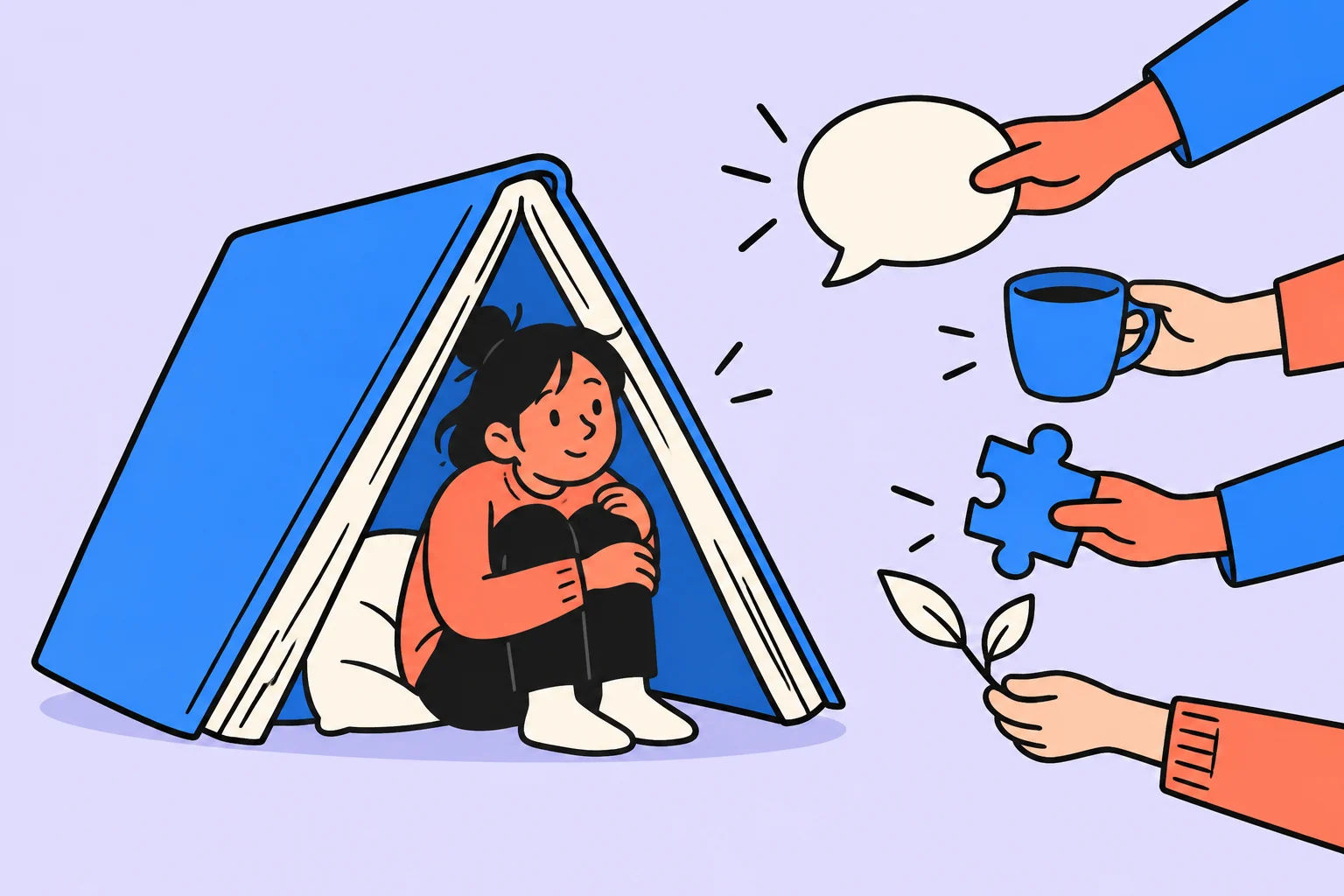
You stand at the entrance to a room full of strangers and feel your pulse quicken. You head for the buffet to give your hands something to do. You check your phone, pretending to be busy. If this sounds familiar, you are not alone. Psychological research suggests that up to 40% of people consider themselves introverts, and social situations cause considerable discomfort for many of them. But communication is a skill rather than an innate talent. Like any skill, it can be developed.
Introversion is not shyness
The first thing to understand is that introversion and shyness are different. Introversion is a preference: you recharge alone and lose energy in large groups. It is a normal temperament trait, not a flaw. Shyness is a fear of being judged negatively by others. You can be an introvert without being shy, or a shy extrovert.
This article does not aim to turn you into an extrovert. That is neither possible nor necessary. Its goal is to give introverts tools for comfortable communication when needed: at work, networking, meeting new people, and family events. You can remain yourself while communicating confidently when the situation calls for it.
of people identify as introverts
of successful leaders name communication skills as the main factor in their careers
of regular practice is enough to noticeably improve social skills
Why communication can be difficult for introverts
An introvert's brain processes information through a longer neural pathway that passes through areas associated with planning and memory. This means introverts think more deeply about every aspect of a conversation, which is why they need more time to respond. In rapid small talk, where remarks fly like ping-pong balls, an introvert feels as though everything is happening in slow motion.
The second reason is social energy. fMRI research shows that introverts' brains respond more strongly to social stimuli: more dopamine with less stimulation. What feels pleasantly stimulating to an extrovert feels overwhelming to an introvert. After a party, an extrovert feels energized; an introvert feels drained. This is neither laziness nor antisocial behavior. It is neurobiology.
The third reason is the inner critic. Introverts tend to reflect on themselves and often replay conversations: “What if I said something stupid? What did they think of me?” This critic makes every social situation stressful by adding a layer of after-the-fact judgment that drains even more energy.
Strategies for comfortable communication
Strategy 1: Prepare rather than improvise
Extroverts can arrive at an event and go with the flow. Introverts do better with preparation. Before a meeting or event, consider who will be there and which topics are relevant. Prepare 3-5 questions to ask. Skip generic questions like “What do you do?” and try something interesting: “What is the most unusual thing that happened to you in the past month?” or “If you could instantly master any skill, which would you choose?”
Strategy 2: One person rather than a crowd
Introverts excel at one-to-one conversations or small groups of up to 3-4 people. This is your superpower; use it. At a party, do not try to be the life of the gathering. Find someone else standing on the sidelines and start a conversation. A deep conversation with one person is more valuable than exchanging superficial remarks with twenty.
Strategy 3: Listening as a superpower
Most people enjoy talking about themselves. Harvard research shows that talking about yourself activates the brain's pleasure centers, just as food and money do. Introverts are natural listeners. Ask open-ended questions and listen sincerely to the answers. People will consider you a wonderful conversationalist even if you spoke only 20% of the time.
Four safe topics for any conversation: Family (family and loved ones), Occupation (work and other activities), Recreation (hobbies and leisure), and Dreams (dreams and plans). If the conversation stalls, switch to one of these topics. They are universal and interest most people.
Daily practices for developing skills
Communication is trained like a muscle: through regular, gradually increasing effort. Start with minimal social interactions and gradually increase the difficulty.
Level 1 (weeks 1-2): initiate one short conversation a day. With a cashier, delivery person, or colleague at the coffee machine. It need not be long; a few words beyond the bare minimum are enough. Ask “How is your day?” or comment on the weather. The goal is to get used to initiating rather than waiting.
Level 2 (weeks 3-4): ask two open-ended questions in every conversation. An open-ended question cannot be answered with “yes” or “no.” Instead of “Did you like the film?” ask “What stood out to you most in the film?”
Level 3 (month 2): reach out first to three people you have not spoken to in a while. Suggest meeting up. One refusal is normal. Two are too. But one of the three will probably be pleased. Maintaining social connections regularly is an investment that pays back tenfold.
Level 4 (month 3): attend an event where you know nobody. A conference, workshop, or interest group. Set a goal of meeting two people. Not twenty, but two. Quality over quantity.
Habits for everyday communication
The eye-contact habit: maintain eye contact for 60-70% of a conversation. Not constantly, which can be intimidating, but regularly. If looking someone in the eyes is difficult, look at the bridge of their nose; nobody will notice the difference.
The name habit: when you meet someone, repeat their name aloud: “Nice to meet you, Alexey.” Use the name once more in the conversation. People like the sound of their own name, and using it instantly creates a sense of closeness.
The first-step habit: be the one who says hello first, asks the first question, or suggests meeting up. It is difficult, but it is what distinguishes an introvert with developed social skills from someone who is simply an introvert. Every first step becomes a little easier than the last.
How to manage social energy
The most important thing for an introvert is learning to manage energy. Do not try to be switched on 24/7. Plan social activities with recovery time in mind. After an intense work meeting, give yourself 15 minutes of quiet. After a major event, keep an evening free at home.
Set a social budget: decide how much social activity you can handle without burning out, and stay within that limit. For some, it is one event a week; for others, three. Knowing your limit is wisdom rather than weakness.
Being sociable is a skill, not a personality trait
You do not have to become an extrovert. You can remain someone who prefers depth over breadth in communication. But having the skills to communicate comfortably expands your opportunities in your career, friendships, and relationships. Start with one habit, practice every day, and after three months you will be surprised by how much more confident you feel in social situations. Sinqly's AI coach can help you build a personal plan for developing communication skills that takes your temperament and goals into account.
Turn an idea into action
Was this helpful?
Rate the article and tell us what was missing. Your feedback goes to the Sinqly team and will not be published on the site.

21 Days to Build a Habit: Myth or Reality?
Are 21 days really enough to build a habit? Exploring the UCL study, the neuroscience of automatic behavior and realistic timelines.

How to start waking up early: a 30-day plan
A step-by-step plan for switching to an earlier wake-up time in 30 days. The science of circadian rhythms, chronotypes, nutrition, melatonin, morning habits, and a challenge.

A Habit in 21 Days: What the Research Says and How to Start
Why 21 days does not guarantee a habit. The limits of Lally's research, a practical plan and a completed example for tracking actions and missed attempts.