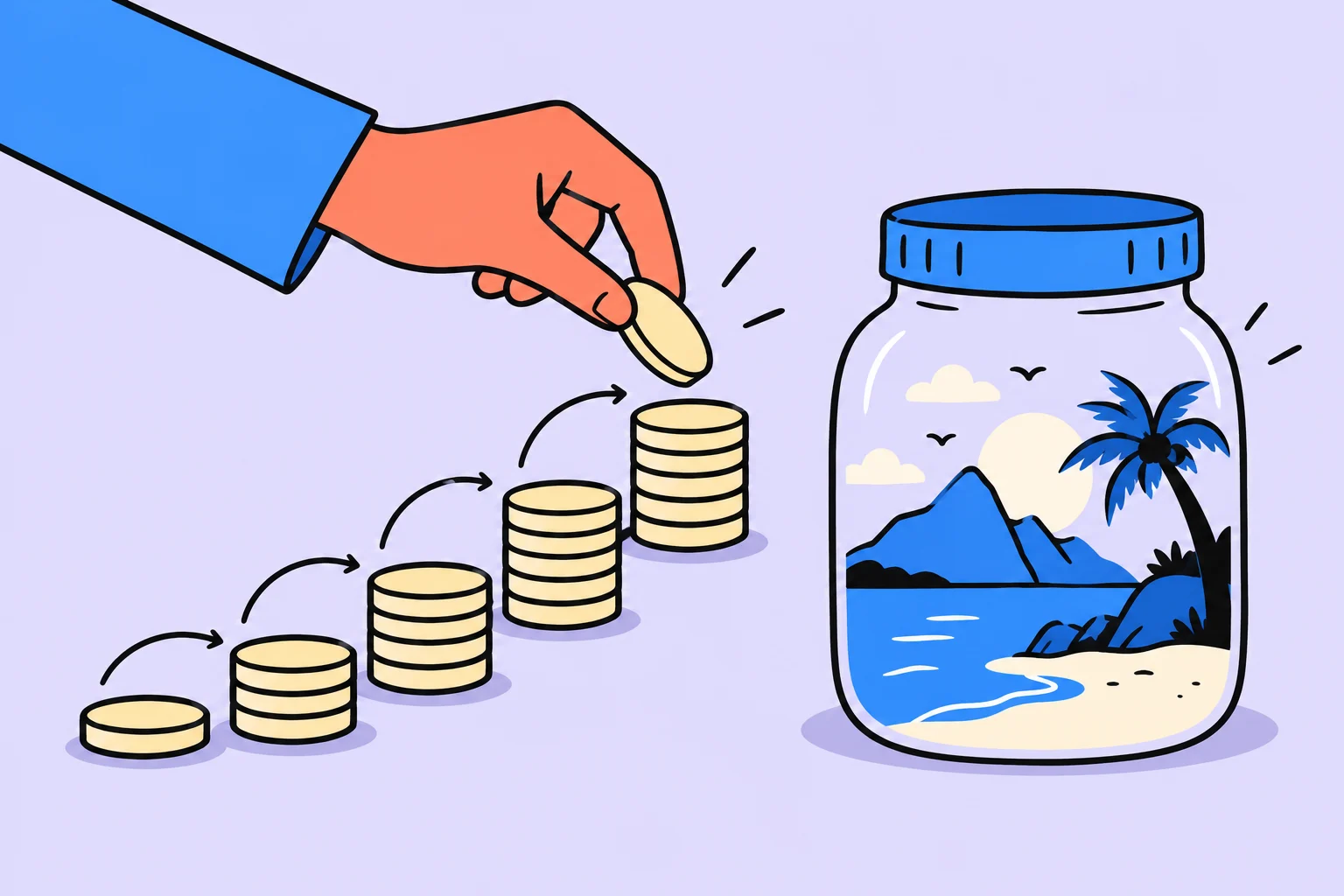
A new apartment, a car, a dream trip or an education: everyone has a goal they need to save for. But a gulf separates wanting something from achieving it. Most people dream without saving, or save for a couple of months and then stop. This article offers a concrete plan to turn an abstract dream into a reachable financial goal with a clear schedule and daily steps.
Step 1: Define your goal in numbers
“I want to save for a car” is not a goal. “I want to save 1 500 000 rubles for a Kia K5 by December 2027” is a goal. Specific numbers and deadlines distinguish a goal from a dream. Without clear parameters, your brain cannot plan actions, and saving remains a background wish.
Write down three parameters: the exact amount, the deadline and the purpose. If you do not know the amount, spend an hour researching it. Find real prices and add 10-15% for unexpected costs. For a trip, include tickets, accommodation, a visa, insurance and daily expenses. For an apartment, include the down payment, transaction costs and renovations.
Important: do not underestimate the amount to avoid intimidating yourself. An honest calculation with a realistic deadline is better than an optimistic fiction that leads to disappointment. If the required amount feels daunting, divide the goal into stages. Saving 1 500 000 is intimidating. Saving 125 000 over the first three months is quite manageable.
Step 2: Calculate the monthly amount
The formula is simple: divide your target amount by the number of months until the deadline. If you need 1 500 000 in 24 months, save 62 500 rubles per month. Too much? You have three options: extend the deadline, reduce the goal or find additional income.
Account for deposit interest. If your money is in a savings account earning 12% annually, you actually need to save slightly less: the bank contributes the difference. Use any compound-interest calculator. Monthly deposits of 55 000 rubles at 12% will give you approximately 1 500 000 over two years.
rubles/month to save 1.5 million in 2 years, excluding interest
rubles/month for the same goal at 12% annual interest
rubles saved each month thanks to compound interest
Step 3: Choose a savings strategy
Several established strategies suit different situations. Saving a fixed percentage is the simplest. You set aside the same percentage of every payment: your salary, bonus or side income. Save 20% of everything that comes in. The advantage is automaticity: you do not have to decide how much to save each time.
The “reverse budget” strategy: transfer money to your savings account first, then live on the remainder. Set up an automatic transfer on payday. Psychologically, this is much easier than saving “whatever is left” at the end of the month, because by then the remainder usually tends toward zero.
The gradual-increase strategy: start with a comfortable amount and raise it by 5-10% each month. Save 10 000 in the first month, 11 000 in the second and 12 000 in the third. This lets you gradually adjust to higher savings without a shock. After a year, your monthly amount will have grown significantly, but each step will have felt like a small effort.
Do not mix savings for different goals in one place. Open separate savings accounts labeled “Car,” “Vacation” and “Emergency fund.” Seeing progress toward a specific goal is much more motivating than an abstract “total balance.”
Step 4: Build money-saving habits
Saving is about optimizing spending as well as earning. It does not require austerity or giving up pleasure. It means spending consciously on what really brings you joy and reducing spending that happens on autopilot.
The subscription-audit habit: review all subscriptions once a month. A streaming service you do not watch? An app you used once? Canceling unnecessary subscriptions can free up 2000-5000 rubles monthly, or up to 60 000 rubles over a year.
The shopping-list habit: never go shopping without a list. Impulse purchases in supermarkets increase the bill by 20-40%. Lists are not just for groceries: before buying clothes, write down exactly what you need and stick to the plan.
The price-comparison habit: before a purchase over 1000 rubles, spend five minutes comparing prices at different shops. For electronics and appliances, the difference can be 15-30%. Five minutes can save you several thousand rubles.
Step 5: Consider additional income
Sometimes spending less is not enough. If your monthly savings target still seems unrealistic after optimizing expenses, consider additional income. This does not mean working 16 hours a day. Some options do not require a substantial time commitment.
Monetize your skills by freelancing in your professional field. A designer can take on small projects at weekends. An accountant can keep books for a sole proprietor. A translator can translate texts through freelance platforms. Even 10-15 hours a month can bring in an extra 20 000-50 000.
Sell things you no longer need: walk through your apartment and identify anything you have not used for more than a year. Clothes, electronics, books and sports equipment can all be sold on Avito to make a one-off contribution to your dream fund. Many people are surprised to find unused belongings worth 50 000-100 000 rubles.
Step 6: Track your progress
Visualizing progress is a powerful motivator. As you watch the bar move from 0% to 100%, your desire to continue grows. Research shows that people who regularly track progress toward a goal reach it 2.5 times as often as those who do not.
Use any tool that suits you: a spreadsheet, an app or even a sticker on the fridge with a thermometer-style scale.
Set checkpoints at 25%, 50% and 75%. At each checkpoint, allow yourself a small reward, but not a financial one that undermines progress: dinner at your favorite restaurant, a day off or a small gift. The brain needs intermediate rewards on a long journey.
How to avoid giving up halfway
The most dangerous point is the third or fourth month. Initial enthusiasm fades, the goal is still far away and temptations have not disappeared. This is where most people give up. How can you keep going?
First, make saving as automatic as possible. A payday transfer removes the need to make a decision every month. Decide once, and the system keeps working. Second, keep your dream in sight: a photo of the car on your phone's lock screen, or a picture of the city you want to visit on your desktop. A visual reminder of the goal fuels motivation.
Third, be flexible. Unexpected expenses are normal. If you cannot save the planned amount one month, do not give up entirely. Save at least a small portion. Even 1000 rubles is better than zero: you preserve the habit and momentum. Make up the difference the following month.
Your dream is closer than it seems
The journey toward a dream starts with one calculation and one automatic transfer. You do not need to change your whole life in a day. Define your goal, calculate the amount, automate the process and add a couple of conscious spending habits. After a few months, you may be surprised by how far you have come.
Turn an idea into action
Was this helpful?
Rate the article and tell us what was missing. Your feedback goes to the Sinqly team and will not be published on the site.
A business plan with AI: inputs, calculations, and assumption checks
Prepare a business plan with AI: a complete educational service model, break-even calculation, scenarios, and cash balances. Assumptions are separated from verified data.

12 Financial Habits That Will Change Your Life
12 financial habits of wealthy people. Expense tracking, the 50/30/20 budget, compound interest and an emergency fund: step-by-step instructions and research.

How to Find Your Dream Job: A Step-by-Step Plan
A step-by-step plan for finding your ideal job: self-reflection, writing a resume, networking and preparing for interviews. A practical Sinqly guide for 2026.