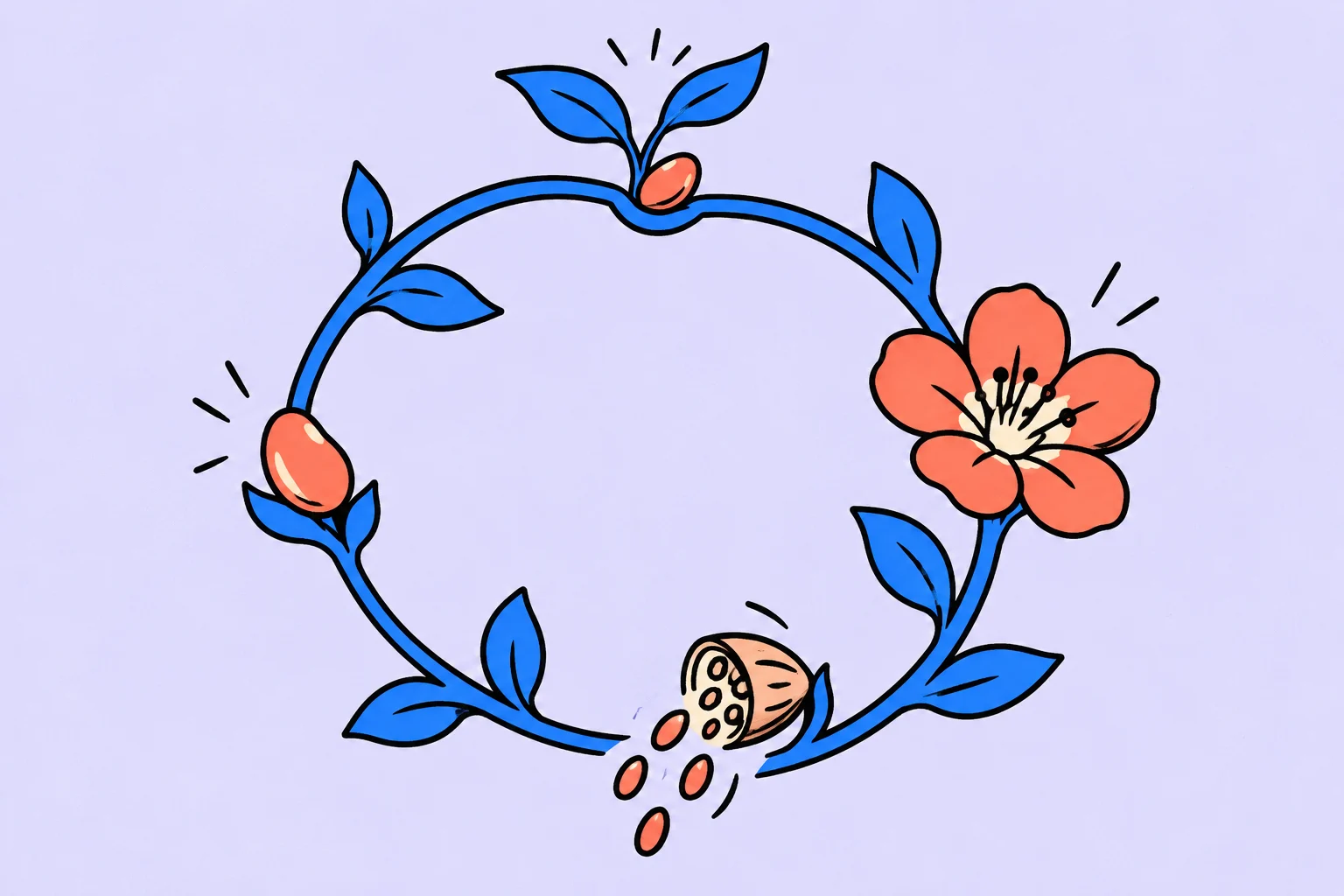
The life cycle shows how project work changes
A project life cycle is a sequence of phases from initiation to completion. The phases and their names depend on the project; a generic model cannot replace understanding the intended outcome.
In this training example, a team is preparing a small exhibition of local artists. First, it needs to understand the goal and whether the event is feasible. Then it must agree on the venue, artworks and preparation. During the exhibition, other actions matter: welcoming visitors, handling issues and retaining materials. After it closes, the team still needs to return artworks, settle accounts and capture lessons.
All these actions belong to one project, but require different decisions. If the team treats the launch as the last step, it may forget closure. If detailed production begins before the venue is checked, the plan may need to be reworked.
- Initiation
The goal, boundaries and authority to begin are clear.
- Preparation
The artworks, participants and event conditions are agreed.
- Execution
Deliver the result and respond to deviations.
- Closure
Hand over the outcome, close obligations and record lessons.
Initiation: should the work begin at all?
At the start, check the problem or opportunity, intended outcome and constraints. For the exhibition, this means more than wanting to display artworks: it includes an available venue, participants’ agreement, the team’s time and a defined audience. Name unknown conditions before making promises.
A useful output from this phase is a short agreed record: what the team wants to achieve, what is included, who makes the key decision and what still needs checking. In a formal setting, this may be a project charter. In a small team, clarity of agreement matters more than the document’s name.
- Hope
“We will surely find a space and finish in time.” The basis has not been checked.
- Decision
“We have a confirmed venue and participants; preparation can begin within the agreed boundaries.”
Preparation: make the outcome achievable
Break preparation into deliverables: an agreed list of artworks, a ready exhibition, an invitation and a visitor reception process. Identify dependencies. Objects cannot be placed definitively before the space is confirmed, but information about their dimensions and display requirements can be collected in advance.
| Question | Example answer |
|---|---|
| What must be ready? | A layout plan and installation sequence |
| Who is involved? | Named people who have agreed to do the work |
| What depends on others? | Access and artwork handover times are confirmed |
| Where is the contingency? | There is room to fix a significant problem before opening |
| How will deviations be noticed? | A venue readiness check is scheduled |
Do not try to eliminate all uncertainty. Some of it cannot be removed in advance. Identify which unknown conditions are acceptable and which would make the commitment unachievable. The latter need early checks or a decision to change the concept.
Execution and monitoring happen together
When installation starts, the plan meets reality. An object may not fit, a participant may be late or a material may be unsuitable. Monitoring helps the team see the impact and choose an action, rather than merely recording a deviation in a report.
- Check the actual result of the current work.
- Compare it with the conditions needed for the next step.
- Find the cause of a significant difference.
- Agree on a change if it affects commitments.
- Update the immediate plan and inform participants.
Do not confuse a life cycle phase with a management process. For example, risks can be assessed both at initiation and during the event. Having “moved into execution” does not make refining the plan a mistake.
One project across all stages: launching an open class
At initiation, the team discusses why the open class is needed: to introduce beginners to the practice format and understand their questions. The decision to proceed depends on the instructor’s availability, the audience and the ability to prepare useful material. If the goal is unclear, a detailed timetable will not resolve that uncertainty.
During preparation, the team agrees on the outcome, boundaries, roles, plan and readiness criteria. For example, a participant should receive an explanation of the method and complete a short exercise; selling a large course is not an essential outcome of the class itself. The team checks the venue and decides in advance what to do if a technical failure occurs.
During execution, the team prepares the program, invitation and materials. Monitoring runs alongside this work: dependencies, quality and changes are checked. It is not a separate final stage when people first discover that the venue is unusable. If the exercise will not fit the available time, adjust the scope before making a promise to participants.
As the project reaches completion, the team runs the class, provides the promised materials, closes remaining obligations and reviews the outcome. “The broadcast has ended” does not mean the project is closed if participants are still owed a recording or an answer. For an ongoing product, operational work may continue after the project; identify who owns it.
Moving between stages is a decision, not a date in a table
Define evidence of readiness for each transition. From idea to preparation: a clear goal and a decision to allocate resources. From preparation to execution: a feasible plan and agreed boundaries. Before running the event: checked materials and the main participant flow. Before closure: an accepted result and handed-over obligations.
In real work, stages may overlap and repeat. A small part of the format can be tested before full preparation, then the concept refined. Do not present one linear model as mandatory for every project: the life cycle depends on uncertainty, the product and requirements.
If a check changes the goal, explicitly revisit the relevant decision. Do not keep executing an old plan merely because the team has moved into an “in progress” column. The cost of work already done is not a sufficient reason to continue something that is no longer needed.
At the end, retain decisions, reusable materials, owners of remaining work and one or two lessons rather than the entire stream of messages. The next project needs clear reasoning and current starting materials, not an archive with no navigation.
Record the next step for the current stage
Start with one task: “Check venue readiness before installation.” In the description, record the expected output: confirmed access, placement space and the conditions without which the next work cannot start. You do not need to transfer the whole article into a service; keep what will be useful during execution.
Schedule the check before artworks are handed over at the venue. Separately record the return and closure actions so the project does not stop abruptly at opening.
- Create a task with a concrete action in its title.
- Add readiness conditions and the necessary context to its description.
- Choose a day for the work and check that it fits alongside other commitments.
Registration in Sinqly is free. The example in this article can also be carried out in an ordinary document; the service helps you return to the actions you chose.
Closure: what remains after the visible outcome
The exhibition has closed, but the project may still have obligations. Artworks need to be returned, promised materials handed over, agreements settled and useful information retained. Unless these actions are named, they often remain only in the organizer’s head.
After completion, ask three questions: what outcome was achieved, what cost more than expected and what should change in the next project? Keep specific observations. “Plan better” does not help the next team; “confirm dimensions before printing the layout plan” gives it a useful action.
A completed project leaves no hidden loose ends. The result has been handed over, obligations are closed or explicitly transferred, and the lessons can be used.
More questions to clarify
Do stages always follow a strict sequence?
No. Depending on the project, phases may overlap, repeat or include short validation cycles. Choose the sequence to suit the work.
How many phases should there be?
There is no single number for every project. Identify transitions where decisions, risks or working conditions change.
How does completion differ from stopping?
Completion involves checking the outcome and closing obligations. A project can be stopped before achieving its goal, but the team must still explicitly decide what happens to materials, promises and remaining work.
Was this helpful?
Rate the article and tell us what was missing. Your feedback goes to the Sinqly team and will not be published on the site.
Sources and notes
- Atlassian: the project life cycle
- The suggested process reflects editorial practice; it does not promise identical results for everyone.
The critical path: a simple project calculation
Find the longest chain of dependent activities and understand which delays will move the whole project. A small worked example calculated by hand, without specialist software.
Project risks: build a register and prepare an action plan
How to describe a risk, choose an early warning and prepare a response. A simple register for a small launch, without invented precision or an endless list of everything that might go wrong.

Project stakeholders: who influences the outcome and how to work with them
How to identify project stakeholders, understand their expectations and choose a communication approach. Includes an influence map and a small launch example.