ADHD is not a childhood disorder that people outgrow. According to a large-scale study published in The Lancet Psychiatry (2023), up to 60% of children with ADHD continue experiencing significant symptoms in adulthood. Meanwhile, millions of adults do not even suspect that their chronic forgetfulness, concentration problems, and impulsivity have a neurobiological cause. In this article, we examine adult ADHD in detail: which signs help identify it, how diagnosis works, and what to do if you suspect you have this condition.
Adults worldwide live with ADHD, many without a diagnosis
Children with ADHD retain symptoms in adulthood
Adults with ADHD have at least one co-occurring disorder
Adults with ADHD in Russia do not have an official diagnosis
ADHD explained simply
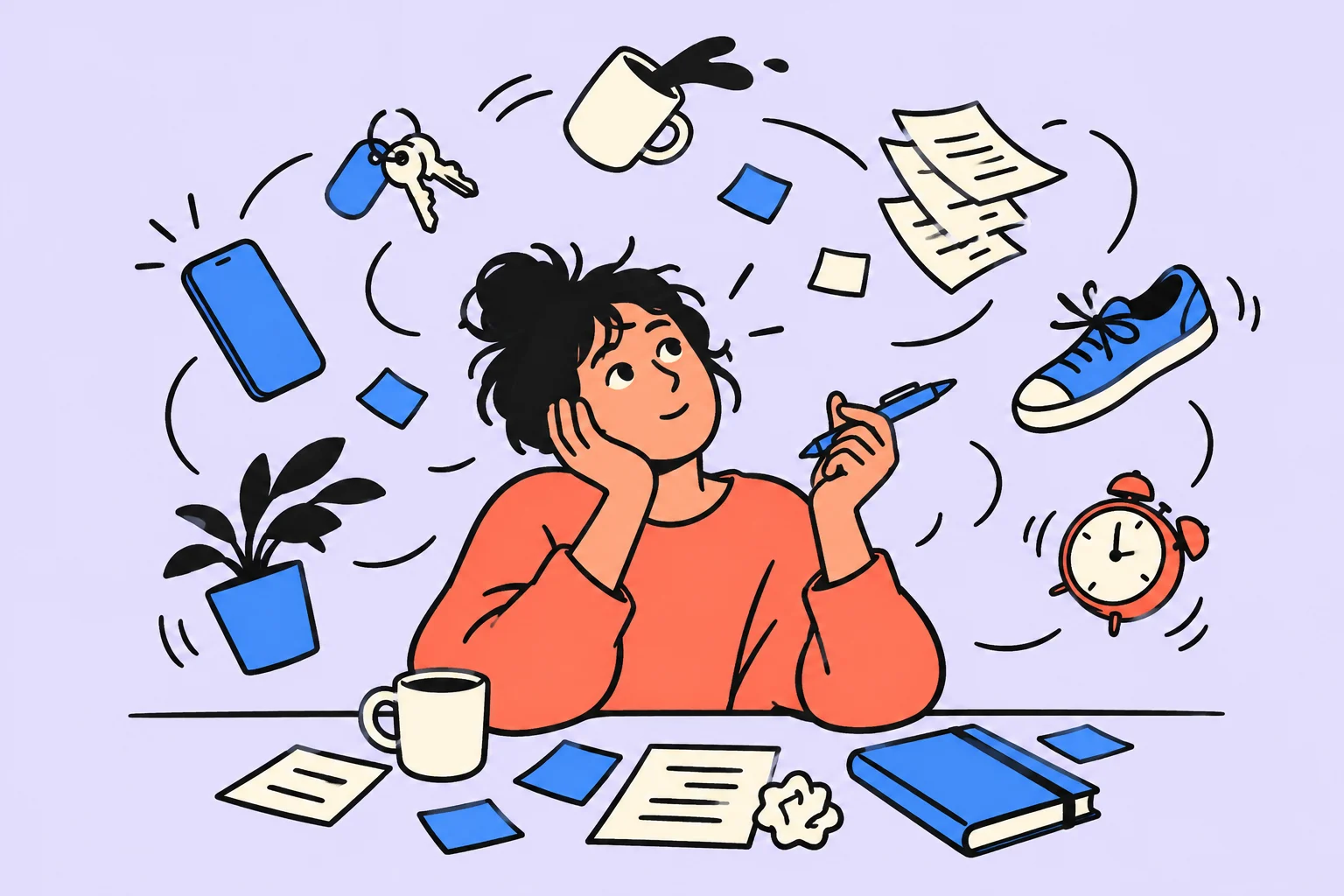
ADHD (attention deficit hyperactivity disorder) is a neurobiological disorder in which the brain regulates three key functions differently: attention, impulse control, and activity level. To explain ADHD simply, imagine a browser with 30 open tabs, all demanding attention at once, while the button for closing unnecessary tabs does not work. At the same time, one random tab can capture all your attention for hours.
ADHD is rooted in impaired functioning of neurotransmitter systems, primarily dopamine and norepinephrine. Dopamine is a neurotransmitter responsible for motivation, a sense of reward, and the ability to sustain attention. With ADHD, the dopamine system works less efficiently, so the brain constantly seeks stimulation, often finding it in the most engaging activities rather than the necessary ones. Read more about dopamine's role in our article Dopamine and motivation with ADHD.
It is important to understand that ADHD is not a literal shortage of attention. A person with ADHD can spend hours immersed in an interesting task (called hyperfocus), yet be unable to make themselves fill out a tax return. The problem is attention regulation rather than quantity: the ability to direct attention where it is needed rather than where it is drawn.
ADHD is not a fashionable diagnosis or an excuse. The disorder is recognized by the World Health Organization (ICD-11), the American Psychiatric Association (DSM-5), and decades of neuroimaging research. MRI scans show structural and functional differences in the brains of people with ADHD, particularly in the prefrontal cortex responsible for planning and self-control.
Myths about adult ADHD: what gets in the way of diagnosis
One of the main problems with adult ADHD is the abundance of myths that prevent people from seeking timely help. Let us examine the most common misconceptions.
Myth 1: ADHD is a childhood illness that adults outgrow. Reality: ADHD is a lifelong neurobiological condition. Symptoms can change with age: children's physical hyperactivity becomes inner restlessness in adults, and inattention becomes chronic disorganization. ADHD itself, however, does not go away. A University of California study (2022) found that 90% of adults with ADHD retain at least mild functional impairment.
Myth 2: If you can concentrate on video games, you do not have ADHD. Reality: hyperfocus on interesting tasks is one of ADHD's key signs rather than evidence against it. The ADHD brain easily engages in activities with instant feedback (games, social media, and hobbies), but struggles with delayed-reward tasks (a report, cleaning, or paying bills). The problem is the ability to choose what to concentrate on rather than the ability to concentrate.
Myth 3: ADHD is just laziness and a lack of willpower. Reality: ADHD is associated with impaired functioning of the dopamine system and the prefrontal cortex. This is a physiological characteristic rather than a moral choice. When someone with ADHD cannot make themselves start a task, the issue is an inability to initiate the neurochemical process of motivation rather than unwillingness. Accusing someone with ADHD of laziness is like accusing a nearsighted person of being unwilling to see.
Myth 4: Only boys have ADHD. Reality: ADHD occurs in both sexes, but in women it more often remains unrecognized because the inattentive subtype predominates, without pronounced hyperactivity. We discuss these differences in more detail below.
Adult ADHD symptoms: a full list of signs
Adult ADHD signs fall into three groups: inattention, hyperactivity, and impulsivity. However, ADHD manifests differently in every person: some predominantly experience inattention, others hyperactivity, and most a combination. Here is a full list of adult ADHD symptoms, grouped by category.
Inattention: difficulty focusing on routine tasks (reports, documents, or household chores); frequently losing things such as keys, a phone, a wallet, or documents; inability to finish projects, with many started and few completed; jumping between tasks and inability to work sequentially; missing details and making careless mistakes; difficulty perceiving time, lateness, and underestimating task duration; trouble reading long texts, with thoughts drifting after a couple of paragraphs.
Hyperactivity (which looks different in adults than in children): inner restlessness and a feeling of having an engine inside; inability to relax even on vacation; a constant need to be busy; fidgeting in your chair, tapping fingers, or bouncing a leg; excessive talking, finding it hard to stop once you start; inability to enjoy quiet leisure, with sitting silently reading a book feeling like torture.
Impulsivity: interrupting people in conversation; impulsive purchases you later regret; making decisions without thinking through consequences; impatience in lines and traffic; abrupt mood changes; emotional outbursts, with disproportionately strong reactions to minor irritants; a tendency toward risky behavior.
Having several symptoms on the list does not automatically mean you have ADHD. Diagnosis requires symptoms to have been present since childhood (before age 12), appear in two or more areas of life (work, home, or relationships), significantly reduce quality of life, and not be explained by other conditions (anxiety, depression, or lack of sleep). Only a qualified psychiatrist can make a diagnosis.
Hidden signs of adult ADHD: what often gets missed
Beyond the classic trio of inattention, hyperactivity, and impulsivity, there are less familiar adult ADHD signs that doctors and patients themselves often do not associate with the disorder. These hidden symptoms frequently cause the greatest distress.
Emotional dysregulation. Rapid mood swings, disproportionately strong emotional reactions to small events, and difficulty managing anger or frustration. Researcher Russell Barkley considers emotional dysregulation a central ADHD symptom rather than merely a side effect. A person with ADHD may burst into tears over a minor setback or become furious over a triviality, then feel completely normal 10 minutes later.
Decision paralysis. An inability to choose between several options, postponing decisions for weeks or months, and feeling overwhelmed when even a simple decision is required (what to order at a restaurant or which film to watch). This is linked to impaired executive function: the brain cannot prioritize and evaluate options.
Chronic procrastination. Systematically putting things off, particularly boring, difficult, or unpleasant tasks. This procrastination is accompanied by painful guilt and anxiety: the person knows what they should do and wants to do it, yet physically cannot start. This vicious cycle of “I do not act → I blame myself → I find it even harder to act” is one of ADHD's most destructive aspects. Read more about strategies for tackling it in the article ADHD and productivity.
Impaired perception of time. People with ADHD experience time blindness, an inability to feel how much time has passed. An hour can feel like 15 minutes when engaged in something interesting, or an eternity during a boring task. This leads to chronic lateness, missed deadlines, and inability to estimate how long a task will take.
Rejection Sensitive Dysphoria (RSD). Acute, painful sensitivity to rejection, criticism, or the feeling of having let someone down. Up to 99% of adults with ADHD describe this symptom, according to clinician William Dodson. RSD can cause a person to avoid new undertakings, relationships, or career advancement out of fear of rejection.
ADHD in women and men: key differences
ADHD was long considered a predominantly male disorder. Historically, research was conducted on boys, and diagnostic criteria were built around hyperactive behavior. Today, however, we know that ADHD occurs almost as frequently in women, but manifests differently and is therefore diagnosed much less often.
In men, ADHD more often appears through externalized symptoms: physical hyperactivity, impulsivity, risky behavior, and conflict. These symptoms are noticeable to others, so men are more often diagnosed during childhood or adolescence.
In women, the inattentive subtype predominates: distractibility, forgetfulness, daydreaming, and organizational difficulties. Instead of external hyperactivity, there is internal chaos: racing thoughts, mood swings, and a sense of overload. Women with ADHD more often mask their difficulties, compensating through perfectionism, excessive responsibility, and enormous energy expenditure on things that others find easy.
According to a Harvard Medical School study (2020), women receive an ADHD diagnosis on average 5–10 years later than men. By diagnosis, they are significantly more likely to have co-occurring anxiety and depressive disorders, the consequence of years of unconscious compensation. Women with undiagnosed ADHD are 4–6 times more likely to experience professional burnout.
Social expectations exacerbate the problem. Women are expected to be organized, pay attention to details, manage a household, and remember every relative's birthday. When a woman with ADHD cannot meet these expectations, she sees it as a personal failure rather than a symptom of a disorder. Years of self-blame lead to chronically low self-esteem even before diagnosis.
ADHD and working memory: why you forget everything
Working memory is the ability to hold information in your head and manipulate it in real time. Think of working memory as a computer's RAM: it determines how many windows you can keep open simultaneously. With ADHD, this RAM has a reduced capacity and information is unloaded faster.
In daily life, working-memory deficits with ADHD look like this: you enter a room and forget why; lose your train of thought mid-sentence; cannot remember what someone asked you 5 minutes ago; forget to pay bills even when you have money; start cooking and forget a pan on the stove. This is not poor memory in the usual sense: long-term memory often works perfectly well with ADHD. The problem is specifically working, or operational, memory.
Functional MRI studies show reduced activity in the dorsolateral prefrontal cortex in ADHD, the brain region responsible for working memory. This confirms that forgetfulness with ADHD is a neurobiological symptom rather than a character trait.
A practical solution: if your working memory is unreliable, create an external system to compensate for this deficit. Write everything down. Use task managers. Set reminders. Create checklists for routine processes. The platform Sinqly for ADHD was created for precisely this purpose: it serves as external working memory, helping you retain tasks, ideas, and plans.
How adult ADHD is diagnosed: a step-by-step process
Diagnosing adult ADHD is a comprehensive process requiring a qualified specialist. There is no single test or blood analysis that can confirm or rule out ADHD. Diagnosis is based on a clinical assessment involving several stages.
Self-assessment and preparation
Complete the ASRS-v1.1 (Adult ADHD Self-Report Scale) screening questionnaire, available free online. Write specific examples of difficulties in different areas of life: work, study, household life, and relationships. Gather school report cards and feedback: symptoms must have appeared before age 12.
Finding a specialist
Consult a psychiatrist specializing in adult ADHD. General psychiatrists are often insufficiently familiar with ADHD's presentation in adulthood. Major Russian cities have clinics and specialists working with ADHD: seek recommendations in communities.
Clinical interview
The psychiatrist conducts a detailed interview covering current symptoms, developmental history, childhood memories, and family history (ADHD has a strong genetic component, with heritability around 74%). Close relatives or a partner may also be interviewed.
Standardized questionnaires and tests
The doctor uses validated instruments: ASRS, WURS (Wender Utah Rating Scale), the Conners scale, and executive-function tests. Neuropsychological testing may also be ordered to assess attention, working memory, and cognitive flexibility.
Ruling out other conditions
ADHD-like symptoms can be caused by anxiety disorders, depression, sleep disorders, thyroid disease, iron or vitamin D deficiency, and post-traumatic stress disorder. The doctor may order blood tests and additional examinations.
Diagnosis and treatment plan
If the diagnosis is confirmed, the doctor discusses treatment options: medication (stimulants or nonstimulants), cognitive behavioral therapy, coaching, and self-organization strategies. A comprehensive approach usually delivers the best results.
Tip: before visiting a psychiatrist, keep a symptom diary for 1–2 weeks. Record specific situations: “forgot a meeting,” “could not start a report for 3 hours,” “lost my keys for the second time this week.” Concrete examples help the doctor assess symptom severity and its impact on your life more accurately. To keep this diary, you can use the Sinqly task manager with its notes feature.
ADHD and co-occurring conditions: comorbidity
ADHD rarely comes alone. According to a systematic review published in Journal of Clinical Medicine (2021), up to 80% of adults with ADHD have at least one co-occurring mental disorder, and 50% have two or more.
The most common co-occurring conditions are anxiety disorders (up to 50% of adults with ADHD), persistent worry intensified by inability to control one's life; depression (up to 30%), often reactive, resulting from chronic failures and self-blame; sleep disorders (25–50%), difficulty falling asleep because of racing thoughts and disrupted circadian rhythms; addictions (15–25%), alcohol, drugs, or overeating as self-medication; and learning disorders (30–50%), including dyslexia and dyscalculia.
Co-occurring conditions often mask ADHD. A typical scenario: someone visits a doctor with anxiety or depression and receives antidepressants that help only partially because the underlying cause, unrecognized ADHD, remains untreated. Therefore, if standard anxiety or depression treatment does not deliver the expected results, consider the possibility of ADHD as the primary or a co-occurring diagnosis.
ADHD also significantly increases the risk of professional burnout. Constant efforts to compensate for symptoms, chronic stress from disorganization, and the feeling that you work twice as hard for the same result all deplete resources faster than in neurotypical people.
How to live with ADHD: practical strategies
Receiving a diagnosis is the first step. But how do you build everyday life around ADHD's characteristics? Here are strategies whose effectiveness is supported by clinical research and the experience of millions of people with ADHD.
1. Create an external organizational system. With ADHD, internal systems such as intentions, plans in your head, and “I will remember” do not work. You need an external system: a task manager, calendar, reminders, and checklists. Anything you can move out of your head and into an external system should be moved. Detailed recommendations are in the article How to organize life with ADHD.
2. Use the two-minute rule. If a task takes less than two minutes, do it right now. Do not write it down, postpone it, or plan it: simply do it. This prevents small tasks accumulating and later becoming paralyzing.
3. Work with your body rather than against it. Regular physical exercise increases dopamine and norepinephrine, the very neurotransmitters whose deficiency underlies ADHD. Studies show that 30 minutes of cardio improves concentration for 2–4 hours after exercise. This is a free, accessible complement to any therapy.
4. Structure your environment. Remove distractions: turn off phone notifications while working, use noise-canceling headphones, and keep your workspace clear. If you work from home, create a separate work area that your brain associates with productivity.
5. Use body doubling. Many people with ADHD find it easier to work in another person's presence. This could be a colleague in the office, a friend in a café, or even an online stream of a work session. Another person's presence creates gentle social pressure that helps maintain focus.
6. Forgive yourself. People with ADHD often live with chronic guilt and shame. “Why can I not just do this?” and “Everyone else manages, but I do not”: do these thoughts sound familiar? Remember: ADHD is a neurobiological characteristic rather than a character defect. Be as kind to yourself as you would to a friend with this diagnosis.
Read our review of the best digital tools for people with ADHD, from task managers to timers and meditation apps, in our selection The best apps for ADHD. Well-chosen tools can compensate for up to 40% of executive-function difficulties.
ADHD symptoms in the workplace: how to recognize them
The workplace is often the first context in which ADHD symptoms become truly problematic. In school and university, intelligence and last-minute work before exams can still compensate for ADHD. But at work, where daily consistency, long-term planning, and attention to detail are required, ADHD manifests at full strength.
Typical ADHD symptoms at work include chronic lateness and missed deadlines; difficulty with long projects lacking clear structure; careless errors in documents and reports; procrastinating on boring tasks while doing excellent work on interesting ones; prioritization problems, with everything seeming equally urgent; impulsive remarks in meetings; and difficulty working in open-plan offices because of sensitivity to noise.
At the same time, people with ADHD often have outstanding professional qualities: creative thinking, the ability to find unconventional solutions, energy, the ability to work in crises (a deadline is the best motivator with ADHD), and rapid adaptation to change. The key to a successful career with ADHD is to choose a profession that uses your strengths and create a system to compensate for weaknesses. To manage work tasks, try a task manager with AI prioritization to help identify what matters amid the chaos.
ADHD is a different operating system rather than a defect
It is important to end on this point: ADHD is not only about problems. Many researchers and clinicians, including Edward Hallowell, author of the bestseller Driven to Distraction, describe ADHD as a different operating system for the brain, with both disadvantages and unique advantages.
The strengths of people with ADHD include high creativity and the ability to generate ideas; hyperfocus, the ability to immerse themselves in a task for hours when it truly engages them; energy and enthusiasm; fast thinking and the ability to see connections between seemingly unrelated things; resilience in crises, with people with ADHD often working very well under pressure; empathy and emotional depth.
The key to a fulfilling life with ADHD is to create an environment that brings out your strengths and compensates for weaknesses through systems, tools, and support, rather than trying to become neurotypical. Detailed strategies for building this environment are in the topic section All about ADHD.
If questions persist, prepare an organizational plan for consulting a specialist. Create a task in Sinqly: registration is free.
Resources for further study of ADHD
If you suspect you have ADHD or have already received a diagnosis, here are reliable resources for developing your knowledge.
Books: Driven to Distraction by Edward Hallowell and John Ratey, a classic translated into Russian as Why I Get Distracted; ADHD 2.0 by the same authors, an updated perspective incorporating the latest research; and Taking Charge of Adult ADHD by Russell Barkley, a practical guide with specific strategies.
Online resources: CHADD (Children and Adults with ADHD), the largest international organization dedicated to ADHD; ADDitude Magazine, with scientifically grounded articles; and communities on social media and Reddit (r/ADHD), offering support from people with similar experiences.
For an initial self-assessment, we recommend taking the Sinqly productivity test . It helps identify areas that need attention and can be a starting point for a conversation with a doctor.
Frequently asked questions about adult ADHD
What is adult ADHD in simple terms?
ADHD (attention deficit hyperactivity disorder) is a neurobiological disorder in which the brain regulates attention, impulses, and activity level differently. In adults, this appears as difficulties with concentration, organization, time management, and emotions. It is a characteristic of the brain's dopamine system, confirmed by decades of scientific research, rather than laziness or a weak character.
What are the main symptoms of adult ADHD?
The main symptoms of adult ADHD include difficulty concentrating on routine tasks, chronic forgetfulness, procrastination, impulsive decisions and purchases, inner restlessness, emotional dysregulation, working-memory problems, impaired time perception, decision paralysis, and rejection sensitivity (RSD).
How does ADHD differ in women and men?
In men, ADHD more often appears as hyperactivity and impulsivity that are noticeable to others. In women, the inattentive subtype predominates: distractibility, forgetfulness, and inner thought chaos. Women more often compensate for symptoms through perfectionism, receiving a diagnosis 5–10 years later than men.
Which doctor should you consult if you suspect ADHD?
Consult a psychiatrist, preferably one specializing in adult ADHD. Diagnosis includes a clinical interview, standardized questionnaires (ASRS, WURS), a childhood history, and ruling out other conditions. The process usually takes 2–4 visits.
Can adult ADHD be cured?
ADHD is a lifelong neurobiological characteristic that cannot be cured. However, symptoms can be effectively managed. Medication helps 70–80% of patients; combined with cognitive behavioral therapy and external organizational systems, it improves quality of life by 45% compared with monotherapy.
What is working memory, and why is it important with ADHD?
Working memory is the ability to hold information in consciousness and manipulate it. It is reduced in ADHD, appearing as forgetting tasks, losing your train of thought mid-conversation, and difficulty multitasking. Notes, reminders, checklists, and digital organizational tools help compensate for this deficit.
How does ADHD affect work and career?
ADHD can create difficulties: deadline problems, inattention to detail, and procrastination on routine tasks. However, ADHD also offers advantages: creativity, energy, the ability to hyperfocus, and excellent work in crises. Success depends on choosing a suitable profession and creating an environment that compensates for difficulties.
Was this helpful?
Rate the article and tell us what was missing. Your feedback goes to the Sinqly team and will not be published on the site.
Dopamine and motivation with ADHD: using neurochemistry for productivity
How the dopamine system works with ADHD. 7 strategies for managing motivation through neurochemistry: gamification, stacking, micro rewards, and physical activity.
How to organize life with ADHD: a complete guide to systems and practical tips
A complete guide to organizing life with ADHD. Proven planning systems, practical tips, tools, and habits for people with attention deficit hyperactivity disorder.
The best apps for people with ADHD in 2026
The best ADHD apps: task managers, habit trackers, and focus timers. A detailed review of 12 tools for people with ADHD.